winter flower seeds to plant Late Winter Flower Seed Collection – Kids Seed Co
SKU: 962499642
winter flower seeds to plant

winter flower seeds to plant Late Winter Flower Seed Collection – Kids Seed Co

Sale price$24.51 Regular price$27.23
Save 10%

Shipping Estimate
USA
  • USA
  • CAN

Ships within 48 hours · Estimated delivery Jul 9 - Jul 14

Promo Codes Available:

For Your Every Summer RSVP, with Code: SUMMER15

Description

winter flower seeds to plant Late Winter Flower Seed Collection – Kids Seed CoPlant flower seeds this winter! There are many flower varieties that can be sown in the garden in winter. Some varieties benefit from cold stratification, a period of cold moist conditions, and some varieties will produce early spring blooms after overwintering. We put together this collection of 9 of our favorite flower varieties that can be sown in your garden in winter. While all of these varieties will overwinter in your gardens, they can also be

Plant flower seeds this winter! There are many flower varieties that can be sown in the garden in winter. Some varieties benefit from cold-stratification, a period of cold moist conditions, and some varieties will produce early spring blooms after overwintering. 

We put together this collection of 9 of our favorite flower varieties that can be sown in your garden in winter. While all of these varieties will overwinter in your gardens, they can also be sown in early spring, several weeks before your last frost. 

Seed Varieties:

Wild Bergamot (Monarda fistulosa)

An herbaceous perennial plant native to much of North America with beautiful light purple blooms. Wild bergamot honey is prized for its' herby-sweet flavor and the flowers attract lots of beneficial insects to the garden. Native American used the plant as a medicinal remedy and generally infused the aromatic leaves in tea. (As always, consult your medical provider for advise on herbal remedies!) Wild bergamot spreads through underground rhizomes and it looks beautiful in mass plantings. We love wild bergamot as a cut-flower in arrangements. 

Origin: We collected the parent seed of our Wild Bergamot from wild plants on a trail near Watch Knob Mountain in Swannanoa, NC many years ago. 

(Approximately 50 seeds per packet)

Planting Instructions: Sow a few seeds in a 4 inch pot indoors in mid-winter, barely covering them with soil. Transplant outside in the spring or summer, 6-8 weeks after starting the seeds, spacing plants 12-18" apart in full sun to part shade. Seeds can also be sown directly in the garden 6-8 weeks before your last frost in spring or in the fall a few weeks after your first frost.

Milkweed (Asclepias tuberosa)

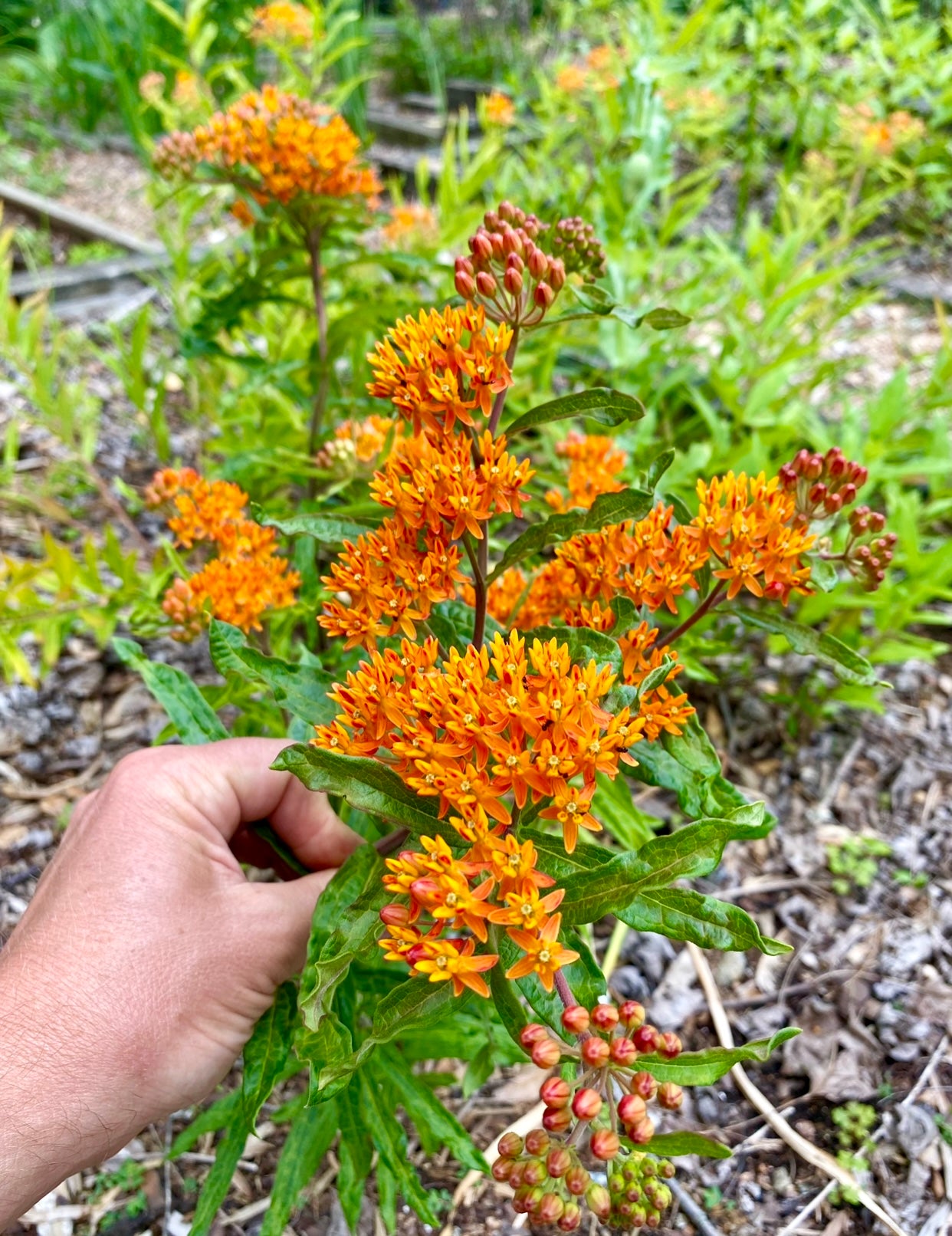
Perhaps the single most important thing home gardeners can do to support monarch butterfly populations is to plant perennial milkweed. This native heirloom plant provides food and habitat for monarch butterflies and the plant is an essential food source for monarch caterpillars. In summer, deep orange blooms look beautiful in the garden and provide a wonderful source of nectar for a range of beneficial insects.

Butterfly milkweed has smaller leaves than common or swamp milkweed and the flowers are a dark shade of orange. The plants generally grow to approximately 24" tall. Butterfly milkweed is a perennial plant and spreads through underground rhizomes as well as through scattered seeds. We grow our milkweed in border and peripheral areas of the garden where the plants have room to spread into a monarch nursery. 

NOTE: Sap is mildly toxic; avoid eye/skin contact and do not ingest.  

Origin: We harvested the parent seed of our milkweed from the Beaver Lake Bird Sanctuary in Asheville, NC. 

(Approximately 30 seeds per packet)

Planting Instructions: Seeds germinate best when COLD STRATIFIED. Simply place seeds on a damp paper towel in a plastic bag in the refrigerator for about 30 days before sowing seeds in the garden or starting in containers to transplant in spring. Seeds can also be sown in the garden in fall where cold stratification will occur naturally in winter. Sow seeds or transplant seedlings in full sun and keep well watered until established. Milkweed may not bloom in the first year but will perennialize and bloom in the second year and for years to come. 

Bachelor Button (Centaurea cyanus)

With amazing sky-blue color, bachelor buttons look stunning in mass plantings. They are easy-to-grow, drought tolerant and edible petals add a fun garnish to salads! Bachelor buttons appear in many European folk tales and men of olden days would frequently wear a bloom on their lapel. 

Origin: We collected the parent seed of the colorful bachelor button mix from two sources. First, from a wheat field in Hungary while visiting family there and second from the garden of a friend in Asheville, NC who has saved her seeds for over thirty years. The true blue blooms are of Hungarian origin and the other colors were carefully selected over the years in Asheville. 

(Approximately 100 seeds per packet)

Planting Instructions: sow a group of 3 seeds 1/4" deep every 8" in spring as soon as soil can be worked. Full sun. 24"-36" height. Seeds can also be sown in fall a few weeks after your first frost.

Cleome (Cleome hassleriana)

With big dramatic flowers in shades of pink, purple and white, cleome are a wonderful addition to the cut-flower garden. The plants generally grow to about 4-5 ft tall and they attract all sorts of pollinators, especially hummingbirds! Cleome make wonderfully fragrant cut flowers and the spiky seed pods add a unique look to the garden. Cleome like to grow in full sun but once they're established they need very little care.

Origin: The parent seed of our Cleome came from the Tuileries Garden, located between the Louvre and the Place de la Concorde in the 1st arrondissement of Paris, France. Many years ago we knew a gardener at Tuileries and she gave us Cleome seeds from their collection. 

(Approximately 50 seeds per packet)

Planting Instructions: Sow cleome seeds by scattering the seeds on prepared soil in full sun. The seeds germinate best with light. You can either sow the seeds in the fall and they'll emerge when conditions are right in spring, or,  you can sow seeds a few weeks before your last frost date in spring. Seeds can take 10-15 days to germinate. 

Nigella (Nigella damascena)

Nigella is an airy plant and lively blooms range in color from red, blue, violet and white. This early bloomer self sows easily. Nigella makes a great cut-flower and dried seed pods have a unique look in dried arrangements. Also known as Love-in-a-Mist, this hearty and easy-to-grow plant will become an instant favorite and garden mainstay. 

Origin: We were given the parent seed of our nigella by a friend who volunteers at community garden in Tokyo, Japan while we were on a trip to visit family there.

(Approximately 50 seeds per packet)

Planting Instructions: sow a group of 3 seeds every 8" by barely covering with soil a few weeks before your last frost in spring. Full sun. Thin to 1 every 8" when plants are 3" tall. Seeds can also be sown in fall a few weeks after your first frost.

Lupine (Lupinus polyphyllus)

Lupines are perennial flowers with huge, stately blooms. Mid-winter sown lupines might not bloom until their second year in cool climates (Zone 4-7) and in warm climates (Zone 7 & Up) fall planting generally produces blooms in early spring. Mostly Pink and Purple blooms. 

The wonderful book "Ms. Rumphius" by Barbara Cooney inspired us to grow lupines and the blooms are a reminder to work to add beauty to the world. 36"- 48" tall plants. 

Origin: The parent seed of our lupines we given to us by a dear friend who has a gorgeous farm near Eugene, Oregon. 

(Approximately 50 seeds per packet)

Planting Instructions: Sow 1 seed 1/8" deep every 12" in late fall or early winter in full sun. (May not bloom until year 2 in cooler climates)

Echinacea (Echinacea purpurea)

A gorgeous wildflower native to North America, echinacea is a popular perennial in many gardens and makes a wonderful cut-flower and attractor of pollinators. The plants have many herbal uses and the flowers grow on long stems to about 5 feet tall. The blooms of our echinacea variety are generally purple and range in hues from lighter to darker purple.

The genus name Echinacea comes from the Greek work for hedgehog, referring to the spiny seed heads of the flower. Native Americans used the plant extensively for a wide range of wellness applications for the antibiotic properties of the plant and immune boosting attributes. German physician Dr. Gerhard Madaus thoroughly researched the plant in the early 20th century and his work led to increased adoption of echinacea in naturopathic applications. 

Note: Echinacea is a perennial plant so it will grow anew from established roots every year. The plants generally don't bloom until their second year but will bloom each year after. 

Origin: The parent seed of our echinacea came from two sources, both from wildcrafted seeds. First, we save seeds from wild plants near the NC Arboretum in Bent Creek, NC and also from seeds we saved from wild plants near Cacapon State Park near Berkley Springs, WV. 

(Approximately 50 Seeds per packet)

Planting Instructions: Echinacea seeds benefit from cold-stratification, a period of cold, moist conditions. We recommend planting seeds either in the fall after your first frost or in late winter several weeks before your last frost. Seeds can be manually cold stratified too by placing seeds on a damp paper towel in a plastic bag. Keep the bag in the refrigerator for at least 30 days before planting. Sow seeds 1/4" deep in full sun to part shade in well drained soil. Keep seeds moist until they germinate.

Flanders Poppi ( Papaveri rhoeas )

In Flanders fields the poppies blow
Between the crosses, row on row,
    That mark our place; and in the sky
    The larks, still bravely singing, fly
Scarce heard amid the guns below.
We are the Dead. Short days ago
We lived, felt dawn, saw sunset glow,
    Loved and were loved, and now we lie,
        In Flanders fields.
Take up our quarrel with the foe:
To you from failing hands we throw
    The torch; be yours to hold it high.
    If ye break faith with us who die
We shall not sleep, though poppies grow
        In Flanders fields
The poem above, "In Flanders Fields" was written by Canadian Physician Lieutenant-Colonel John McCrae. He was inspired to write it on May 3, 1915, after presiding over the funeral of friend and fellow soldier Lieutenant Alexis Helmer, who died in the second battle of Ypres. The Flanders poppy grew in the most ravaged battle fields of the First World War in stark contrast to the devastation that surrounded them. 
The beautiful red blooms have become a symbol of remembrance for those who have died in the service of their country and in our garden here in zone 7b we typically have blooms by Memorial Day. 
Origin: We collected the parent seed of our Flanders poppies in France. On a trip to visit Mama's sister and her family in Meximieux, a suburb of Lyon, we saved seeds that were growing at the edge of a wheat field. 
(Approximately 200 seeds per packet)
Planting Instructions: In most climates, except the coldest zones, seeds are best sown onto prepared soil by scattering in the fall after the first frost. They can also be sown in the same way in late winter about 4 weeks before the last frost. Sow in full sun. 

PoppI (Papaveri spp.)

Poppies are such a joyful bloom to have in the garden and they are some of the first flowers to bloom in early spring. Our mix has vibrant blooms that are red, pink, purple and white and some interesting combinations have developed in our garden over the years. Plants grow about 4-6ft tall. 


Origin: We collected the parent seed of this poppi mix on the farm of our cousin in Hungary many years ago.

(Approximately 200 seeds per packet)

Planting Instructions: In most climates, except the coldest zones, seeds are best sown onto prepared soil by scattering in the fall after the first frost. They can also be sown in the same way in late winter about 4 weeks before the last frost. Sow in full sun. 

 We hope you enjoy growing these flowers! 

Shipping Notes
  • Free Standard Shipping on $100+ Orders to the USA.
  • Except Preorder products are shipped in 48 hours.
  • Delivery to the USA:
  1. Standard Shipping : 3-10 business days
  • If time is of the essence, please consider selecting expedited delivery for faster service.
Exchange/Return Notes
  • We offer a 30-day return/exchange service after receiving.
  • Final sale items are not eligible for returns or exchanges.
  • To process your return/exchange, please contact us at [email protected]
  • Please click here for more details>>> Return & Exchange Policy
SKU: 962499642

Discover Niche Categories That Outsell winter flower seeds to plant

Top-Converting Item to Boost Your Average Order

4.3 ★★★★★
Based on 1687 reviews
Sort
Highest Rating
Newest First
Oldest First
Product Reviews
D
Dieter
West Palm Beach, US
★★★★★ 5
A Hands-On and Deep Guide to Linux Kernel Programming
Format: Paperback
Linux Kernel Programming, Second Edition is a very practical and well-structured book for anyone who wants to understand how the Linux kernel works. It focuses on both theory and real hands-on learning. The book uses a clear style and explains complex topics in a simple way. It is designed to help readers build real skills, not just read concepts. It is especially useful for developers who want to work closer to the operating system. One of the most interesting parts of the book is the strong introduction to kernel programming. It explains how to set up a development environment, build the Linux kernel from source, and write the first kernel module. This section gives readers a solid starting point and builds confidence early in the learning process. It also explains why loadable kernel modules are widely used in real-world projects. Another highlight is the deep coverage of kernel internals. The book explains core concepts such as kernel architecture, processes, threads, and the difference between user mode and kernel mode. These ideas are often hard to understand, but the book presents them in a clear and structured way. This helps readers see how the operating system really works under the surface. The memory management section is especially strong and detailed. The book spends several chapters explaining how memory is allocated and managed inside the kernel. It also explains advanced topics such as page allocation, memory reclaim, and the out-of-memory system. These chapters are very useful for understanding performance and stability in real systems. Another very interesting section is the coverage of CPU scheduling. The book explains how the Linux kernel decides which task runs at a given time. It introduces scheduling policies, priorities, and modern features like control groups. The explanations are practical and supported by examples, which makes the topic easier to follow. The chapters on kernel synchronization are also a major highlight. They explain concepts such as locks, atomic operations, and deadlock prevention. These topics are critical for writing safe and reliable kernel code. The book also shows real examples and common mistakes, which helps readers avoid problems in their own work. Another strength of the book is its hands-on approach. It includes many kernel modules, scripts, and examples that readers can try themselves. This makes learning more engaging and helps turn theory into real skills. The focus on practical work makes the book stand out from more theoretical resources. Overall, this book is a great choice for developers, system programmers, and engineers who want to understand the Linux kernel in depth. It starts with the basics and moves into advanced topics in a smooth way. The combination of clear explanations and practical examples makes it a strong and valuable learning resource.
WAS THIS REVIEW HELPFUL?YesReportShare
Reviewed in the United States on April 16, 2026
E
Verified Purchase
Ember
Alexandria, US
★★★★★ 4
Poor quality binding
Format: Paperback, Format: Paperback
Binding glue fell apart in less than a week and the pages fell out. Content is great though and I have a shiny new kernel based on Kali. 4 stars despite the binding because the content is top tier if you love all things Linux 🤌
WAS THIS REVIEW HELPFUL?YesReportShare
Reviewed in the United States on July 4, 2025
S
S Navin
Battle Creek, US
★★★★★ 5
An Essential Guide for Mastering Linux Kernel Development
Format: Paperback, Format: Paperback
Linux Kernel Programming - Second Edition: A Comprehensive and Practical Guide to Kernel Internals, Writing Modules, and Kernel Synchronization is an outstanding resource for anyone eager to understand the inner workings of the Linux kernel. Whether you're a beginner looking to get started or an experienced developer aiming to deepen your knowledge, this book delivers a well-structured and hands-on approach to kernel programming. The book starts with the fundamentals—setting up a kernel development environment, understanding kernel release nomenclature, and compiling the 6.x Linux kernel from source. As you progress, it dives into advanced topics such as kernel configuration, writing and debugging loadable kernel modules (LKMs), kernel synchronization mechanisms, memory management, CPU scheduling, and much more. Each chapter builds on practical examples, ensuring that readers not only understand the theory but also learn how to apply it in real-world scenarios. One of the book's biggest strengths is its focus on practical application. From exploring the kernel build process and bootloader configurations to working with Git for kernel development and troubleshooting system crashes using debugging tools, the book provides step-by-step guidance. The coverage of kernel synchronization techniques—including spinlocks, mutexes, and RCU—makes it an invaluable reference for those dealing with concurrent programming in the kernel space. Whether you're an aspiring kernel developer, a DevOps engineer, or a systems programmer, this book is a must-have. The clear explanations, well-structured content, and hands-on exercises make it a perfect companion for anyone wanting to go from a beginner to an expert in Linux kernel programming. Highly recommended for anyone serious about understanding and working with the Linux kernel!
WAS THIS REVIEW HELPFUL?YesReportShare
Reviewed in the United States on January 29, 2025
C
Cliente Kindle
Lake Worth, US
★★★★★ 5
Broad, detailed and comprehensible book on Linux Kernel Programming
Format: Paperback, Format: Paperback
I got on my desk a copy of "Linux Kernel Programmin (2E)" by Kaiwan N. Billimoria and will shortly mention what this book is about. It is a book that you can read cover-to-cover to have a better understanding of kernel development, but I see also how it can be used as a reference when you are going to throw C code at your compiler and build a linux kernel. There is a number of scenario why you might want to do that: - You are recompiling the kernel for a new machine that needs better support - You are going to implement a kernel module and you need some context - You are going to work on the kernel yourself While all of those use-cases for the book are technically a fit, apart from gaining some higher understanding I see the most out of it if you are going to code on the kernel itself. There you have everything that is needed. You can go back and forth between your code and the book, and still learn by doing. What mostly impressed me is the breath of the topics: the chapter about writing a config file for the kernel enlists a total of seven (7!) different strategies to get started with a configuration file for your kernel. Also a lot of side tools are mentioned to help out with kernel development and debugging. Quite some module development can be in theory done without fully understanding the details of the kernel itself, but the deeper you reach, the more you will need the details that are well discussed in the book. Memory allocation, CPU scheduling algorithms, the book does not try to save words and describe in detail and plain language most things there is to know, not sparing plenty of references to other books and articles. Also, the material is up-to-date with the latest kernel.
WAS THIS REVIEW HELPFUL?YesReportShare
Reviewed in the United States on March 8, 2024
S
Sergio Prado
San Leandro, US
★★★★★ 5
For begginers and also experienced kernel developers!
Format: Paperback
There are a few aspects about the book that I really like. One is that every chapter provides a very detailed and immersive look into a specific part of kernel development. Another interesting aspect about the book is that it is based on a very recent kernel version (6.1), which is also an LTS version that will be maintained for a few years. I am not aware of any other book about the Linux kernel based on such a recent version. The first 3 chapters of the book explains how to configure and build the Linux kernel (both natively for x86_64 and cross-compiling for AArch64). After that, chapters 4 and 5 explains all you need to know about how to write kernel modules. And starting from chapter 6, the book introduces different aspects of kernel programming in very detail, from the scheduler to memory management and synchronization. Get ready, because it is indeed a big book, with more than 800+ pages! I really think the book targets both beginners and experts. For beginners, it will be a deep dive into major kernel programming concepts (make sure you follow along the exercises proposed by the author). For experienced kernel developers, the book is really a refresher. Though I work with the Linux kernel for 15+ years, I can still learn a lot by reading the book. An old dog can always learn new tricks, right?
WAS THIS REVIEW HELPFUL?YesReportShare
Reviewed in the United States on May 30, 2024

recommand products