SKU: 95132932719
watermelon succulent

watermelon succulent String of Watermelon – Senecio herreianus 2" Pot

Sale price$23.53 Regular price$26.14
Save 10%

Shipping Estimate
USA
  • USA
  • CAN

Ships within 48 hours · Estimated delivery Jul 14 - Jul 19

Promo Codes Available:

For Your Every Summer RSVP, with Code: SUMMER15

Description

watermelon succulent String of Watermelon – Senecio herreianus 2" PotIntroducing the string of watermelon, known as Senecio herreianus (now Curio herreianus), which is a popular trailing succulent native to South Africa. It belongs to the Asteraceae family and is loved for its unique foliage and trailing growth habit. It has several other common names such as Gooseberry Plant, String of Beads, String of Pearls, String of Raindrops, Curio herreanus, Senecio herreanus, and String of Tears. The string of watermelon is a

Introducing the string of watermelon, known as Senecio herreianus (now Curio herreianus), which is a popular trailing succulent native to South Africa. It belongs to the Asteraceae family and is loved for its unique foliage and trailing growth habit. It has several other common names such as Gooseberry Plant, String of Beads, String of Pearls, String of Raindrops, Curio herreanus, Senecio herreanus, and String of Tears. 

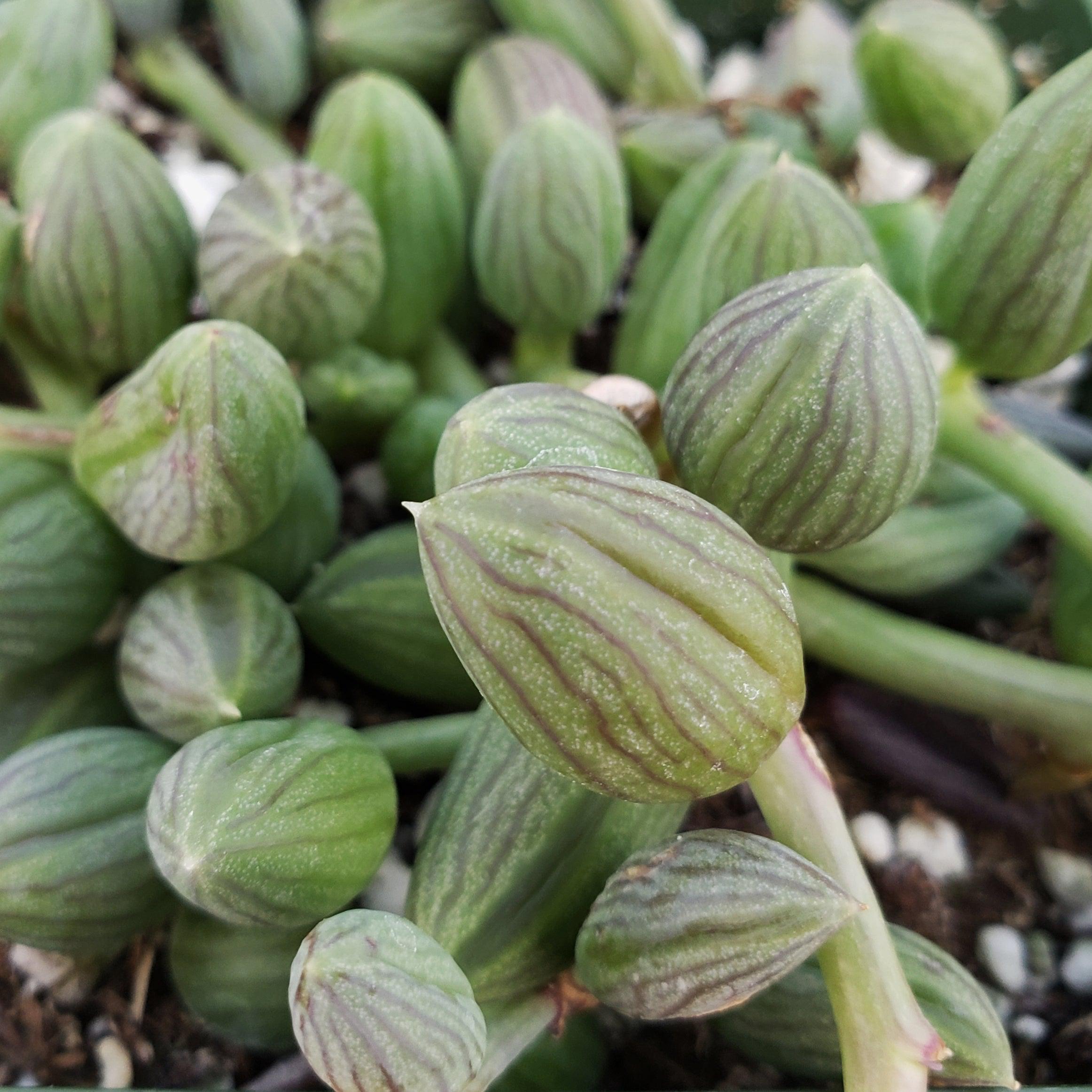
The string of watermelon is a stunning succulent with trailing stems and egg-shaped leaves, similar to a String of pearls but larger and elongated. It can grow over 2 feet long and can be found trailing from a pot or creeping along the ground. The leaves are green, lined with dark green or purple tones, resembling the rind of a watermelon, and can be deepened by bright sunlight.  

When grown as a houseplant, the string of watermelon can reach a height of about 6-8 inches and spread out in a trailing manner. It's a great choice for hanging baskets or as a trailing accent in pots. 

This plant's flowers bloom from spring to fall and are white or off-white, with small, daisy-like blooms. The plant is known for its ability to attract butterflies and bees with its sweet nectar. Its delicate petals bring a touch of elegance to any garden or landscape. 

You can propagate the string of watermelon through stem cuttings. Simply take a healthy stem cutting, remove the lower leaves, and allow the cutting to dry for a day or two. Then, place the cutting in well-draining soil and keep it slightly moist. Over time, it will develop roots and start growing into a new plant. 

Watering Needs 

Like most succulents, the string of watermelon prefers well-draining soil and doesn't like to sit in wet conditions for too long. Overwatering can cause root rot and other issues, while underwatering can cause leaves to shrivel and drop. 

Before watering, insert your finger about an inch into the soil to check if it's dry. If it feels moist, wait a few days before watering. When watering, ensure that the soil is well saturated until water drains from the bottom of the pot. This ensures that the roots get enough moisture. 

In the spring and summer, during the growing season, water your string of watermelons every 1-2 weeks. In the dormant period (fall and winter), you can reduce watering to once every 3-4 weeks. 

Remember, it's always better to underwater than overwater your string of watermelon. If in doubt, it's safer to wait a little longer between waterings. 

Light Requirement 

When grown indoors, the string of watermelon thrives in bright, indirect light. Place it near a window that receives bright, filtered sunlight for a few hours a day. Avoid exposing the leaves to direct sunlight because it can scorch them. 

For outdoors cultivation, it can handle more direct sunlight. However, it's still best to provide it with partial shade during the hottest parts of the day, especially in regions with intense sun. Morning or late afternoon sun is ideal, as it gives the plant the light it needs without the risk of burning the leaves. 

When transitioning your string of watermelon from indoor to outdoor or vice versa, it's important to acclimate it gradually to prevent shock. Start by placing it in a slightly shadier spot for a few hours a day, then gradually increase its exposure to brighter light over the course of a week or two. 

Remember, the string of watermelon can adapt to different light conditions, but it generally prefers bright, indirect light indoors and partial shade with some direct sunlight outdoors. Observing the plant's response to light and adjusting accordingly will help it thrive. 

Optimal Soil & Fertilizer 

The string of watermelon plants favors very airy, sandy soil that drains well. Planting them in ordinary soil will result in compacted roots, stunted growth, and most likely root rot. Instead, make or buy a well-draining potting mix, or ideally use our specialized succulent potting mix that contains 5 natural substrates and mycorrhizae to promote the development of a strong root system that helps your succulent to thrive. 

The string of watermelon is a relatively low-maintenance plant when it comes to fertilizing. During the growing season in the spring, you can feed it with a balanced (5-10-5), water-soluble NPK fertilizer diluted to half strength. Apply the fertilizer once a year to provide the necessary nutrients for healthy growth. 

When applying fertilizer, make sure to water the plant thoroughly first. Then, dilute the fertilizer according to the instructions and apply it to the soil around the base of the plant. Avoid getting the fertilizer on the leaves, as it can cause burns. 

Remember, it's always better to under-fertilize than over-fertilize your string of watermelon. Too much fertilizer can lead to excessive growth and weak stems. Always follow the instructions on the fertilizer package and adjust the frequency of application based on the plant's response. 

Hardiness Zone & More 

When growing indoors, the string of watermelon prefers temperatures between 60°F and 75°F. It can tolerate slightly cooler temperatures during the winter months as long as it's not exposed to frost or freezing conditions. The string of watermelon appreciates moderate to high humidity levels. You can boost humidity by placing a tray filled with water near the plant or using a humidifier. Misting the leaves occasionally can also help provide some humidity. 

When grown outdoors, the string of watermelon thrives in hardiness zones 9 to 11, which are regions with milder climates. These zones generally have average minimum temperatures ranging from 20°F to 40°F. 

The string of watermelon succulents appreciates moderate humidity levels outdoors as well. In regions with naturally higher humidity, the plant can thrive. However, if you live in a drier climate, you can increase humidity by misting the leaves or placing a humidity tray nearby. 

Final Thoughts

Overall, the string of watermelon is a charming and unique plant that brings a touch of whimsy to any space. With its trailing stems and bead-like leaves resembling watermelons or pearls, it's a real eye-catcher. This low-maintenance succulent is perfect for hanging baskets or as a trailing accent in pots. While its small, daisy-like flowers are less significant, the focus is truly on its stunning foliage. Propagating the string of watermelon through stem cuttings is also relatively easy. It requires plenty of sunlight, well-draining soil, and regular watering to thrive. So, if you're looking for a fun and easy-to-care-for plant that adds a pop of green to your surroundings, the string of watermelon is a fantastic choice. 

Shipping Notes
  • Free Standard Shipping on $100+ Orders to the USA.
  • Except Preorder products are shipped in 48 hours.
  • Delivery to the USA:
  1. Standard Shipping : 3-10 business days
  • If time is of the essence, please consider selecting expedited delivery for faster service.
Exchange/Return Notes
  • We offer a 30-day return/exchange service after receiving.
  • Final sale items are not eligible for returns or exchanges.
  • To process your return/exchange, please contact us at [email protected]
  • Please click here for more details>>> Return & Exchange Policy
SKU: 95132932719

Discover Niche Categories That Outsell watermelon succulent

Top-Converting Item to Boost Your Average Order

4.2 ★★★★★
Based on 2224 reviews
Sort
Highest Rating
Newest First
Oldest First
Product Reviews
L
Laurie Macarthur
Chelsea, US
★★★★★ 5
The Pope Preaches of Peace-Not Surprising
Format: Kindle
This collection of homilies were delivered before Pope Leo’s comments regarding the war in Iran. They reflect that he is, and should be, an advocate for world peace.
WAS THIS REVIEW HELPFUL?YesReportShare
Reviewed in the United States on April 20, 2026
A
Amazon Customer
Grantham, US
★★★★★ 1
Only buy this book if you like right wing politics. Otherwise you’ll hate it.
Format: Hardcover
I would definitely choose a different book about Pope Leo. The first thing I noticed when this $32 “Definitive Biography” arrived was how thin it was. I opened it up to large writing and big margins. Definitive biography? $32? Then he spends the first 3 chapters bashing Pope Francis. It’s right wing politics. He even talks about Democrats wanting to pack the U.S Supreme Court! We all know it’s packed with conservatives from Trump. He finally gets to talking about Leo in Chapter 5 - but the first paragraph in that chapter bashes Francis! I’m trying to read more but he keeps adding little digs about Francis. The author appears to keep praising “traditionalists” but how is it traditional to bash the pope? John Paul II and Benedict were too conservative for me but I still respected the Holy Fathers, just disagreed. So I looked up the author and saw “Heritage Foundation,” “Hoover Institute,” and “Newsmax contributor” by his name. I didn’t want to buy a political book! I don’t usually write reviews on Amazon but felt I had to in this case for this overpriced political spiel…
WAS THIS REVIEW HELPFUL?YesReportShare
Reviewed in the United States on May 2, 2026
L
Verified Purchase
Larry Gilstrap
Natrona Heights, US
★★★★★ 5
Fascinating, enlightening, troubling
Format: Paperback
55 pages into the book: So far the author (Schoch) has done a very good job of conveying background information on the statues of Easter Island (along with their mysterious Rongorongo script), the dating of the Great Sphinx (in Egypt) to a time millennia before the usually given orthodox figure of 2650 B.C.E., and on the significance of the findings at Gobekli Tepe, which have been dated to 10,000 B.C.E to about 8,000 B.C.E. But the author's style of including anecdotes from his personal and professional life, which do have bearing on the subject matter, provides for a more enriching reading experience. He points out the humanity of scientists, which we and they often need to keep in mind when considering their pronouncements. And while the book is very well written, and the author is extremely competent in his field (Geology), one or two technical misstatements may be found in these pages. What caught my attention was the statement that by facing due East, the Great Sphinx was also facing the Vernal Equinox. The sentence was unqualified, giving readers the impression that the Vernal Equinox is always, at all times, due East. It is not. Rather, the V.E. (the point on the Ecliptic where the Sun's yearly progress transitions from the southern celestial hemisphere, to the northern) rises and sets every day, just like every other point on the celestial equator, as seen from Earth. But this is a fairly minor annoyance which does not diminish the overall thesis in the least. And it is a pleasure to read from a scientist who dares to follow the evidence where it leads, instead of where orthodoxy, the status quo, and politicians would rather it go. In Forgotten Civilization, Schoch is tying together a number of disparate subjects which have fascinated me for the past forty years - ancient civilization and technology, astronomical catastrophies, the environmental history of the earth and its impact on the evolution of human beings. Much of my fascination with ancient enigmas began with Chariots of the Gods by Erich von Daniken, but Schoch is approaching the same set of mysteries armed with the tools of legitimate science, and not reaching for outlandish theories when the evidence does not demand he do so. In writing as a traditionally trained scientist, following the path of reason and insight, I feel greater confidence that the material presented is trustworthy, and will not be a waste of time or effort as I continue reading this excellent volume. Addendum (2013/04/12) - Finished reading the book, and am left both excited, energized and very concerned. The main thesis of the book is that one or more major solar outbursts (Coronal Mass Ejection [CME] and/or Solar Proton Events [SPE]) impacted the Earth about 12,000 years ago (c. 9700 BCE) effectively bringing the last true ice age - the Younger Dryas - to an end. As fascinating, and explanatory as this assertion is, the author suggests that we are entering a time of similar solar behavior, implying that we, too, may be the recipients of our own solar outburst, resulting in the end of civilization as we know it. Schoch (the author) backs up his hypothesis with a fair amount of evidence provided along somewhat tenuous lines of evidence, which added together build a fairly strong case. The most direct evidence are the isotope levels of Beryllium-10 contained in the Greenland ice core samples dating back to that time, which suggest a sudden influx of cosmic rays associated with a major solar event. Other evidence cited includes the vitrified ("melted into glass") rocks and castles found around the world. And while I'm not used to thinking of castles dating back to the last ice age, it is often suggested by archeologists that succeeding ancient cultures often reused existing sites left behind by preceding cultures. However, there are ancient Indian / Sanskrit accounts of flying houses armed with apparently nuclear missiles, which seemed to have occurred thousands of years before the current thread of civilization begins. Additionally, Schoch has a tendency to see solar outburst evidence in some very ambiguous situations. Intrigued by the Rongorongo script on Easter Island, the good Doctor's wife suggested the character forms were similar to petroglyphs shown in the video "Symbols of an Alien Sky". To be fair, one classic figure, known as the Squatter Man, does bear an astonishing similarity to one of the Z-Pinch instabilities described by plasma physicist, Anthony L. Peratt. Indeed Peratt himself had noticed that many petroglyphs found around the world looked very much like what one might see if a huge plasma discharge from the Sun impacted our atmosphere. The upshot of all of this is that Schoch succeeds in proving his case. And he does so with a brilliant display of disparate data from an array of scientific fields and endeavors. The ambiguities which caused me some doubts seem to be the way that science actually advances. It seems that intuition and inspiration are the first step in recognizing a potential truth, however much dismissed by the orthodox scientific community. In one of five excellent appendix articles, Schoch explains the reality of orthodoxy and politics in the scientific establishment, and how inertia, intransigence, and censorship serve vested personal interests at the expense of truth and progress. Given the wealth of ideas and information presented, and the nearly overabundant food for thought contained in this modest volume, it seems impossible to do full justice to Schoch's work, without a review nearly as long as the book itself. It is far easier to simply read for one's self, to get the fullest sense of what may be the ultimate history lesson.
WAS THIS REVIEW HELPFUL?YesReportShare
Reviewed in the United States on March 21, 2013
I
Verified Purchase
isabella
Lake Worth, US
★★★★★ 4
Review of new and cutting edge perspective by a credible source
Unexpectedly chatty, like a fireside conversation, but Robert Bloch brings the same open mindedness and lack of fear of entrenched mainstream academics to the idea that maybe a massive Solar Flare caused and extinction of much of life about 12,000 yrs ago, that he brought to the updating of the age of the Sphinx. He does tend to jump about in order to incorporate several subjects, and the open mindedness does lead him to be willing to discuss some pretty hairy and unlikely theories, but to his credit his dismissal of the silliest of them is courteous and gentle; very unlike the usual ad hominem viciousness we see. Unfortunately, he doesn't bring the same degree of hard science to some of the ideas like, for example, his wifes' "G! theory". (Has anyone measured H2 atoms to see if they are floating off into space Robert?). However, he does one thing for me I always very much enjoy - he brings new information that informs and sends you running for text books in order to fully understand. His hard science knowledge of what constitutes solar and cosmic rays, their magnetic and electrical functions, is like a full on first year college course. (Incidentally bringing yet more hard science to blow away the stupid AGW theories of Algore and IPCC). If you are into learning some hard facts to explain what might have happened 12,000 yrs ago and what helped to bring us to where we are now, it's an excellent full on read.
WAS THIS REVIEW HELPFUL?YesReportShare
Reviewed in the United States on June 12, 2014
S
Verified Purchase
Sailorman
Charlottesville, US
★★★★★ 5
A Fascinating and Engaging Read
Format: Paperback
This book was published in 2012. When it first came on the market I was intrigued by the title “Forgotten Civilizations” and it was written by Dr. Robert F. Schoch, one of the authors that I revere as a brilliant scientist and intellectual with one of the most open minds to alternate explanations of mainstream scientific paradigms in the modern scientific community. But the remainder of the title, “The Role of Solar Outburst in Our Past and Future”, kind of turned me off, as I assumed this was just another December 21, 2012 doomsday book, and after reading scare books on the coming computer disaster of the millennium change from 1999 to 2000, and several books on the coming Armageddon in 2012, where in both cases nothing happened, I was burnt out on doomsday prognostications. I couldn’t have been more wrong. This book is absolutely fascinating. I think that Graham Hancock, Andrew Collins, Robert Schoch, and other researchers and authors have adequately explained the cause of the Younger Dryas ice age, that began in 10900 BCE, as being caused by a comet impacting the northern hemisphere of earth, but speculation of what caused the end of it, about 9700 BCE, always appeared to be a pretty weak arguments to me. Here I think Dr. Schoch has nailed a very likely cause, and he has the data to back it up, with clues left from Easter Island through western United States to the middle east of something catastrophic happening in the skies 11,700 years ago. Dr. Schoch typically follows the data no matter where it leads him, even if to controversial conclusions (i.e. the Great Sphinx is much older that the Egyptian civilization, possibly 10,000 to 12,000 years old). In Chapters #7 and #8 Dr. Schoch provides a detailed history of the sun’s activity to as far back as records have been kept and as deep as ice cores and tree rings can provide empirical data. He documents the sun’s activity and the corresponding periods of abrupt and severe climate change that occurred during periods of high solar activity. Schoch points out that “our sun has been more active over the last few decade (since about the middle of the twentieth century) than it has been for thousands of years previously”. He goes on to say, “the current overall level of solar activity is the highest it has been since about 9500 BCE to 9000 BCE, near the end of the last ice age!” And, “the level of solar activity during the past 70 years is exceptional, and the previous period of equally high activity occurred more than 8,000 years ago”. Global warming? Ya think? And Schoch points out that throughout history periods of abrupt and severe climate change occur during periods of high solar activity. In Chapter #8 Dr. Schoch discusses the science of “Cosmoclimatology”, the study if how the sun, planets, our solar system, and even events that happen in deep space and in other solar systems, can have an impact on earth. It sounds fishy but Dr. Schoch shows where “changes in greenhouse gases have been correlated with global temperature changes for hundreds of thousands – even millions – of years, long before humans could conceivably have been causing such changes. Indeed, increases in carbon dioxide may in part be a consequence of global warming rather than the cause (Ferreyra 2011). Increases in temperature due to other factors (such as increases in solar activity) may warm the oceans, for instance, resulting in the releases of carbon dioxide and the inability to absorb more carbon dioxide; once the carbon dioxide is in the atmosphere, it may further reinforce global warming.” I’m trading my Toyota Prius in on the biggest pollution belching SUV I can find. Dr. Schoch points out that, Ilya G. Usoskin, “found that periods of higher solar activity and lower cosmic ray flux tend to be associated with warmer climate and vice versa”, and, “Il-Hyun Cho and colleagues have found additional evidence that solar activity can directly affect the weather and climate on earth.” Research shows that the earth experienced “hot house” conditions around 500, 375, 250, and 100 million years ago and “icehouse” conditions with periodic glaciations around 450, 300, and 150 million years ago. Dr. Schoch says, “According to the new paradigm of Cosmoclimatology (research shows) solar and galactic influences can have major effects on the climate of earth.” Chapter #12 provides a detailed description of “The Carrington Event”, something I have never heard of before and found fascinating. The Carrington Event deserves a book on its own. Perhaps there is one or Dr. Schoch will write one. The Carrington Event occurred in 1859 when a solar outburst hit the earth like a tidal wave hitting an island, seriously disrupting electrical distributions and communication systems (telegraph) of the time. Dr. Schoch then goes into describing the impact of a similar or greater intensity solar outburst on today’s electrical distribution systems, communication systems, satellites, pipelines, railroads, etc. It’s happened before and if it would happen again today, it could spoil your whole afternoon. In the last few chapters Dr. Schoch, investigates some new age alternate explanations that challenge the mainstream scientific paradigms in the scientific community. Things like extremely low frequency electromagnetic waves, sound waves, water memory, Zep Tepi, telepathy, levitation, etc. Some of this stuff, like Edgar Chase the “Sleeping Prophet”, I have trouble with, but who am I to debate Dr. Schoch? As I said earlier, Schoch is a scientist with an open mind who does not reject all theories deemed “pseudoscience” out of hand, but rather keeps an open mind, and considers all ideas. There are five appendixes (26 pages) that should not be skipped, as they are all very interesting and contribute to the understanding of the book. The only thing negative I can say about Dr. Schoch’s book is that, while Dr. Schoch has done rigorous research and has an extensive bibliography, he has listed his references in parentheses in the text rather than footnotes or numeric references to notes or the bibliography. That, along with Dr. Schoch’s liberal use of parentheses, to add additional information, I found broke my train of thought, and was annoying at first, and maddening by the time I got to the end of the book. Thus four and a half stars rounded to five, but four and a half stars certainly does not reflect the excellent quality and content of the information contained in this book. If you’re into this stuff like I am I think you will like this book, but if you are a liberal, closed mind, man-made global warming zealot, you ain’t gonn’a exactly fall in love with this book, and you might want to pick up some of Al Gore’s scientific work.
WAS THIS REVIEW HELPFUL?YesReportShare
Reviewed in the United States on February 6, 2017

recommand products