SKU: 88405199715
trailing lavender plants

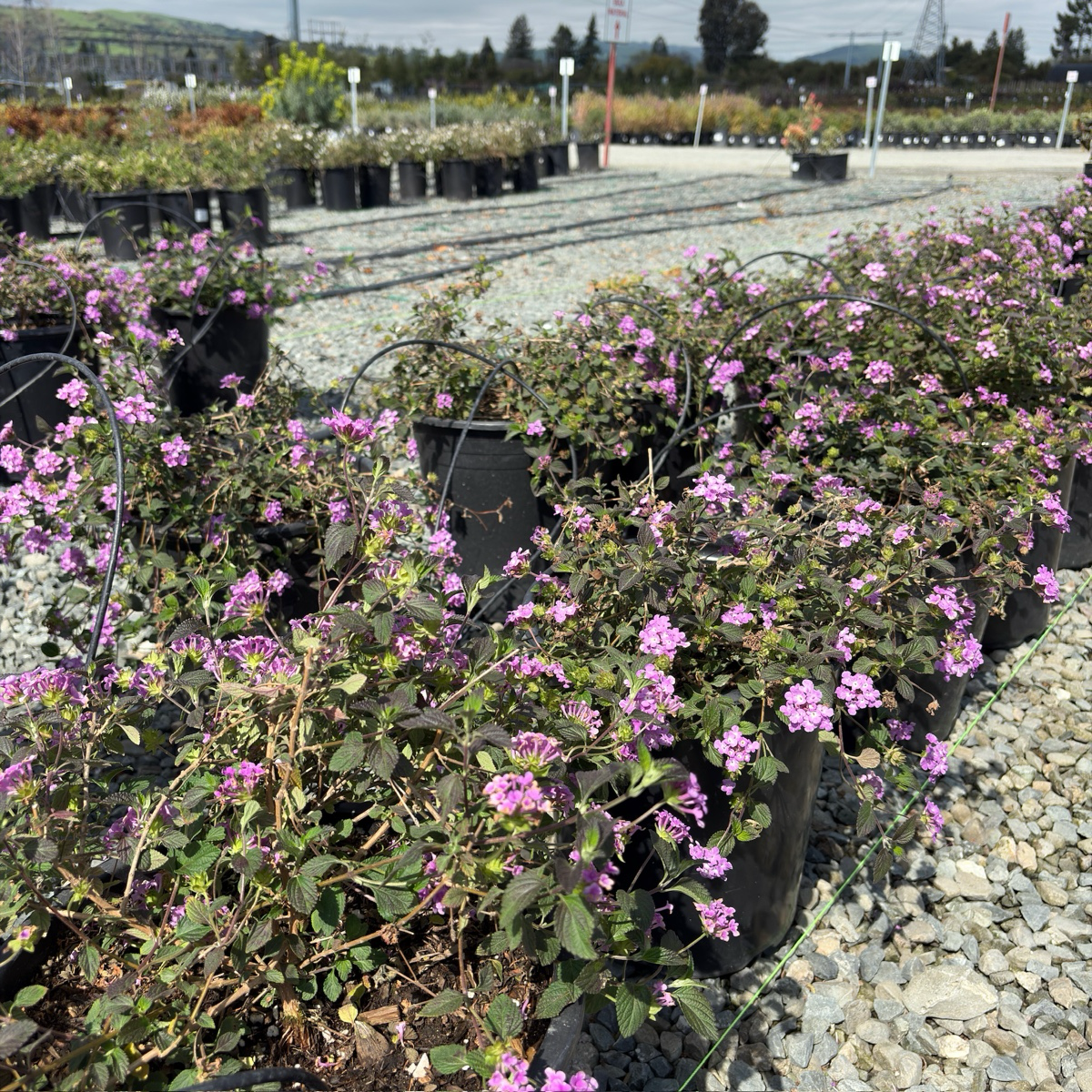
trailing lavender plants Purple Trailing Lantana

Sale price$24.73 Regular price$27.48
Save 10%

Shipping Estimate
USA
  • USA
  • CAN

Ships within 48 hours · Estimated delivery Jul 10 - Jul 15

Promo Codes Available:

For Your Every Summer RSVP, with Code: SUMMER15

Description

trailing lavender plants Purple Trailing LantanaPurple Trailing Lantana is a vigorous, fast spreading evergreen groundcover prized for its non stop display of lavender purple flower clusters and exceptional drought tolerance. It forms a dense mat of slightly rough, aromatic foliage, from which masses of small, pale purple flowers with white or yellow centers bloom profusely from spring through fall. It thrives in intense heat, full sun, and poor soils, making it ideal for covering slopes, spilling

Purple Trailing Lantana is a vigorous, fast-spreading evergreen groundcover prized for its non-stop display of lavender-purple flower clusters and exceptional drought tolerance. It forms a dense mat of slightly rough, aromatic foliage, from which masses of small, pale purple flowers with white or yellow centers bloom profusely from spring through fall. It thrives in intense heat, full sun, and poor soils, making it ideal for covering slopes, spilling over walls, or filling difficult dry areas. Important Note: It is considered invasive in many warm climates, including parts of California and Florida, due to its prolific seeding and rapid spread.

  • Long Blooming Groundcover: Flowers almost continuously with clusters of lavender-purple and white blooms from spring until frost.

  • Fast-Spreading & Drought Tolerant: Quickly forms a dense, low mat (1-2 ft tall, spreading 3-10 ft) that thrives with minimal water once established.

  • Extreme Heat & Salt Tolerance: Excellently adapted to hot, sunny, coastal, and arid conditions.

  • Important Invasive Risk: Listed as invasive in many regions. Its berries are spread by birds, allowing it to colonize natural areas and outcompete native plants. Use sterile cultivars or plant with extreme caution.

  • Attracts Butterflies: A reliable nectar source for butterflies.

Shipping Notes
  • Free Standard Shipping on $100+ Orders to the USA.
  • Except Preorder products are shipped in 48 hours.
  • Delivery to the USA:
  1. Standard Shipping : 3-10 business days
  • If time is of the essence, please consider selecting expedited delivery for faster service.
Exchange/Return Notes
  • We offer a 30-day return/exchange service after receiving.
  • Final sale items are not eligible for returns or exchanges.
  • To process your return/exchange, please contact us at [email protected]
  • Please click here for more details>>> Return & Exchange Policy
SKU: 88405199715

Discover Niche Categories That Outsell trailing lavender plants

Top-Converting Item to Boost Your Average Order

4.5 ★★★★★
Based on 1397 reviews
Sort
Highest Rating
Newest First
Oldest First
Product Reviews
J
Verified Purchase
J. Edgar
San Leandro, US
★★★★★ 4
How many trees do we have left?
In this book, the author takes a look at the downfall of civilizations. Yes, that's plural. There are several models of how civilization is progressing. One is that we're getting better and better as time goes by. Another, less popular one states that we are actually in decline, going down from some sort of golden age. You'll find many of these proponents in the old age homes and such. For them, the only disagreement is when we are declining from. Wright takes a look at the cyclical nature of the rise and fall of civilizations, taking examples from several once- prospering civilizations. This book stands as a call to action that something must be done to grow smartly and be careful on how we allocate the scant resources we have left. While he doesn't hit an anything new, this book's strength is its concise nature. The several examples are familiar and in that have more impact. The strongest example is one he visits several times to show an analogy of current times: Easter Island. This isolated speck in the Pacific was once a thriving mini-civilization with culture and art. And a lot of trees. These trees helped the islanders fish and raise their ceremonial head sculptures. However, these trees also were a poorly cultivated resource. Someone not too long ago cut down the last tree, and the island is now a wasteland and anthropological curiosity. We are doing the same thing. How many trees do we have left to cut?
WAS THIS REVIEW HELPFUL?YesReportShare
Reviewed in the United States on October 14, 2009
W
Verified Purchase
W Lorraine Watkins
Dallas, US
★★★★★ 3
Good on Review Short on Direct Experience
It is an extensive review of the literature on rise and fall of civilizations with observations on our's. Extremely well footnoted and referenced it however suffers from the author appearing to have little direct primary experience in the study of his topic. Nonetheless there is good information here and substantiation of the notion that cultures come and go, frequently going as a result of the lack of capacity necessary to change group behavior in response to certain challenges. He presents compelling evidence that those overwhelming challenges often revolve around irrational and compulsive exploitation of natural resources. Sadly I share the author's pessimism in regard to our global culture being likely to respond adequately to the ongoing destruction of our livable earthly environment. I fear the planet is headed for a massive kill off in the disturbingly near future.
WAS THIS REVIEW HELPFUL?YesReportShare
Reviewed in the United States on April 13, 2013
P
Verified Purchase
phamv
Bozeman, US
★★★★★ 5
I hate to be the kind of person preaching on Doom's ...
This is an impressive quick read. I hate to be the kind of person preaching on Doom's Day, but I do find the definition of progress to be a multi-faceted, direct correlation to humanity, or as this book challenges, inversely related. As Le Corbusier once stated in Towards a New Architecture, "[Progress is] the study of minute points pushed to its limits." I think that we forget that limits do exist. On a sustainability level, we seem to forget that growth is bound to a carrying capacity which is only a constant. We exceed limits in population, in wealth, in energy consumption, and we are doing so blindly because we believe we are progressing. This is the first that I heard the term "progress traps" (which I think Wright may have coined himself), and I believe we seem to fall under the impression that distilling or expanding our limitations is an ultimate form of progress, when in fact, its lack in sustainability will only push us back. If you have the time, it's a pretty quick and enlightening read. If you are still on the fence with the concepts discussed in the book, I recommend finding it at a local library before committing to buy. For me, I recommend it. Also, if you are interested, there is a documentary based on this book called "Surviving Progress" (2011). I prefer the book so much more, but the documentary wasn't that bad.
WAS THIS REVIEW HELPFUL?YesReportShare
Reviewed in the United States on August 29, 2015
M
Verified Purchase
MITCHELL T WEBB
Draper, US
★★★★★ 5
Negro Slave Bible
I like the large print. And, I appreciate the honest commentary.
WAS THIS REVIEW HELPFUL?YesReportShare
Reviewed in the United States on May 7, 2026
J
Verified Purchase
joan williams
Houston, US
★★★★★ 5
None
Format: Paperback
Great book, very informative
WAS THIS REVIEW HELPFUL?YesReportShare
Reviewed in the United States on May 4, 2026

recommand products