SKU: 87283244948
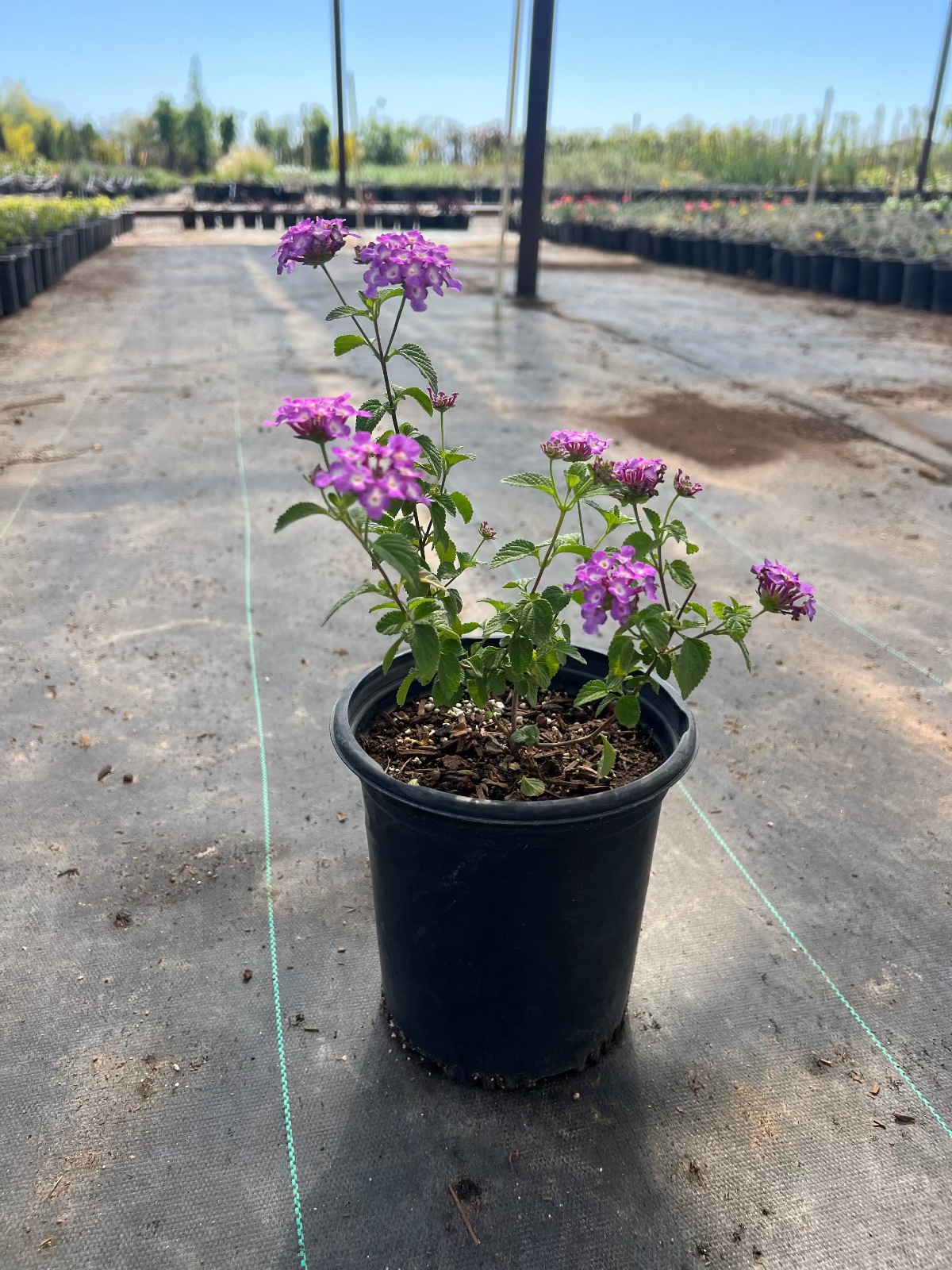
trailing lavender lantana plant

trailing lavender lantana plant Purple Trailing Lantana AZ | Lantana montevidensis

Sale price$23.98 Regular price$26.65
Save 10%

Pay in installments of $6.66 with ShopPay, AfterPay and Klarna

Shipping Estimate
USA
  • USA
  • CAN

Ships within 48 hours · Estimated delivery Jul 22 - Jul 27

Promo Codes Available:

For Your Every Summer RSVP, with Code: SUMMER15

Description

trailing lavender lantana plant Purple Trailing Lantana AZ | Lantana montevidensisPhoenix's Best Trailing Groundcover for Slopes, Borders & Cascading Color Purple Trailing Lantana (Lantana montevidensis) is Phoenix's most reliable low water trailing groundcover for season long color. Its cascading stems spill over walls, blanket slopes, and fill borders with vivid lavender purple blooms from spring through falland often into winter in the warmest Phoenix microclimates. Whether you're covering a hot slope in Scottsdale, softening a

Phoenix's Best Trailing Groundcover for Slopes, Borders & Cascading Color

Purple Trailing Lantana (Lantana montevidensis) is Phoenix's most reliable low-water trailing groundcover for season-long color. Its cascading stems spill over walls, blanket slopes, and fill borders with vivid lavender-purple blooms from spring through fall—and often into winter in the warmest Phoenix microclimates. Whether you're covering a hot slope in Scottsdale, softening a retaining wall in Chandler, or creating a colorful groundcover bed in Peoria, Purple Trailing Lantana delivers effortless, butterfly-attracting color with virtually no irrigation once established.

Purple Trailing Lantana Plant Details

Attribute Detail
Scientific Name Lantana montevidensis
Common Names Purple Trailing Lantana, Weeping Lantana, Purple Lantana
Mature Height 1–2 ft
Mature Width 4–6 ft (trailing spread)
Growth Rate Fast — 3–5 ft spread per season in Phoenix
Sun Full sun (6+ hrs). Handles reflected heat from walls and pavement.
Water Low once established. Highly drought-tolerant.
USDA Zones 9–11 (Phoenix is Zone 9b–10a)
Soil Well-draining. Adapts to Arizona caliche soils with minimal amendment.
Foliage Semi-evergreen — holds leaves year-round in warm microclimates
Bloom Color Lavender-purple, continuous spring through fall
Wildlife Value Attracts butterflies, bees, and hummingbirds

Purple Trailing Lantana Uses in Phoenix Landscapes

Slope Coverage & Erosion Control

Purple Trailing Lantana's vigorous trailing habit makes it one of the best plants for stabilizing slopes in the Phoenix Valley. Its spreading stems root as they go, binding soil and preventing erosion on grades that are difficult to maintain. Once established, it requires no supplemental irrigation and covers large areas quickly — plant 3–4 feet apart for full slope coverage within one growing season.

Retaining Walls & Spilling Borders

Few plants create a more dramatic effect than Purple Trailing Lantana cascading over a retaining wall or raised planter edge. The long, arching stems spill beautifully over stone, block, and concrete edges, softening hard landscape lines with a continuous curtain of purple blooms. Plant at the top of walls 3–4 feet apart; trails will cascade down naturally within the first season.

Low-Water Groundcover Beds

As a flat groundcover, Purple Trailing Lantana suppresses weeds and creates a dense flowering carpet that requires virtually no care once established. It pairs beautifully with Desert Spoon, Texas Sage, and Ruellia (Mexican Petunia) for a layered, all-season desert landscape design. For a groundcover bed, plant 3 feet apart on center for coverage within 1–2 seasons.

Butterfly & Pollinator Gardens

Purple Trailing Lantana is one of the best butterfly-attracting plants available in the Phoenix Valley. Its continuous blooms provide nectar from spring through fall, supporting monarch, swallowtail, and painted lady butterflies alongside native bees and hummingbirds. Mass plantings of 5–10 plants create spectacular wildlife habitat while delivering bold color with zero summer irrigation once established.

Best Time to Plant Purple Trailing Lantana in Phoenix

Fall planting (October–November) is ideal — soil is still warm for fast root establishment, cooler air reduces transplant stress, and the plant gets 6–8 months to establish before its first Phoenix summer. Spring planting (February–April) is the second-best window. Avoid planting in peak summer (June–August) as newly planted lantana needs consistent moisture that can be hard to maintain without daily watering.

How to Plant Purple Trailing Lantana

  1. Dig wide, not deep — 2–3x the root ball width, same depth. Lantana roots spread outward, not deep.
  2. Check for caliche — break through any hardpan layer with a breaker bar or pick to ensure drainage. Lantana will not thrive in waterlogged soil.
  3. Backfill with native soil — a light 20% organic compost blend is fine. Avoid over-amending; lantana prefers lean, well-draining soils.
  4. Spacing — 3–4 ft apart for slopes and groundcover; 3 ft apart for wall cascades where faster coverage is desired.
  5. Water basin — build a 3–4 inch ring of soil around the plant to direct irrigation water to the root zone during establishment.
  6. Mulch — 2–3 inches of gravel or decomposed granite mulch around the base to retain moisture and moderate summer soil temperatures.

Watering Purple Trailing Lantana in Phoenix

First Year Watering Schedule

  • Weeks 1–2: Every 1–2 days, deep and slow (20–30 min drip)
  • Month 1–2: Every 3–4 days
  • Month 3–6: Every 7–10 days (every 5–7 days in peak summer heat)
  • After Year 1: Every 10–14 days in summer; every 3–4 weeks in winter. Established plants are highly drought-tolerant.

Drip Irrigation

Place drip emitters 18–24 inches from the crown. Use 1 GPH emitters for 1-gallon plants; 2 GPH for 3/5-gallon plants. Once established (typically 6–8 months in Phoenix), Purple Trailing Lantana rarely needs supplemental water beyond summer heat spikes.

How fast does Purple Trailing Lantana grow in Phoenix?
Very fast. In Phoenix's long warm season, established plants spread 3–5 feet per year and bloom continuously from spring through fall. First-year plants focused on root establishment may bloom lighter, but second-year plants are prolific.

Is it drought tolerant once established?
Yes — one of the most drought-tolerant flowering groundcovers available for Zone 9b–10a. Once established, Purple Trailing Lantana thrives on minimal supplemental irrigation and tolerates weeks without water in summer.

Does it come back after a freeze?
In Zone 9b–10a (greater Phoenix), Purple Trailing Lantana is semi-evergreen and rarely dies back completely. In colder spots or in unusual freeze events, it may die to the crown but re-sprouts vigorously in spring. Cut back frost-damaged stems to 6 inches in late February.

Can I plant it near a pool?
Purple Trailing Lantana is relatively pool-friendly — it produces minimal litter and is not a messy bloomer. Keep it trimmed back from the water's edge and it works well as a surrounding groundcover or border.

What's the difference between Purple Trailing Lantana and other lantana varieties?
Purple Trailing Lantana stays lower (1–2 ft) and spreads wider than shrub lantana varieties. Its trailing, cascading habit makes it ideal for groundcover and wall plantings where upright lantana varieties would be too tall and bushy.

You May Also Like

  • Radiation Lantana — Vivid orange-red trailing lantana; same low-water habit, hot sunset colors
  • New Gold Lantana — Compact golden-yellow lantana for borders and mass plantings
  • Dallas Red Lantana — Bold red and orange shrub lantana for height and color in desert landscapes
  • White Trailing Lantana — Clean white-flowering trailing variety; pairs beautifully with purple and gold lantanas
  • Moss Verbena — Fine-textured purple groundcover for the same slope and border applications

How Many Purple Trailing Lantana Do I Need?

This is a wide spreader: 1 to 2 feet tall and 4 to 6 feet across. For slopes and groundcover beds, plant on 3-foot centers so plants knit together within a season or two. At 3-foot spacing one plant covers roughly 8 square feet once filled in.

Area to Cover Plants Needed (3 ft spacing)
50 sq ft about 6 plants
100 sq ft about 12 plants
200 sq ft about 24 plants
400 sq ft about 48 plants

On a hot slope where you want fast erosion control, tighten to 2.5-foot spacing (about one plant per 5 to 6 square feet).

Purple Trailing Lantana Season-by-Season in Phoenix

  • Spring (Feb to Apr): After a late-February cutback, fresh growth flushes out and the first lavender-purple blooms open. Best spring planting window.
  • Summer (May to Sep): Peak season. Blooms nonstop through extreme and reflected heat off walls and pavement, and monsoon rains (Jul to Sep) drive an extra surge of growth and color. Virtually no irrigation needed once established.
  • Fall (Oct to Nov): Prime planting season and heavy continued bloom as nights cool.
  • Winter (Dec to Jan): Semi-evergreen and rarely fully dormant in greater Phoenix. In a hard freeze it may die to the crown, then re-sprouts vigorously in spring. Cut frost-nipped stems back to about 6 inches in late February.

At a Glance

✔ Pollinator-Friendly   ✔ Hummingbird-Friendly   ✔ Heat-Loving (Reflected-Heat Tolerant)   ✔ Drought-Tolerant   ✔ Pool-Friendly (Low-Litter)   ✔ Low-Maintenance   ✔ Deer & Rabbit-Resistant   ✔ Cold-Hardy to 20°F (recovers from roots)

Plant It With

  • Radiation Lantana: hot orange-red trailing color to play against the purple on a big slope.
  • New Gold Lantana: golden blooms for a classic purple-and-gold groundcover sweep.
  • Dallas Red Lantana: a taller shrub lantana to add height behind the trailing carpet.
  • Moss Verbena: fine-textured purple groundcover that blends seamlessly for the same slope and border use.

Is Purple Trailing Lantana Right for Your Yard?

This is the go-to plant for hot, sunny slopes, wall tops, and wide low-water beds in full sun and reflected heat, on well-draining soil. It is not a fit for shade or small tidy borders (it wants room to run), and lantana foliage and berries are toxic if eaten, so keep it away from spots where pets or small children graze.

Shipping Notes
  • Free Standard Shipping on $100+ Orders to the USA.
  • Except Preorder products are shipped in 48 hours.
  • Delivery to the USA:
  1. Standard Shipping : 3-10 business days
  • If time is of the essence, please consider selecting expedited delivery for faster service.
Exchange/Return Notes
  • We offer a 30-day return/exchange service after receiving.
  • Final sale items are not eligible for returns or exchanges.
  • To process your return/exchange, please contact us at [email protected]
  • Please click here for more details>>> Return & Exchange Policy
SKU: 87283244948

Discover Niche Categories That Outsell trailing lavender lantana plant

Top-Converting Item to Boost Your Average Order

4.5 ★★★★★
Based on 15 reviews
Sort
Highest Rating
Newest First
Oldest First
Product Reviews
D
Verified Purchase
dra
Draper, US
★★★★★ 5
Fractured pop art masterpiece
Walker (Lee Marvin) and Mal Reese (John Vernon) stage a robbery, stealing a bag of cash from some crooks conducting a delivery by helicopter in deserted Alcatraz. Reese double crosses Walker and leaves him for dead, taking off with the cash and Walker's wife. Walker survives, escapes from the island, and comes after Reese, and all the rest of his criminal organisation, with the mantra, "I want my $93,000." On this third or fourth viewing, I was struck less by what an exemplary action film this is (Marvin, the hardest man in the history of the movies, was at least as mean and relentless in The Killers), and more by how deeply artiness is infused into its structure and design. The recurrent flashing back and forward in time, especially at the start between the planning - not in the traditional meticulous heist film set up, just a series of fractured, barely linked brief meetings and conversations - and the robbery, but also Walker's thoughts returning to his betrayal, feed the predominant critical interpretation that Walker was fatally wounded on Alcatraz, and the whole film is his trying to process this and his fantasy of revenge. Boorman addresses this directly in the commentary, to the extent that he refuses to commit and says it's intended to be ambiguous. I'm now firmly in the dying-flashback camp, because of Walker's almost magical powers. (On reflection, it's like the question of whether Deckard is a replicant - you can enjoy debating it and looking for clues, but in the end the answer is yes.) He appears in new scenes and locations with no evidence of having travelled, and generally in a spiffy new outfit (more of this later) despite carrying nothing but his revolver, and, particularly in the central sequence, he evades being apprehended either by coincidence (the lift he's in opens and closes while the baddies waiting for the same lift are distracted by a commotion) or by the sheer application of cool (waiting immobile but scarcely invisible in an underground car park while his pursuer is gunned down by police). He also has an advisor/mentor, played by Keenan Wynn, who pops up in scenes like a cartoon character (he looks like a sort of dome shaped, bristle headed man in a suit who might appear in Ren and Stimpy) and gives Walker his next mission, while the two of them assiduously avoid eye contact as if one or both aren't really there. From Walker's re-emergence in the first of a series of natty suits, Point Blank is constructed as a series of set pieces. The first is the oddest, continuing the flashbacks and playing with chronology. Walker is seen striding intently down a corridor, and we hear the sound of his footsteps over a series of scenes of his meeting his wife, and the two of them sharing innocent good times with Reese. He confronts his wife, fires six shots into her bed before realising Reese isn't there. A scene later, she's dead after an apparent overdose. A scene after that, the body is gone, the apartment is bare, and Walker has boarded himself inside. Did Walker even see his wife? Had she died already? A messenger arrives from whom Walker extracts a name, and he's off chasing the next link. Walker meets care dealer Big John, whose yard has enormous signs in a jazzy '50s font. He asks for a test drive, buckles his seatbelt, and smashes the car between pillars (c.f. The Driver) until John spills the next name. The most self-consciously art-directed scene follows, in which Walker visits a nightclub which features both a bikini-clad go-go dancer and a trio playing something between jazz and James Brown. Tipped off by a flirtatious waitress that he's being followed, he ducks behind the stage, and fights two baddies while giant faces are projected on a huge screen behind him. In a moment that suggests Tarantino watched this while writing Inglourious Basterds, Walker pulls down a rack of celluloid canisters to trap one pursuer, and then returns things to some kind of action movie orthodoxy by subduing the other one with a haymaker to the groin. In the centrepiece, Walker meets his sister-in-law Chris (Angie Dickinson). Grief and his mission of revenge don't mean he misses the chance to share her bed, and emerge, manhood serenely unthreatened, in her borrowed yellow shortie robe. The colour scheme gets turned up to 11 at this stage, with Walker in a mustard shirt-sports jacket combo (his outfits get truly creative whenever he's bedded Angie - later, he sports a shirt somewhere between salmon and ruby grapefruit - which I guess is the wardrobe equivalent of Joseph Gordon Levitt's post-coital dance routine in (500) Days of Summer), Angie in a rockin' yellow shift dress and matching '60s mid-length coat (let down soon after by wearing something striped like a bee), and Reese in a light tan, crushed velour t-shirt that might be the least flattering male garment in cinema until Borat's mankini. Walker even finds a sightseeing telescope painted lemon yellow, which he casually dislocates from its moorings to scope out Reese's penthouse lair. Once Reese is dealt with, the movie shifts into an early example of crime-as-big-business. Reese's boss is Carter, whose sleek Mad Men-style office and threads are matched by his resemblance to that series' Ted. According to IMDb, Lloyd Bochner, who plays Carter, was doing voice-over work from age eleven, and between him, Vernon's baritone (you know how it sounds - like Dean Wormer: "Fat, drunk and stupid is no way to go through life, son."), and Marvin's basso profundo, there's a meeting of male voices unmatched until, say, Brideshead Revisited. Around this point the architecture of LA attracts more and more focus, both modernist glass towers and the concrete culvert of the LA River, where a sniper lurks who might have inspired the climactic shooter in Get Carter. The commentary is conducted as a dialogue between Boorman and Soderbergh, who, if you've seen this, early Nic Roeg (Performance and Don't Look Now), and were already acquainted with the colour yellow, seems less original than he otherwise might. He has the decency to open by talking about how many times he's stolen from Point Blank. He's not the only one though. Point Blank deconstructs and toys with the action film as knowingly as anything in the 45+ years since, up to and including Archer and the entire oeuvre of Shane Black. Just when it's in danger of becoming too clever to be satisfying as a genre piece, it gets your attention with a pistol whipping, a punch to the groin, or the rarely-shown actual end result of the villain-takes-a-long-fall thing. And of course there's Marvin, who, whether dressed like a dandy, wearing a robe, or looking baffled when the next corporate criminal explains that they just don't have $93,000 to hand over, can't be beat. Seriously, you're not obliged to love it, but you have to see it at least once.
WAS THIS REVIEW HELPFUL?YesReportShare
Reviewed in the United States on May 3, 2014
J
Verified Purchase
J. H. Haley
Port Orchard, US
★★★★★ 4
Lee Marvin's best
Finally it's in dvd. Been looking for it for years. Point Blank is Lee Marvin's best movie, the best character for him, and has his best tag line. I'll leave that for you to find. (It has to with seat belts.) The movie is aptly named. The plot is steam-roller direct, but the director uses some arty time-lapse devices that either distract by conflicting with the directness of the character and the plot, or enhance by providing depth and interest, I can't decide. But they do jarr a little and seem dated. I suppose I do like the uniqueness they add. It's a really good Lee Marvin movie, and Angie Dickinson to boot. Who remembers her answer when Johnny Carson asked her whether she dressed to please herself or others? Memorable.
WAS THIS REVIEW HELPFUL?YesReportShare
Reviewed in the United States on September 25, 2007
M
Verified Purchase
mojo_navigator
Charlottesville, US
★★★★★ 5
Excellent Blu-Ray Transfer - Big Improvement to the DVD
I've been a big fan of this movie for many years, long before the advent of DVD let alone Blu-Ray. I used to go and see it at the repertory cinema often - the first time, I was stunned by the quasi-hallucinatory cinematography of it. A totally unique film that's never been replicated before or since (although The Limey was a good attempt) Frankly the story is incidental and not worth summarising or even paying much attention to. The cinematic style of it is what makes it so riveting both then and now - an excellent psychedelic time-capsule of late `60s LA punctuated by stunning performances from the likes of Marvin, Dickinson and others. The DVD was a huge let-down when released. Despite the accolades that it had at the time, it had a "watery" non-filmic quality which made it dull and tiresome to watch even once. Without capturing the garish color and mind-bending trippiness of the film, you were reduced to following the plot which, like I said, is the least interesting aspect of it. The Blu-Ray is MILES superior to the DVD. The integrity of every component in this movie that I've discussed above is perfectly captured; the emotional power of it is all there in bucketloads. The colors are strong and vivid and in true Blu-ray style you notice subtleties that you hadn't noticed before (e.g. the green chairs in the corporate offices, Angie Dickinson's expression after the "what's my last name" exchange). The overall quality is very filmic (no DNR etc) and good grain where appropriate. It looks like a strong 35 mm print that has been run a few times but has plenty of life left. So no Criterion day-it-was-released look but more than satisfactory. Ideally, I would like Criterion to get hold of this as I think they would clearly be able to make an improvement but this is a minor quibble. For fans of `60s cinema and experimental film-making, this Blu-Ray edition will thoroughly satisfy. I no longer feel the need to see this in a movie house anymore unless there's a full restoration of the original 35mm print (which does happen from time to time)
WAS THIS REVIEW HELPFUL?YesReportShare
Reviewed in the United States on September 26, 2014
K
Verified Purchase
KEITH
Draper, US
★★★★★ 5
Displeasure And Distance
The movie 'Point Blank' is like staring at a visual of Alcatraz prison from the opposite shore. Meaning accumulates over landmarks when we are suspicious about the details. On such a sound the channel of moving water has a stationary dock. A metal walkway connector bridge glows in unnatural radiances; the sun seems set on it, at dusk. These sea shore implements, at Alcatraz or at another bay denote civility and schedules of operation. When money and it's acquisition exist in our brains as enticements the places become spectrums with loose enthusiasms and burnished red-glows. Walker(Lee Marvin) the anti-hero of the movie 'Point Blank' is a tall, laconic, dark-suited figure. Walker's parted white hair gets swept up in the wind, unstraightened, but his bushy eyebrows are solid supports of displeasure and distance. 'Point Blank' directed by John Boorman is a 1967 classic crime film and is the story of a solo struggle-Walker's-to reconnect and recover the money that was stolen from him by his ex-partner Mal Reese(John Vernon). Walker importunes abandoned places, like an Alcatraz prison cell with questions: "How did it happen?" He is ruminating over incidents that are seen in flashback entries, but these brief remonstrance are also plot points on a scheme of surreal adventuring. Lynne(Sharon Acker), Walker's wife, has reproachments about herself, her 'past', but the enviable story is told. Lynne's monotonous sentiments recall a walk on the pier in the rain, with herself and Walker in mild drunkeness. Lynne's voice is synthesized to a soft, dreamy intercession; another vision from Walker's life, also an evocative impression of a stoic wanderer's accentuated provocateur encounters. In his film direction Boorman takes the novel "The Hunter" written by Donald Westlake and gives weight to a story about the cavorting of a slick, popular, caper anti-hero named Parker (From "The Hunter" , also other serial books written by Hunter under pseudonyms like Richard Stark). This story is recreated by Boorman for Parker of the novel and his hyperbolic lurid situations. 'Point Blank' invests visuals with sensual revelations of mystery. The breaths of relaxed reflection give toxicity to moods and the imagination has righteous experience of titillation. The viewer is invited to understand the whisperings of breezes brushing against one another at random convexes-these are soft exposing indescrepancies. At a reunion, another recounting of Walker being hailed over by Mal Reese is one twist. At another rally, in a room in San Francisco, that is similar, Walker warns his target bluntly: "If you don't, I'll kill you." There is an abrupt appearance, also in a semi-populated venue, of assistance made towards Walker. This inviting frenemy says: "If you're looking for Carter, I may be able to help you." This is Yost played by Keenan Wyn. The themes of thrifty fantasy contrive to bounce off Walker. In sunlit rooms and concrete runs ambush attacks set by Walker realize glib confrontations. One such scene involves Brewster(Carroll O'Connor) in an amorous exchange with Walker that suggests that the veritable energies of excitement between Walker and Brewster were procured and transcribed for 'Point Blank' from other products of fictitious dealings. 'Point Blank' co-stars Angie Dickinson as Chris and Lloyd Bochner as Frederick Carter.
WAS THIS REVIEW HELPFUL?YesReportShare
Reviewed in the United States on July 17, 2025
P
Verified Purchase
Parker
Alexandria, US
★★★★★ 3
Dated, but....
Compared to the novel on which it is based, this movie is a complete letdown, so fans of the Parker series of novels who are drawn to this book may want to think twice about watching the film if they are looking for a faithful adaptation of the first Parker novel. That being said, it was not the intention of the director John Boorman to adapt Richard Stark's excellent novel, "the Hunter" to film, but rather to create an entirely new piece of fiction from the skeleton of the original story, so one most try to judge the movie on its own merits, which is difficult to do. As in other reviews, I must commend the directing. The style of the film is way ahead of it's time, with stark visuals, stylized fight scenes, and prolonged moments of silence. I love the long Walk lee Marvin takes thru the a multi-colored corridor where his footsteps drown out all other sound. Marvin's performance is also very strong, and he shows himself to have been an actor who took chances with his image and, in this case, used his clout to make a movie which otherwise would not have been so memorable. In the end, one must ask the question "Why?" Why not faithfully adapt "The Hunter" into film? It certainly would not have stifled the film's creativity, and nothing in the movie's script was any better than what was in the book. There is also the annoying occurrence of changing the protagonists' name from Parker to something else; in this case, Walker. This trend continued in another six film adaptations of the Parker novels, the last of which was 1999's Payback, starring Mel Gibson as Porter.
WAS THIS REVIEW HELPFUL?YesReportShare
Reviewed in the United States on July 1, 2011

recommand products