SKU: 85466807822
cucumber plant care from seed

cucumber plant care from seed Heirloom Boston Pickling Cucumber Seeds | Grow Boston Pickling Cucumbers

Sale price$26.29 Regular price$29.21
Save 10%

Pay in installments of $7.30 with ShopPay, AfterPay and Klarna

Shipping Estimate
USA
  • USA
  • CAN

Ships within 48 hours · Estimated delivery Jul 22 - Jul 27

Promo Codes Available:

For Your Every Summer RSVP, with Code: SUMMER15

Description

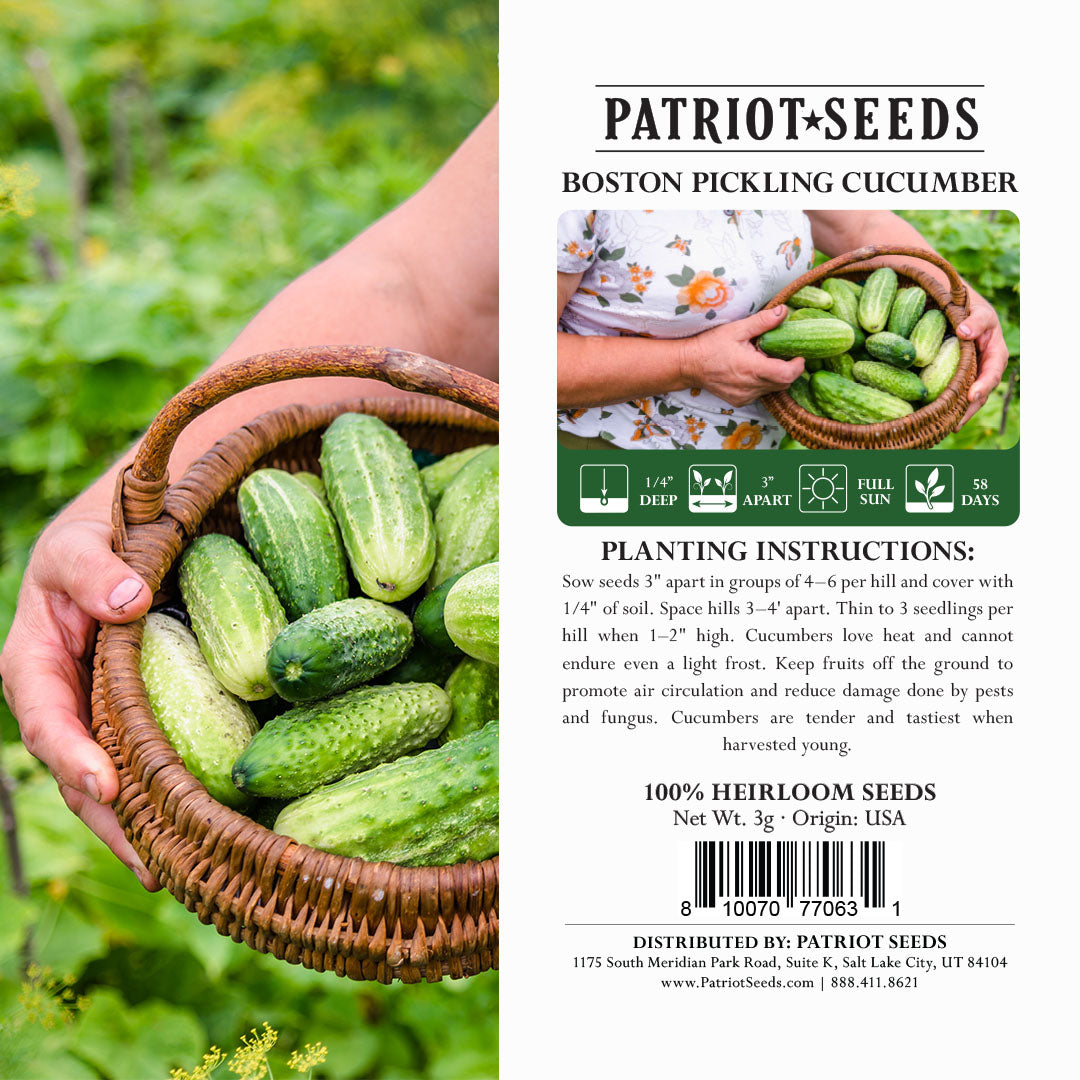
cucumber plant care from seed Heirloom Boston Pickling Cucumber Seeds | Grow Boston Pickling CucumbersHeirloom Boston Pickling Cucumber (3g) Produces heavy and continual yields of fruits measuring 3 to 6 inches, perfect for pickling. The dark green, blunt ended cucumbers can also be used in salads! The average time to maturity is 57 days. Heirloom Boston Pickling Cucumber Planting Instructions Cucumbers are very sensitive to cold. They need warm soil and air, whether direct seeded or transplanted. Don't rush to plant too early. Seeds will not

Heirloom Boston Pickling Cucumber (3g)

Produces heavy and continual yields of fruits measuring 3 to 6 inches, perfect for pickling.

The dark green, blunt-ended cucumbers can also be used in salads! The average time to maturity is 57 days.

Heirloom Boston Pickling Cucumber Planting Instructions

  • Cucumbers are very sensitive to cold. They need warm soil and air, whether direct seeded or transplanted.
  • Don't rush to plant too early. Seeds will not germinate if soil temperature is below 50°F, and germinate only slowly at 68°F.
  • Direct seed 1 to 1 1/2 inches deep, either in rows (2 inches apart in rows 5 to 6 feet apart) or in hills (3 to 6 seeds per hill, hills spaced 3 to 5 feet apart).
  • Thin to 8 to 15 inches apart in rows or 2 to 3 plants per hill. Snip off plants when thinning to avoid disturbing the roots of nearby plants.
  • For early crops, use black plastic mulch and row covers or other protection to speed warming and protect plants.


    Direct Seed into Holes in Plastic

    Cucumbers seeded into black plastic usually produce larger yields, as well as earlier ones. For extra early crops, start plants inside 3 to 5 weeks before transplanting.

    Sow 3 seeds per pot in 2-inch pots. Thin to 1 or 2 plants per pot. Grow above 70°F during the day and above 60°F at night.

    Be careful when hardening-off plants not to expose them to cold temperatures. Plants with 1 or 2 true leaves transplant best.

    Transplant into black plastic mulch or warm garden soil after danger of frost has passed and weather has settled. Be careful not to damage roots when transplanting.

    If using peat pots, make sure they are saturated before transplanting and completely buried. If using row covers, remove when flowers begin to blossom to assure good pollination.

    For a continuous harvest, make successive plantings every 2 to 3 weeks until about 3 months before the first fall frost date. About 1 month before first frost, start pinching off new flowers so plants channel energy into ripening existing fruit.

    Most cucumbers have both male and female flowers. The male flowers blossom first and produce pollen, but no fruit. Cucumbers are heavy feeders and require fertile soil, nitrogen fertilizer, and/or additions of high-N organic matter sources. Pale, yellowish leaves indicate nitrogen deficiency. Leaf bronzing is a sign of potassium deficiency.

    To reduce pest and disease pressure, do not plant cucumbers where you've grown them in the last 2 years.


    Heirloom Boston Pickling Cucumber Harvesting Instructions

    Generally the time to harvest cucumbers is approximately 60 to 70 days from planting to harvest.

    Cucumbers can be picked at any time there is fruit, depending on the cucumber variety and use of the fruit. Cucumbers should be picked early in the morning and refrigerated immediately.

    The larger a cucumber gets, the more of its flavor is lost, becoming bitter and unpalatable. Cucumbers that have turned yellow are past their peak.

    Once the first cucumbers are ready to be harvested, cut the vine about a 1/2 inch above the fruit. Harvest all of the vegetables before maturity to ensure quality fruits and higher yields.

    During harvest time, cucumbers should be picked at least every other day, with daily harvesting being ideal.


    Saving Seeds

    Slice fruit lengthwise and scrape seeds out with spoon. Allow seeds and jelly-like liquid to sit in jar at room temperature for 3 or 4 days. Fungus will start to form on top. Stir daily.

    Jelly will dissolve and good seeds will sink to bottom while remaining debris and immature seeds can be rinsed away. Spread seeds on a paper towel or screen until dry.

    Shipping Notes
    • Free Standard Shipping on $100+ Orders to the USA.
    • Except Preorder products are shipped in 48 hours.
    • Delivery to the USA:
    1. Standard Shipping : 3-10 business days
    • If time is of the essence, please consider selecting expedited delivery for faster service.
    Exchange/Return Notes
    • We offer a 30-day return/exchange service after receiving.
    • Final sale items are not eligible for returns or exchanges.
    • To process your return/exchange, please contact us at [email protected]
    • Please click here for more details>>> Return & Exchange Policy
    SKU: 85466807822

    Discover Niche Categories That Outsell cucumber plant care from seed

    Top-Converting Item to Boost Your Average Order

    4.9 ★★★★★
    Based on 24 reviews
    Sort
    Highest Rating
    Newest First
    Oldest First
    Product Reviews
    B
    Verified Purchase
    Brian Tarbox
    Carnegie, US
    ★★★★★ 4
    Very accurate view of admission (I worked there); compelling read, enlightening even for people who think they already know
    Format: Kindle
    I was a Senior Interviewer during my senior year at Wesleyan 1981 and so I worked with many of the main characters in the book. Although the book describes a later time period it rang entirely true to me. The volume of applications...the controlled chaos...the searching for a hook or a champion for an application was very familiar. At least at Wes it seemed (and seems) that unless one's application has some unusual feature that the school is looking for that year (a particular athlete or a particular musician or a particular tough background that was overcome) the road to admission will be challenging. An area that did surprise me was the emphasis on the family of the applicant...and the degree to which an applicant was held to a higher standard if their parents were deemed to be college fluent. I guess this makes sense and actually provides a leveling of the playing field but it was surprising none the less. It may also be surprising to some that these days you don't just need to convince the gatekeepers that you could be successful at the school..you must also show how your presence would enhance the school. This is of course an enormous burden for most teenagers. Like it or not this is the reality at many "top" schools. If you or your child is applying to college you owe it to yourself to read this book....either to understand the game or to make an informed decision not to play.
    WAS THIS REVIEW HELPFUL?YesReportShare
    Reviewed in the United States on May 20, 2013
    P
    Verified Purchase
    P. Meltzer
    West Palm Beach, US
    ★★★★★ 5
    What is better? The overachieving 6 or underachieving 8?
    Format: Hardcover
    First, let me say that I thought that this was an excellent book and would recommend it to anyone who is at all interested in the college admissions process. Second, I was surprised at how many of the reviewers seemed shocked--shocked!--that applicants got bonus points for coming from minority backgrounds. Was this some kind of revelation? However one thing that surprised me a little bit is how--even moving beyond race entirely--the more advantages you have had in life, the more disadvantageous it will be for your admissions process. For example, I was unaware that having successful parents would be, in essence, held against you on the theory that more would be expected of you. While other reviewers have (jokingly?) said that they would advise their white kids not to check the "Caucasian" box, I might advise my (still very young) kids to say that their parents have been unemployed their whole life. I suppose that the main issue which this whole process really boils down to is the following: As a college applicant, is it more important to succeed in life relative to the world around you (i.e. relative to your classmates, to others of your race, to others of your geographical area, to your own parents' life and accomplishments, etc.) or is it more important to succeed absolutely and not on a relative scale. This book clearly informs us that the answer is the former and not the latter. Whether that should be the answer is another question. For example, say that a student's entire life could be distilled into 2 numbers each on a sliding scale from 1-10. The first number is simply your academic performance (grades, SAT's, course load, etc.) The second number is your background (race, economic circumstances, gender, etc.) In the case of Wesleyan, it seems clear to me that they would rather have a student whose first number was, say, a 6 if his or her second was a 2 (take Mig for example in Steinberg's book) than a student whose first number was an 8 if the second number was a 9 or 10 (take Tiffany Wang for example). Whether that is the right approach is certainly a legitimate issue for discusion and I'm not saying that it's not. I suppose that one of the things that would be interesting to know (even though one never really can know of course) is whether those numbers will change in the future. For example, if one were to know that Mig would always be a 6 and Tiffany would always be an 8, would that change the analysis as to which is the right approach? I suspect that part of the reason that a school like Wesleyan would favor the overachieving 6 over the underachieving 8 is due to the hope or expectation that those trends will continue in the future and that one day the 6 will actually be ahead of the 8. And maybe that's the way it works. Who knows.
    WAS THIS REVIEW HELPFUL?YesReportShare
    Reviewed in the United States on February 28, 2003
    J
    Verified Purchase
    Jeremy W.
    Phoenix, US
    ★★★★★ 5
    You will find out how a selective private college evaluate and admit students
    Format: Paperback
    I'm a high school counselor and college advisor. Fifteen years ago when I started my college counseling position, I struggled to understand or explain to students and their parents how a selective private college evaluate and admit students. It was this book that helped me understand the essence of selective private college admissions. Compared to other dry theory books, this book tells the admissions practice as stories that are easy to read, understand, and associate with. I highly recommend this book to students, parents, and new counselors.
    WAS THIS REVIEW HELPFUL?YesReportShare
    Reviewed in the United States on December 5, 2024
    M
    Verified Purchase
    M. Tucker
    Omaha, US
    ★★★★★ 3
    Who edited this mess?!?!?!?
    Format: Kindle
    This is a very interesting work of nonfiction. I found it intriguing and read it very quickly. I actually got invested in these students and their stories and their journey to get admitted to the college that was right for them. BUT, and this is a big but, this book is so poorly edited, it is disgraceful! If a person were reading this for research purposes, and it could be useful for just that, good luck to them. The dates are all over the place. At one point, the kids are being considered for the class of 2004, then it makes a reference to the current year as 2000, then it reverts back to 2004 for a long while, then it mentions how the kids--currently at their various chosen colleges--reacted to the events of 9/11/01. What the hell? It's very confusing. It makes it very difficult to keep things in context.
    WAS THIS REVIEW HELPFUL?YesReportShare
    Reviewed in the United States on August 8, 2013
    A
    Verified Purchase
    Amazon Customer
    San Leandro, US
    ★★★★★ 5
    Abundant information but needs update
    Format: Kindle
    I struggled a little when try to decide how many star to give. It's an excellent book and very informative. It feels like I was not reading a college admission advisory book, which very often are dry and mechanical. It feels like reading stories of students and AOs, I got attached and involved emotionally, and really felt for them. But there were abundant information in the book, I was able to use the book to answer most my questions. If you need a list of YESs, Nos, Warnings..., then this is not the book for you. If you need to know what happens during admission process, then this is an excellent book for you. Based on the information in this book, I was able to extract my own conclusions. The reason I hesitated if I should rate this book as a five stars book is how long ago it was written. A lot has changed. Many aspects stayed same, but many aspects changed. It will be misleading if this is the only guide book you are using. Wish everyone a great college application season.
    WAS THIS REVIEW HELPFUL?YesReportShare
    Reviewed in the United States on September 12, 2015

    recommand products