SKU: 83729254806
garden row seed planter

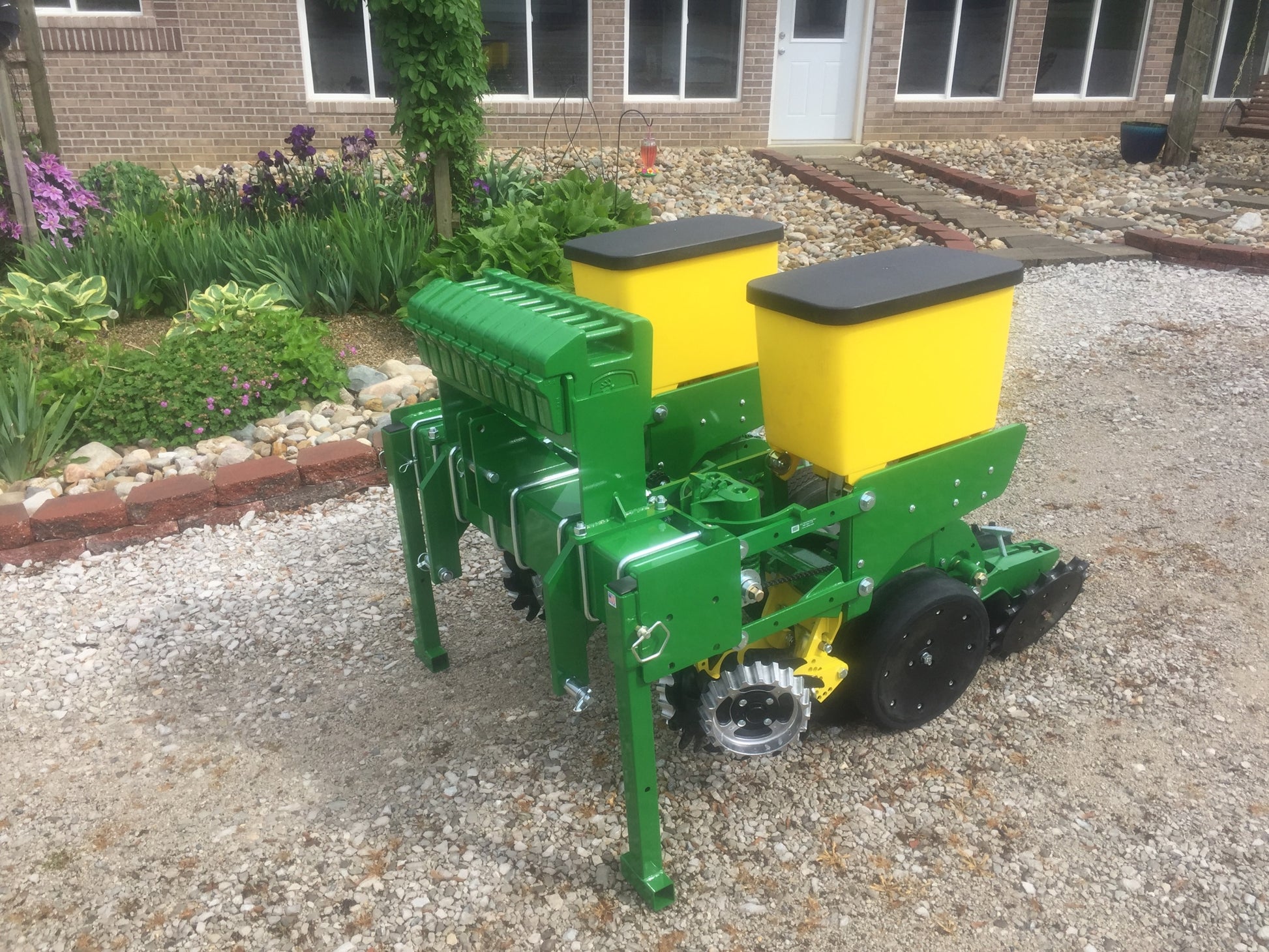
garden row seed planter Biggs Planter 2‑Row Food Plot Planter | BP2 Series

Sale price$21.11 Regular price$23.45
Save 10%

Pay in installments of $5.86 with ShopPay, AfterPay and Klarna

Shipping Estimate
USA
  • USA
  • CAN

Ships within 48 hours · Estimated delivery Jul 19 - Jul 24

Promo Codes Available:

For Your Every Summer RSVP, with Code: SUMMER15

Description

garden row seed planter Biggs Planter 2‑Row Food Plot Planter | BP2 SeriesProduct Description Biggs Planter 2Row Food Plot Planter BP2 Series 30 36 Row Spacing 2555 HP For Tractors DESCRIPTION The 2 Row Food Plot Planters are versatile planting solutions designed for wildlife food plots, small farms, and specialty crop applications. Built with Precision Planting finger pickup meters, dry fertilizer systems, and durable row units, these planters deliver accurate seed placement and efficient fertilization. Buyers can choose

Product Description

Biggs Planter 2‑Row Food Plot Planter | BP2 Series | 30″/36″ Row Spacing | 25–55 HP | For Tractors

DESCRIPTION

The 2 Row Food Plot Planters are versatile planting solutions designed for wildlife food plots, small farms, and specialty crop applications. Built with Precision Planting finger pickup meters, dry fertilizer systems, and durable row units, these planters deliver accurate seed placement and efficient fertilization. Buyers can choose between new or used JD MaxEmerge Plus/XP row units, with options for single or double disc fertilizer openers, quick‑attach or pin‑on mounts, and rebuild packages for extended service life. Compact yet powerful, these planters are ideal for smaller tractors while still offering professional planting performance.

Key Features

  • 2 Row Design – Compact size for food plots and small acreage.
  • Precision Planting Finger Pickup – Ensures accurate seed placement.
  • Dry Fertilizer System – Includes fertilizer boxes and openers for efficient nutrient delivery.
  • Row Unit Options – New MaxEmerge Plus/XP or used JD MaxEmerge Plus row units available.
  • Fertilizer Opener Choices – Single disc (better for no‑till) or double disc openers.
  • Mounting Options – Pin‑on or quick‑attach configurations.
  • Customizable – Optional rebuilds with new parts, powder coating, and hardware upgrades.
  • Versatile Use – Can plant food plots, small fields, or side‑dress urea.
  • Cost‑Effective – Multiple models at different price points to fit budgets.

Detailed Specifications

Model BP2NF (New Finger Pickup)

Specification Details
Row Units New Precision Planting Finger Pickup
Fertilizer System Dry fertilizer with openers
Condition New

Model BP2UF (Used JD Units)

Specification Details
Row Units Used JD MaxEmerge Plus
Seed Boxes New poly boxes
Fertilizer System Dry fertilizer with openers
Condition Used row units (cosmetic/mechanical wear)

Model BP2UFSD (Used JD Units w/ Single Disc Fertilizer)

Specification Details
Row Units Used JD MaxEmerge Plus
Seed Boxes New poly boxes
Fertilizer System Dry fertilizer with single disc openers (better for no‑till)
Condition Used row units (cosmetic/mechanical wear)

Model BP2NXP (New JD Plus/XP Units)

Specification Details
Row Units New MaxEmerge Plus or XP
Fertilizer System Dry fertilizer with openers
Condition New

Model BPUPLUS (Used JD Plus Units)

Specification Details
Row Units Used JD Plus
Attachments Not included
Condition Used

Manuals & Documents

OWNERS MANUAL

General Warranty Info:

  • Ripping It Outdoors works closely with our manufacturers to supply and support your products warranty needs as best as possible!
  • The majority of products come with a manufacturer represented warranty against manufacturing defects for at least a 12 month period after the date of sale. 
  • Expendable components and "wear parts" including but not limited to blades, knives, teeth, oil, chain sprockets, skid shoes, knife mounting discs, and similar components are usually excluded from manufacturer warranties.
  • Please reach out to us for any specific warranty information needed about products and parts you can’t find!

Videos

Shipping

General Shipping Info:

  • Instantly calculate shipping quotes to the lower 48 states by 1. adding this product to your cart, 2. click continue to the checkout page and 3. enter your shipping address to check rates. Contact us for quotes for shipping to Hawaii, Alaska, Canada, Mexico and Internationally.
  • Complimentary lift gate service on all freight shipments where it’s possible. We guarantee safe delivery!
  • Low shipping rates for customers. We have negotiated the best possible rates for customers from our trusted carriers (ODFL, ESTES, UPS, and FedEx) & Top Private Drivers.
  • Negotiate shipping rates if you think we can do better please reach out. Keep in mind some shipping rates also include assembly & configuration as well!
Shipping Notes
  • Free Standard Shipping on $100+ Orders to the USA.
  • Except Preorder products are shipped in 48 hours.
  • Delivery to the USA:
  1. Standard Shipping : 3-10 business days
  • If time is of the essence, please consider selecting expedited delivery for faster service.
Exchange/Return Notes
  • We offer a 30-day return/exchange service after receiving.
  • Final sale items are not eligible for returns or exchanges.
  • To process your return/exchange, please contact us at [email protected]
  • Please click here for more details>>> Return & Exchange Policy
SKU: 83729254806

Discover Niche Categories That Outsell garden row seed planter

Top-Converting Item to Boost Your Average Order

4.7 ★★★★★
Based on 15 reviews
Sort
Highest Rating
Newest First
Oldest First
Product Reviews
P
Verified Purchase
Peter Sorenson
Natrona Heights, US
★★★★★ 5
The Innovator's DNA - Disruptive Research - Disruptive Writing
A Politically Correct Status Quo It is politically correct in management circles to say that you are "results oriented" or that you "drive for results" in your organization. The status quo in business schools is to indoctrinate students in the delivery skills of analyzing, planning, detail-oriented implementing, and disciplined executing. This book and the research upon which it is based disrupts that politically correct status quo. Clayton Christensen has spent close to two decades creating the research, conceptual, and application foundation of the disruptive innovation body of knowledge. He has been working for more than 8 years with Jeff Dyer and Hal Gregersen, both gifted researchers, teachers, and consultants in their own right, on this project. These guys are a disruptive "dream team" of contributors. This book articulates an extension of the disruptive innovation body of knowledge that clearly describes an individual profile of the disruptive innovator and an organizational profile of an organization that makes disruptive innovation happen. So what makes this book disruptive? The first thing is timing. It arrives on the scene at a time when innovation is one of the most critical components of a solution to our global financial and organizational mess. If we are to get out of our morass of debt and sluggish growth and respond to the continually emerging challenges of a burgeoning global society it will ride on the backs and wings of innovation. The status quo must be disrupted for us to survive and thrive! Second is the audacity of the core models. The authors claim that innovation can be learned at both the individual and organizational level. Individuals can increase their ability to discover (Discovery Quotient - DQ) and learn to be more innovative. They cite the four specific behavioral skills of asking questions, engaging in observations, networking with people who have a different point of view, and experimenting to figure out what can work as the common elements of what innovators do. They also identify the cognitive skill of associational thinking, the ability to find connections between ideas that do not seem to be related to each other, as the connection between the behavioral skills and the generation of ideas. They extend their claim that the innovation competency can be learned to the organizational domain by saying that organizations can become more innovative through developing and leading people, designing and implementing processes, and advocating and living by philosophies that support innovation. These two arguments stand in stark contrast to the beliefs and practices of a vast majority of leaders and institutions. (For a diagram of the Model see [...]) 'And all of this is built upon the third source of disruption: research. Their work is based on well-founded research into the "DNA" of the world's leading innovators and the world's most innovative organizations. The authors conducted nearly 100 interviews of world class innovators and their colleagues to get at the heart of what innovators do. They also interviewed and surveyed executives who are not innovators. (Their survey data base has over 5000 respondents in it.) So they have been able to compare and contrast the two populations to more clearly see what it takes to effectively innovate. They have also done research on business results attributable to innovation. Collaborating with HOLT (a division of Credit Suisse) they were able to craft a measurement called the "innovation premium." This measure identifies if an organization's market capitalization can be accounted for by existing cash flows or if there is an innovation influence on the stock price. By using this measure, they have been able to clearly and objectively identify which organizations are benefiting from innovation. Yet to Explore The tension in the balance of influence and power between the leaders with predominantly "Discovery" or "Delivery" mindsets is an area that has yet to be explored. If the premises of this book are sound, and I believe they are, we need to figure out how to manage that tension and balance in order to generate, incubate, and strengthen innovative ideas as we bring them to full fruition in the marketplace. Great ideas that are not delivered upon are simply recreational pursuits that do not build great people, great institutions, and great societies. So there is work yet to do. Invest Your Time and Effort This book makes a significant contribution to both the disruptive innovation body of knowledge and the evolving body of practice on innovating disruptively. It is well worth reading, pondering, and acting upon.
WAS THIS REVIEW HELPFUL?YesReportShare
Reviewed in the United States on August 18, 2011
A
Verified Purchase
Amazon Customer
Dallas, US
★★★★★ 5
Inspiring and well-written
This is a very interesting book written by some Harvard profs. They did a large national survey of innovative businesses and their leaders. The book posits that innovative people follow five skills: associating, questioning, observing, networking, and experimenting. These skills can be found at the individual or organizational level. The idea is that most people have these skills in their DNA and can bring them out with some practice. There are a lot of interesting and inspiring examples like Steve Jobs and Jeff Bezos. Although this book seems like a self-help type book with a lot of hype, it has an academic underpinning. Any organization that is interested in promoting innovation could benefit from encouraging these 5 skills. If you are interested in innovation or creativity in business or any organization that produces something, you will like this book. The books is a little distracting to read because it has sidebars all through it giving interesting examples that break up reading concentration. Aside from that, it is a well-written book that is easy and enjoyable to read. I enjoyed the book greatly and found it to be inspiring.
WAS THIS REVIEW HELPFUL?YesReportShare
Reviewed in the United States on December 5, 2015
S
Verified Purchase
Stephen Collins
Omaha, US
★★★★★ 4
Great read and research. But what about daily application for regular people?
The research piece behind this book might be the next thing I read, as I'm intrigued by the academic rigor applied. The reveal and living examples of the five skills - questioning, networking, experimenting, observing and associating - are tangible and approachable given their articulation through well-known and highly visible entrepreneurs running innovative companies. There's much to be gleaned by looking at the way these people behave and, even through simple emulation, enhancing one's own skills. My only real disappointment with the book is its limited approach to practical, daily application for those not yet at the top of the tree. It's rather a different kettle of fish for the innovation-minded, but stuck in bureaucracy, worker who wants to make things better, is still motivated, and hasn't been crushed by the machine. How does that person actively innovate? And, in some cases, get away with it? This book (or an accompanying volume) focussing on daily, in-work, innovation would be useful.
WAS THIS REVIEW HELPFUL?YesReportShare
Reviewed in the United States on May 23, 2013
A
Verified Purchase
Annette
New York, US
★★★★★ 5
A Favorite Book on Innovation
Format: Hardcover
Very well written and enough stories to help the true content stick. This is a favorite book of mine and has lead to interesting conversations to boot.
WAS THIS REVIEW HELPFUL?YesReportShare
Reviewed in the United States on September 29, 2025
K
Verified Purchase
Kurt Manwaring
Phoenix, US
★★★★★ 5
An exceptional five stars out of five
Few qualities separate inordinately successful entrepreneurs from the rest of the pack than the ability to innovate. Many have debated whether individuals are born with this quality or whether it can be nurtured. In The Innovator's DNA, Jeff Dyer, Hal Gregersen and Clayton Christensen explain that while genetics play a role, innovation is most certainly a skill that can be learned. In particular, the authors introduce and expound upon five "discovery skills" found in the leaders of some of the most innovative companies in the world: (1) associating, (2) questioning, (3) observing, (4) networking and (5) experimenting. Each discovery skill is accompanied by real-world examples and pragmatic exercises that make the book unusually valuable in an age where copious books on change, leadership and innovation overwhelm the already-overwhelmed executive. I give The Innovator's DNA an exceptional five stars out of five. The authors present a very readable book and provide concrete exercises for developing innovative skills. Using the principles provided in the book, I created a folder on my computer that I call my "Innovation Room." I use this to track progress as I work through various exercises and as I take time to ponder about how to apply innovative solutions to extant problems in Utah. This book was and will continue to be useful to me, and is recommended as a must-read for those interested in adding rare innovative attributes to their arsenal of problem-solving and decision-making skills. *NOTE: The preceding text is taken verbatim from my short book review printed in the June 2012 edition of Utah Business.
WAS THIS REVIEW HELPFUL?YesReportShare
Reviewed in the United States on March 22, 2013

recommand products