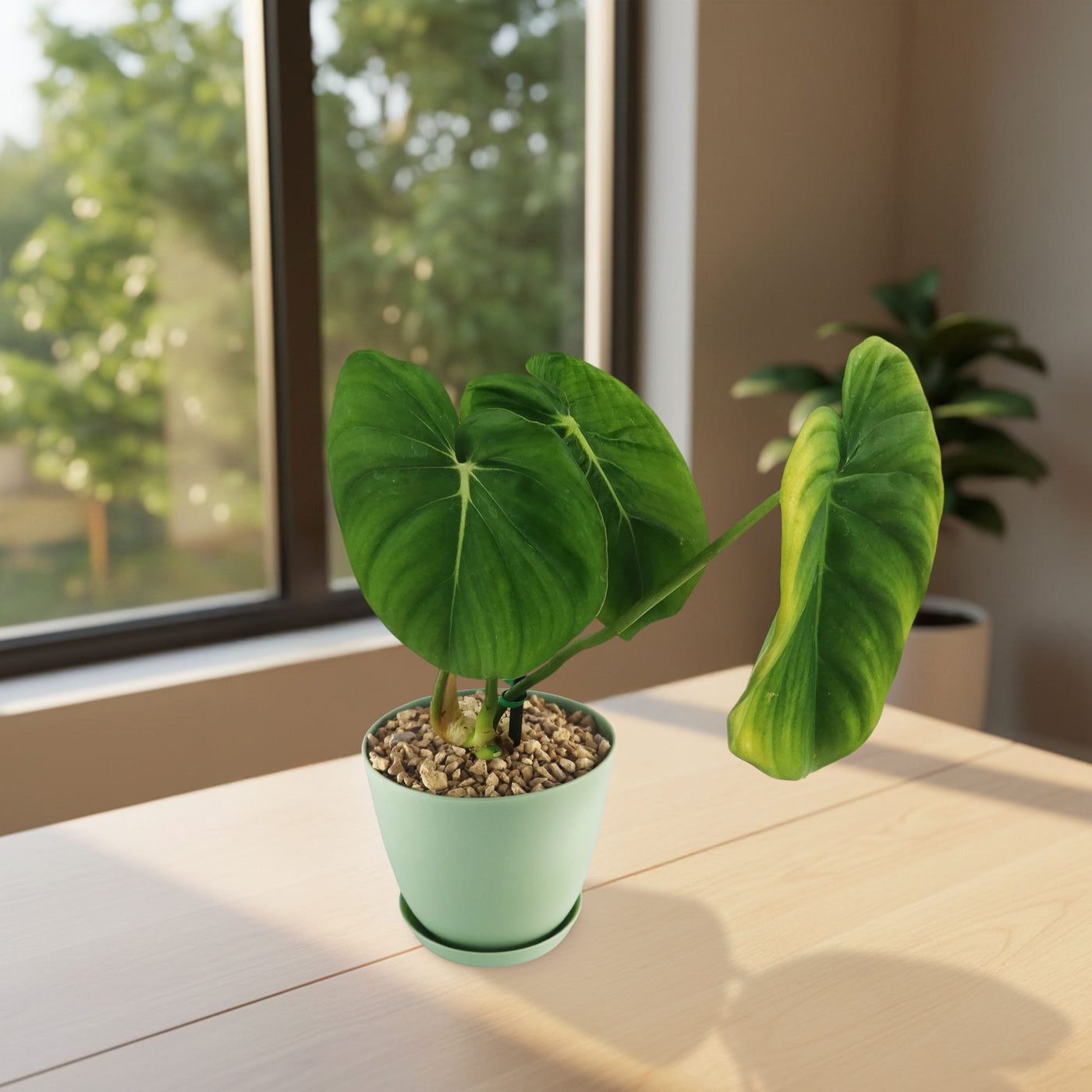
SKU: 83150428021
philodendron cross mcdowell

philodendron cross mcdowell Shop 'Philodendron Mcdowell' Care & Growing Guide

Sale price$20.53 Regular price$22.81
Save 10%

Pay in installments of $5.70 with ShopPay, AfterPay and Klarna

Shipping Estimate
USA
  • USA
  • CAN

Ships within 48 hours · Estimated delivery Jul 23 - Jul 28

Promo Codes Available:

For Your Every Summer RSVP, with Code: SUMMER15

Description

philodendron cross mcdowell Shop 'Philodendron Mcdowell' Care & Growing GuideThe Philodendron Mcdowell is a crawling, drought tolerant plant that has lush, heart shaped leaves and a velvet like texture. This tropical plant is well known among collectors and indoor plant enthusiasts, and it is the ideal combination of easy care and captivating beauty. This crawling hybrid is a cross between Philodendron gloriosum and Philodendron pastazanum. This unique origin gives McDowell its natural adaptability to warm and humid

The Philodendron ‘Mcdowell’ is a crawling, drought-tolerant plant that has lush, heart-shaped leaves and a velvet-like texture. This tropical plant is well-known among collectors and indoor plant enthusiasts, and it is the ideal combination of easy care and captivating beauty.  

This crawling hybrid is a cross between Philodendron gloriosum and Philodendron pastazanum. This unique origin gives ‘McDowell’ its natural adaptability to warm and humid environments, as well as being tolerant to low light; which mimics the shaded conditions of tropical forest floors.

The standout feature of the Mcdowell Philodendron plant is undoubtedly its massive, heart-shaped leaves, which can reach up to 2 feet in length when grown in ideal conditions.

These leaves have a deep green hue with prominent, white-veined patterns, and their texture resembles a velvety fabric, giving the plant an exceptionally tactile allure.

It is a terrestrial grower, which means it typically crawls along the soil rather than climbing, making it ideal for low, wide pots. 

Though it rarely blooms indoors, the Philodendron 'Mcdowell' plant can produce tiny, spathe-like flowers. These blooms are not as showy as the plant's foliage and often go unnoticed, but they do emit a subtle fragrance. Flowering may occur if the plant is grown outdoors in a tropical climate or in a greenhouse that replicates its native conditions. 

As an indoor plant, Philodendron ‘Mcdowell’ not only enhances the aesthetic of a space with its dramatic foliage, but it also helps purify the air by absorbing pollutants. Like other philodendrons, it plays a role in removing toxins, making it an excellent choice for improving indoor air quality. Its lush, tropical appearance adds a sense of tranquility and vibrant greenery to any interior setting.

When and How to Water Philodendron ‘Mcdowell

Like other drought-tolerant plants, the Philodendron McDowell can handle some neglect when it comes to watering. It is important to allow the soil to dry out between waterings to prevent root rot. Overwatering can be more harmful than underwatering for this plant.  

In the spring and summer, during the growing season, you want to keep the soil slightly moist but not waterlogged. A good rule of thumb is to water it when the top inch of the soil feels dry to the touch. You can water it thoroughly typically for 1-2 weeks, allowing excess water to drain out of the pot to prevent root rot. 

In the fall and winter, during the dormant season, the McDowell Philodendron plant doesn't need as much water. You should reduce the frequency of watering to once a week. It's essential to adjust your watering schedule based on the plant's needs and the environmental conditions. Overwatering can be more harmful than underwatering for this plant, so it's better to err on the side of slightly underwatering than overdoing it. Just keep an eye on the moisture and adjust accordingly to keep your Philodendron happy and healthy!

Light Requirements – Where to Place Your Philodendron Plant 

When grown indoors, it does well in bright, indirect light for at least 4-6 hours a day. You can place it near a window where it can get filtered sunlight or even a few feet away from a window with bright, indirect light.

Just avoid placing it in direct sunlight as that can scorch its leaves. If you notice the leaves turning yellow or brown, it might be getting too much light. 

For outdoor cultivation, Philodendron McDowell can still do well in bright, indirect light. It's best to place it in a spot where it gets filtered sunlight or dappled shade.

If you're in a region with intense sunlight, make sure to protect it from direct sun exposure, especially during the hottest parts of the day.

Remember, the key is to provide it with the right balance of light – not too dim and not too bright. 

Optimal Soil & Fertilizer Needs 

When it comes to soil for your Philodendron McDowell, it thrives in a well-draining potting mix. This type of soil allows excess water to drain away, preventing waterlogging, which can lead to root rot. You can also consider adding some orchid bark or charcoal to the mix to enhance aeration and drainage, promoting healthy root growth. Planet Desert specialized potting soil, opens in a new tabGo to soil cactus mix blend 1 gal 4 qt cacti succulent dirt compost growing media that includes an organic substrate with mycorrhizae to help with the growth of a healthy root system to help your succulents thrive. 

Your Philodendron McDowell doesn't require a lot of feeding. During the growing season in spring, you can fertilize it with a balanced NPK fertilizer diluted to half strength. Feed the plant once a year to provide it with the necessary nutrients for healthy growth. During the dormant season in fall and winter, you can reduce or stop fertilizing altogether since the plant's growth slows down during this time. Always remember to follow the instructions on the fertilizer package to avoid overfeeding, which can harm the plant. With the right soil mix and proper fertilization, your Philodendron plant will continue to thrive and grace your space with its lush green foliage.

Hardiness Zones & More 

When grown indoors, with bright, indirect light keep the temperature between 65-80°F during the day and no lower than 60°F at night. Avoid placing it near drafty windows or doors as sudden temperature drops can stress the plant. Maintaining a stable temperature will help your Philodendron thrive and remain healthy indoors. 

For outdoor planting, the Philodendron McDowell is suitable for USDA hardiness zones 10-11. These zones typically have milder winters with temperatures above 30°F.

If you live in a colder climate, you can still grow it outdoors during the warmer months and bring it inside before the temperatures drop. This plant thrives in temperatures above 50°F and doesn't tolerate frost well. 

The Philodendron plants enjoy moderate to high humidity levels. Indoors, you can increase humidity by misting the plant regularly, using a humidifier, or placing a tray of water near the plant. Outdoors in humid regions, the plant will naturally benefit from the ambient moisture in the air. 

Wildlife – Philodendron Mcdowell Attracts the Following Friendly Pollinators 

The Philodendron McDowell is known to attract pollinators such as bees, hummingbirds, and butterflies with its unique flowers. These pollinators are drawn to the plant's nectar and can help facilitate the pollination process, leading to the production of seeds. By attracting these pollinators, the Philodendron McDowell contributes to the ecosystem's biodiversity and promotes plant reproduction. 

Butterflies
Bees
Hummingbirds
Lady Bugs
Multi Pollinators
Other Birds

Philodendron McDowell is mildly toxic to pets and humans, causing symptoms such as irritation and swelling if ingested. It is safe to touch and handle without any adverse effects. However, it is recommended to keep this plant out of reach of pets and children to prevent accidental ingestion.

How to Propagate Your Philodendron ‘Mcdowell 

The Philodendron McDowell can be propagate through stem cuttings. To propagate your plant, you can take a cutting with at least one node (where leaves are attached) and place it in water or directly into a well-draining potting mix. Keep the cutting in a warm and humid environment, and roots should start to develop within a few weeks. Once the roots are established, you can transplant the cutting into a larger pot with soil and continue to care for it as you would a mature plant. This method of propagation is relatively straightforward and can help you expand your Philodendron collection. 

Key Takeaways

  1. This Philodendron is a hybrid created by John Banta, a cross between Philodendron gloriosum and Philodendron pastazanum. It inherits the striking heart-shaped leaves and velvety texture from its parent plants.
  2. The Philodendron 'Mcdowell' is a crawler rather than a climber, unlike vining Philodendrons, which grow upward with support.
  3. The extremely large, heart-shaped leaves are velvety with prominent white veins, making it a popular choice among collectors. Young leaves often emerge with a pinkish hue before maturing into a deep green.
  4. As a crawler rather than a climber, Mcdowell grows horizontally across the soil, requiring a wide pot or ground space to thrive.
  5. This Philodendron plant is known for its air-purifying qualities, making it a popular choice for indoor spaces.

The Bottom Line 

Overall, the Philodendron ‘Mcdowell’ is a stunning hybrid known for its large, heart-shaped, velvety leaves with distinct white veins that give it a bold, tropical appearance. As a crawling variety, it grows horizontally, spreading across the soil, which makes it ideal for wide containers or as a ground cover in tropical gardens. This plant thrives in bright, indirect light and requires consistently moist but well-drained soil. It’s essential to let the top inch dry out between waterings to prevent root rot. High humidity (around 60-80%) and warm temperatures between 65-80°F are ideal for its growth, making it a great indoor plant, especially when a humidifier is available in drier environments. With proper care and attention, Philodendron ‘Mcdowell’ brings lush, green beauty to any space and rewards growers with its impressive, luxurious foliage. Order your very own Philodendron ‘Mcdowell’ for sale today! 

Shipping Notes
  • Free Standard Shipping on $100+ Orders to the USA.
  • Except Preorder products are shipped in 48 hours.
  • Delivery to the USA:
  1. Standard Shipping : 3-10 business days
  • If time is of the essence, please consider selecting expedited delivery for faster service.
Exchange/Return Notes
  • We offer a 30-day return/exchange service after receiving.
  • Final sale items are not eligible for returns or exchanges.
  • To process your return/exchange, please contact us at [email protected]
  • Please click here for more details>>> Return & Exchange Policy
SKU: 83150428021

Discover Niche Categories That Outsell philodendron cross mcdowell

Top-Converting Item to Boost Your Average Order

4.0 ★★★★★
Based on 22 reviews
Sort
Highest Rating
Newest First
Oldest First
Product Reviews
J
Verified Purchase
Jenna
Charlottesville, US
★★★★★ 5
Stop complaining about the size and review the actual product! (Rant, Review, & Recipe)
Flavor Name: Culinary, Size: 1.06 oz (Pack of 1), Flavor Name: Culinary, Size: 1.06 oz (Pack of 1)
I was a little hesitant at first to buy this starter size pouch because of the price. I wanted good quality but kept asking myself, "What if I don't like it?" The company offers a 100% refund on their product so I went for it. Problem solved! RANT: The biggest complaint I see from people on here is in regards to the amount you are getting for the price. They are not reviewing the quality of the item within the packaging or the flavor, etc. If you don't review the actual product and focus only on the quantity or packaging, the review is mostly worthless. As consumers, we get enough worthless reviews that are paid for, we don't need more worthless reviews because people only want to focus on the quantity and packaging and not review the quality. All are important in a review but the quality should be what is focused on. Why is that that because it is a smaller size, people feel entitled to receive it for next to nothing? These are probably the same people that pay almost $2 for a 20 oz bottle of soda while the 2 liter bottle is only $1 and they don't bat an eyelash. What they fail to understand is that making smaller sizes like this is not very cost effective for them to make. It probably costs them the same, or close to the same amount of money to purchase the bags they use for this size as it does for a larger size. These sampler sizes don't sell as well either. Unlike the bottle of soda that is "personalized" in size for the consumer to grab and go, this is a product that takes time and effort for the consumer to prepare. It is not meant to be a personalized size. If it were, people would have no problem paying for the convenience. Consumers are so spoiled and don't understand the costs associated with what it takes to import, pay the farmers a fair wage, the manpower and materials it takes to package the product, etc. I can guarantee you however, if a fair wage is not paid, someone is bound to call the 5:00 news! If you want sample sizes, fair wages, and the like, the consumer is going to have to pay for them or the company will go out of business really fast. How many people have purchased an actual vanilla bean? Or saffron? Or truffles? No one seems to have a problem paying a high price for these items but complain about $10 for 30g of quality culinary matcha. Just like those items, a little matcha goes a long way. It depends on how you plan to use it. If you are going to bake with it, buying a starter size is not cost effective for you. If you are using it to make a tea latte, which is why I bought it, this is still gives you enough for 15 lattes that are 16 oz in size making them roughly $1.63 each (my recipe for this is below). Costs will vary depending on your ingredients of choice, and the area you live in. My numbers are based on $10 for 15 servings of this matcha and $0.08 per oz of organic vanilla almond milk in Austin, TX. Go to a coffee shop and you will pay at least $5 for a matcha latte of the same size, which is yet another thing buyers won't complain about. OK, RANT OVER...ON TO THE REVIEW! REVIEW/COMPARISON: I used to hate the taste of Matcha but after years of taste bud readjustment, I decided to give it another try at Starbucks. They use Teavana brand for their lattes which is like Jade Leaf and does not use fillers and is organic. I try to avoid dairy so I used almond milk for my iced latte instead. Neither their tea or almond milk is sweetened so I added 3 pumps of vanilla to their venti size (they usually use 6 if you want it sweetened). Something about their almond milk leaves a bad aftertaste but before that hit, it was really good. Like most people, I can't afford $5 a day for one of these so I decided to buy the powder to make on my own at home (I was a barista in a former life so I often do this with my coffee concoctions too). What I don't like about the Teavana brand is that it is much more expensive ($25 for 40g) and they claim it is ceremonial grade and yet, it looks and tastes exactly like Jade Leaf's culinary grade. In the brief research I did before buying, not a single self-proclaimed matcha aficionado EVER said to use ceremonial grade for a latte. They all very plainly stated that it was NOT for culinary use and that the taste is quite different. It is also higher in chlorophyll so it is a much brighter green color. That begs the question as to why Teavana, which looks and tastes the same as Jade Leaf is labeled ceremonial grade and being used for lattes when it is clearly the same culinary grade. This morning, I made my first iced latte with this stuff from Jade Leaf. Using an organic, vanilla (sweetened) almond milk I found it was perfectly sweet and still had the very slight hint of the bitterness that comes from green tea. No weird almond milk aftertaste like the one from Starbucks. Needless to say, in the end, I will be buying this again in a larger size. It does say to store it in the fridge so that is where mine went when I was done with it. I plan to do a juice fast soon and a few recipes I have seen call for green tea for an extra metabolic and antioxidant boost. I plan to use this instead since it is so much more nutritionally dense than regular tea leaves. RECIPE: They offer some recipe options on their Amazon listing and also on their website, but this was my super simple one that I threw together and was delicious. Iced Matcha Vanilla Almond Latte: 4 oz (1/2 c) hot water (not boiling but barely steaming to help dissolve the matcha easily) 1 tsp Jade Leaf Organic Matcha 12 oz (1-1/2 c) cold vanilla flavored almond milk, or other milk of choice Sweetener of choice, to taste (optional, I don't use any because my almond milk is already sweetened) Ice cubes NOTE: Sweetening options will have to be done at different steps depending on what you are using. If you are using liquid sugars like Torani or homemade simple syrups, those can go in at any time. Honey, agave, coconut nectar, sugar, and artificial sweeteners, should be blended in when you whisk the matcha into the hot water otherwise they will not dissolve properly and will settle at the bottom of the cup. 1. In a glass measuring cup, add 4 oz hot water. 2. Add 1 tsp of matcha powder and whisk together (see note for adding optional sweeteners) 3. Pour into a 16-20 oz cup over a few ice cubes to cool it. 4. Top off with the 12 oz vanilla almond milk (or other milk of choice) and stir to blend. Add more ice if desired. ENJOY Y'ALL!
WAS THIS REVIEW HELPFUL?YesReportShare
Reviewed in the United States on July 24, 2017
K
Verified Purchase
KoKo
Fort Morgan, US
★★★★★ 5
Matcha Powder
Flavor Name: Culinary, Size: 1.06 oz (Pack of 1)
Jade Leaf Matcha has become my go-to matcha powder, and I keep coming back to it time and time again. The quality is consistently great, with a fresh flavor and vibrant green color that mixes well into drinks and recipes. I use it regularly for matcha lattes, smoothies, and even baking, and it always delivers great results. For a culinary-grade matcha, I think the flavor is excellent—not overly bitter and smooth enough to enjoy daily. It blends easily and provides the perfect matcha taste without breaking the budget. I’ve tried other brands over the years, but this is the one I continue to repurchase. If you’re looking for a reliable, high-quality matcha for everyday use, I highly recommend giving this one a try.
WAS THIS REVIEW HELPFUL?YesReportShare
Reviewed in the United States on June 7, 2026
G
Verified Purchase
Giselle Derun
Whiting, US
★★★★★ 5
Good taste,
Flavor Name: Culinary, Size: 3.53 oz (Pack of 1)
This matcha has a nice, rich flavor and works really well for lattes. It mixes easily without clumps and the color is vibrant. Good quality for the price and perfect for daily use.
WAS THIS REVIEW HELPFUL?YesReportShare
Reviewed in the United States on April 26, 2026
M
Verified Purchase
Mac Author Anonymous
Cuba, US
★★★★★ 4
Matcha
Flavor Name: Culinary, Size: 1.06 oz (Pack of 1)
I haven’t decided if I really like Matcha, as I got this, just to find that out. I find that the packaging is interesting, and it is best, probably, to store it in the package it comes in. It has a mild flavor, and I am just making tea with it, as I don’t bake any more. It is a bright green powder with a smooth, mild taste, and in a clever package.
WAS THIS REVIEW HELPFUL?YesReportShare
Reviewed in the United States on June 7, 2026
K
Verified Purchase
KB Mom
Lake Worth, US
★★★★★ 5
A Premium Matcha Experience for the True Connoisseur
Flavor Name: Culinary, Size: 1.06 oz (Pack of 1)
I recently had the pleasure of trying the Jade Leaf Matcha Organic Premium Ceremonial Grade Matcha Green Tea Powder, and it truly lives up to its reputation as a high-quality product. As someone who enjoys matcha regularly, I was eager to compare this offering to others on the market, and I have to say I was very impressed. The first thing I noticed was the vibrant green color of the powder. It’s a rich, deep green that is indicative of the quality and freshness of the leaves. When prepared, the tea has a smooth, silky texture and a natural sweetness that makes it enjoyable both on its own and as an addition to smoothies or lattes. I appreciate that this matcha doesn’t have the bitterness that can sometimes accompany lesser-quality varieties, making it a perfect choice for ceremonial use or a relaxing daily treat. As a ceremonial grade matcha, it’s clear that Jade Leaf has carefully sourced and processed the tea leaves. The flavor is balanced and complex, with grassy, vegetal notes followed by a subtle sweetness. It has the perfect level of umami, which is an essential characteristic of a high-quality matcha. I’ve tried a variety of brands, but this one stands out for its consistency and superior taste. The packaging is also noteworthy. The resealable bag ensures the matcha stays fresh, which is crucial for preserving its delicate flavor and antioxidants. It’s easy to scoop out the right amount without making a mess, and the instructions on the back are clear and helpful for those new to preparing matcha. Whether you’re a seasoned matcha drinker or new to the world of green tea, this Jade Leaf matcha provides a top-notch experience. I highly recommend it for anyone looking for an authentic, high-quality matcha that delivers excellent taste and a sense of calm and clarity with every sip.
WAS THIS REVIEW HELPFUL?YesReportShare
Reviewed in the United States on January 12, 2026

recommand products