Pay in installments of $7.48 with
 ,
,
 and
and

Shipping Estimate
USA
- USA
- CAN
- USA
- CAN
Ships within 48 hours · Estimated delivery Jul 22 - Jul 27
 Promo Codes Available:
For Your Every Summer RSVP, with Code: SUMMER15
Description
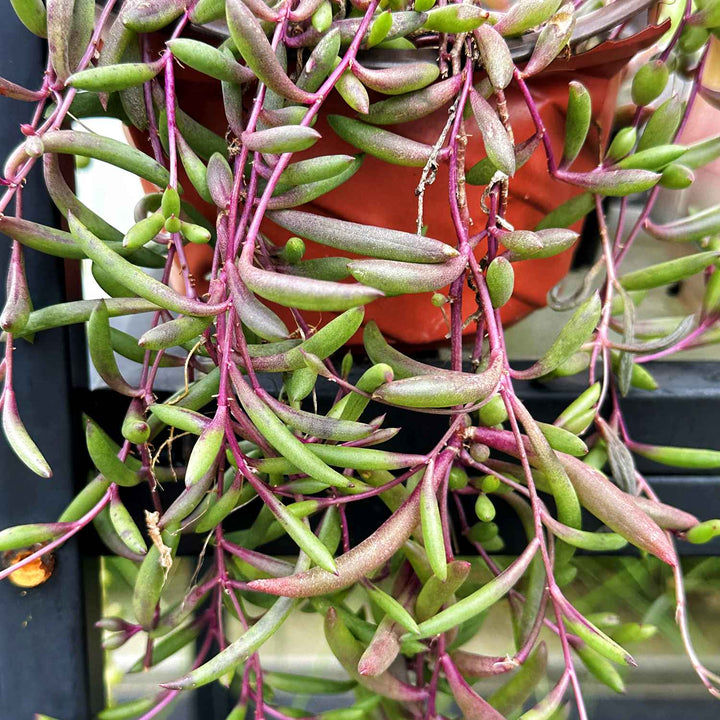
necklace vine succulent Othonna Capensis/Ruby Necklace, Trailing SucculentAbout Othonna Capensis Ruby NecklaceOthonna capensis, also called ''Little Pickles'' or ''Ruby Necklace'', is a trailing succulent with small green leaves that hang on stems up to 2 feet long. When stressed, the leaves turn purple or burgundy, and the stems turn ruby red to purple. Meanwhile, white tufts of hair come out between stems and leaves, which is exceptionally stunning in hanging baskets or wall gardens. Small, yellow, and daisy like blooms
About Othonna Capensis Ruby NecklaceOthonna capensis, also called ''Little Pickles'' or ''Ruby Necklace'', is a trailing succulent with small green leaves that hang on stems up to 2 feet long. When stressed, the leaves turn purple or burgundy, and the stems turn ruby red to purple. Meanwhile, white tufts of hair come out between stems and leaves, which is exceptionally stunning in hanging baskets or wall gardens. Small, yellow, and daisy-like blooms all year round.
How to care for Othonna Capensis Ruby Necklace
Sun/Location: Othonna capensis “Ruby Necklace” can be propagated from stem cuttings. It is indoor succulents and needs to be moved indoors to grow by the window to get at least 6-hour sun exposure or under a grow light to maintain the color. It can be placed outdoors in spring and fall to get full sunlight. Shade is required in summer to avoid sunburn.
Soil/Pot: Othonna capensis prefers a well-drainage soil mix, click here to get the best succulent soil recipe. As a hanging plant, the Ruby Necklace do well in hanging planter with drainage holes.
Watering: The best way of watering is the 'soak and dry' method. Water deeply enough for water to run out of the drainage hole, then wait for the soil to fully dry before watering again. Click here to learn how to water succulents.
More Information
Primary color: green/lime
Secondary color: purple/black
Bloom color: bright-yellow daisy flowers
Cold hardiness: zone 9a-11b(from 20F to 50F)
Product format: rooted in 4'' pot
Suitability: balcony, Window, Garden
Propagation: stem cutting
Special characteristic: pet safe, showy blooms, easy to propagate, fast grower
Shipping Notes
- Free Standard Shipping on $100+ Orders to the USA.
- Except Preorder products are shipped in 48 hours.
- Delivery to the USA:
- Standard Shipping : 3-10 business days
- If time is of the essence, please consider selecting expedited delivery for faster service.
Exchange/Return Notes
- We offer a 30-day return/exchange service after receiving.
- Final sale items are not eligible for returns or exchanges.
- To process your return/exchange, please contact us at [email protected]
- Please click here for more details>>> Return & Exchange Policy
4.5 ★★★★★
Based on 10 reviews
Sort
Product Reviews
★★★★★ 4
Very accurate view of admission (I worked there); compelling read, enlightening even for people who think they already know
Format: Kindle
I was a Senior Interviewer during my senior year at Wesleyan 1981 and so I worked with many of the main characters in the book. Although the book describes a later time period it rang entirely true to me. The volume of applications...the controlled chaos...the searching for a hook or a champion for an application was very familiar.
At least at Wes it seemed (and seems) that unless one's application has some unusual feature that the school is looking for that year (a particular athlete or a particular musician or a particular tough background that was overcome) the road to admission will be challenging.
An area that did surprise me was the emphasis on the family of the applicant...and the degree to which an applicant was held to a higher standard if their parents were deemed to be college fluent. I guess this makes sense and actually provides a leveling of the playing field but it was surprising none the less.
It may also be surprising to some that these days you don't just need to convince the gatekeepers that you could be successful at the school..you must also show how your presence would enhance the school. This is of course an enormous burden for most teenagers.
Like it or not this is the reality at many "top" schools. If you or your child is applying to college you owe it to yourself to read this book....either to understand the game or to make an informed decision not to play.
WAS THIS REVIEW HELPFUL?YesReportShare
Reviewed in the United States on May 20, 2013
★★★★★ 5
What is better? The overachieving 6 or underachieving 8?
Format: Hardcover
First, let me say that I thought that this was an excellent book and would recommend it to anyone who is at all interested in the college admissions process. Second, I was surprised at how many of the reviewers seemed shocked--shocked!--that applicants got bonus points for coming from minority backgrounds. Was this some kind of revelation? However one thing that surprised me a little bit is how--even moving beyond race entirely--the more advantages you have had in life, the more disadvantageous it will be for your admissions process. For example, I was unaware that having successful parents would be, in essence, held against you on the theory that more would be expected of you. While other reviewers have (jokingly?) said that they would advise their white kids not to check the "Caucasian" box, I might advise my (still very young) kids to say that their parents have been unemployed their whole life.
I suppose that the main issue which this whole process really boils down to is the following: As a college applicant, is it more important to succeed in life relative to the world around you (i.e. relative to your classmates, to others of your race, to others of your geographical area, to your own parents' life and accomplishments, etc.) or is it more important to succeed absolutely and not on a relative scale. This book clearly informs us that the answer is the former and not the latter. Whether that should be the answer is another question.
For example, say that a student's entire life could be distilled into 2 numbers each on a sliding scale from 1-10. The first number is simply your academic performance (grades, SAT's, course load, etc.) The second number is your background (race, economic circumstances, gender, etc.) In the case of Wesleyan, it seems clear to me that they would rather have a student whose first number was, say, a 6 if his or her second was a 2 (take Mig for example in Steinberg's book) than a student whose first number was an 8 if the second number was a 9 or 10 (take Tiffany Wang for example). Whether that is the right approach is certainly a legitimate issue for discusion and I'm not saying that it's not.
I suppose that one of the things that would be interesting to know (even though one never really can know of course) is whether those numbers will change in the future. For example, if one were to know that Mig would always be a 6 and Tiffany would always be an 8, would that change the analysis as to which is the right approach? I suspect that part of the reason that a school like Wesleyan would favor the overachieving 6 over the underachieving 8 is due to the hope or expectation that those trends will continue in the future and that one day the 6 will actually be ahead of the 8. And maybe that's the way it works. Who knows.
WAS THIS REVIEW HELPFUL?YesReportShare
Reviewed in the United States on February 28, 2003
★★★★★ 5
You will find out how a selective private college evaluate and admit students
Format: Paperback
I'm a high school counselor and college advisor. Fifteen years ago when I started my college counseling position, I struggled to understand or explain to students and their parents how a selective private college evaluate and admit students. It was this book that helped me understand the essence of selective private college admissions. Compared to other dry theory books, this book tells the admissions practice as stories that are easy to read, understand, and associate with. I highly recommend this book to students, parents, and new counselors.
WAS THIS REVIEW HELPFUL?YesReportShare
Reviewed in the United States on December 5, 2024
★★★★★ 3
Who edited this mess?!?!?!?
Format: Kindle
This is a very interesting work of nonfiction. I found it intriguing and read it very quickly. I actually got invested in these students and their stories and their journey to get admitted to the college that was right for them. BUT, and this is a big but, this book is so poorly edited, it is disgraceful! If a person were reading this for research purposes, and it could be useful for just that, good luck to them. The dates are all over the place. At one point, the kids are being considered for the class of 2004, then it makes a reference to the current year as 2000, then it reverts back to 2004 for a long while, then it mentions how the kids--currently at their various chosen colleges--reacted to the events of 9/11/01. What the hell? It's very confusing. It makes it very difficult to keep things in context.
WAS THIS REVIEW HELPFUL?YesReportShare
Reviewed in the United States on August 8, 2013
★★★★★ 5
Abundant information but needs update
Format: Kindle
I struggled a little when try to decide how many star to give. It's an excellent book and very informative. It feels like I was not reading a college admission advisory book, which very often are dry and mechanical. It feels like reading stories of students and AOs, I got attached and involved emotionally, and really felt for them. But there were abundant information in the book, I was able to use the book to answer most my questions. If you need a list of YESs, Nos, Warnings..., then this is not the book for you. If you need to know what happens during admission process, then this is an excellent book for you. Based on the information in this book, I was able to extract my own conclusions.
The reason I hesitated if I should rate this book as a five stars book is how long ago it was written. A lot has changed. Many aspects stayed same, but many aspects changed. It will be misleading if this is the only guide book you are using. Wish everyone a great college application season.
WAS THIS REVIEW HELPFUL?YesReportShare
Reviewed in the United States on September 12, 2015