SKU: 82604082766
sage succulent

sage succulent White Sage Plants ‘Salvia apiana’

Sale price$25.61 Regular price$28.46
Save 10%

Pay in installments of $7.12 with ShopPay, AfterPay and Klarna

Shipping Estimate
USA
  • USA
  • CAN

Ships within 48 hours · Estimated delivery Jul 22 - Jul 27

Promo Codes Available:

For Your Every Summer RSVP, with Code: SUMMER15

Description

sage succulent White Sage Plants ‘Salvia apiana’The white sage plant, known as Salvia apiana, is a fragrant evergreen shrub popular in gardens for drought tolerant, or low maintenance landscapes. This Salvia apiana reflects the white to silver appearance of its elliptical leaves. It has several other common names such as Sacred Sage, or bee sage. The plants unique scent, which is both pungent and sweet, is a defining feature, and is often grown in herb gardens, medicinal plant collections, and

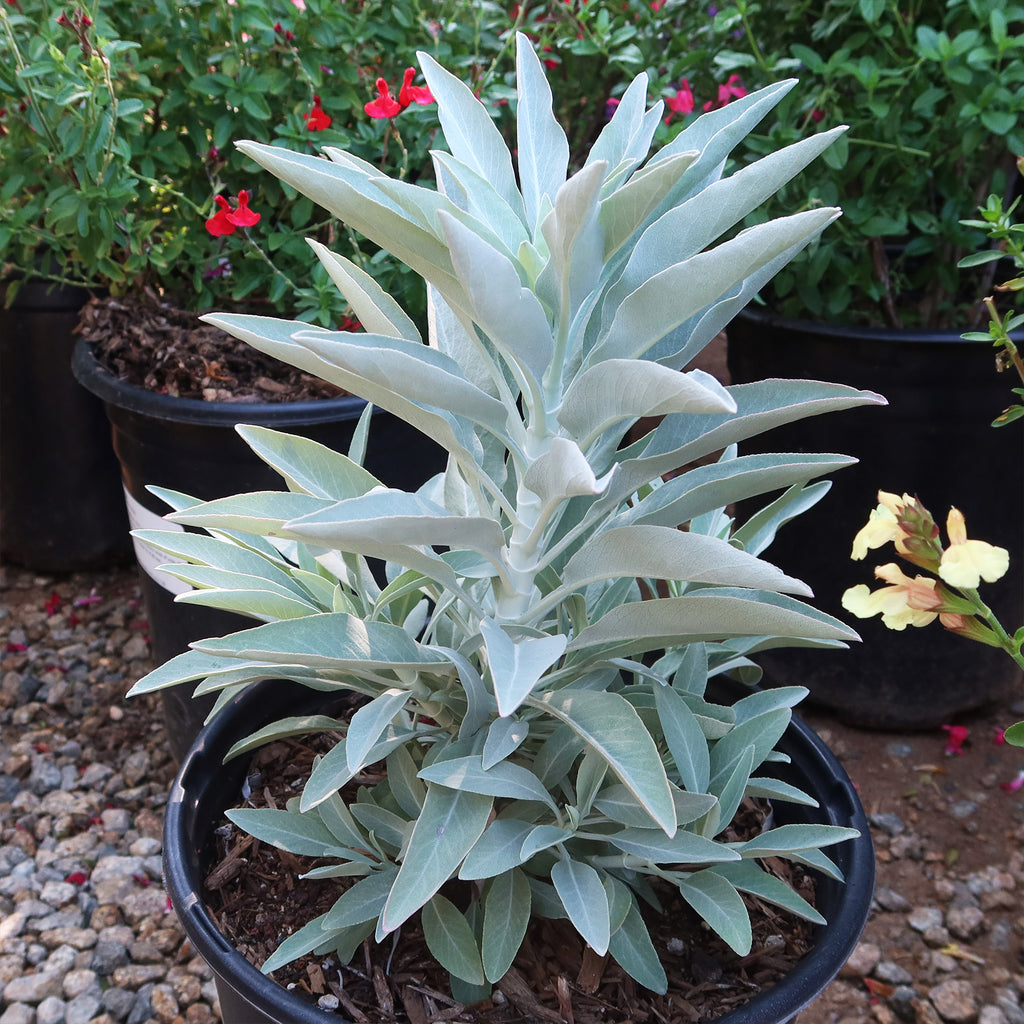
The white sage plant, known as Salvia apiana, is a fragrant evergreen shrub popular in gardens for drought-tolerant, or low-maintenance landscapes. This Salvia apiana reflects the white-to-silver appearance of its elliptical leaves.  

It has several other common names such as Sacred Sage, or bee sage. The plant’s unique scent, which is both pungent and sweet, is a defining feature, and is often grown in herb gardens, medicinal plant collections, and ornamental spaces for its aesthetic appeal and cultural value.

It is most commonly used in Native American rituals for ceremonial smudging and cleansing. White sage is often bundled into smudge sticks for these rituals, which are deeply rooted in Indigenous practices.

This California white sage is renowned for its historical and cultural significance. The only region where white sage naturally occurs are Southern California and Northern Baja.  It holds significant cultural value for the Indigenous communities in these areas.

The White Sage typically can grow up to 5 feet tall and wide.

The silvery-white foliage gives the plant its characteristic look, with leaves that are slightly furry to the touch, adding a soft texture to the landscape.

Its upright, woody stems support this compact structure, making it ideal for borders, drought-tolerant gardens, focal points for water-wise gardens, or as a specimen plant in a xeriscape design. This sage plant is also reflective of the moon and night lighting.

The white sage plant blooms in late spring to summer, with white to pale lavender flowers. The white sage flower stalks can reach up to 6 feet in height. These delicate blooms not only enhance the plant’s ornamental value but also provide a vital food source for a variety of pollinators.  

When and How to Water Your White Sage Plant 

Native to arid regions, these white sage plants are adapted to drought conditions, so they prefer infrequent watering. When watering your sage plant, it's essential to mimic its natural habitat by allowing the soil to dry out between waterings. Overwatering can lead to root rot and other issues, so it's crucial to strike a balance. 

In the spring and summer, during the growing season, you can water your Salvia apiana more frequently, but always check the soil moisture level before watering. A good practice is to water deeply but less frequently to encourage the plant's roots to grow deeper into the soil. In contrast, during the winter months or dormant periods, reduce watering to prevent waterlogged soil, which can harm the plant. 

Observing your Salvia apiana plant for signs of wilting or drooping can also indicate when it needs water. Remember, it's better to underwater than overwater white sage plants. By understanding and meeting the watering needs of your Salvia apiana, you can help it thrive and enjoy its aromatic foliage and beautiful white flowers. 

Light Requirements – Where to Put White Sage

When grown indoors, it's crucial to place your white sage plant in a location that receives plenty of bright, indirect sunlight for at least 4-6 hours. A south-facing window is ideal for indoor Salvia apiana, as it can get the sunlight it needs without being exposed to direct harsh rays that could scorch its leaves. Rotate the plant occasionally to ensure all sides receive adequate light for even growth.

For outdoor cultivation, white sage plants thrive in full sun conditions. They require at least 6 to 8 hours of direct sunlight daily to grow vigorously and produce their aromatic leaves and flowers.

Ensure no large trees or structures shade the plant during the day. It is well-suited to arid and sunny climates, making it an excellent choice for gardens in regions with plenty of sunlight. 

By providing the right amount of light, whether indoors near a sunny window or outdoors in a full-sun location, you can help your plant flourish and maintain its health and vitality.

Remember to adjust the plant's position as needed to ensure it receives adequate sunlight for robust growth and abundant foliage.

Optimal Soil & Fertilizer Needs

White sage prefers well-draining soil with a sandy or gravelly texture, mimicking its natural arid habitat. Planting them in ordinary soil will result in compacted roots, stunted growth, and most likely root rot.  A well-drained potting mix works well for container-grown plants, ensuring excess water can easily drain away to prevent root rot. Instead, make or buy a well-draining potting mix, or ideally use our Go to soil-cactus-mix-blend-1-gal-4-qt-cacti-succulent-dirt-compost-growing-media that contains 5 natural substrates and mycorrhizae to promote the development of a strong root system that helps your plant to thrive. 

In terms of fertilization, white sage is a low-maintenance plant that doesn't require frequent feeding. A light application of a balanced fertilizer, such as a 10-10-10 formula, in the spring as new growth begins can help provide the necessary nutrients for the plant's development. Avoid over-fertilizing, as this can lead to excessive foliage growth at the expense of the plant's aromatic qualities. 

Organic fertilizers, such as compost or well-aged manure, can also be beneficial for California white sage plants. These natural fertilizers provide a slow release of nutrients that can support the plant's growth without the risk of chemical buildup in the soil. By selecting the right soil type and using a balanced fertilizer sparingly, you can help your plant thrive and maintain its unique fragrance and appearance. 

Hardiness Zone & More

When grown indoors, white sage prefers a warm and dry environment similar to its native habitat. Maintain indoor temperatures around 60-75°F during the day and slightly cooler at night. Avoid placing the plant near drafts or heating vents that can create temperature fluctuations, which may stress the plant. 

For outdoor cultivation, white sage is well-suited to regions with warm to hot climates. It is typically recommended for USDA hardiness zones 9-11, where temperatures remain above freezing throughout the year. It can tolerate temperatures down to approximately 20°F, but prolonged exposure to frost can damage the plant. In terms of humidity, it thrives in low-humidity environments, making it an excellent choice for arid or semi-arid regions where humidity levels are naturally low. 

This traditional method of drying white sage leaves helps to preserve their aroma and medicinal properties. Once the leaves are completely dry, they can be used for smudging rituals or for making herbal teas. 

Wildlife - White Sage Plant attracts the following Friendly-Pollinators

White Sage flowers are particularly loved for their ability to attract pollinators, especially native bees like the California bumblebee or carpenter bees. The abundance of nectar in its flowers serves as a food source for various pollinators, contributing to the health of the surrounding ecosystem. In addition to bees, the plant is frequently visited by hummingbirds and butterflies, adding a dynamic element to any garden. 

Butterflies
Bees
Hummingbirds
Lady Bugs
Multi Pollinators
Other Birds

Toxicity: As for toxicity, White Sage is generally non-toxic to humans, pets, and livestock. It is safe for use in herbal preparations and ceremonies, and there are no significant risks of toxicity for dogs, cats, or birds. However, as with any plant, it’s essential to ensure that pets don’t consume large quantities, as excessive ingestion of any plant material may cause minor gastrointestinal discomfort in sensitive animals.

Propagating White Sage Plant

To propagate white sage plants, you can use both seeds and stem cuttings. When propagating from Salvia apiana seeds, start by collecting mature seeds from the plant and sowing them in a well-draining soil mix in early spring. Keep the soil consistently moist but not waterlogged until the seeds germinate. For stem cuttings, take a 4-6 inch cutting from a healthy Salvia plant, remove the lower leaves, and place the cutting in a pot with a mix of perlite and peat moss. Keep the soil lightly moist and provide indirect light until roots develop. With proper care and attention, you can successfully propagate Salvia apiana plants to expand your garden or share with others. 

Key Takeaways 

  1. It is most commonly used in Native American rituals for ceremonial smudging and cleansing.
  2. White Sage (Salvia apiana) is a hardy, aromatic shrub with striking silvery foliage and fragrant leaves.
  3. Known for its cultural significance and ability to thrive in dry, arid conditions.
  4. Perfect for low-maintenance, drought-tolerant gardens.
  5. It reaches a mature size of 5 feet, with upright growth and tall spikes of pale lavender flowers.
  6. Requires full sun, well-drained soil, and minimal watering once established.
  7. Ideal for xeriscaping due to its drought tolerance.
  8. It attracts pollinators and is non-toxic, making it versatile for both ornamental and practical uses.
  9. A standout addition to your garden—order your white sage plant for sale today!
Shipping Notes
  • Free Standard Shipping on $100+ Orders to the USA.
  • Except Preorder products are shipped in 48 hours.
  • Delivery to the USA:
  1. Standard Shipping : 3-10 business days
  • If time is of the essence, please consider selecting expedited delivery for faster service.
Exchange/Return Notes
  • We offer a 30-day return/exchange service after receiving.
  • Final sale items are not eligible for returns or exchanges.
  • To process your return/exchange, please contact us at [email protected]
  • Please click here for more details>>> Return & Exchange Policy
SKU: 82604082766

Discover Niche Categories That Outsell sage succulent

Top-Converting Item to Boost Your Average Order

4.1 ★★★★★
Based on 12 reviews
Sort
Highest Rating
Newest First
Oldest First
Product Reviews
S
Verified Purchase
Sal P.
Dallas, US
★★★★★ 5
Great Execution Book!
Format: Hardcover
I just finished "Measure What Matters" by John Doerr. Such a great book full of advice for companies struggling with #execution. My favorite #quotes from this book: "Good ideas with great execution are how you make magic." @Larry Page "Ideas are easy. Execution is everything." "I view this year's failure as next year's opportunity to try it again." @Gordon Moore "Specific hard goals produce a higher level of output than vaguely worded ones." "Set goals from bottom up." "Dare to fail." "... four OKR superpowers: focus, alignment, tracking, and stretching." "Bad companies are destroyed by crisis. Good companies survive them. Great companies are improved by them." @Andy Grove "When you are tired of saying it, people are starting to hear it." Jeff Weiner "Done is better than perfect." Sheryl Sandberg "... if we try to focus on everything, we focus on nothing." "Growth costs money." "... you can only do one big thing at a time really well, and so you better know what that one is." "Doing too much too soon will definitely end in pain." "To inspire true commitment, leaders must practice what they teach" "Transparency seeds collaboration." "Having a good mission is not enough. You need a concrete objective, and to need to know how you're going to get there." "... my favorite definition of entrepreneurs: Those who do more than anyone thinks possible ... with less than anyone thinks possible." "If you set a crazy, ambitious goal and miss it, you'll still achieve something remarkable." @Larry Page "Stretch goals can be crushing if people do not believe they're achievable. That's where the art of framing comes in." "Feedback is an opinion, grounded in observations and experiences, which allows us to know what impression we make on others." Sheryl Sandberg "Feedback can be highly constructive- but only if it is specific." "Continuous recognition is a powerful driver of engagement." "... a really good company values different opinions." "... behavior defines a company more meaningfully than product lines or market share." "Vision-based leadership beats command-and-control." "People watch what you do more than what you say." "Time is the enemy of transformation." "... there was no shame in trying your hardest and failing, not when OKRs help you fail smart and fail fast." "Goal setting is more art than science."
WAS THIS REVIEW HELPFUL?YesReportShare
Reviewed in the United States on September 20, 2018
K
Verified Purchase
Kevin
Omaha, US
★★★★★ 3
helpful and moderately entertaining
Format: Kindle
Like most business books this likely could have been a long journal article, but overall still worth a quick read.
WAS THIS REVIEW HELPFUL?YesReportShare
Reviewed in the United States on March 10, 2026
D
Verified Purchase
David E.
Natrona Heights, US
★★★★★ 5
Excellent way to learn about a framework used by Andy Grove and Google. Specific examples and case studies are terrific!
Format: Hardcover
I couldn’t put this book down, so I read it in one sitting. Many business books talk about the organizational brilliance of Andy Grove's Intel, Google, disruptive startups, and high-performing charities. This one actively teaches you how to mimic their organizational brilliance. The book distinguishes itself by providing clear examples of how OKRs help organizations achieve their full potential. Primary source documents, including internal memos, show how Intel CEO Andy Grove used OKRs to rapidly respond to competitive threats. As an admirer of Google, I enjoyed learning how OKRs were used at key points in its history. When Google employed 25 people, CEO Larry Page set OKRs for every engineer. When Chrome sought to disrupt the browser market, OKRs enhanced the product team’s creativity. When YouTube sought to establish its own identity within Google, OKRs helped the team set appropriate business goals. It’s really nice that specific OKRs from Google’s history are included in the book. Some people mistakenly believe that OKRs only work for Google, and the book provides clear examples of how OKRs were successfully implemented by startups, large corporations, and non-profit organizations. Entrepreneurs will enjoy learning how fitness, education, healthcare, and food delivery startups used OKRs to find new markets and manage their expanding headcount. Fans of corporate transformations will enjoy learning how OKRs led to human resources and technology process overhauls at some of the world's largest companies. Non-profit leaders will enjoy learning how the Bill & Melinda Gates Foundation and Bono used OKRs to impact millions. All in all, I found the chapters to be short yet impactful, and arranged in a logical sequence. I particularly liked that as the book progresses, it provides clear examples of how to overcome the nuances of implementing OKRs. I felt my OKR-setting muscles getting stronger by the end of the book.
WAS THIS REVIEW HELPFUL?YesReportShare
Reviewed in the United States on April 30, 2018
I
Verified Purchase
Ian Mann
Lexington, US
★★★★★ 4
... Doerr began his career under the tutelage of the great Andy Grove
Author John Doerr began his career under the tutelage of the great Andy Grove, CEO of Intel, who transformed that company into the world's largest manufacturer of semiconductors. It was Andy Grove who turned a simple method “OKRs”, into a devastatingly effective business tool which became the lifeblood of Intel. In 1978, Intel had developed the first high-performance, 16-bit microprocessor, the 8086. Soon it was getting overtaken by Motorola’s 68000 which was easier to program. Using OKRs, Intel launched “Operation Crush” to deal with this threat. The results were fast, focused and effective. “When we smacked Motorola between the eyes,” Doerr writes, “A manager there told me, ‘I couldn’t get a plane ticket from Chicago to Arizona approved in the time you took to launch your campaign.’” Doerr left Intel to join the venture capital firm at Kleiner Perkins Caufield & Byers, and became an early investor in Google. There he managed to entrench Andy Grove’s business tool to great effect and it is acknowledged as a key contributor to Google’s success. The results have made Doerr the 105th richest man in the US. This book describes how to use this tool. John Doerr is the current evangelist for OKRs, OKR stands for Objectives and Key Results. As a strategist, I know the importance of knowing where you are going or as Yogi Berra pithily said: "If you don’t know where you’re going, you might not get there.” However, as Doerr writes, and as you and I know, “Ideas are easy. Execution is everything.” OKRs are for executing. An “objective” is simply what is to be achieved, no more and no less. Key results benchmark and monitor how we get to the objective. The difference between ‘key results’ and ‘key performance indicators’ are very different. I may really be impressed that you performed well, but your efforts are only useful if you achieved the results I need. Marissa Mayer would say of OKRs, “It’s not a key result unless it has a number.” With a number attached, OKRs are either met of not met. There is no grey area, no room for doubt. The time frame for an OKR can vary from a month to a quarter or more, but at the end of the period, they have either been met or they have not. When the objective is clear and specific, it produces far better results than when it is vaguely worded. ‘Performance excellence,’ or ‘Customer satisfaction’ are very different when expressed as ‘98% error free’, or ‘delivered within 12 hours’. Aside from Google and Intel, OKR adherents include IT firms such as AOL, Dropbox, LinkedIn, Oracle, Slack, Spotify, and Twitter. But adherents also include firms such as Anheuser-Busch, BMW, Disney, Exxon, and Samsung. The simplicity of the design of OKRs hides the complexity of implementing the method. When the OKR is formulated, it will undergo iteration – this is inevitable. And this is not the problem. The problem is the commitment of the most senior managers to the discipline that is required. Without the most senior managers' commitment this will fail, much as your previous systems have failed to produce the promised result. In a meta-analysis of seventy studies, high commitment to managing the company by objectives showed a productivity increase of 56%. Where that commitment was low, productivity increases were a mere 6%. The problem with getting results is compounded when we are employing people to think. On an assembly line, it’s easy enough to distinguish output from activity. It gets trickier when employees are paid to think. In a thinking environment, many of the benefits of OKRs are highlighted. A particular challenge for many in such an environment is separating the person from the activity. All too often, feedback becomes very personal leading many managers to avoid confronting non-performance. When the focus is on unequivocal results that can be tracked, then non-performance can move to an analytical discussion. After all, a performance management system is a tool, not a weapon. The OKR is formulated as “We will achieve a certain objective as measured by the following key results. This begins at the highest appropriate level of the organization and then all below can align their OKRs to this meta-OKR. When Bob Noyce and Andy Grove began the “Crush” project, the directive to Intel’s management level was simple and clear: “We’re going to win in 16-bit microprocessors. We’re committed to this.” This objective was given to the top one hundred people at the meeting. It was conveyed to the next level in 24 hours. Intel was close to a billion-dollar company at the time, and “it turned on a dime” - through a clear, aligned, objective and a clear required result. The “Crush” project included top management, the entire sales force, four different marketing departments, and three geographic locations—all working together as one. It was proof of Andy Groves assertion that “Bad companies are destroyed by crisis. Good companies survive them. Great companies are improved by them.” Great companies are not great because they have a great idea, but because their execution is great. There are no exceptions. Those who do not have excellent execution are an accident waiting to happen. Using OKRs, a successful organization can focus on the handful of initiatives that can make a real difference and defer the less urgent ones. The very act of formulating the objective makes communication with clarity possible. Focusing on results rather than activities allows people to adjust their activities to meet the results, rather than to slavishly following performance indicators, as the environment changes. Consider this horrifying finding: In a survey of eleven thousand senior executives and managers, a majority couldn’t name their company’s top priorities! “There are so many people working so hard and achieving so little,” Andy Grove noted. To address this issue will require commitment to making the OKR process effective, and this commitment should not be understated, which is why it has to start from the very top. If you are a leader of your business your commitment should start with a reading of John Doerr’s book, and then share it with your colleagues. My personal experience with the process is best summed up by actress Mae West’s famous statement: I never said it would be easy, I only said it would be worth it. Readability Light --+-- Serious Insights High ---+- Low Practical High +---- Low *Ian Mann of Gateways consults internationally on strategy and implementation and is the author of the recently released ‘Executive Update.’
WAS THIS REVIEW HELPFUL?YesReportShare
Reviewed in the United States on July 27, 2018
E
Verified Purchase
Elizabeth
Bozeman, US
★★★★★ 5
An incredible book that will change your perspective on life.
Format: Paperback
For a long time, I have been reading the works of great poets such as Rumi and Hafez with little knowledge of other poets of the past. However, with confidence, I can say that Kalil Gibran fits into the group of the greatest poets of all time for his wonderous style of writing that invites you into his literary magic. This book guides you along lessons that cover every aspect of life- marriage, children, friendship, etc. The lessons in this book will change your view on life's greatest challenges. Even after you finish the book, you can always come back and review a chapter that you would like to refresh on. Overall, this book is great for anyone who loves poetry and can decipher old English to uncover the beautiful message that Gibran offers to his readers.
WAS THIS REVIEW HELPFUL?YesReportShare
Reviewed in the United States on January 11, 2024

recommand products