SKU: 78719666379
anthurium warocqueanum dark form

anthurium warocqueanum dark form Anthurium Queen Warocqueanum 'Dark Narrow' – Soiled

Sale price$20.29 Regular price$22.54
Save 10%

Pay in installments of $5.63 with ShopPay, AfterPay and Klarna

Shipping Estimate
USA
  • USA
  • CAN

Ships within 48 hours · Estimated delivery Jul 16 - Jul 21

Promo Codes Available:

For Your Every Summer RSVP, with Code: SUMMER15

Description

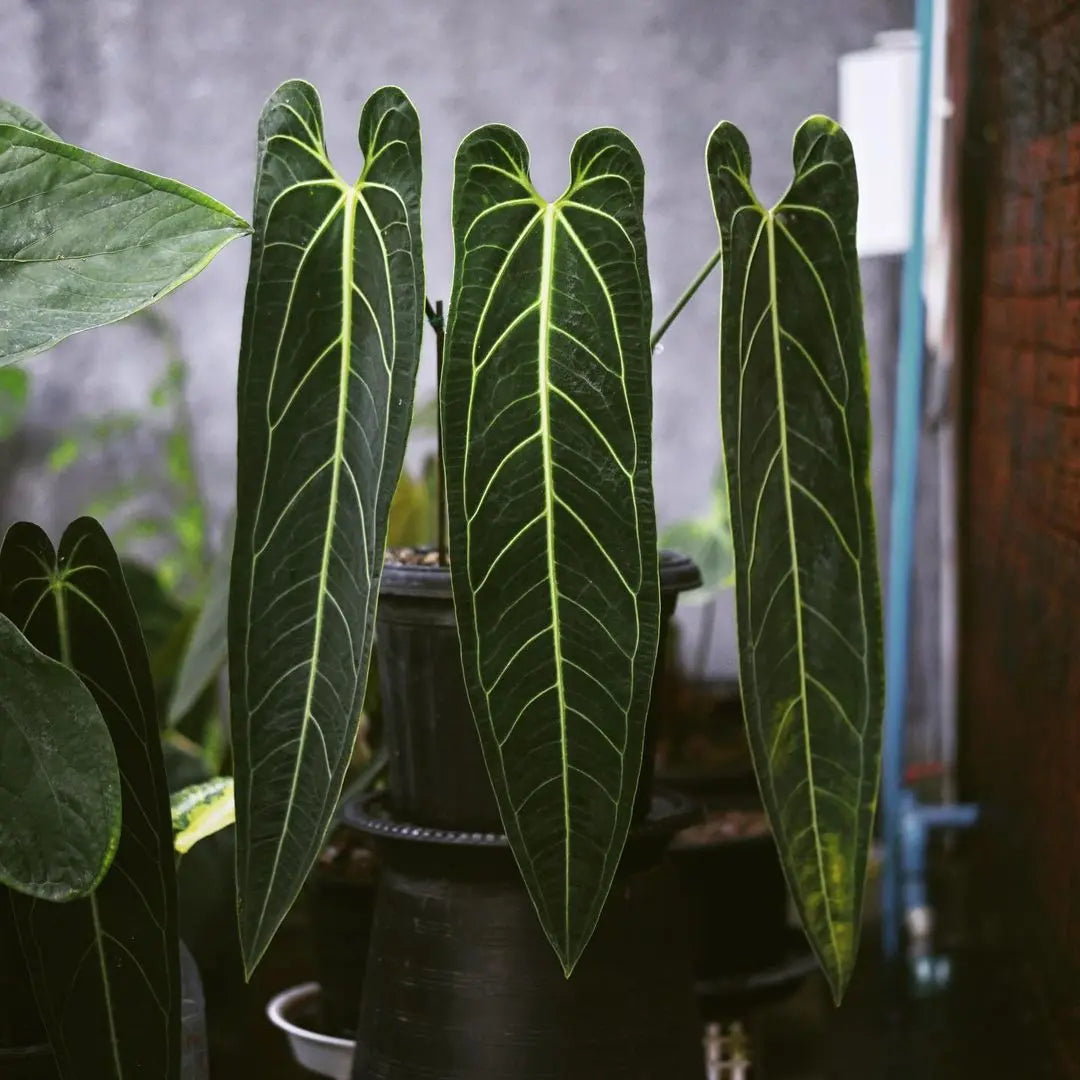
anthurium warocqueanum dark form Anthurium Queen Warocqueanum 'Dark Narrow' – SoiledIf the Anthurium veitchii is the King, then Anthurium warocqueanum is unquestionably the Queen and the 'Dark Narrow' form is the Queen at her most regal. Native to the rainforests of Colombia and named to honour Belgian industrialist and plant collector M. Warocqu, this epiphytic aroid produces pendant, velvety leaves that hang downward in long, narrow arcs reaching 90120 cm at maturity deep near black green in colour, each one traced with a fine

If the Anthurium veitchii is the King, then Anthurium warocqueanum is unquestionably the Queen — and the 'Dark Narrow' form is the Queen at her most regal. Native to the rainforests of Colombia and named to honour Belgian industrialist and plant collector M. Warocqué, this epiphytic aroid produces pendant, velvety leaves that hang downward in long, narrow arcs — reaching 90–120 cm at maturity — deep near-black-green in colour, each one traced with a fine network of silver-white veins that gleam against the dark surface like threads of light through silk. The 'Dark Narrow' designation refers to the collector-selected ecotype with the deepest, most saturated leaf colour, narrower and more elongated leaf form, and fewer but more dramatically defined veins compared to the broader, greener standard form. A member of the Cardiolonchium section — the velvet-leaved royalty of the Anthurium genus — it is one of the most coveted aroids in the world.

💡 The Leaf Count Rule — How to Know If Your Queen Is Happy Unlike most plants where the health metric is new growth, the Queen Anthurium is measured differently: a thriving plant retains all its existing leaves and adds new ones on top. A stressed plant drops one older leaf for every new one it produces — staying permanently at the same leaf count no matter how long you wait. A healthy, well-established specimen can hold 6–8 leaves simultaneously. If your plant is cycling leaves rather than accumulating them, review light, humidity, temperature, and watering simultaneously — all four factors together determine her happiness.
⚠️ Do Not Let Water Sit on the Velvety Leaves The thick, velvety surface of the leaves is beautiful but vulnerable. Water sitting on the leaf surface — from misting, overhead watering, or condensation — creates ideal conditions for bacterial leaf spot: brown circles with a yellow halo, which spread rapidly and are permanent. Never mist the leaves directly. Use a humidifier to maintain humidity, ensure strong air circulation around the foliage at all times, and water at the base only.
☀️

Light

Bright indirect light — 6–8 hours daily, but never direct sun. An east-facing window or 1–2 m from a filtered south-facing window is ideal. The 'Dark Narrow' form's deep colouration is most vivid in bright indirect light — in lower light leaves trend greener and growth slows significantly. A quality grow light at 12–14 hours is an excellent solution and produces some of the most impressive leaf development. No morning or late evening direct sun on the velvety surface — even gentle direct sun scorches the leaves.

💧

Watering

Keep the substrate barely moist — allow the top 3–4 cm to approach dryness, then water thoroughly. In chunky mix this means checking every 5–7 days. The roots need excellent airflow and will rot rapidly in saturated substrate. Use filtered or rainwater at room temperature. Never let the pot sit in standing water. Reduce slightly in winter but never allow to fully dry. This is a heavier drinker than most aroids — do not underwater.

💦

Humidity

70–85% — the single most critical factor for sustained health and long leaf development. A humidifier running nearby is strongly recommended. Crucially, pair high humidity with good air circulation — stagnant humid air is as damaging as dry air. A gentle fan on low, directed away from the plant but circulating the room, provides the airflow the leaves need. Never mist directly onto the velvety surface.

🌱

Growing Media

Chunky, extremely well-aerated epiphytic mix — 40% orchid bark, 30% perlite, 20% sphagnum moss, 10% coco coir. Or 100% sphagnum moss kept barely moist. pH 5.5–6.5. Shallow wide pot or hanging basket. The entire stem can be packed in damp sphagnum to encourage aerial root development along its length. Repot every 2 years in spring — do not disturb roots unnecessarily. Can also be grown on an epiphytic mount.

🌾

Feeding

A heavy feeder compared to most aroids — balanced liquid fertilizer at half strength every 3–4 weeks in spring and summer. An extended-release fertilizer applied at half label strength every 3 months is an excellent low-maintenance alternative. Apply only to moist substrate. Flush thoroughly every 2–3 months to prevent salt build-up. Stop feeding in winter.

🌿 Supporting Long Mature Leaves As leaves reach 60–120 cm they become heavy and may droop or kink at the petiole — which can damage the leaf permanently. Gently stake mature leaves with a soft tie to a bamboo cane or hang the plant where leaves can drape freely without obstruction. The pendant form is natural; what to prevent is the leaf bending or folding against itself under its own weight.
⚠️ Common Issues & Quick Fixes

Dropping One Leaf for Every New One — No Progress

The Queen's distress signal. Review all four factors simultaneously: light (too low?), humidity (below 70%?), temperature (below 20°C at night?), and watering (inconsistent?). Usually one is the culprit — improve all four and the cycle breaks within 1–2 leaf cycles. Do not repot during this phase; root disturbance compounds stress.

Brown Circles with Yellow Halo on Leaves

Bacterial leaf spot — caused by water sitting on the velvety leaf surface. Remove affected leaves with clean scissors. Improve air circulation immediately, stop all misting, and ensure humidity comes from a humidifier rather than direct water. Existing spots are permanent; new growth will be clean in improved conditions.

Brown Crispy Leaf Tips or Edges

Low humidity, proximity to an AC vent or fan, or underwatering. Boost humidity to 70%+, move away from drying air sources, and check that the substrate is not drying out fully between waterings. Trim existing brown tips neatly — they will not recover.

Leaves Getting Greener, Less Dark

The 'Dark Narrow' colouration deepens in bright indirect light and diminishes in low light. Move to a brighter position or add a grow light. The deep near-black-green is most vivid at the right light level — too little and the leaves trend olive-green; too much direct sun and they bleach.

Root Rot — Yellow Leaves, Soft Stem Base

Overwatering or substrate staying saturated too long. Unpot immediately, trim all black and mushy roots with clean scissors, allow to air-dry for a few hours, then repot in fresh chunky mix. Water much less going forward — the roots need to breathe between waterings.

📋 Quick Plant Profile

Botanical Name Anthurium warocqueanum T.Moore 'Dark Narrow'
Named After M. Warocqué — Belgian industrialist and plant collector
Common Name Queen Anthurium — paired with A. veitchii, the King Anthurium
Section Cardiolonchium — the velvet-leaved group; includes A. crystallinum and A. magnificum
Family Araceae
Origin Colombia; epiphytic in tropical rainforest
'Dark Narrow' Form Near-black-green colouration; narrow elongated leaves; fewer but more defined silver veins vs. standard form
Mature Leaf Length 90–120 cm; pendant, hanging downward; cardboard-thick and velvety
Health Metric Leaf count accumulates on a happy plant; cycling (losing one per new one) = distress signal
Light Bright indirect; 6–8 hours; grow light excellent; no direct sun
Watering Top 3–4 cm approaching dry; filtered water; heavier drinker than most aroids; no standing water
Humidity 70–85%; humidifier essential; strong air circulation alongside; never mist leaves directly
Temperature 20°C–30°C; cold-sensitive; nighttime minimum 18°C critical
Soil Chunky epiphytic mix or 100% sphagnum moss; pH 5.5–6.5; shallow wide pot or hanging basket
Feeding Heavy feeder — every 3–4 weeks in growing season; extended-release alternative every 3 months
Do Not Mist Water on velvety leaves causes bacterial leaf spot — use humidifier only
Ideal For Serious Collectors, Hanging Displays, Grow Tents, Bright Humid Rooms
Care Level Advanced — humidity, air circulation, and consistent warmth are the three pillars
Shipping Notes
  • Free Standard Shipping on $100+ Orders to the USA.
  • Except Preorder products are shipped in 48 hours.
  • Delivery to the USA:
  1. Standard Shipping : 3-10 business days
  • If time is of the essence, please consider selecting expedited delivery for faster service.
Exchange/Return Notes
  • We offer a 30-day return/exchange service after receiving.
  • Final sale items are not eligible for returns or exchanges.
  • To process your return/exchange, please contact us at [email protected]
  • Please click here for more details>>> Return & Exchange Policy
SKU: 78719666379

Discover Niche Categories That Outsell anthurium warocqueanum dark form

Top-Converting Item to Boost Your Average Order

4.9 ★★★★★
Based on 25 reviews
Sort
Highest Rating
Newest First
Oldest First
Product Reviews
M
Verified Purchase
Mary Bollinger
Louisville, US
★★★★★ 5
Fun read
Format: Hardcover
My daughter loves these books!
WAS THIS REVIEW HELPFUL?YesReportShare
Reviewed in the United States on January 24, 2026
S
Verified Purchase
Shava Nerad
Lowell, US
★★★★★ 5
You can get this online free, but I bought it. Let Fanon turn your brain inside out.
I actually like the idea of supporting a press that is publishing Fanon. When I was growing up with my dad working with the SCLC and Dr. Martin Luther King, Jr., as part of the night security crew for the summer marches, I was probably more aware than most Americans -- certainly most Americans outside of the black community -- of how much permeability there was between the nonviolent SCLC, and the Black Panther movement, for which Fanon was a seed influence. Youth in the SNCC organization, the youth group associated with the SCLC, often went back and forth between SNCC and the Panthers as they developed their activist identity and their ideas of how justice might be achieved. The phrase "by any means necessary" used by the Panthers often scared the bejeezus out of the white community. But when I sat down with my father -- who was an adherent of formal nonviolence -- he handed me Fanon to read, and told me that it was a valid investigation as to whether violence should be considered if nonviolent means were not entertained by the state. To my dad, who was a peaceful but fiercely justice-oriented man (for those of you who know the idiom "fire of Amos" he had it), he considered that without the counterpoint of the Panthers, MLK would never have gotten a hearing in Washington DC. Just the idea that there were revolutionaries in American society looking at American "apartheid" and saying, "We are willing to take care of our own if you separate us. We see our situation as that of a post-colonial slavery society and use the model of African liberation as our model. We are willing to be peaceful if we are given justice in peace, but we do not believe that you are acting in good faith and will use whatever means necessary to see you follow your own promises of justice and see justice for our own people if you will not see that done." That was actually a step down from Fanon. That was actually optimism. But all white Americans heard out of any of that was: "...by any means necessary." They didn't think of how they were creating the circumstances that might precipitate violence. That whites had created a system that instituted violence to keep slaves, and later free blacks, contained and preserve power and privilege for the white majority. It is hard for most Americans to even realize that America -- although we became independent from England -- continued as a colonial nation and economy on our own continent and territory. That all the institutions of the repression and destruction of indigenous and imported-slave cultures that happened "over there" in countries that Europeans colonized far from home, we did at home as a break-away colony, and the Europeans who conquered America never relented, compromised, or acknowledged that colonial reality in the way that the Spanish, Dutch, Portuguese, Italian, French, and British Empires did in their colonial domains. So Fanon is someone worth reading, not only for Africans, or for African-Americans, but for any American or anyone else in the world who wants to better ponder white privilege in America and how it became so very different from colonial privilege as that faded in Africa, through the lens of this Algerian revolutionary philosopher, who so influenced our Panthers. I remain committed to nonviolence personally, but I understand intensely how MLK and Malcolm balance each other. And how that can actually lead to better peaceful solutions, in a social justice conflict where the status quo has been preserved by judicial and extrajudicial violence by a superior force. This is still relevant in puppet regimes all over the world. In client states of capitalist powers and of Russia and China. In the conflicts surrounding Israel, and the conflicts throughout the Middle East and Central Asia that are often couched in sectarian terms or sectarian vs secular terms. It is vital to understanding countries like Zimbabwe or South Africa, where the dynamics of early black leadership as colonial-wannabes are creating environments of corruption and scandal, and robbing their own people. Everyone should read Fanon. If you can't afford the book here, you can find it online free. This book, and Black Skin, White Masks, both highly recommended. If you don't like Marxist/Socialist politics, try to suspend disbelief a bit. The philosophy, sociology, and psychology is amazing.
WAS THIS REVIEW HELPFUL?YesReportShare
Reviewed in the United States on March 28, 2019
T
Verified Purchase
TH
Lowell, US
★★★★★ 5
The destruction of racism
Format: Paperback
This is a very open and candid view of racism in the early 19th century
WAS THIS REVIEW HELPFUL?YesReportShare
Reviewed in the United States on May 22, 2026
B
Verified Purchase
Benguet Bill
Pawtucket, US
★★★★★ 5
good read
Format: Paperback
classic work on imperialism
WAS THIS REVIEW HELPFUL?YesReportShare
Reviewed in the United States on January 11, 2026
A
Verified Purchase
A. Kassahun
Whiting, US
★★★★★ 5
Must read book on African colonial sociology and politics
Fanon describes the character of (European) colonialists, the colonised Africans (the "masses" - rural and urban, the elites, the nationalists, the tribalists) wonderfully. The book is wonderfully written - Fanon must have been a good writer. Fanon is a psychiatrist, and worked in Algeria as psychiatrist, but he many have travelled other African countries too. His book shows his deep knowledge of both African and European sociology, psychology and politics. The book is still relevant; his analysis as to what will happen after the liberation of African countries is amazingly valid. He is in a way one of the most important African (though he is born in Latin America) sociologist and political scientist. Fanon's book starts on "violence", he doesn't shy away from prescribing violence in the struggle for liberation. Some find Fanon advocating violence, but that is not the case. He puts in perspective the violence perpetrated by colonists against the resulting reaction that culminates in the violence of the colonised. His clear analysis demystifies the violence that still grips Africa. Unfortunately Fanon seems to put all European in Africa as colonists. Many cases from South Africa show that that should not be the case. But his views may be due to the brutal repression he has to witness and experience in Algeria by the French government and French citizens there.
WAS THIS REVIEW HELPFUL?YesReportShare
Reviewed in the United States on March 13, 2010

recommand products