SKU: 77338519552
tongue succulent

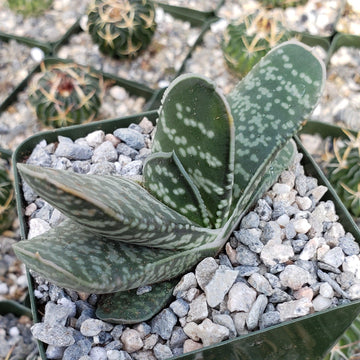
tongue succulent Gasteria bicolor liliputana

Sale price$25.27 Regular price$28.08
Save 10%

Shipping Estimate
USA
  • USA
  • CAN

Ships within 48 hours · Estimated delivery Jul 12 - Jul 17

Promo Codes Available:

For Your Every Summer RSVP, with Code: SUMMER15

Description

tongue succulent Gasteria bicolor liliputanaGasteria Bicolor Liliputana goes by the common name Dwarf Ox Tongue. With its bell shaped pinky appearance, it is a dwarf succulent with leaves that scatter & come together in rosettes. The plant has its origin in The Eastern Cape and belongs to the family of Asphodelaceae. Gasteria Bicolor Liliputana offers a dormancy of summers and it can grow up to 10 centimeters in height. Growth Rate The plant tends to grow at a really slow pace. It takes its

Gasteria Bicolor Liliputana goes by the common name “Dwarf Ox-Tongue”. With its bell-shaped pinky appearance, it is a dwarf succulent with leaves that scatter & come together in rosettes. The plant has its origin in The Eastern Cape and belongs to the family of Asphodelaceae. Gasteria Bicolor Liliputana offers a dormancy of summers and it can grow up to 10 centimeters in height.

Growth Rate

The plant tends to grow at a really slow pace. It takes its time nurturing and forming a compact appearance.

Flowering

Gasteria Liliputana is known for its reddish pink-colored flowers that bloom between the winter and the spring season.

Watering and Feeding

Water regularly in the summer and spring season, making sure the soil dries out completely before your next round. Avoid watering in winters. Feed the plant with a mineral fertilizer during the spring season.

Soil

Shallow, well-drained, and sandy soil is ideal for Gasteria Bicolor. Ensure that the soil mixture is quick draining so there is no rotting of the roots.

Hardiness

The plant grows best in summers, keeping in mind its frost tolerance of 5 to 10° C (41 to 50° F). Dwarf Gasteria succulent belongs to the hardiness zone of 10a to 11b.

Light

These houseplants need partial and indirect sunlight to grow well. While they prefer ample and bright sun exposure, keeping them away from the direct and strong sun is ideal.

Propagation

Leaf cuttings or seeds can be the ideal methods for propagation. Cross-pollinate the seeds and bury their basal part in the soil. Within a month or two, small plants will start forming.

Gasteria Bicolor Liliputana Dwarf Ox-Tongue is one of those rare species that are extensively used for both, making of traditional medicines as well as for decorative purposes, especially outdoors like the rooftops. It looks beautiful in gardens too.

Some of the information in this description has been found at desert-tropicals.com, llifle.com and cactus-art.biz

Shipping Notes
  • Free Standard Shipping on $100+ Orders to the USA.
  • Except Preorder products are shipped in 48 hours.
  • Delivery to the USA:
  1. Standard Shipping : 3-10 business days
  • If time is of the essence, please consider selecting expedited delivery for faster service.
Exchange/Return Notes
  • We offer a 30-day return/exchange service after receiving.
  • Final sale items are not eligible for returns or exchanges.
  • To process your return/exchange, please contact us at [email protected]
  • Please click here for more details>>> Return & Exchange Policy
SKU: 77338519552

Discover Niche Categories That Outsell tongue succulent

Top-Converting Item to Boost Your Average Order

4.6 ★★★★★
Based on 652 reviews
Sort
Highest Rating
Newest First
Oldest First
Product Reviews
A
Verified Purchase
Alfred H.
San Leandro, US
★★★★★ 5
A concise, readable history of European developments prior to W.W. i.
Format: Paperback
This is part of a 4 volume series on (primarily) European history covering the development of the French and Industrial revolution(s) with particular emphasis on the Belle Epoque that marked the end of nearly 100 years of peace among the European Powers. It covers a variety of topics ranging from the emergence of the working classes; the role of the middle class; industrial capitalism; nationalism; the sciences and the arts; and, even a chapter on the "New Woman". Quite encompassing in its treatment and its analysis of the a period that serves as a background to the twentieth century.
WAS THIS REVIEW HELPFUL?YesReportShare
Reviewed in the United States on August 3, 2018
J
Verified Purchase
Juan Manuel Wills
Louisville, US
★★★★★ 5
Un comentario
Format: Paperback
El mundo burgués generó desarrollos muy importantes para los habitantes de Europa Occidental particularmente; incrementó de manera importante los niveles de vida de una porción significativa de la sociedad, introdujo innovaciones claras en las ciencias, en lo educativo, en el comercio global y en el intercambio entre diferentes culturas. Mejoró la productividad, las comunicaciones, la alimentación......Pero también incorporó consigo tendencias negativas y difíciles que cambiaron para siempre la interrelación entre pares al crearse una diferencia significativa de clases, la alta, burguesa y la trabajadora y proletaria, continuó la discriminación sobre la campesina, estableció el concepto forzado de nacionalismo, transformó a los países mas desarrollados en imperios con ansias de crecimiento y de dominio de los menos preparados, se evidenció la explotación del tercer mundo, se inició el armamentismo y la instigación a la guerra que culminó con la desastrosa confrontación de 1914. El mundo, a partir de ese momento no volverá a ser igual. Todos estos conceptos, esta historia, están amenamente descritos por el autor, con un gran conocimiento de la época y con una inteligente asociación de los acontecimientos para hacer entender al lector sus grandes transformaciones e implicaciones. Como los otros tres libros de la serie, lo recomiendo ampliamente. Permite entender todo la evolución de nuestra civilización en los dos últimos siglos así como la influencia generada por los grandes imperios de la época y sus pensadores
WAS THIS REVIEW HELPFUL?YesReportShare
Reviewed in the United States on November 28, 2011
P
Verified Purchase
Peyman ADL DOUSTI HAGH
Pawtucket, US
★★★★★ 5
This is a good book to read and understand how the European nations ...
Format: Paperback
This is a good book to read and understand how the European nations deployed their armies around the world to extract natural resources from other nations. Now, we have developing and underdeveloped nations.
WAS THIS REVIEW HELPFUL?YesReportShare
Reviewed in the United States on October 1, 2017
A
Verified Purchase
Al Singh
Dallas, US
★★★★★ 4
Interesting book, dull period
Format: Paperback
As a Marxist historian, Hobsbawm sees the world at this time, as well as the modern world, as a playground for the forces of capitalism. He apologizes for taking a eurocentric approach to world history, while acknowledging that Europe largely determined the course of world events during this period. In spite of the title, there actually isn't much discussion of colonial empires; Hobsbawm seems more interested in how the Age of Empire affected the rulers more than the ruled. His Marxist sympathies are in evidence and at times make his conclusions a bit predictable, but some of his cultural critiques are quite brilliant. The chapter on the dilemmas posed by modern science is exceptional. Reading a book like this seems to me much more interesting than actually living in this period would have been.
WAS THIS REVIEW HELPFUL?YesReportShare
Reviewed in the United States on May 23, 2014
S
Verified Purchase
scilla
Belleville, US
★★★★★ 5
is incredibly informative and wonderfully written. But it is not an easy read
Format: Paperback
This series of books by Hobsbawm, The Age of Revolution, The Age of Capital, The Age of Empire, The Age of Extremes, is incredibly informative and wonderfully written. But it is not an easy read.
WAS THIS REVIEW HELPFUL?YesReportShare
Reviewed in the United States on March 9, 2016

recommand products