SKU: 74641921657
impact 2.8 sc herbicide label

impact 2.8 sc herbicide label Avenger® | AG Optima Burndown Herbicide | Concentrate

Sale price$21.87 Regular price$24.30
Save 10%

Pay in installments of $6.08 with ShopPay, AfterPay and Klarna

Shipping Estimate
USA
  • USA
  • CAN

Ships within 48 hours · Estimated delivery Jul 21 - Jul 26

Promo Codes Available:

For Your Every Summer RSVP, with Code: SUMMER15

Description

impact 2.8 sc herbicide label Avenger® | AG Optima Burndown Herbicide | ConcentrateAvenger AG Optima Burndown Herbicide Concentrate 32 oz. Item # AVGR OPTC32OZ 12 View SDS Avenger AG Optima is an excellent botanical alternative to synthetic, toxic herbicides when you need to use in areas where children and pets are present. Its intended for both agricultural and non agricultural use and has a more economical dilution ratio versus competitors. Using a natural citrus oil base, this is a non selective herbicide that kills a broad

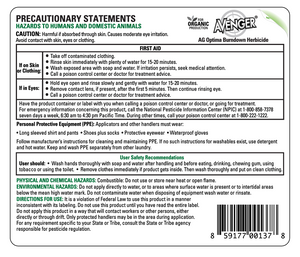
Avenger® | AG Optima Burndown Herbicide | Concentrate | 32 oz.
Item # AVGR-OPTC32OZ-12 - View SDS

Avenger® AG Optima is an excellent botanical alternative to synthetic, toxic herbicides when you need to use in areas where children and pets are present. It’s intended for both agricultural and non-agricultural use and has a more economical dilution ratio versus competitors.  Using a natural citrus oil base, this is a non-selective herbicide that kills a broad spectrum of weeds and unwanted grasses naturally and quickly. Its main ingredient is d-Limonene and it is for use in organic production around both food crop and non-crop areas. Always follow label directions.

  • Environment: Outdoors, Crops, Orchards & Vineyards, Nursery
  • Active Ingredients: d-Limonene (citrus oil)
  • Shelf Life: 2 years from manufacture date
  • Toxicity: No toxicity known
  • Certifications: EPA, USDA NOP
  • Storage: Store in original container

 How to Use: 

Mix this product in clean water and apply to the foliage of vegetation to be controlled. Spray until weeds are thoroughly wet. Because the underside of the weed leaf may be more susceptible, side sprays are recommended.

Environmental Conditions:

Avenger® AG Optima is effective over a wide range of environmental conditions. Cool weather may slow the activity of the product. For best results, spray when ambient high temperatures are expected above 50°F and lows above freezing. On cooler days, spray during the warm part of the day. Allow heavy dew to evaporate prior to Avenger® AG Optima applications. Do not apply if windy conditions exist or rain is expected within 2 hours.

Mixing of Avenger® AG Optima:

 Fill the spray tank ½ full with clean water. Add Avenger® AG Optima while agitating. Then fill remainder with water.

Tank Mixing of Avenger® AG Optima:

 Fill the spray tank ½ full with clean water. Add any dry formulations and then liquid formulations to the tank. Add Avenger® AG Optima while agitating. Then fill remainder with water.

 Restrictions:

 Do NOT exceed 5 gallons of Avenger® AG Optima (20.4 lbs. d-limonene) per acre per application. Do NOT exceed a total of 16 gallons of Avenger® AG Optima (65.1 lbs. d-limonene; Table 1) per acre per year. Determine the final desired finished spray volume according to the appropriate dilution as describe in Table 1. Irrigation and Aerial

Applications: Do not apply this product through any type of irrigation system or by aerial application.

 Spray Drift Management:

 Follow directions for minimizing spray drift. Do not allow the herbicide solution to contact desirable vegetation as small amounts can cause severe damage to crops and other desirable plants. AVOID CONTACT WITH CROP – Intentional or accidental contact (including drift) of Avenger® AG Optima with the crop may result in severe damage or loss of the crop.

 Application Rate:

Four types of applications are described below: Broadcast, Banded, Spot and Pre-Harvest Desiccation. Mixing volumes for two dilution rates are found in Table 1. Apply Avenger® AG Optima at a 7-10% mixture depending on the size of the weeds. For smaller, young, actively growing weeds and grasses, apply the lower 7% mixture. For controlling larger, tough to kill weeds, use the higher 10% mixture. Use the lowest mixture whenever possible to control weeds and grass.

  • Broadcast Applications: Broadcast treatments are used for burndown of unwanted weeds and grass across a field or a plot or apply to burndown winter foliage. Apply Avenger® AG Optima at pre-emergence or at planting. Applications must be made before seedling emergence to avoid severe injury. Allow at least 2 days between application and transplanting. Spray until weeds and grass are thoroughly wet.
  • Banded Applications: Control or suppression of emerged weeds and grasses in row middles and between vines and trees. Apply Avenger® AG Optima at a 7-10% mixture depending on the size of the weeds. Only use the 10% mixture when absolutely necessary to control difficult weeds. Apply by directing spray between the rows and using hooded sprayers to prevent spray contact with crop plants. Keep hoods adjusted to ensure adequate contact with weeds and grass while shielding the crop from the herbicide. To minimize drift, do not use nozzles or nozzle configurations that produce fine droplets (mist).
  • Spot Applications: In cool situations or for tough to kill weeds, a more concentrated spray of d-limonene may be needed. In such situations, a 10% mixture of Avenger® AG Optima (1:10 mixture) may be used up to one (1) week before harvest (see Table 1).
  • Pre-Harvest Desiccation of Vegetable Vines: Apply Avenger® AG Optima at a 7 or 10% mixture to aid in the desiccation of vegetable vines prior to harvest operations. A second application may be necessary to obtain sufficient desiccation.

Table 1. Mixing Directions of Avenger® AG Optima

Desired Spray volume (gallons)

7%

10%

1

9 fl. Oz

13 fl. Oz

60

4.2 gal

6 gal

100

7 gal

10 gal

160

11.2 gal

16 gal

228

16 gal

N/A

Shipping Notes
  • Free Standard Shipping on $100+ Orders to the USA.
  • Except Preorder products are shipped in 48 hours.
  • Delivery to the USA:
  1. Standard Shipping : 3-10 business days
  • If time is of the essence, please consider selecting expedited delivery for faster service.
Exchange/Return Notes
  • We offer a 30-day return/exchange service after receiving.
  • Final sale items are not eligible for returns or exchanges.
  • To process your return/exchange, please contact us at [email protected]
  • Please click here for more details>>> Return & Exchange Policy
SKU: 74641921657

Discover Niche Categories That Outsell impact 2.8 sc herbicide label

Top-Converting Item to Boost Your Average Order

4.2 ★★★★★
Based on 12 reviews
Sort
Highest Rating
Newest First
Oldest First
Product Reviews
K
Verified Purchase
Kathy Sund prescher
West Palm Beach, US
★★★★★ 4
For those that really Want to know!
Format: Paperback
I chose this rating because of the excellence of content. This author has chosen to give us, those who are truly seeking answers to difficult questions, the possibilities in finding closure or agreement with the very difficult task of merging Science, and all it entails, with our faith. I always feel pulled both ways with ther being no logical way to blend the two, I then felt I must have to give up one for the other but could not do so. This book has helped me begin the journey of understanding what I've always known to be true but could not put together. They do work. There are logical explanations for the seeming opposites of scripture and science. It's a Very important read. For years I have wished C.S. Lewis was still alive. He i have turned to for so many things. But with so many advances since his death, I have needed new thoughts as like minded as he . There are more Lewises out there!!
WAS THIS REVIEW HELPFUL?YesReportShare
Reviewed in the United States on January 24, 2013
M
Verified Purchase
michaelshive
New York, US
★★★★★ 3
Thought-provoking but misses its "target audience"
Format: Paperback
First, the good. This is a thought-provoking book that takes complex subject matter and makes it very easy to understand. In "The Evolution of Adam" Dr. Enns does an excellent job on many fronts - most notably giving a brief overview of the history of biblical criticism and its importance to the evolution debate. His ability to distill ideas down to the core was impressive. If I had to recommend to someone 50 pages on biblical criticism I might tell them to read the first portion of this book. However, as I read the book I kept wondering how the path he was taking would allow him to argue for an Evangelical perspective (as he says in the introduction). In short, he does not. Not even close. Dr. Enns must not know his target audience very well if he thinks that this book is targeted for Evangelicals. Virtually none of the positions that he espouses in this book are even close to what an Evangelical Christian would be comfortable defending. He has little regard for any historicity behind any of the biblical accounts and frequently tosses out the phrase "most scholars agree" as a trump card. He does a good job of helping understand the culture and history that surrounded the biblical accounts yet in the end the reader is left wondering where story and history actually meet or if possibly the whole thing was simply conjured up for political reasons. In the end, I think the question the reader is left with is "does it matter if anything in the Bible ACTUALLY happened?". How you answer that may well determine how much you enjoy this book.
WAS THIS REVIEW HELPFUL?YesReportShare
Reviewed in the United States on January 24, 2012
J
Verified Purchase
J. Thomas Campbell
Port Orchard, US
★★★★★ 5
Peter Enns "Upends" Tradition!
Format: Paperback
One cannot but deeply admire what Peter Enns has managed to produce within the span of less than 150 pages - not counting his endnotes. Kudos as well for his penetrating exegetical insights...to say nothing as regards his courage: few conservative evangelicals (and even fewer fundamentalists) will find the title "The Evolution of Adam" something that warms the heart. And yet what Enns has produced here not only is revolutionary (in a very real sense - see below) but may well prove to be one of the more controversial books on the science/theology debate of recent years. Why so? Primarily because (according to Enns - Part Two of his book) Paul's creative use (in Romans) of the Adam and Eve story in Genesis was primarily for apologetic purposes...a matter that will be discussed in greater detail below. But we begin with Part One. Essentially Part One (four chapters) represents Enns' understanding of the crucial importance Ancient Near Eastern influences exerted upon the biblical writers - the writer/s of the Genesis creation account in particular. Enns (correctly in my view)hammers this point repeatedly for the reader to consider - i.e., the bible (the whole of it) was not written in a cultural vacuum unsullied by the surrounding culture/s of pagan religious thought, whether ancient Sumerian, Babylonian, or Greco-Roman. Indeed, to do otherwise would have been an impossibility - somewhat like trying to walk along the Tibetan foothills while refusing to breathe its polluted 'pagan' air. None of us ever fully escapes the surrounding influences of culture - and the bible was never intended to do so; rather, God (if one believes in biblical inspiration...as Enns does) works fully within the conceptual categories of culture. Hence, the two creation accounts in Genesis come to us fully embedded with the concepts of Ancient Near Eastern thought patterns. Perhaps the most we can say here is that the Genesis accounts represent (in varying ways) the "demythologizing" of prior Ancient Near Eastern accounts: the God of Israel is not to be identified with any aspect (sun, moon, stars, etc.) of the created order. So far so good. There's nothing really new here that hasn't been said already by any number of conservative evangelical scholars. Part Two, however, is something entirely different. Here Enns focuses his attention on Paul's creative use of the Old Testament, seeing as how the death and resurrection of Christ has caused Paul to look at the OT writings from a radically different perspective - Romans 5:12-21 in particular. These verses have a long, long history in the Christian Church as providing the church's understanding of how sin and death entered the world of human existence: we all "inherited" sin and death in and through the disobedience of Adam back in Eden. Not so...says Enns. And here is where his account veers off in a direction entirely different from traditional orthodox belief - for, according to Enns, Paul gave a particular 'Pauline spin' to these verses that cannot be found either in the OT itself, or in the Second Temple Judaism of which Paul himself was a part. Because the death and resurrection of Christ radically altered Paul's understanding of God's redemptive work in the world he (Paul) "found" in the Adam story an ideal explanation for why it is all Jews and Gentiles alike share in the universal experience of sin and death. Therefore, Adam's disobedience in Eden is NOT the cause of the universal human experience of sin and death (per Enns); rather, the story of Adam's disobedience served Paul's apologetic purposes...quite apart from whatever the story's original intention might have been. The true "origin" of sin and death remains a mystery, for the answer is not to be found (indeed if it can be "found" at all!) in the early Genesis account of Adam and Eve. And here is where we encounter the book's controversial nature, for Enns' view represents a dramatic departure from the traditional view - a traditional view that has a rich theological heritage that passes directly through the Reformation all the way back to Augustine. As previously stated, I deeply admire and respect what Enns has done here. For the most part I think he is on the right track. Furthermore, he makes mention of the fact that recent developments in biology have strongly indicated that we cannot possibly trace all modern humans back to an original "Adam and Eve." However, we knew that already...quite apart from modern biology informing us of the fact. Anthropology and paleontology had already amassed considerable evidence that proto-humans and modern humans were spread across the earth long before any conceivable Adam and Eve could have existed. Apparently, however, modern biology speaks with a more powerful voice than anthropology; thus, we are seeing a spate of books recently on the topic of whether or not Adam and Eve were historical - Enns' book being only one of a growing number. (Due to the geneologies in early Genesis we are somewhat limited in "how far back" we can place an Adam and Eve. Placing them 25 to 40 thousand years into the past in order somehow to allow them to be the true ancestors of all modern humans does a grave injustice to the geneologies that plain and simply do not allow for this sort of radical time reversal - a matter that any number of evangelicals, who have done this sort of thing, seem unwilling to appreciate. The early Genesis geneologies, even allowing for some "gaps," serve as a control against such unwarranted time expansion. An Adam and Eve of perhaps 6 to 8 thousand BC appears to be about the limit of what we can reasonably expect). In any case, Enns has raised a thorny and difficult issue in a way previous books on the question have not, and I believe his book will contribute substantially to more open theological discussion (one hopes without heated rancor) on the debate. In the meanwhile, some final thoughts. Personally, I find it more than a tad curious that David Rohl (a somewhat controversial Egyptologist) has recently authored a book (From Eden to Exile, Greenleaf Press) in which he strongly defends an historical Adam - and yet Rohl acknowledges that he is an atheist. All this is most strange: an evangelical scholar arguing against an historical Adam while an atheistic historian argues for one! ("What fools these mortals be!") I happen to agree with much of what Enns writes. However, I think Rohl has a point- even though how he fleshes his historical Adam out is somewhat bizarre. For one thing, I'm not entirely comfortable (despite some of Enns' powerful arguments) with a geneology of Jesus in the Gospels that would include "fictious" characters who never even existed. (I might as well inform you that my great, great grandfather was Dr. Jekyll and my great, great, great grandfather was Mr. Hyde). I don't see why getting rid of an historical Adam is at all necessary. Enns himself offers the possibility that OT Israel viewed Adam as their senior partriarch - the man who originally started the "clan." I personally see great possibilities here via leaving Adam within historical existence as Israel's original, grand patriarch. The origin of sin and death via the Adam and Eve story is another matter entirely. Biology and anthropology together appear to just plain and simply rule it out - and sticking Adam back into the age of the Cro-Magnons and Neaderthals in order to "save" the doctrine is a clear instance of an act of sheer desperation. But I see no reason why we necessarily have to conclude that the "origin" of sin and death (if that's the right word even to use...which I'm not even sure about) can only be regarded as lost in the misty past. I think there is a possible way forward here, and even via an historical Adam, while at the same time embracing what Enns is talking about. I think there may well be a way to retain a personal Adam (perhaps 6 to 8 thousand BC), while also showing how sin and death had their origin in him...but with an entirely different understanding that is informed by Enns' book. Unfortunately, spelling all that out is - like "The Evolution of Adam" - a book unto itself. And Amazon commentary is not the place where one is allowed to "write a book" - quite apart from how lengthy my own commentary here has been. In the meanwhile...kudos again to Enns for his truly provocative and highly insightful contribution to the cause. His vigorous defense of the incarnation, the atonement, and the resurrection is profoundly gratifying. Because of his firm stance here no one can accuse him of being unorthodox! (NOTE: Readers interested in a critical analysis of David Rohl's "From Eden to Exile: the 5000 Year History of the People of the Bible," and why this book is of such strategic importance for Old Testament studies - scholars in particular, can easily access my recent review of this book (titled "David Rohl: A "Maverick" in Search of History") by clicking on "See All My Reviews" directly above, or by going to the book's Amazon website. Hope you enjoy the read!
WAS THIS REVIEW HELPFUL?YesReportShare
Reviewed in the United States on January 18, 2012
L
Verified Purchase
Leslie Danner
Belleville, US
★★★★★ 5
A must-have for students and researchers
Format: Spiral-bound
I use this all the time. The Concise Guide to APA Style (7th Edition) is incredibly helpful, easy to navigate, and much less overwhelming than flipping through the full manual. Great quick reference for papers, citations, and formatting.
WAS THIS REVIEW HELPFUL?YesReportShare
Reviewed in the United States on May 16, 2026
K
Verified Purchase
Kapplez
Fort Morgan, US
★★★★★ 5
Perfect for learning APA format
Format: Spiral-bound
If you are one learning how to write, cite and use references in APA format this is the perfect book for you. It literally breaks down everything for you and has examples of what to do. It has an example essay if you need something to reference as well. I'd recommend this book to anyone that has a strict professor or that is learning how to write APA.
WAS THIS REVIEW HELPFUL?YesReportShare
Reviewed in the United States on February 15, 2026

recommand products