SKU: 74437358779
bush succulent

bush succulent Shop 'Elephant bush - Portulacaria afra' Care and Info

Sale price$20.83 Regular price$23.14
Save 10%

Pay in installments of $5.79 with ShopPay, AfterPay and Klarna

Shipping Estimate
USA
  • USA
  • CAN

Ships within 48 hours · Estimated delivery Jul 21 - Jul 26

Promo Codes Available:

For Your Every Summer RSVP, with Code: SUMMER15

Description

bush succulent Shop 'Elephant bush - Portulacaria afra' Care and InfoIntroducing the Elephant Bush, also known as Portulacaria afra, which is a fascinating and popular succulent garden plant native to South Africa. It belongs to the Portulacaceae family and is known for its unique appearance and easy care requirements. The elephant bush succulent gets its name from its resemblance to the foliage of an elephant's trunk. It is also commonly referred to as the dwarf jade plant, small leaf jade, miniature jade, elephant

Introducing the Elephant Bush, also known as Portulacaria afra, which is a fascinating and popular succulent garden plant native to South Africa. It belongs to the Portulacaceae family and is known for its unique appearance and easy-care requirements.

The elephant bush succulent gets its name from its resemblance to the foliage of an elephant's trunk. It is also commonly referred to as the dwarf jade plant, small leaf jade, miniature jade, elephant food, or the Spekboom. The name "Dwarf Jade Plant" comes from its small, jade-like leaves, while "Spekboom" is an Afrikaans term meaning "bacon tree" due to the plant's edible leaves that reportedly taste like bacon.


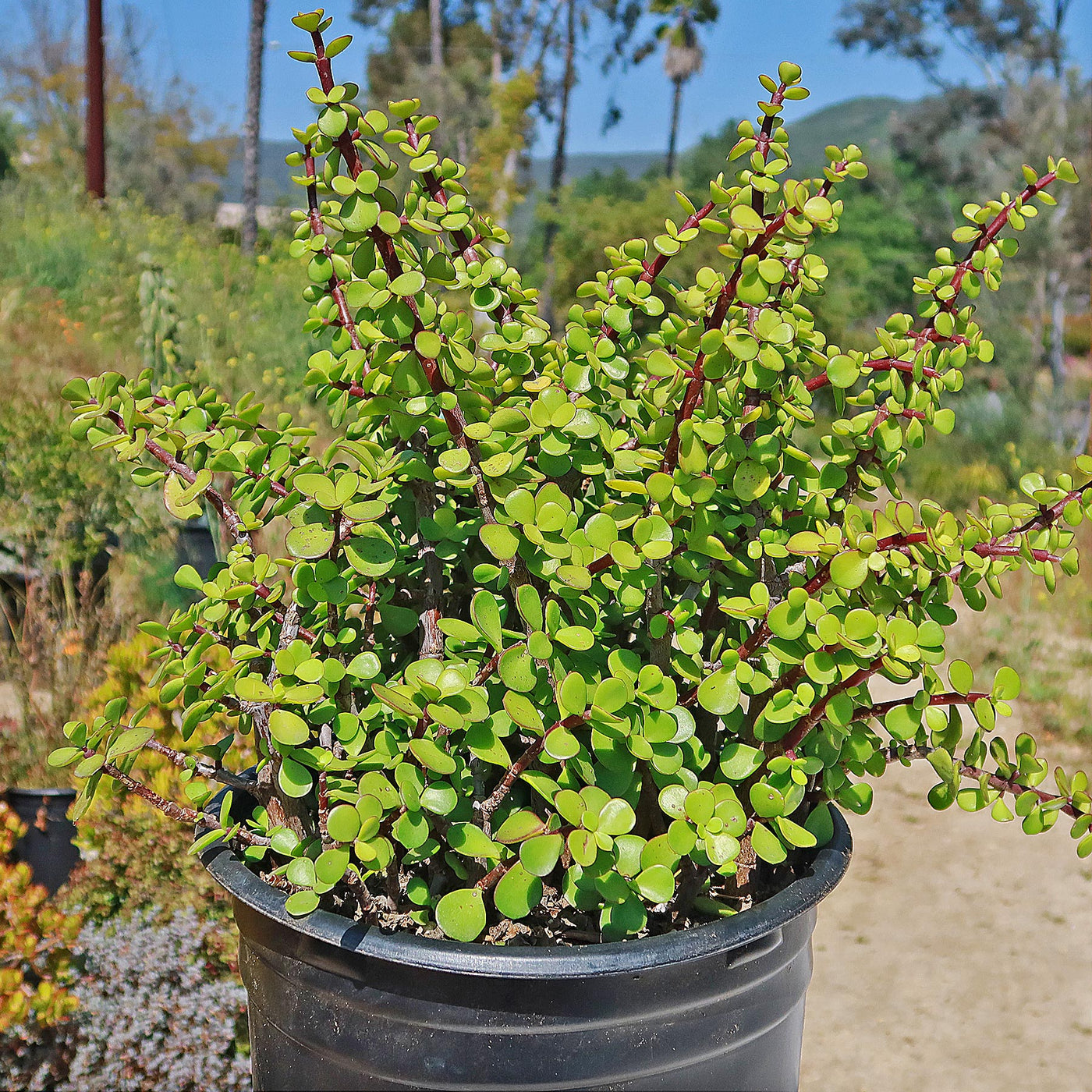
The elephant bush plant features small, round, and fleshy pale green leaves that store water, allowing your elephant bush plant to withstand drought conditions. 

The trailing stems of the elephant bush plants are thick and red-hued, which gives them a unique and appealing appearance in hanging baskets.

When grown as a houseplant, the elephant bush typically reaches a height of 1 to 3 feet.

However, if planted outdoors in its native habitat, your Portulacaria afra can grow much larger, reaching heights of up to 20 feet. The elephant bush makes for an excellent bonsai due to its unique growth pattern and ability to withstand pruning. Its thick, fleshy leaves and sturdy branches give it a robust appearance, making it an ideal succulent for shaping into intricate bonsai designs. 

The elephant bush flowers are small, star-shaped, and usually a light pink or lavender color. While the flowers are not the main attraction of this elephant bush succulent, they can add a touch of beauty when they bloom during the spring to late summer.

The elephant bush Portulacaria afra comes in various varieties, including a slow-growing variegated form Portulacaria afra variegata; a trailing growth bush Portulacaria afra prostrata; and a midstripe rainbow bush Portulacaria afra medio-picta, offers a diverse range of beauty in green spaces.

When and How to Water Your Elephant Bush

Like other drought-tolerant jade plants, your elephant bush succulent prefers a watering routine that allows the soil to dry out between waterings. Overwatering can harm the elephant bush plant and cause root rot.

In the summer, during the growing season, you should water elephant bush succulents once or twice a month when the soil is dry. A good rule of thumb is to water this elephant plant when the top 1-2 inches of soil feel dry to the touch. In the winter, during the dormant period,  you probably do not need to water them at all. 

Remember, it's always better to underwater than to overwater the elephant bush plant. This resilient Portulacaria afra plant can tolerate drought conditions better than excessive moisture. So, keep an eye on the soil moisture and adjust your watering schedule accordingly.

Light Requirements - Where to Place Your Elephant Bush Plant

When growing the elephant bush indoors, it thrives in bright, indirect light. Place your elephant bush plant near a window where it can receive plenty of natural bright light, but make sure to avoid direct sunlight, especially during the hottest parts of the day.

If you notice the leaves turning yellow or getting scorched, it's a sign that the Portulacaria afra elephant bush is receiving too much direct sunlight. So, finding that sweet spot of bright, indirect light is key to keeping your elephant bush succulent plant happy indoors.

If you decide to grow your elephant bush outdoors, it loves basking in the full sun. Although partial shade in the afternoon is frequently preferred, these plants need at least six hours of strong light each day to survive.

This is true, especially in hotter climates where the plant may become stressed by the afternoon sun's intense heat.

Your succulents should not be placed in any areas that receive continuous, direct sunlight, as this could lead to burned foliage.

Remember, the elephant bush is a versatile succulent plant and can adapt to different light conditions. Just keep in mind that it prefers bright, indirect light indoors and full sun to partial shade outdoors.

Optimal Soil & Fertilizer Needs 

Elephant succulents are very airy, porous, nutrient-rich well-drained soil with a pH of 5.5- 6.5; succulents require fast-draining soil that dries completely between waterings. Your soil must have a sandy texture and a low water-holding capacity, just like desert soil.  Ideally, you want to use our specialized succulent potting mix that contains 5 natural substrates to promote the development of a strong root system that helps your African elephant bush plant to thrive.   

When it comes to fertilizing your elephant bush plant, it only needs a small amount of fertilizer applied once a year in spring. These succulents prefer a fertilizer with lower doses of NPK, with a maximum ratio of 5-10-5 that is higher in phosphorus than nitrogen.

Hardiness Zones & More 

When it comes to growing the Elephant Bush plant indoors, the Elephant Bush prefers a cozy environment with temperatures between 65°F and 75°F. It can tolerate slightly cooler temperatures, but it's best to avoid extreme cold or frost. If you notice the leaves starting to shrivel or the tips turning brown, it may be a sign that the air is too dry. You can increase humidity by placing a tray of water near the plant or using a humidifier.

If you are living in USDA zones 9-11, you can grow your Elephant Bush plant outdoors year-round. These zones have mild temperatures and are less prone to frost.  

In cooler zones, it can be kept outdoors during the summer and brought in as the temperature drops. 

Elephant Bush can handle average to slightly higher humidity levels outdoors. Just make sure to provide well-draining soil to prevent waterlogged conditions, as excessive moisture can lead to root rot.

Don't worry if your succulents become too hot; they can tolerate triple-digit temperatures in the summer and prefer constant temperatures above 70 degrees Fahrenheit. 

Wildlife - Portulacaria afra Attracts the Following Friendly Pollinators

Portulacaria afra have tiny, star-shaped flowers, which bloom in clusters, and are a magnet for friendly pollinators. Bees are particularly drawn to its nectar-rich blooms, while butterflies and other beneficial insects are also frequent visitors. In areas where it thrives outdoors, hummingbirds may be attracted to the vibrant blossoms as well. 

Butterflies
Bees
Hummingbirds
Lady Bugs
Multi Pollinators
Other Birds

According to ASPCA, the Portulacaria afra Elephant Bush is friendly to both humans and pets such as dogs and cats. This makes it a great choice for households with curious pets or small children.

How to Propagate Your Portulacaria afra

This African elephant bush is relatively easy to propagate. It can be grown from stem cuttings, which should be allowed to dry for a day or two before being planted in well-draining soil. The cuttings usually root quickly and can be grown into new, young plants.

Key Takeaways

  1. Elephant Bush (Portulacaria afra) is a fantastic succulent with small, jade-like leaves.
  2. Visually appealing and easy to care for, adaptable for both indoor and outdoor growth.
  3. Tolerates a wide range of warm temperatures, between 65°F and 75°F, and handles higher humidity levels.
  4. It can thrives in bright, indirect light. It is suitable for beginner and experienced plant enthusiasts alike.
  5. Often grown as a seasonal accent plant or houseplant.
  6. Order your Elephant Bush today and add something truly exceptional to your garden.

The Bottom Line

Overall, Portulacaria afra, or Elephant Bush, is a remarkable plant that combines beauty, resilience, and ecological value. Its succulent, jade-like leaves and sprawling growth make it a striking addition to both indoor and outdoor settings, while its ability to tolerate drought and thrive in poor soils underscores its low-maintenance appeal. This plant’s capacity to attract friendly pollinators such as bees and butterflies further enhances its value in promoting biodiversity. With minimal care—bright, indirect light, well-draining soil, occasional watering, and protection from frost—Portulacaria afra can flourish for years, serving as both a stunning decorative element and an eco-friendly choice for any garden or home.

Shipping Notes
  • Free Standard Shipping on $100+ Orders to the USA.
  • Except Preorder products are shipped in 48 hours.
  • Delivery to the USA:
  1. Standard Shipping : 3-10 business days
  • If time is of the essence, please consider selecting expedited delivery for faster service.
Exchange/Return Notes
  • We offer a 30-day return/exchange service after receiving.
  • Final sale items are not eligible for returns or exchanges.
  • To process your return/exchange, please contact us at [email protected]
  • Please click here for more details>>> Return & Exchange Policy
SKU: 74437358779

Discover Niche Categories That Outsell bush succulent

Top-Converting Item to Boost Your Average Order

4.3 ★★★★★
Based on 27 reviews
Sort
Highest Rating
Newest First
Oldest First
Product Reviews
K
Verified Purchase
Kathy Sund prescher
Lowell, US
★★★★★ 4
For those that really Want to know!
Format: Paperback
I chose this rating because of the excellence of content. This author has chosen to give us, those who are truly seeking answers to difficult questions, the possibilities in finding closure or agreement with the very difficult task of merging Science, and all it entails, with our faith. I always feel pulled both ways with ther being no logical way to blend the two, I then felt I must have to give up one for the other but could not do so. This book has helped me begin the journey of understanding what I've always known to be true but could not put together. They do work. There are logical explanations for the seeming opposites of scripture and science. It's a Very important read. For years I have wished C.S. Lewis was still alive. He i have turned to for so many things. But with so many advances since his death, I have needed new thoughts as like minded as he . There are more Lewises out there!!
WAS THIS REVIEW HELPFUL?YesReportShare
Reviewed in the United States on January 24, 2013
M
Verified Purchase
michaelshive
West Palm Beach, US
★★★★★ 3
Thought-provoking but misses its "target audience"
Format: Paperback
First, the good. This is a thought-provoking book that takes complex subject matter and makes it very easy to understand. In "The Evolution of Adam" Dr. Enns does an excellent job on many fronts - most notably giving a brief overview of the history of biblical criticism and its importance to the evolution debate. His ability to distill ideas down to the core was impressive. If I had to recommend to someone 50 pages on biblical criticism I might tell them to read the first portion of this book. However, as I read the book I kept wondering how the path he was taking would allow him to argue for an Evangelical perspective (as he says in the introduction). In short, he does not. Not even close. Dr. Enns must not know his target audience very well if he thinks that this book is targeted for Evangelicals. Virtually none of the positions that he espouses in this book are even close to what an Evangelical Christian would be comfortable defending. He has little regard for any historicity behind any of the biblical accounts and frequently tosses out the phrase "most scholars agree" as a trump card. He does a good job of helping understand the culture and history that surrounded the biblical accounts yet in the end the reader is left wondering where story and history actually meet or if possibly the whole thing was simply conjured up for political reasons. In the end, I think the question the reader is left with is "does it matter if anything in the Bible ACTUALLY happened?". How you answer that may well determine how much you enjoy this book.
WAS THIS REVIEW HELPFUL?YesReportShare
Reviewed in the United States on January 24, 2012
J
Verified Purchase
J. Thomas Campbell
Alexandria, US
★★★★★ 5
Peter Enns "Upends" Tradition!
Format: Paperback
One cannot but deeply admire what Peter Enns has managed to produce within the span of less than 150 pages - not counting his endnotes. Kudos as well for his penetrating exegetical insights...to say nothing as regards his courage: few conservative evangelicals (and even fewer fundamentalists) will find the title "The Evolution of Adam" something that warms the heart. And yet what Enns has produced here not only is revolutionary (in a very real sense - see below) but may well prove to be one of the more controversial books on the science/theology debate of recent years. Why so? Primarily because (according to Enns - Part Two of his book) Paul's creative use (in Romans) of the Adam and Eve story in Genesis was primarily for apologetic purposes...a matter that will be discussed in greater detail below. But we begin with Part One. Essentially Part One (four chapters) represents Enns' understanding of the crucial importance Ancient Near Eastern influences exerted upon the biblical writers - the writer/s of the Genesis creation account in particular. Enns (correctly in my view)hammers this point repeatedly for the reader to consider - i.e., the bible (the whole of it) was not written in a cultural vacuum unsullied by the surrounding culture/s of pagan religious thought, whether ancient Sumerian, Babylonian, or Greco-Roman. Indeed, to do otherwise would have been an impossibility - somewhat like trying to walk along the Tibetan foothills while refusing to breathe its polluted 'pagan' air. None of us ever fully escapes the surrounding influences of culture - and the bible was never intended to do so; rather, God (if one believes in biblical inspiration...as Enns does) works fully within the conceptual categories of culture. Hence, the two creation accounts in Genesis come to us fully embedded with the concepts of Ancient Near Eastern thought patterns. Perhaps the most we can say here is that the Genesis accounts represent (in varying ways) the "demythologizing" of prior Ancient Near Eastern accounts: the God of Israel is not to be identified with any aspect (sun, moon, stars, etc.) of the created order. So far so good. There's nothing really new here that hasn't been said already by any number of conservative evangelical scholars. Part Two, however, is something entirely different. Here Enns focuses his attention on Paul's creative use of the Old Testament, seeing as how the death and resurrection of Christ has caused Paul to look at the OT writings from a radically different perspective - Romans 5:12-21 in particular. These verses have a long, long history in the Christian Church as providing the church's understanding of how sin and death entered the world of human existence: we all "inherited" sin and death in and through the disobedience of Adam back in Eden. Not so...says Enns. And here is where his account veers off in a direction entirely different from traditional orthodox belief - for, according to Enns, Paul gave a particular 'Pauline spin' to these verses that cannot be found either in the OT itself, or in the Second Temple Judaism of which Paul himself was a part. Because the death and resurrection of Christ radically altered Paul's understanding of God's redemptive work in the world he (Paul) "found" in the Adam story an ideal explanation for why it is all Jews and Gentiles alike share in the universal experience of sin and death. Therefore, Adam's disobedience in Eden is NOT the cause of the universal human experience of sin and death (per Enns); rather, the story of Adam's disobedience served Paul's apologetic purposes...quite apart from whatever the story's original intention might have been. The true "origin" of sin and death remains a mystery, for the answer is not to be found (indeed if it can be "found" at all!) in the early Genesis account of Adam and Eve. And here is where we encounter the book's controversial nature, for Enns' view represents a dramatic departure from the traditional view - a traditional view that has a rich theological heritage that passes directly through the Reformation all the way back to Augustine. As previously stated, I deeply admire and respect what Enns has done here. For the most part I think he is on the right track. Furthermore, he makes mention of the fact that recent developments in biology have strongly indicated that we cannot possibly trace all modern humans back to an original "Adam and Eve." However, we knew that already...quite apart from modern biology informing us of the fact. Anthropology and paleontology had already amassed considerable evidence that proto-humans and modern humans were spread across the earth long before any conceivable Adam and Eve could have existed. Apparently, however, modern biology speaks with a more powerful voice than anthropology; thus, we are seeing a spate of books recently on the topic of whether or not Adam and Eve were historical - Enns' book being only one of a growing number. (Due to the geneologies in early Genesis we are somewhat limited in "how far back" we can place an Adam and Eve. Placing them 25 to 40 thousand years into the past in order somehow to allow them to be the true ancestors of all modern humans does a grave injustice to the geneologies that plain and simply do not allow for this sort of radical time reversal - a matter that any number of evangelicals, who have done this sort of thing, seem unwilling to appreciate. The early Genesis geneologies, even allowing for some "gaps," serve as a control against such unwarranted time expansion. An Adam and Eve of perhaps 6 to 8 thousand BC appears to be about the limit of what we can reasonably expect). In any case, Enns has raised a thorny and difficult issue in a way previous books on the question have not, and I believe his book will contribute substantially to more open theological discussion (one hopes without heated rancor) on the debate. In the meanwhile, some final thoughts. Personally, I find it more than a tad curious that David Rohl (a somewhat controversial Egyptologist) has recently authored a book (From Eden to Exile, Greenleaf Press) in which he strongly defends an historical Adam - and yet Rohl acknowledges that he is an atheist. All this is most strange: an evangelical scholar arguing against an historical Adam while an atheistic historian argues for one! ("What fools these mortals be!") I happen to agree with much of what Enns writes. However, I think Rohl has a point- even though how he fleshes his historical Adam out is somewhat bizarre. For one thing, I'm not entirely comfortable (despite some of Enns' powerful arguments) with a geneology of Jesus in the Gospels that would include "fictious" characters who never even existed. (I might as well inform you that my great, great grandfather was Dr. Jekyll and my great, great, great grandfather was Mr. Hyde). I don't see why getting rid of an historical Adam is at all necessary. Enns himself offers the possibility that OT Israel viewed Adam as their senior partriarch - the man who originally started the "clan." I personally see great possibilities here via leaving Adam within historical existence as Israel's original, grand patriarch. The origin of sin and death via the Adam and Eve story is another matter entirely. Biology and anthropology together appear to just plain and simply rule it out - and sticking Adam back into the age of the Cro-Magnons and Neaderthals in order to "save" the doctrine is a clear instance of an act of sheer desperation. But I see no reason why we necessarily have to conclude that the "origin" of sin and death (if that's the right word even to use...which I'm not even sure about) can only be regarded as lost in the misty past. I think there is a possible way forward here, and even via an historical Adam, while at the same time embracing what Enns is talking about. I think there may well be a way to retain a personal Adam (perhaps 6 to 8 thousand BC), while also showing how sin and death had their origin in him...but with an entirely different understanding that is informed by Enns' book. Unfortunately, spelling all that out is - like "The Evolution of Adam" - a book unto itself. And Amazon commentary is not the place where one is allowed to "write a book" - quite apart from how lengthy my own commentary here has been. In the meanwhile...kudos again to Enns for his truly provocative and highly insightful contribution to the cause. His vigorous defense of the incarnation, the atonement, and the resurrection is profoundly gratifying. Because of his firm stance here no one can accuse him of being unorthodox! (NOTE: Readers interested in a critical analysis of David Rohl's "From Eden to Exile: the 5000 Year History of the People of the Bible," and why this book is of such strategic importance for Old Testament studies - scholars in particular, can easily access my recent review of this book (titled "David Rohl: A "Maverick" in Search of History") by clicking on "See All My Reviews" directly above, or by going to the book's Amazon website. Hope you enjoy the read!
WAS THIS REVIEW HELPFUL?YesReportShare
Reviewed in the United States on January 18, 2012
L
Verified Purchase
Leslie Danner
Port Orchard, US
★★★★★ 5
A must-have for students and researchers
Format: Spiral-bound
I use this all the time. The Concise Guide to APA Style (7th Edition) is incredibly helpful, easy to navigate, and much less overwhelming than flipping through the full manual. Great quick reference for papers, citations, and formatting.
WAS THIS REVIEW HELPFUL?YesReportShare
Reviewed in the United States on May 16, 2026
K
Verified Purchase
Kapplez
Grantham, US
★★★★★ 5
Perfect for learning APA format
Format: Spiral-bound
If you are one learning how to write, cite and use references in APA format this is the perfect book for you. It literally breaks down everything for you and has examples of what to do. It has an example essay if you need something to reference as well. I'd recommend this book to anyone that has a strict professor or that is learning how to write APA.
WAS THIS REVIEW HELPFUL?YesReportShare
Reviewed in the United States on February 15, 2026

recommand products