SKU: 72134510668
jade plant succulent types

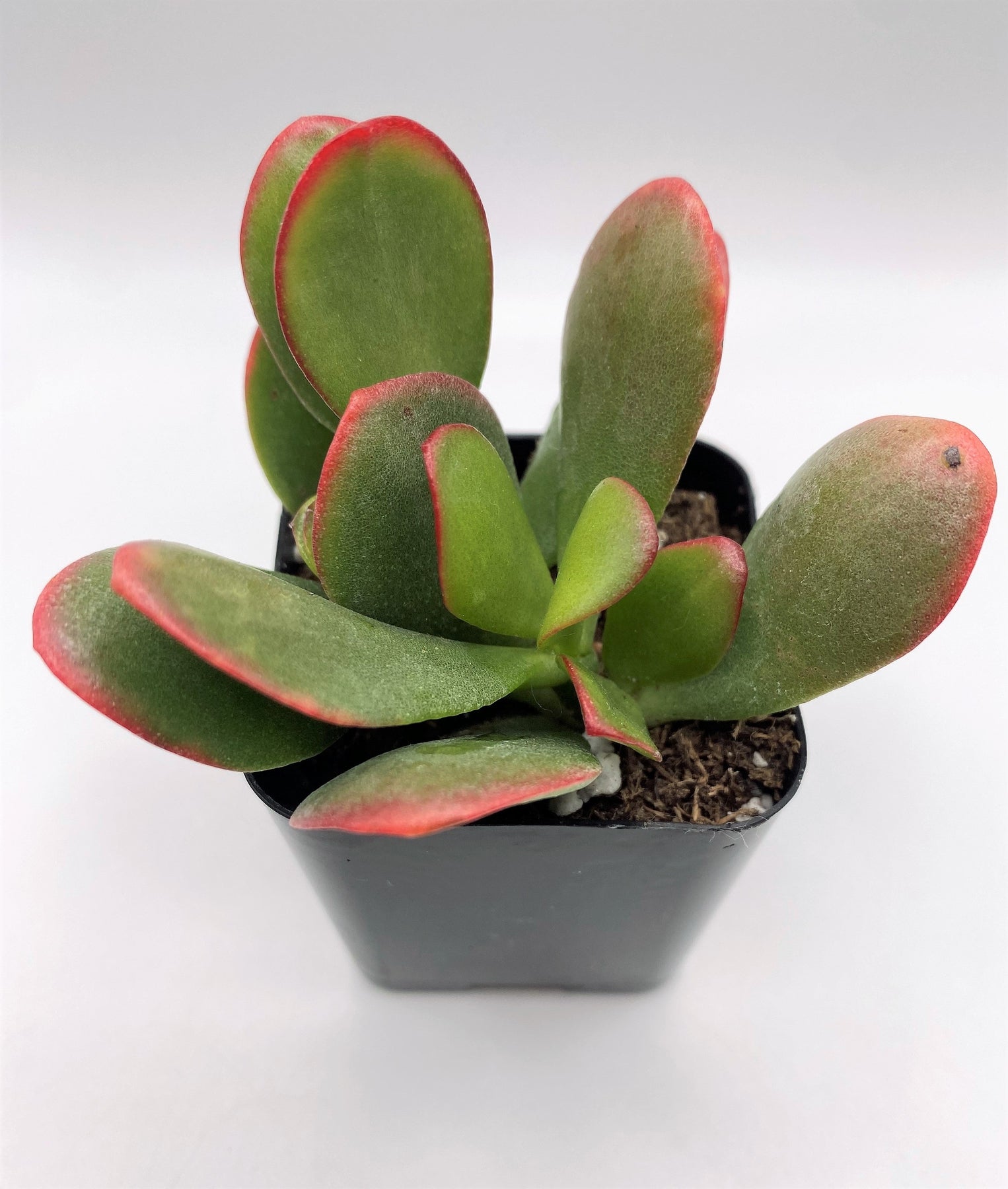
jade plant succulent types #27 Crassula Rainbow Jade

Sale price$24.03 Regular price$26.70
Save 10%

Pay in installments of $6.67 with ShopPay, AfterPay and Klarna

Shipping Estimate
USA
  • USA
  • CAN

Ships within 48 hours · Estimated delivery Jul 18 - Jul 23

Promo Codes Available:

For Your Every Summer RSVP, with Code: SUMMER15

Description

jade plant succulent types #27 Crassula Rainbow Jade"Rainbow Jade" or "Hummel's Sunset" is a cultivar of Crassula ovata, formerly C. argentea, which is known for its golden yellow leaves with bright red tips. This feature is intensified when grown in full sun. This cultivar was developed by Ed Hummel and won the 1993 Royal Horticultural Society's Award of Garden Merit. "Hummel's Sunset" is perfect for creating bonsai type houseplants or used in landscaping. The name Crassula comes from the Latin

"Rainbow Jade" or "Hummel's Sunset" is a cultivar of Crassula ovata, formerly C. argentea, which is known for its golden yellow leaves with bright red tips. This feature is intensified when grown in full sun. This cultivar was developed by Ed Hummel and won the 1993 Royal Horticultural Society's Award of Garden Merit. "Hummel's Sunset" is perfect for creating bonsai type houseplants or used in landscaping.  

The name Crassula comes from the Latin "crassus" meaning thick, which refers to the fleshy leaves and stems of the plants in this genus. Crassula contains over 200 species of succulent type plants, the majority of which come from the southern tip of Africa. This genus has a wide variety of sizes, ranging from 1" miniature succulents to 6' dense shrubs. They can grow into erect shrubs or mini-trees, or remain prostrate as groundcovers or clumps of rosettes.

Crassula prefer full sun to partial shade, however intense afternoon sun can burn foliage. Most species can be grown indoors if given a large south facing window. Propagation is generally easy  and can be done by leaf or stem cuttings, and even seed. Crassula are best planted in well draining soil, and are susceptible to root rot or fungus if overwatered. Many species go dormant when temperatures go too high or low. Some varieties of these succulents are hardy but most will not survive a hard frost. 

*We also sell Crassula Jade types in Exact 1 gallon containers and large cuttings on our website if interested!

Here's your opportunity to order exact succulent species at an awesome price!  We will continue to add new types as they become available, and we're pretty darn sure you won't find them cheaper anywhere!

We always do our best to ship the largest and healthiest succulents we have available.  But size and color may vary based on multiple factors including time of year, growing temps, length of days, and their growing seasons. Succulents generally slow down and almost stop growing during the coldest months of the year, but come spring and summer you can often see growth in just days.

If looking for exact Haworthias, Gasterias and Aloes, please see those pages specifically.

Some containers may have 1,2,3, and even 4 smaller rooted plants, this can also vary based on the species and the way they grow, vertical vs horizontal being possible factors.  Containers are basic plastic nursery stock with colors are usually orange or black, and approx. 2" tall and across the top.

Please remember these are juvenile specimens, they are nowhere near maturity, and any small imperfections will be outgrown in time.  Please see our multiple blogs and care instruction on potential soil displacement during shipping, and propagating many types of succulent leaves etc.

Unfortunately we cannot delay shipping on these exact types as our stock is always changing and what we have available today, may not be available tomorrow or next week/month.
Shipping Notes
  • Free Standard Shipping on $100+ Orders to the USA.
  • Except Preorder products are shipped in 48 hours.
  • Delivery to the USA:
  1. Standard Shipping : 3-10 business days
  • If time is of the essence, please consider selecting expedited delivery for faster service.
Exchange/Return Notes
  • We offer a 30-day return/exchange service after receiving.
  • Final sale items are not eligible for returns or exchanges.
  • To process your return/exchange, please contact us at [email protected]
  • Please click here for more details>>> Return & Exchange Policy
SKU: 72134510668

Discover Niche Categories That Outsell jade plant succulent types

Top-Converting Item to Boost Your Average Order

4.1 ★★★★★
Based on 5 reviews
Sort
Highest Rating
Newest First
Oldest First
Product Reviews
J
Verified Purchase
John Moore
Omaha, US
★★★★★ 5
Guided tour through a difficult work
Format: Paperback
For the non-expert reader of Plato, this is a very good text for working through Timaeus. Actually, it may be useful to expert readers as well, but I wouldn't know about that, being firmly situated in the non-expert camp. Though some scholars may take exception to certain parts of Cornford's translation and interpretation, for those of us trying to get through it for the first time and on our own, this is still an exceptional guide. By the way, for an alternative translation and interpretation, the reader may want to check out Kalkavage's translation (Focus Philosophical Library), it is very good (I would rate it 5 stars also) and has some extremely helpful appendices for understanding references to music, astronomy, and geometry.
WAS THIS REVIEW HELPFUL?YesReportShare
Reviewed in the United States on January 6, 2013
R
Verified Purchase
Reviewer from San Ramon
Natrona Heights, US
★★★★★ 5
Cornford's Plato Cosmology/Timaeus
Format: Paperback
This is an excellent and invaluable reference book for Plato's Timaeus. If you are reading Timaeus you MUST have this book. It contains line-by-line commentary, and also, most valuable, some very helpful illustrations (example: illustration of the human body as Timaeus explained it). I would, however, balance this book with other books that attempt to place Timaeus within the rest of Plato's works. I recommend, for example, Peter Kalkavage's Timaeus. There, he attempts to link Timaeus and Republic.
WAS THIS REVIEW HELPFUL?YesReportShare
Reviewed in the United States on February 8, 2011
W
Verified Purchase
Wilbur F. Pierce
Birmingham, US
★★★★★ 5
An Excellent Choice
Format: Paperback
Excellent introduction, notes and translation.
WAS THIS REVIEW HELPFUL?YesReportShare
Reviewed in the United States on June 8, 2017
D
Verified Purchase
David Lemberg
Charlottesville, US
★★★★★ 5
Five Stars
Format: Paperback
Professor Cornford's translation with running commentary is definitive.
WAS THIS REVIEW HELPFUL?YesReportShare
Reviewed in the United States on November 5, 2015
J
Jordan Bell
Phoenix, US
★★★★★ 5
Plato's dialogue about the physical world
Format: Paperback
The two biggest topics in the Timaeus are astronomy and the elements of bodies, which are constructed using triangles and the tetrahedron, octahedron, icosahedron, and cube. I would like to see a translation of the Timaeus that uses it as a way to introduce all the astronomy that appears in the dialogue. Introducing the astronomy does not mean just talking in words about spheres or the zodiac or the ecliptic, but actually explaining how these were used by astronomers. Cornford has much to say, but to someone who has not learned any Greek astronomy his commentary will be opaque and hard to use. I didn't know the astronomy well enough to readily understand Cornford's explanations. I plan to learn more classical Greek astronomy, perhaps using Evans' , and then read Waterfield's translation of the Timaeus . Before reading this you should have read the Republic and know some classical Greek natural philosophy, mathematics, and astronomy. Although Cornford's commentary makes the dialogue staccato, I am glad for it because I wouldn't otherwise have understood much of what Plato says. The Timaeus and the Parmenides are the two dialogues of Plato that one needs commentary to understand; the Parmenides demands the commentary because so much of what is happening depends on the original language, and the Timaeus demands the commentary because of all the things the reader is supposed to be familiar with. The following is a list of topics I kept while reading the dialogue: theory of Forms 27d-28a, 51a-52a; harmonics 35b-36b; time 37c-38e, 39b-e; vision 45b-46c, 67c-68d; space 52b; surfaces 53c; weight 62d-63e; sound 67a-67c; physiology 70c-79e, 80d-86a; antiperistasis 79e-80c.
WAS THIS REVIEW HELPFUL?YesReportShare
Reviewed in the United States on December 12, 2015

recommand products