SKU: 71611580197
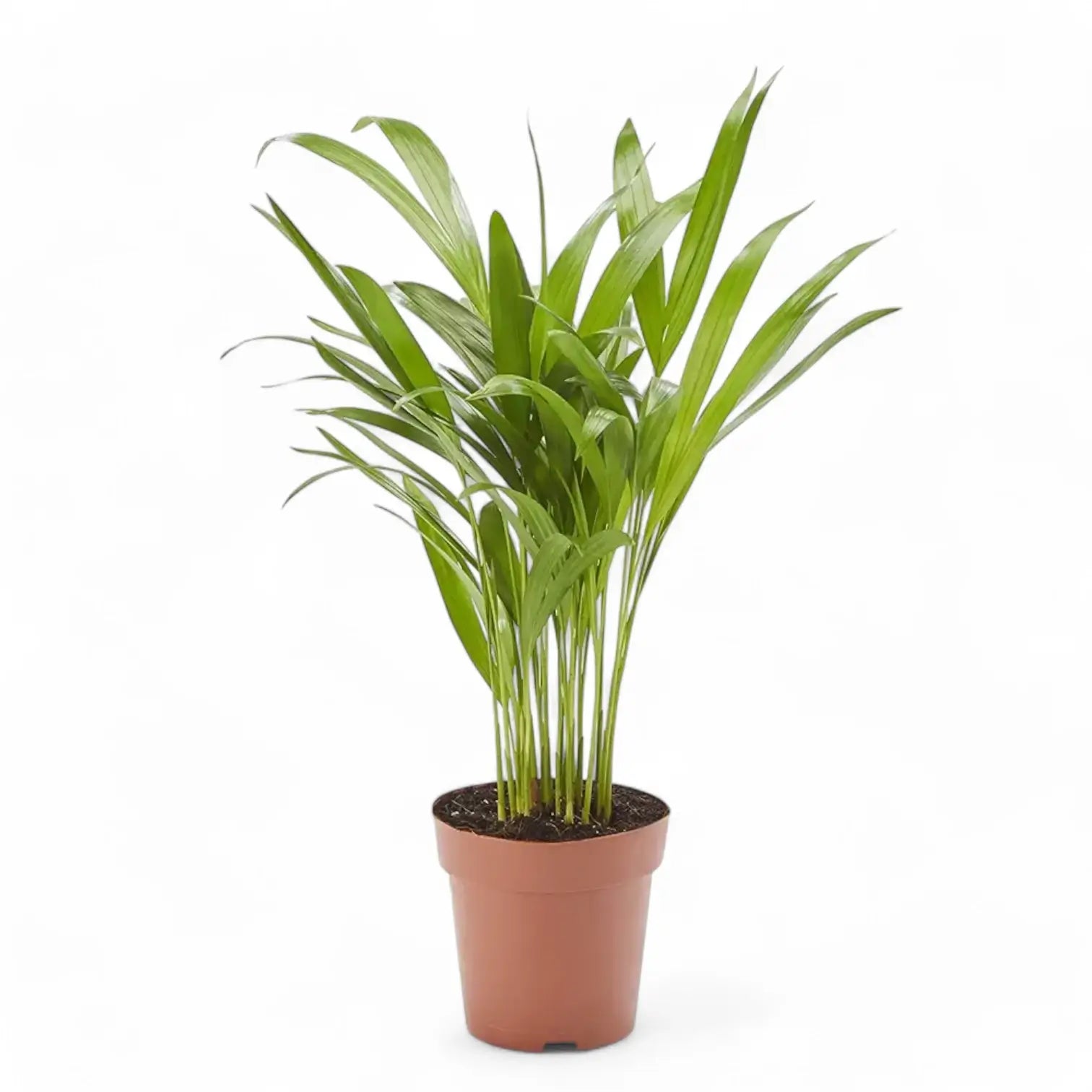
areca palm yellow stem

areca palm yellow stem Chrysalidocarpus lutescens

Sale price$23.02 Regular price$25.58
Save 10%

Pay in installments of $6.39 with ShopPay, AfterPay and Klarna

Shipping Estimate
USA
  • USA
  • CAN

Ships within 48 hours · Estimated delivery Jul 18 - Jul 23

Promo Codes Available:

For Your Every Summer RSVP, with Code: SUMMER15

Description

areca palm yellow stem Chrysalidocarpus lutescensChrysalidocarpus lutescens Chrysalidocarpus lutescens, still widely known under the synonym Dypsis lutescens, is a clustering palm with upright cane like stems and long, arching feather leaves. Several stems rise from the base, creating a soft, fountain shaped crown with yellow green petioles and narrow leaflets arranged along each frond. Indoors, this palm develops slowly into a broad, leafy specimen with a layered vertical outline. As the stems

Chrysalidocarpus lutescens

Chrysalidocarpus lutescens, still widely known under the synonym Dypsis lutescens, is a clustering palm with upright cane-like stems and long, arching feather leaves. Several stems rise from the base, creating a soft, fountain-shaped crown with yellow-green petioles and narrow leaflets arranged along each frond.

Indoors, this palm develops slowly into a broad, leafy specimen with a layered vertical outline. As the stems mature, they become more defined, while the fronds keep the crown airy, layered, and finely textured.

Golden cane palm details

  • Golden cane palm forming grouped yellow-green stems
  • Arching pinnate fronds with many narrow green leaflets
  • Yellow-green leaf stalks and midribs give the plant its warm tone
  • Can form a sizeable indoor floor plant over time
  • Rarely flowers indoors; mature outdoor plants may produce yellow flowers and small fruits

Eastern Madagascar origin and clumping growth

Chrysalidocarpus lutescens is native to Madagascar and belongs to the palm family, Arecaceae. In habitat and tropical cultivation it can grow as a shrub-like or tree-like palm, with multiple stems forming a broad clump. Indoors, its final shape depends on light, root space, and steady watering.

Each stem grows from a central crown. Fully brown fronds can be removed at the base, while green fronds should stay in place so the palm retains enough leaf area for new fronds. New fronds emerge from the growing points and gradually open into the palm’s feathered canopy.

Because this palm forms a clump, uneven growth is normal: some canes may sit lower while newer stems fill the centre. Turn the pot occasionally so the crown develops evenly, and keep the leaf bases open enough for inspection because pests often settle where the fronds meet the stems.

Keeping Chrysalidocarpus lutescens evenly leafy

  • Light: Use a bright, indirect position. Gentle morning or late afternoon sun suits acclimated plants, while strong midday sun behind glass can scorch fronds.
  • Watering: Keep the substrate evenly lightly moist during active growth, then let the upper layer dry before watering again. Avoid cold, saturated soil.
  • Substrate: Use an airy, well-drained palm or houseplant mix with mineral drainage material to keep the root zone open.
  • Temperature: Keep the palm warm, ideally above 18 °C, and avoid cold draughts or temperatures below about 15 °C.
  • Humidity: Average to moderate indoor humidity is workable, although very dry heated air can crisp leaflet tips. Use a humidifier where winter air becomes persistently dry.
  • Feeding: Use a low-strength fertiliser in spring and summer. Too much feed can show as yellowing or salt stress on leaflet tips.
  • Repotting: Move up one pot size when roots have filled the container, often after 2–3 years. Avoid oversized pots that keep the mix wet for too long.
  • Pruning: Remove only fully spent fronds. Cutting green fronds reduces the palm’s active leaf area.
  • Leaf cleaning: Wipe dusty leaflets gently or rinse the fronds with lukewarm water so the narrow leaflets can receive light evenly.

Frond, cane and pest checks

  • Brown tips: Often linked to dry air, irregular watering, salt build-up, or old leaf age. Check moisture pattern and flush the substrate if fertiliser salts have built up.
  • Yellowing fronds: Can follow overwatering, poor drainage, low light, nutrient imbalance, or natural ageing of older leaves. Check the root zone before feeding.
  • Mites or scale insects: Fine stippling, webbing, sticky residue, or bumps on stems and leaf bases need early inspection and treatment.
  • Collapsed stems: Soft bases usually point to root or crown stress from persistently wet, cool conditions.

Pet-safe palm status

ASPCA treats the areca palm, Chrysalidocarpus lutescens, as non-toxic to cats and dogs. Sensitive pets may still get mild stomach upset from chewing the fronds.

Accepted name and synonym note

Chrysalidocarpus lutescens H.Wendl. is the accepted botanical name for this Arecaceae species. Dypsis lutescens remains a common synonym in horticulture. The genus name refers to chrysalis-like fruits, while lutescens means turning yellow, matching the yellow tones in the flowers, stems, and leaflet midribs.

Chrysalidocarpus lutescens grows into golden cane clusters with airy fronds and a full upright palm outline.

Shipping Notes
  • Free Standard Shipping on $100+ Orders to the USA.
  • Except Preorder products are shipped in 48 hours.
  • Delivery to the USA:
  1. Standard Shipping : 3-10 business days
  • If time is of the essence, please consider selecting expedited delivery for faster service.
Exchange/Return Notes
  • We offer a 30-day return/exchange service after receiving.
  • Final sale items are not eligible for returns or exchanges.
  • To process your return/exchange, please contact us at [email protected]
  • Please click here for more details>>> Return & Exchange Policy
SKU: 71611580197

Discover Niche Categories That Outsell areca palm yellow stem

Top-Converting Item to Boost Your Average Order

4.5 ★★★★★
Based on 22 reviews
Sort
Highest Rating
Newest First
Oldest First
Product Reviews
M
Mel
Boise, US
★★★★★ 4
Pretty good beginner book, very user friendly covers Development and Design
Format: Paperback, Format: Paperback
I enjoy learning Game Dev, but I research books because many authors promise a lot and deliver half or not at all and I have to put the book down. This book was pretty good. I appreciate the author explaining things, and remember he's writing a book for beginners. There's also a good amount of pics in the book, and I dislike a book with no pics. Also, he breaks it down very simply and explains that you're not going to learn the entire Unity ecosystem, but rather a beginner-level understanding to get a person started. I enjoyed this book and will definitely go over particular info again. They have a Discord group and a newsletter with tips and it also goes over Game Design. I was surprised to see this, and maybe it's new to me, and I like the analogy of explaining complex terms. A con of the book is that as it progresses, it starts to come off as advanced in scripting, and I turned to AI for additional explanations. Still, the author did explain in advance that it's about to get more advanced, but that's me going deeper into the meaning and explanations. Other than that, it's a good read that you will go to more than once and has practical info to help you on your Unity journey.
WAS THIS REVIEW HELPFUL?YesReportShare
Reviewed in the United States on December 1, 2025
S
SkyGuardian
New York, US
★★★★★ 5
This is a game changer in Unity!
Format: Paperback
The amazing part about this book is how it begins. It tells you which Unity, VS (Visual Studios), and which C# versions you should use for best results. This in my thoughts are the most important part when programming, know which ones to use to make your experience the best it can be. There are exclusives in this as well. This book has some major pics to show those who are visual learners and that is a great asset as most people need to see it and use it in order to understand what they are doing. Books sometimes leaves this important thing and some get lost in the reading and put those types of books down and never pick them up again. I read through this book and found things that intrigue me and make me want to literally just get into it until I'm done reading and using the pics to guide me through. This book also works with MacOS as well. I'm not much into that operating system but I know many who prefer that and that is awesome that this teaches this way as well. This even has pop quizzes for you to do to enhance the effects of learning and I am sure this would be a book that would be used in schools if it were offered as a preferred reading/teaching structuring the class for success. I have said it before in my reviews that this is again another great book to add to your collection. Each book of this type is something that should be purchased or gifted to someone to make their lives easier when it comes to programming and the way this book does it's teaching style it makes programming that much easier and more fun. So many things in this book I don't have enough room or a way of putting it into words. Best tog eab this book and enjoy every part of it and I promise it won't be a waste of money.
WAS THIS REVIEW HELPFUL?YesReportShare
Reviewed in the United States on November 15, 2025
J
Jason Skillman
Cuba, US
★★★★★ 5
Great for getting into Unity and mastering it
Format: Paperback
Sometimes I mentor students who are just getting started in Unity. This is a great resource I can use to help them along. The book has a great start by covering topics like what is a variable, how to call a function, classes, and OOP. There is even some tricks on how to debug your code which a lot of people struggle with. For statements this books covers all of them, if, else, for, switches, etc. Other books don't explain OOP well enough but with book goes over it very well and explains what the difference between a value and reference type is. Towards the end there are a bunch of project examples like making a player, shooting projectiles, and creating a user interface. This book is very up to date and uses Unity 6. If you just started learning Unity then this is a must have book.
WAS THIS REVIEW HELPFUL?YesReportShare
Reviewed in the United States on November 13, 2025
J
Just_A_Reader
Bozeman, US
★★★★★ 5
Code at your own pace to develop great games
Format: Paperback
Creating games isn’t intimidating thanks to this gem of a book. Easy to read and follow, the knowledgeable author makes learning C# fun and helps readers gain confidence, proving even a novice has what it takes to make a game. In addition, the author provides pop quizzes to ensure readers can measure their new-found knowledge before moving onto a new chapter. This hands-on approach is helpful and prevents readers from missing key components. Since my coursework never addressed connecting to the server and pulling data, I found chapter 13 to be of great interest and help. It was interesting to learn what happens behind the scenes and gave me valuable tools to explore, demonstrating this book is advantageous for both novices and professionals. There’s always something new to learn.
WAS THIS REVIEW HELPFUL?YesReportShare
Reviewed in the United States on November 15, 2025
P
Paul Killman
New York, US
★★★★★ 5
Well written and worth the price!
Format: Paperback
Learning C# by Developing Games with Unity 6 is an excellent resource for anyone looking to dive into game development while building a solid foundation in C#. Harrison Ferrone’s writing is clear, approachable, and well-structured, making complex concepts easy to understand—even for beginners. Even though this book is about learning C#, it also touches on game design, lighting and animation. I especially appreciated how the book balances coding fundamentals with Unity-specific techniques, creating a seamless learning experience. Whether you're new to programming or just new to Unity, this book is a fantastic starting point. Highly recommended for aspiring game developers!
WAS THIS REVIEW HELPFUL?YesReportShare
Reviewed in the United States on November 8, 2025

recommand products