SKU: 67056944172
can you use plastic bags to protect plants from frost

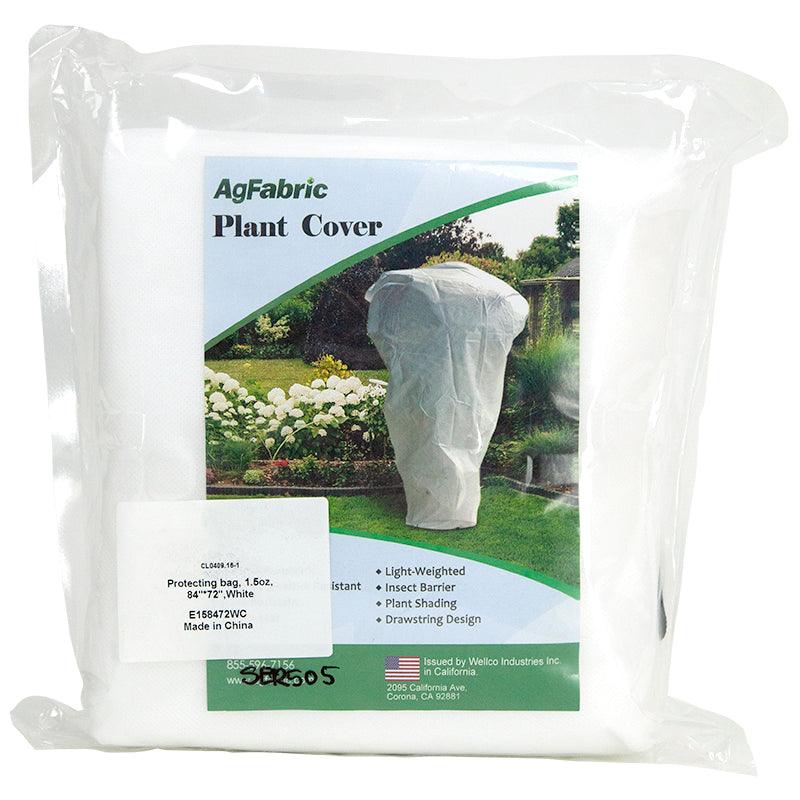
can you use plastic bags to protect plants from frost Frost Blanket Bag 1.5 oz (72"x84")

Sale price$24.09 Regular price$26.77
Save 10%

Shipping Estimate
USA
  • USA
  • CAN

Ships within 48 hours · Estimated delivery Jul 14 - Jul 19

Promo Codes Available:

For Your Every Summer RSVP, with Code: SUMMER15

Description

can you use plastic bags to protect plants from frost Frost Blanket Bag 1.5 oz (72"x84")Superior winter frost protection for all plants and shrubs. Dimensions: 72" W x 84" H Made of 1. 5 oz. fabric (similar weight to Agribon 50) that will protect plants from frost damage. Drawstring at the bottom to secure the frost blanket bag around the plant. Heat and Sun UV resistant material, for long time use. Superior strength and tear resistant. Note: leaves of very tender plants (like citrus) that touch the fabric during freezing temperatures

Superior winter frost protection for all plants and shrubs.

  • Dimensions: 72" W x 84" H
  • Made of 1.5 oz. fabric (similar weight to Agribon 50) that will protect plants from frost damage.
  • Drawstring at the bottom to secure the frost blanket bag around the plant.
  • Heat and Sun UV resistant material, for long time use.
  • Superior strength and tear resistant.

Note: leaves of very tender plants (like citrus) that touch the fabric during freezing temperatures may get burned.

Frost blankets, also known as garden fabric or floating row covers, play a crucial role in protecting plants from frost and extreme weather conditions. They work by creating a barrier that traps heat and maintains a more stable temperature around the plants. This protection helps in extending the growing season, preventing frost damage to tender plants, and even reducing the impact of pests. These blankets are lightweight, allowing light and water to reach the plants while still providing the necessary insulation. They are an essential tool for gardeners and farmers looking to safeguard their crops and enhance plant growth in challenging climates.

Frost Blanket Bag - A Protective Solution for Your Plants

The Frost Blanket Bag is a valuable tool for any gardener or farmer seeking to protect their plants from the damaging effects of frost and cold temperatures. This versatile product offers a simple and effective solution to safeguarding your crops and ornamental plants during chilly weather conditions.

Why Choose a Frost Blanket Bag?

Before we delve into the specifics of the 1.5 oz fabric, let's discuss why choosing a Frost Blanket Bag is a wise decision. Frost poses a significant threat to plants, as it can damage cells, disrupt growth, and even lead to the death of tender crops and sensitive ornamental plants. To mitigate these risks, gardeners and farmers often resort to various protective measures. The Frost Blanket Bag, with its unique design and high-quality materials, offers a dependable solution.

Understanding the 1.5 oz Fabric

The Frost Blanket Bag is crafted from 1.5 oz fabric, a material carefully selected for its advantageous properties in plant protection. Here's a closer look at the benefits of using this particular weight of fabric:

  1. Optimal Balance of Weight and Durability: The 1.5 oz fabric strikes an ideal balance between weight and durability. It is light enough to be easily draped over your plants, allowing them to breathe and receive sunlight while still providing protection from frost. At the same time, it is sturdy enough to withstand wear and tear, ensuring that you can use it season after season.

  2. Effective Frost Protection: The primary purpose of the Frost Blanket Bag is to safeguard your plants from frost damage. The 1.5 oz fabric accomplishes this by trapping heat and preventing cold air from reaching your plants. Its insulation properties create a microclimate under the bag, maintaining a more stable temperature and shielding your plants from frost's harmful effects.

  3. Breathable Material: While offering excellent protection against frost, the 1.5 oz fabric is also breathable. This means that your plants can continue to receive essential air circulation, preventing issues like mold or mildew that can arise from stagnant air. The breathable fabric ensures that your plants remain healthy and vibrant, even while being protected.

  4. UV Resistance: Another notable feature of the 1.5 oz fabric is its UV resistance. This means that it can effectively block harmful ultraviolet rays from reaching your plants. By doing so, it not only provides frost protection but also shields your plants from sunburn and other sun-related damage.

  5. Versatile and Easy to Use: The Frost Blanket Bag made from 1.5 oz fabric is incredibly versatile. Its large size (72" x 84") allows you to cover a wide range of plants, from small shrubs to larger garden beds. Additionally, it is easy to install and remove, making it a convenient option for gardeners of all skill levels.

The Frost Blanket Bag made from 1.5 oz fabric offers a comprehensive solution to protect your plants from frost and cold temperatures. Its unique combination of lightweight durability, effective frost protection, breathability, UV resistance, and versatility make it an invaluable tool for any gardener or farmer. By choosing this product, you can ensure the health and vitality of your plants, even in the face of challenging weather conditions.

Shipping Notes
  • Free Standard Shipping on $100+ Orders to the USA.
  • Except Preorder products are shipped in 48 hours.
  • Delivery to the USA:
  1. Standard Shipping : 3-10 business days
  • If time is of the essence, please consider selecting expedited delivery for faster service.
Exchange/Return Notes
  • We offer a 30-day return/exchange service after receiving.
  • Final sale items are not eligible for returns or exchanges.
  • To process your return/exchange, please contact us at [email protected]
  • Please click here for more details>>> Return & Exchange Policy
SKU: 67056944172

Discover Niche Categories That Outsell can you use plastic bags to protect plants from frost

Top-Converting Item to Boost Your Average Order

4.3 ★★★★★
Based on 1392 reviews
Sort
Highest Rating
Newest First
Oldest First
Product Reviews
L
Verified Purchase
life is good
Massapequa, US
★★★★★ 5
Enlightening!
Format: Paperback
A history of Monroe's discoveries and seminars I took his seminars in the 1993-4 periods Excellent beyond my expectations
WAS THIS REVIEW HELPFUL?YesReportShare
Reviewed in the United States on April 3, 2025
G
Verified Purchase
GiveHerAGoodMunchin
Chelsea, US
★★★★★ 5
Excellent trilogy. This is book 2
Format: Paperback
Bob Monroe is an OG OBE G. Love this trilogy. If you can read, read this
WAS THIS REVIEW HELPFUL?YesReportShare
Reviewed in the United States on August 25, 2025
J
Verified Purchase
Joe Neal
Port Orchard, US
★★★★★ 5
Great (excellent) details for the date written
Format: Paperback
NOTE: I toned this version down in 2021 – I was in a bad place when I wrote the original and there were some hostile and entirely inaccurate personal remarks in it. A few tables/charts with a wealth of information have tiny text but most of this was easy enough to read. The photos are poorly produced (at least in the paperback version I reviewed), which is sad given they would be so handy otherwise. This is a classic post-war treatise on the weapons used for ground warfare during World War II by the U.S. Army and as such the Marines. It was first published around 1947 when the war was fresh and doubtlessly numerous technical details were still classified. It was written by a man intimately involved in many design projects. The coverage pretty much explains the breadth. Examples of use are included for some weapons and detailed tables of data for many. He explains references to the "long primer" for the 76-mm gun and the 81-mm mortar T1 extension tube. I am happy to have bought it for that and numerous other details. One thing I missed when I first wrote the original rambling, a bit over the top review back in September 2015 was that the 57mm M1 antitank gun is not mentioned even though it was a key component of Infantry weaponry in 1944-45, sometimes maligned but often quite effective when carefully used as noted in many, many detailed accounts. Perhaps it was skipped because it was a revision of the British 6 pounder and not designed by Barnes men? Yet, it is an example of the issues caused by the pre war budget minders forcing the Army into desperate choices as explained later – and the using arms who decided to adopt it almost at the last minute, late in 1943. Until a weapon is adopted by the Army ammunition cannot be developed – it costs too much money and time to do so. Most of the book is positive and ignores failures, posed from the viewpoint of a proud designer not an actual user. Yet those failures illustrate the issues Ordnance had to deal with during the war. The U.S. invented the bazooka as the 2.36-inch model in 1942 yet the Germans fielded the more powerful 8.8-cm (88mm) model in 1944; and the U.S. did not get the 3.5-inch (90mm) into production-ready state until the war was ended. This was caused by offloading development onto people who went out for a “super rocket launcher” that had no place in the war. All too often, some excited designers did indeed get ahead of themselves when it came to what worked but was a bit too much (and ultimately impractical for the Army at the time). The inability to develop hollow-charge (HEAT) ammo for cannon and howitzers to reach its minimum potential (twice the caliber in penetration or better) was common for all countries including the U.S. The 105mm howitzer round was pretty good and while disparaged by all and sundry even the 75mm howitzer’s shell could (and did) take out medium armor. Barnes refers to the M3 and M5 light tank as "excellent" when the tanker's epithet would have been "tin plated coffin with a pea-shooter". Here we have an issue with comparing numbers such as armor thickness and penetration power of guns to facts; it is common to think they were butchered such as in Africa when in fact they fought well enough, flaws and all. But they were not the weapons the tankers wanted (nor deserved), and thus tanker’s complaints were valid. And, yes, they were not seen as a prime resource for fighting German tanks and hence reverted to recon and infantry support roles. Where they continued to meet and destroy German armor (but also be destroyed). Any German field commander would have loved to have a battalion of M5s on hand chasing down and chewing up U.S. troops; the contribution of the men in the light tanks in Europe in 1944 and 1945 is all too often belittled by the “number nerds” who toss the light tanks off as useless. They were anything but useless. Why were the M10, M18, and M36 designed as “Gun Motor Carriages” and not tanks? Because they were developed for the tank destroyer forces and the very bigoted officers who held the most sway on development wanted them to be nothing but “motorized antitank guns”. If they had been designed as tanks that would have invalidated Tank Destroyer Doctrine immediately. And yet, in the end, the men doing the fighting needed and wanted tanks, so they used them as tanks as much as they could, despite the open roof and lack of internal machine guns. It is claimed the gun motor carriages were cheaper than tanks (a specious argument given price varied by manufacturer and ultimately depended more on quantities produced not some arbitrary raw number) but to produce the gun motor carriages for a specialist role that was neither tank nor artillery (albeit they were used for both) was a costly thing to do. The failure to develop a better light tank in time is not mentioned even though the T7 light tank with a 57-mm gun was ready in mid-1942 and could have been in the field around 1943 (the Armored Forces botched that one). The M24 was a nice tank but too late simply because development came too late because development had been stunted badly by congress and it’s miserly pre-1941 budget. There are errors: The design of the M24 began in 1943, not 1945. The 76-mm gun could hardly penetrate the "...heaviest German tank armor." But it could penetrate a lot of armor and the myth that all German tanks were Tigers and Panthers is one of those fantasies of the war pursued by people who are glorifying the war not understanding it (most German armor was medium or lighter), let alone the myth that they were always met head-on is ridiculous. The 90-mm gun was not optimized for anti-tank use and hence had the same issues with dealing with the frontal armor of the Panther (though it could handle the Tiger) and yet was better at that than many other guns. The tendency to adapt anti-aircraft guns for anti-tank guns was common and is where Germany got its 88s and the 128mm. The U.S. found it did not need a lot of 90mms (the homeland was not threatened and what it produced was enough for its needs); there was never the demand for a higher altitude version and hence nothing like the 8.8cm FLAK 41 was developed which led to the 8.8cm Kwk43 and Pak43s; yet Ordnance built their own versions of hot 90mm for tank use. I missed the boat in my original review failing to detail how the Army’s main issue was the budget provided by Congress and politicians from 1920 through 1940. They starved the Army; the U.S. was peaceful and they had no interest in making it a military country and as such kept the Army small (and starved the air forces and Navy as well but not as badly). This crippled development; while the Soviets started building a modern Army in 1930 complete with investment in tank forces and tank arsenals; the Germans in 1934 or so; and British in 1934 or so; the U.S. politicians did not begin serious spending on the Army until 1941. Before then, the budget was all about “beans, bullets, and bayonets” and of course bodes to wield them. The Army had to struggle with what it had and put to field what was practical not what was best. Thus, for example, the recoilless rifles (used by the Germans in 1940) did not arrive in U.S. use until 1945. And yet a U.S. officer bult the first recoilless rifle to be used way back around 1916. Indeed, a brief little discussion on how the U.S. produced what it did based on budget would have opened many eyes. The Soviets produced so many thousand T34s for example, more than the U.S. – and in the U.S. the budget people were always saying, “You don’t need any more, stop building them!” As mentioned, the number of 90mm AA guns the U.S. produced was not based on manufacturing capacity but because they didn’t need more. Thus - there is a lot of information and many details many people will never have heard before. There are also many missing details concerning the Ordnance Department struggles to get things done in a very brief time frame thanks to how Congress had refused to let them do anything earlier. Dig into that deeper and you might find it nauseating the way people played games that hindered the U.S. Army in its job of helping beat the Germans. And sometimes couldn't put 2 and 2 together to get the right answer. But, they were human after all, and people do make mistakes. In my original review I argued that “If you want a politics free book you will not get it in this once, not unless you shut your eyes and remain ignorant . . .” but that is wrong. If this was a political book, Barnes might have ripped the budget mongers of the 1920s and 1930s a new sphincter for leaving the Army (and U.S. military as a whole) in such a bad situation as they did when war broke out. But, Barnes had more class than I do.
WAS THIS REVIEW HELPFUL?YesReportShare
Reviewed in the United States on September 19, 2015
P
Verified Purchase
Petey K
West Palm Beach, US
★★★★★ 5
Good content, very small print and photos
Format: Paperback
Get a magnifying glass… the print is tiny. They must have made this book to be a large hard cover because both the print and the photos are so small in paperback. Content looks decent. It’s a gift for my grandson who will probably spend more time with the photos than the reading anyway and his eyesight is better than mine. :D
WAS THIS REVIEW HELPFUL?YesReportShare
Reviewed in the United States on December 16, 2025
M
Verified Purchase
Museum Man
Belleville, US
★★★★★ 4
Printing not up to standards.
Format: Paperback
Printing and pics not up to par.I gifted this book to a coworker and he was not as picky as I.
WAS THIS REVIEW HELPFUL?YesReportShare
Reviewed in the United States on March 8, 2020

recommand products