SKU: 58742508922
ruby necklace plant indoor care

ruby necklace plant indoor care Shop 'Ruby Necklace Plant - Othonna capensis' Care and Growing Guide

Sale price$23.70 Regular price$26.33
Save 10%

Shipping Estimate
USA
  • USA
  • CAN

Ships within 48 hours · Estimated delivery Jul 13 - Jul 18

Promo Codes Available:

For Your Every Summer RSVP, with Code: SUMMER15

Description

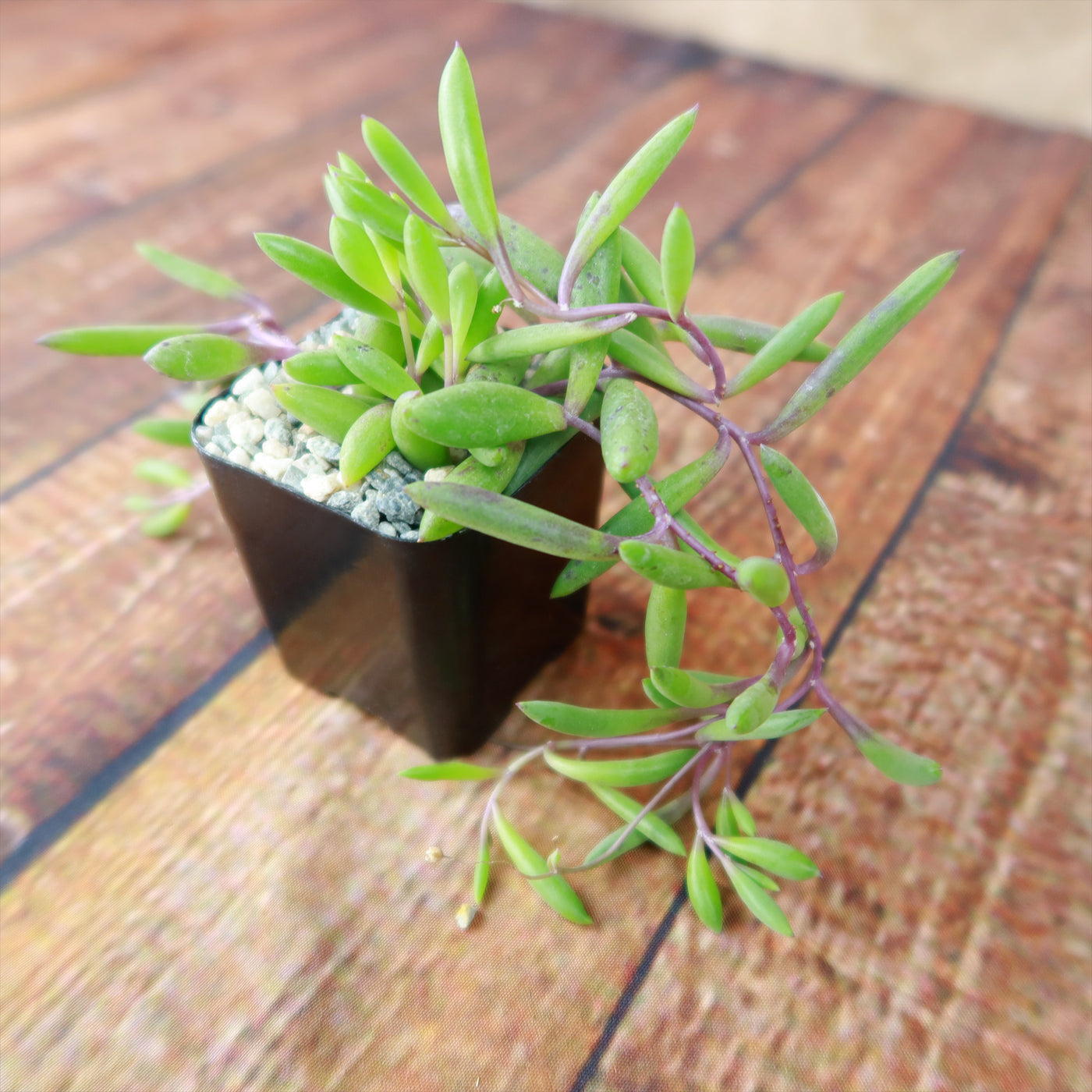
ruby necklace plant indoor care Shop 'Ruby Necklace Plant - Othonna capensis' Care and Growing GuideThe Ruby Necklace Plant, botanically known as Othonna capensis, is a unique and eye catching trailing succulent prized for its vibrant color and cascading growth habit. Popular as a hanging plant, its long trailing stems spill beautifully over containers, showcasing striking ruby red, bean shaped leaves that resemble tiny necklace pendants. Native to South Africa, this trailing succulent has several other common names, such as a string of pickles, a

The Ruby Necklace Plant, botanically known as Othonna capensis, is a unique and eye-catching trailing succulent prized for its vibrant color and cascading growth habit. Popular as a hanging plant, its long trailing stems spill beautifully over containers, showcasing striking ruby-red, bean-shaped leaves that resemble tiny necklace pendants.

Native to South Africa, this trailing succulent has several other common names, such as a string of pickles, a string of rubies, and a little pickle. This ruby necklace plant is a true beauty that can add a pop of color to any indoor or outdoor space! 

The bean-shaped plump leaves of the ruby necklace plant are fleshy and cylindrical. When exposed to direct sun for at least 5-6 hours a day, this sun-loving succulent's foliage color will change from lush green to vibrant red.

They grow densely along the stems, creating a cascading effect that makes them a popular choice for hanging baskets or trailing over the edges of containers

The ruby necklace plant has thin and delicate stems that can grow up to 6.6 ft. long and 2 inches tall; adding to the ruby necklace plant's graceful appearance.

The ruby necklace's most popular feature is its stunning foliage, which has cascading strands of vibrant green leaves that turn reddish in bright sunlight and excellent shape. These string of rubies succulent plants are extremely fast-growing and easy to care for. 

The flowers of the ruby necklace plant are like little daisies. During mid-spring through fall or year-round, it produces these yellow, small, daisy-like flowers that add a bright contrast to the foliage. 

The ruby necklace plant Belongs to the Asteraceae family and is related to the Senecio, including its popular String of Hearts, String of Dolphins, String of Pearls, and more.

When and How to Water Your Ruby Necklace Plant  

The Ruby Necklace plant prefers moderate but careful watering, similar to the dry coastal conditions of its native South African habitat. It grows best when watered using the “soak and dry” method, where the soil is thoroughly watered and then allowed to dry out before watering again.

The Ruby Necklace succulent should be watered about once every 1 to 2 weeks and only water once every 3-4 weeks to keep the soil relatively dry.

In spring and summer, water deeply enough to moisten the soil evenly, but never let the plant sit in soggy soil. By inserting your finger about an inch into the soil, you can determine the moisture level. If it feels dry at that depth, it's a good indication that it's time to water. Be sure to water thoroughly and let the excess water drain out of the pot. 

In fall and winter, reduce watering since the plant becomes less active. Watch for signs such as shriveled leaves, limp stems, or dull coloring, which may indicate the plant needs water.

Light Requirements - Where to Place Your Ruby Necklace Plant

When growing indoors, place your Ruby Necklace plant near a south facing or west facing window where it can receive 4 to 6 hours of direct sunlight.

If your home does not get enough natural light, consider supplementing with artificial grow light to ensure it receives adequate light. 

When growing outdoors, this succulent thrives best in a bright sunny location with partial to full sun exposure. However, it's important to avoid exposing it to direct sunlight over 6 hours daily, especially during the hottest parts of the day.  

If you notice the leaves of this beautiful plant turning yellow or brown, it may be a sign that your necklace plant is getting too much direct sunlight.

Optimal Soil & Fertilizers 

The Ruby Necklace plant prefers a light, airy, well-draining succulent soil mixes, that has a high content of nutrients, making it ideal for growing these succulents. Ideally, ypou can use our specialized potting mix that contains 5 natural substrates and mycorrhizae to promote the development of a strong root system that helps your succulent to thrive. 

When fertilizing your Ruby Necklace plant, keep feeding light and seasonal. Do not over fertilize it, as too much fertilizer can damage the roots and cause weak, leggy growth. A diluted, low nitrogen fertilizer or a balanced fertilizer with an NPK ratio of 5-10-5 works well to support healthy foliage and trailing stem growth.

Hardiness Zone & More 

In the United States, the ruby necklace plant is mostly an indoor plant, but if you live in southern Florida or Hawaii, then you can cultivate it outdoors in USDA zones 9-11.

It thrives in average room temperatures ranging from 60°F to 75°F and can tolerate slightly cooler temperatures in the winter. 

This plant is fairly adaptable and can tolerate average indoor humidity levels. However, it appreciates a bit of extra humidity, so misting the leaves occasionally or placing a tray of water nearby can help create a more favorable environment.

If you live in a drier climate, you can also use a humidifier to maintain the desired humidity level. Just be cautious not to place the plant directly in front of an air conditioner or heating vent, as fluctuating temperatures and dry air can negatively impact its health.

How to Grow as a Houseplant 

You can grow your Ruby Necklace succulent indoors by giving it 4 to 6 hours of bright sunlight each day. Place it in a south or west facing window to help maintain its vibrant purple stems and healthy trailing growth. 

Keep the plant in a warm spot between 65°F and 80°F, and protect it from temperatures below 50°F. It prefers low humidity and adapts well to normal indoor conditions without needing extra moisture in the air. Use a well draining succulent soil and water only when the soil has dried out completely. 

Wildlife – Ruby Necklace Flowers Attract the Following Friendly Pollinators 

When the Ruby Necklace plant blooms, its small yellow daisy like flowers can attract a variety of helpful pollinators such as bees, butterflies, hummingbirds and other beneficial insects. These blooms provide a light source of nectar to these friendly pollinators especially during the warmer months.

Butterflies
Bees
Hummingbirds
Lady Bugs
Multi Pollinators
Other Birds

According to ASPCA, the 'Othonna capensis' is considered non toxic to human, cats, and dogs making it suitable choice for indoor spaces. However, it is still best to prevent pets or small children from chewing on the plant, as it may occasionally cause mild stomach discomfort or digestive upset.

How to Propagate Ruby Necklace Succulent 

To propagate the Ruby Necklace succulent, you can take stem cuttings. With time and proper care, the cutting should develop roots and grow into a new plant. Additionally, if you happen to damage a few leaves or stems, don't worry. You can use these cuttings for propagation. It's an exciting way to expand your collection of Ruby Necklace plants. 

Key Takeaways

  1. The Ruby Necklace is a trailing houseplant that develops stunning purple and ruby colored stems when exposed to bright sunlight.
  2. Its trailing growth makes it perfect for hanging baskets, shelves, and cascading succulent displays.
  3. It produces bright yellow daisy like flowers bloom beautifully against the plant’s colorful foliage.
  4. This drought tolerant succulent thrives on neglect and prefers the soak and dry watering method.
  5. It is considered non toxic to cats, dogs, and humans, making it a great indoor plant choice.

Final Thoughts

Overall, the Ruby Necklace plant (Othonna capensis) is a stunning houseplant with trailing stems and vibrant ruby red foliage that instantly adds color to indoor spaces. It's a perfect choice for hanging baskets or as a cascading plant on shelves. This plant thrives in bright, indirect light and prefers well-draining soil. When it comes to watering, it's best to allow the soil to dry out between waterings to prevent overwatering. With its eye-catching color and easy care requirements, the Ruby Necklace plant is sure to be a showstopper in any succulent collection.

Shipping Notes
  • Free Standard Shipping on $100+ Orders to the USA.
  • Except Preorder products are shipped in 48 hours.
  • Delivery to the USA:
  1. Standard Shipping : 3-10 business days
  • If time is of the essence, please consider selecting expedited delivery for faster service.
Exchange/Return Notes
  • We offer a 30-day return/exchange service after receiving.
  • Final sale items are not eligible for returns or exchanges.
  • To process your return/exchange, please contact us at [email protected]
  • Please click here for more details>>> Return & Exchange Policy
SKU: 58742508922

Discover Niche Categories That Outsell ruby necklace plant indoor care

Top-Converting Item to Boost Your Average Order

4.7 ★★★★★
Based on 502 reviews
Sort
Highest Rating
Newest First
Oldest First
Product Reviews
B
Verified Purchase
BF J.V.
Boise, US
★★★★★ 5
Economical and descent for price
Color: Carbonized, Size: 3-piece, Color: Carbonized, Size: 3-piece
Pleased with price, style, color, and the 3 sizes of these carbonized bamboo cutting boards. Based on the reviews had the expectation of the "smell", which is the oil used to seal the cutting boards. (I suspect linseed oil was used based on the lingering smell, as the off-gasing process is longer. It's also cheaper than Tung oil and food grade mineral oil.) I work with wood and various oil sealants so the smell is a non-issue. As there are natural ways to speed that process up and minimize the smell. In addition, I will be using fractionated coconut oil or food grade mineral oil to seal cutting boards on a regularly basis (monthly or more frequent). As we live in a dry climate, hard water, and frequent use. Appreciate the other reviews which lead to our purchase and reasonable expectation of these cutting boards.
WAS THIS REVIEW HELPFUL?YesReportShare
Reviewed in the United States on May 28, 2026
B
Verified Purchase
briana canterino
Louisville, US
★★★★★ 4
Good but wood smell
Color: Carbonized, Size: 3-piece
These came with a woodsy smell but the price was great for the quality
WAS THIS REVIEW HELPFUL?YesReportShare
Reviewed in the United States on May 8, 2026
R
Verified Purchase
Robert Kiehn
Los Angeles, US
★★★★★ 5
The Best Apologetics Book I've Ever Read!
This is one of the best apologetics books I've ever read!! Greg Koukl, President of Stand To Reason at str.org has written a great and informative book that is very thought provoking and often points out atheist contradictions and logical fallacies not to mention how lackluster and ignorant atheist thinking is. Here is a good review of it: [..] "Discerning Reader Editorial Review Reviewed 02/17/2009 by Tim Challies. Recommended. A valuable tool to assist Christians in sharing and defending the faith. I have a bit of an aversion to books on apologetics. I don't know exactly why this is, but it may be that many of them seem to teach methods of defending the faith that either manipulate or bludgeon. Somehow grace and apologetics do not seem to go together as they ought. So it was with perhaps just a bit of reluctance that I began reading Gregory Koukl's Tactics: A Game Plan for Discussing Your Christian Convictions. This is a book that promises to teach a new method, a respectful method, of defending the faith and of attempting to convince others of the truth of Christianity. This is not an apologetics 101 text, as in a book that will compare and contrast various apologetic methods; instead, it is a guide, a book that seeks to lead the reader into a new method of sharing his faith with others. "If you're like a lot of people who pick up a book like this, you would like to make a difference for the kingdom, but you are not sure how to begin. I want to give you a game plan, a strategy to get involved in a way you never thought you could, yet with a tremendous margin of safety." Here is what Koukl promises--he sets no small goal. "I am going to teach you how to navigate in conversations so that you stay in control--in a good way--even though your knowledge is limited. You may know nothing about answering challenges people raise against what you believe. You may even be a brand new Christian. It doesn't matter. I am going to introduce you to a handful of effective maneuvers--I call them tactics--that will help you stay in control." This tactical approach is a useful one, for it allows you to stay "in the driver's seat in conversations, so you can productively direct the discussion, exposing faulty thinking and suggesting more fruitful alternatives along the way." It is important to note that "tactics are not manipulative tricks or slice ruses. They are not clever ploys to embarrass other people and force them to submit to your point of view. They are not meant to belittle or humiliate those who disagree so you can gain notches in your spiritual belt." Instead, they are ways of guiding a conversation to expose poor reasoning and then use that as a bridge to the truth. Koukl begins by looking at three basics skills the Christian will need if he wishes to be an effective apologist. First, he must have knowledge, having a familiarity with the central message of the Bible; second, he must have knowledge that is tempered by wisdom that makes his message clear and persuasive; third, he must have the character of a Christian, embodying the virtues of the kingdom he serves. Then, over the course of four chapters, Koukl unveils his tactic. He calls it "The Columbo." The key to this tactic is to "go on the offensive in an inoffensive way by using carefully selected questions to productively advance the conversation." Never make a statement when a question will do the job. When you ask questions and listen carefully, you gather information that can be used to show a person where his thinking is faulty. Questions can be used to gather information, to reverse the burden of proof or to lead the conversation. Either way, the person asking the question is the person who leads the discussion. He sets a modest and realistic goal for his interactions with unbelievers. "My goal," he says, "is to find clever ways to exploit someone's bad thinking for the purpose of guiding her to truth, yet remaining gracious and charitable at the same time. My aim is to manage, not manipulate; to control, not coerce; to finesse, not fight. I want the same for you." The goal of this kind of apologetics, then, is not necessarily to win someone to Christ. That may be an ultimate goal or an ultimate hope, but the goal of an individual encounter is nothing more than, in Koukl's words, "putting a stone in someone's shoe." "I want to give him something worth thinking about, something he can't ignore because it continues to poke at him in a good way." In Part 2 of the book, Koukl offers guidance in finding flaws in the way people reason. He offers specific tactics to unveil poor reasoning and to turn it back against a person. He calls these things like Suicide, Sibling Rivalry, Taking the Roof Off. He offers advice on countering the human steamroller (you've tried to discuss issues with people like this) and the Rhodes scholar, the supposed expert. When I think of Christian apologetics, I tend to think of Evidence that Demands a Verdict or some of the classics of days gone by. But in this book Koukl offers a new approach and one that is well-suited to the times. He teaches the Christian to think well, to exemplify grace and to humbly lead a conversation to the truth. "We may spend hours helping someone carefully work through an issue without ever mentioning God, Jesus or the Bible. This does not mean we aren't advancing the kingdom. It is always a step in the right direction when he help others think more carefully. If nothing else, it gives them tools to assess the bigger questions that eventually come up." Apologetics is not always a discipline that is done with grace. But in this book Koukl shares tactics that will prove beneficial to any Christian. They may just revolutionize the way you interact with unbelievers. I highly recommend it." I give this book 5/5 stars and recommend it to both Christians and atheists alike as well as everyone in between.
WAS THIS REVIEW HELPFUL?YesReportShare
Reviewed in the United States on March 30, 2011
F
Verified Purchase
Frances
Cuba, US
★★★★★ 5
Highly recommend
Format: Paperback, Format: Paperback
I just finished reading tactics; it’s a book every Christian should consider adding to their reading list. So often we either avoid hard conversations about faith or we jump into them unprepared and emotional. This book does such a good job of equipping believers to slow down, ask thoughtful questions, and engage in meaningful dialogue with people who disagree with us. It’s not about “winning arguments,” it’s about learning how to think clearly, respond graciously, and represent Christ well. What I really appreciated is how grounded it is in biblical context. It reinforces the tools we already have as disciples (wisdom, discernment, gentleness, and truth) and shows us how to actually apply them in real conversations. It encourages confidence without arrogance and boldness without hostility. If you’ve ever felt unsure about how to defend your faith or navigate tough discussions, this book is incredibly practical and encouraging.
WAS THIS REVIEW HELPFUL?YesReportShare
Reviewed in the United States on March 2, 2026
B
Verified Purchase
Bartol CZ
Grantham, US
★★★★★ 5
Cannot recommend this book enough
Greg Koukl’s "Tactics: A game plan for discussing your Christian convictions" is an excellent tool for anyone engaged in everyday conversations with unbelievers. With a mountain of attacks coming at Christians today, it can easily become overwhelming or even defeating for someone who wants to communicate his or her faith. What Koukl sets out to do in this book is to empower his readers to not only not be afraid, but be confident in what they believe, without feeling like the worlds questions are on their shoulders. The first half of this work deals with the game plan. In every day conversations, there are often a lot of claims about the Christian faith that are unfounded, so Koukl’s tactic is primarily a shifting in the burden of proof. He uses the show Columbo as his primary example, as the main character acts like a bumbling fool, but is really a brilliant detective. He will act like a fool to put off his suspect, but then asks incriminating questions to get his suspect to confess. In the same way, when a Christian is given a claim against his or her faith, they do not need to bear the weight of the claim, but can ask for more information and then allow them to defend their conclusions. It is not confrontational and helps the conversation gain some clarity. More often than not, in those moments, the baseless claims are exposed for what they really are, and the Christian is able to deal with the weightier matters of God and the individual. The second half of his book deals with the practicalities of how this tactic can play out. It is no longer an issue of steering the conversation, but of having the practical thinking skills to be a knowledgeable ambassador. A lot of these principles take practice and immersion for it to become a habitual thing, but that’s the first thing that Koukl encourages his readers to do: Try. You will never be able to become proficient at this if you are not entering into conversation with others. The first thing that he encourages us to look out for in this section is the self-refuting questions or objections, which he calls “suicide.” These are views that are inherently contradictory. He said, “When statements fail to meet their own criteria of validity, they are self-refuting.” The concept of truth as universally relative is a good example of this, since it is making the objective truth claim that all truth is subjectively relative. So, it commits suicide by its own assertions. The following chapter shows not only the logical inconsistencies with self-refuting claims, but also the fact that it cannot play out in reality. No one can live (at least consistently) with a worldview that is inherently contradictory. When someone tells you that you cannot judge or that you should not try and change the beliefs of other people, they are in fact doing the very thing that they claim is wrong. One aspect that I particularly enjoyed was his chapter on taking the roof off. This was a deliberate exposition on Francis Schaeffer’s use of reductio ad absurdum. “Whenever someone tries to deny the truth, reality ultimately betrays them.” When a person holds to a false worldview, oftentimes the reductio can help take them to the logical ends of their view. For instance, if someone holds to monism, where all is one and differences are an illusion, then the internal human drive for justice is equally an illusion, and thus a man loving his wife and family has no moral difference in the universe than a man walking into a kindergarten classroom and shooting everyone in sight. Most do not want to deal with the reality of what their worldview allows. But sometimes people, regardless of whether they are proven wrong, will not let you get a word in. His chapter on the steamroller is particularly helpful here. The Christian wants to be the most loving that he or she can possibly be in a conversation, and the steamroller personality will use that to their advantage, as they control the conversation and avoid dealing with their own claims. So, Koukl has the Christian simply stop the conversation, shame the person for being so overbearing, and if that does not work, simply leave. It does not good to try and have a conversation with someone who is not willing to have a conversation. The three things that he ultimately wants his readers to develop are Character, knowledge, and wisdom. With these three combined, the ambassador has enough in his or her arsenal to fight for the hearts and minds of the people he or she engages. Without knowledge, the Christian is ignorant, without wisdom, he or she is without direction in the conversation, and without character, the Christian runs the risk of being a jerk. Koukl said, “My goal… is to find clever ways to exploit someone’s bad thinking for the purpose of guiding her to truth, yet remaining as gracious and charitable at the same time. My aim is to manage not manipulate; to control, not coerce; to finesse, not fight.” He wants the reader to be the best Christian that the non-Christian has ever met. When the focus is on truth and compassion for the other person, it becomes more a matter of putting a stone in their shoe, to make them think, than a series of manipulating maneuvers to get them to convert. This makes room for friendships to develop, rather than confrontations that create an us/them mentality, and, God willing, these encounters will eventually be the means that God uses to save them. While this book is not a how to guide, it does offer some quality introductions to apologetic arguments and a great framework for discussing Christian convictions with those who do not hold to their worldview. Many who are new to apologetics will find a goldmine in this book, and those who are well versed will find an equal amount of value, since he gives a framework for discussion that is winsome and gets to the root of the issues to let the gospel shine. I reference this book often, since this model is the way I try to do apologetics with both Christians and non-Christians.
WAS THIS REVIEW HELPFUL?YesReportShare
Reviewed in the United States on May 3, 2014

recommand products