SKU: 58017282079
money tree height indoors

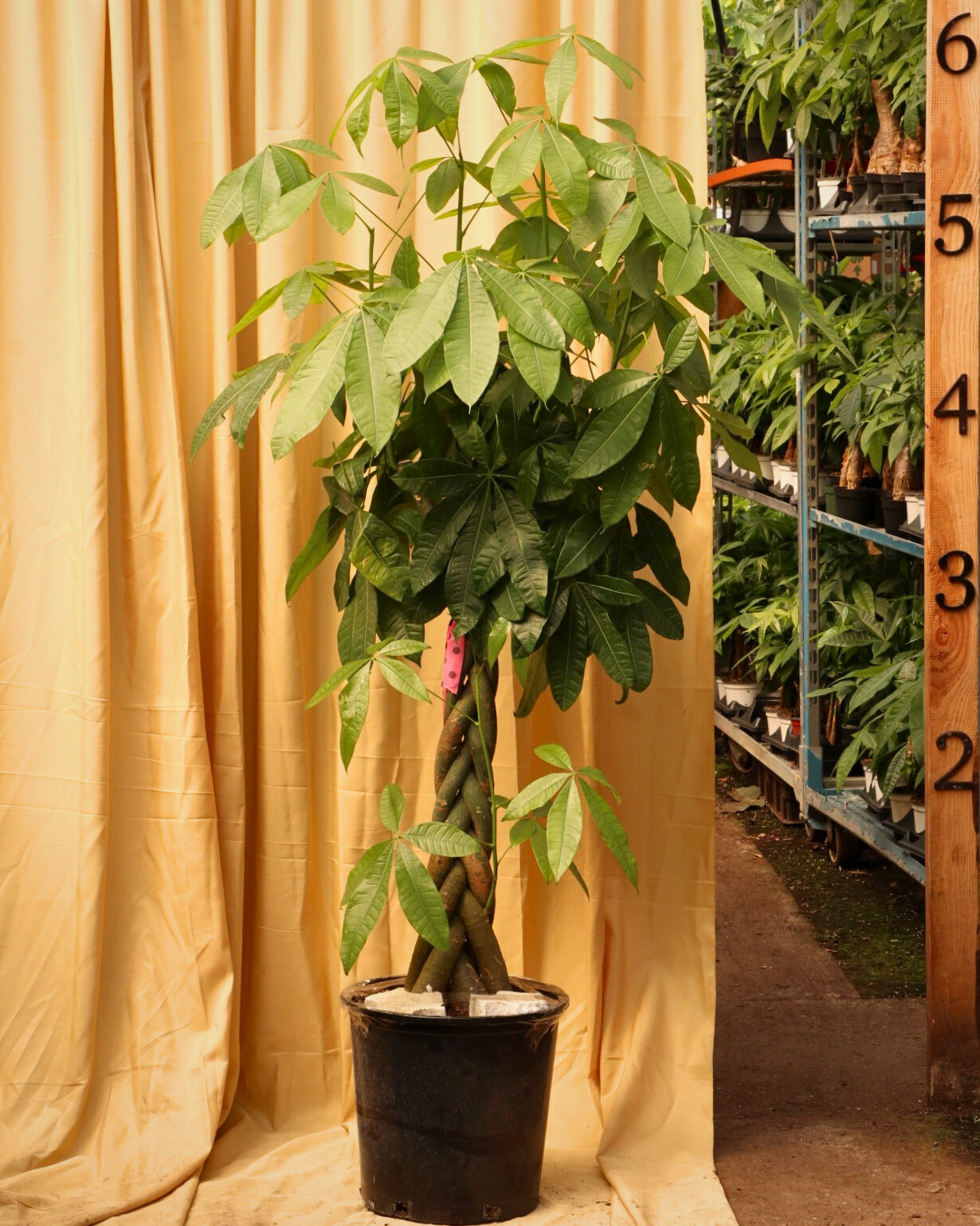
money tree height indoors Full Size Money Tree

Sale price$25.39 Regular price$28.21
Save 10%

Pay in installments of $7.05 with ShopPay, AfterPay and Klarna

Shipping Estimate
USA
  • USA
  • CAN

Ships within 48 hours · Estimated delivery Jul 20 - Jul 25

Promo Codes Available:

For Your Every Summer RSVP, with Code: SUMMER15

Description

money tree height indoors Full Size Money TreeIf youre looking for good luckand a large houseplantthen look no further. Mr. Money Trees beautifully braided, swirling trunk traps good fortune. Not just good luck, but also a good income. Its leaves grow in groups of six, possibly representing six figures. Plus, the whole thing just looks striking. Money Tree benefits Some say a Money Tree can even promote healthier sleep, reduce stress, and decrease conflict in the home. We cant confirm the science

If you’re looking for good luck—and a large houseplant—then look no further. Mr. Money Tree’s beautifully braided, swirling trunk traps good fortune. Not just good luck, but also a good income. Its leaves grow in groups of six, possibly representing six figures. Plus, the whole thing just looks striking.


Money Tree benefits

Some say a Money Tree can even promote healthier sleep, reduce stress, and decrease conflict in the home. We can’t confirm the science behind those beliefs, but research does suggest that the Money Tree is an effective air purifier.


Place this adorable plant beside your bed at night, and take a deep breath. You just might sleep better and feel at ease, and you’ll definitely be breathing in cleaner air!


The Money tree looks cool

Scientifically known as the Pachira Aquatica, the Money Tree is a wetland plant native to Central and South America. Each “Money tree” is actually made up of multiple Pachira Aquaticas, gently hand woven together as they grow to maturity. Thanks to the Money Tree’s umbrella-like foliage, the plant’s swirling trunks look like they’re dancing in the rain, adding whimsy and romance to your indoor garden.


The Money Tree is pet-friendly and non-toxic

Money Trees are non-toxic to cats and dogs. We can’t stop your pet from nibbling on your precious Money Tree, but it won’t end in their demise. (We’ll send all the good vibes to your devoured Money Tree, though).


Lighting

Money Trees love low-light spots, even really low light, and they’ll bring you joyful thoughts even from a shady corner—or in bright indirect light. Money can’t buy happiness, but it can buy plants, which is almost the same thing?


Watering

Most houseplants can’t tolerate much trial and error when it comes to watering. But the Money tree is flexible! Money trees kinda like damp soil (they’re native to swampland after all), so overenthusiastic watering generally won’t kill them.


Pick your exact Money tree 


Now that you're an expert with the Money Tree, order this plant by 7pm ET to get this plant shipped out of our greenhouse in New Jersey tomorrow. (Wondering when it will arrive? Check with the zip code validator on top of the “Add To Cart” button.) We’ll deliver your Money Tree in our sustainable, super-secure packaging system, no matter where you live in the U.S. Your plants will arrive safe and intact!


Hop on a video call to select your Money Tree, and we WILL send out the EXACT plant that you picked out, just like if you picked it up at a local nursery or garden center. Except we have more and fresher plants to choose from, and you can't find our PAFE fine ceramic planter options anywhere other than our website. :)


For any other questions or concerns, please don't hesitate to reach out to us at [email protected] or call/text (609)-968-7063! Or if you want to learn more about the Money Tree, keep scrolling!


Money tree benefits


What is a Money tree good for?

The Money tree looks awesome, purifies the air, brightens your home, and—maybe—brings good fortune. That’s a legend, but nobody said legends can’t be based on truth! You should probably test it out, to be on the safe side.


Does the Money tree clean the air or give oxygen?

The Money tree cleans carbon dioxide from the air and replaces it with nice fresh oxygen for us to breathe. It also sucks up chemicals like formaldehyde and benzene, plus other synthetic chemicals from cleaning products, leaving the air cleaner.


Are Money trees easy to keep alive?

Money trees are very low maintenance. They’re not too fussy about their watering schedules or their lighting. However, everyone has something, and Money trees do prefer a narrow range of temperatures (65-75). They also want some humidity. But that’s all.


Money tree care


How often should I water my Money tree?

Water your Money tree every week or two—more often during the spring and summer, and less often in the fall and winter. The Money tree tolerates overwatering better than underwatering, but make sure you’re using well-draining soil.


How do I keep my Money tree happy?

It’s pretty easy to keep a Money tree happy! Water every week or two. Put it anywhere indoors except in direct sun. And sing it a lullaby every night at bedtime. Even easy-care plants don’t mind a little pampering.


Where should a Money tree be placed in the house?

Most importantly, place the Money tree wherever it can get the right lighting—anywhere from bright indirect light to truly low light. But traditionally, for the best luck, the Money Tree is placed in the southeast section of your home.


Do I need to fertilize my Money tree?

Fertilize your Money tree once a month during spring and summer, when it’s really growing. You can use a general-purpose fertilizer—it’s not a picky eater—but dilute it to half-strength and make sure the soil is wet before applying.


What temperature do Money trees like?

The Money tree is a bit fussy, liking a narrow range of indoor temperatures: 65 to 75 degrees. So keep your home at moderate temps year-round. (Finally, you can tell your spouse or Dad to turn up the heat.)


Can Money trees grow without sunlight?

Money trees can live happily in a dark room with little natural light. So if you have a room with teeny tiny windows, or your neighbor’s way-too-close apartment blocks the sun always, it’s ok—Mr. Money tree will be fine.


Should I spray water on my Money tree?

The Money tree does enjoy humidity, and its leaves will get crinkly in low humidity. However, there’s some debate over whether misting helps or not. To be on the safe side, if you live in low humidity, get a humidifier.


Money tree factoids


Why does the Money tree have 6 leaves?

Some say the six leaves symbolize six figures—in other words, the luck from the Money tree might lead to your next promotion. (It’s us, we’re the ones who say that.) No promises, but work really hard just in case.


What is the superstition about Money trees?

Legend says that having a Money tree in your home will bring good luck and possibly even financial fortune. We prefer “legend” over “superstition” because it sounds fancier and makes us look cooler for believing in it.


Is there a difference between a Money tree and a Money plant?

Yes, the Money tree and the Money plant are totally different species. The Money tree is officially Pachira Aquatica, and the most common money plant, the Chinese Money plant, is Pilea Peperomioides—and it’s a small plant, not a tree.


Is the Money tree good for feng shui?

The Money tree is powerful and meaningful in feng shui, especially if you place it in the southeast area of your home. It symbolizes personal and professional growth and is said to bring good fortune to you and your family.


Do Money trees bloom?

In the wild, Money trees often boast glorious fluffy orange blossoms. But that only happens because they’re pollinated by bats. Assuming you don’t keep any bats inside (weirdo), your Money tree is very unlikely to bloom indoors.


How often do Money trees grow money?

Sadly, the legend that Money trees bring wealth and fortune is more of a metaphor than a practical promise. None of our Money trees have ever grown cash, and if they start, we won’t sell them to you anymore!


Why is it called a Money tree?

The Money tree gets its name from the legend, myth, or superstition that it brings financial luck to its owner or household. However, it’s not literal; Money trees don’t grow money (and no one will pay you to own one).


How long do Money trees live indoors?

Even indoors, a Money tree can live ten years or even longer. Of course, it requires TLC, but it’s an easy-care plant so that’s not a tall order. The Money tree will be your botanical companion for a decade.

Shipping Notes
  • Free Standard Shipping on $100+ Orders to the USA.
  • Except Preorder products are shipped in 48 hours.
  • Delivery to the USA:
  1. Standard Shipping : 3-10 business days
  • If time is of the essence, please consider selecting expedited delivery for faster service.
Exchange/Return Notes
  • We offer a 30-day return/exchange service after receiving.
  • Final sale items are not eligible for returns or exchanges.
  • To process your return/exchange, please contact us at [email protected]
  • Please click here for more details>>> Return & Exchange Policy
SKU: 58017282079

Discover Niche Categories That Outsell money tree height indoors

Top-Converting Item to Boost Your Average Order

4.5 ★★★★★
Based on 8 reviews
Sort
Highest Rating
Newest First
Oldest First
Product Reviews
D
Verified Purchase
Daniel Hahn
Dallas, US
★★★★★ 4
The one-stars miss the point:
Format: Hardcover
Thomas J. Farrell and I may be two of a small handful who actually have read Aristotle's Rhetoric. There are good reasons for this. Aristotle's rhetoric is useful to know historically, and gives one the aroma of scholarship, yet only in the sense of one's being well-read but not particularly useful. Westen's point is that Democrats are starving for useful rhetorical advice. Grounding ourselves in material some 2,300 years old is just not sufficient. cglambdin also missed the whole point, but more bluntly and therefore clearly. I would paraphrase Westen's major point as being: as long as you go around thinking "reason, good/everything else, not so good," you lose. Not only do you lose, you DESERVE TO LOSE. Why? In a democracy, "nobody likes a smartass." The corollary to this is: "if you don't know the difference between being smart and being a smartass, you're probably the latter." Now to an ancient aristocrat like Aristotle, the distinction wouldn't have mattered. In the United States of America, it should matter to everyone aspiring to leadership. We common folk expect our leaders to resonate with our values and life conditions. We don't care whether your blood runs a bit blue (as with the Kennedys) as long as you can be with us in spirit when you need to be. It's only polite. In 1992 the smartass class had great fun with Bill Clinton's "I feel your pain" comment, but missed the point that Clinton resonated while President Bush the First's glance at his watch during the same town meeting debate ended the campaign then and there. Drew Westen evokes what I considered state of the art in the communication field when I was in graduate school twenty-five years ago. Because he's a psychologist, and also not a smartass, I didn't expect him to bring up the theoretical language of people ranging from George Herbert Mead to Kenneth Burke. Rather, he demonstrates their insights! We get it! His work also fits well in the tradition of Walter Fisher's groundbreaking . Two things about Westen's book take off a star. Yes, he does meander. Also, his repetitive bashing of Bob Shrum comes off, at last, as an extended hard-sell advertisement for his own political consulting business. Perfection is elusive. Nevertheless, The Political Brain is doggone useful!
WAS THIS REVIEW HELPFUL?YesReportShare
Reviewed in the United States on July 27, 2007
T
Verified Purchase
The Godfather
Los Angeles, US
★★★★★ 5
Disturbing but necessary read
Format: Paperback
Feels strange saying that I love a book that is as disturbing as this one is but I love that it's well-written and documented and it exposes some horrendous events in the history of the Americas as well as the world. Americans may well point fingers at the Nazis (and deservedly so) but it's a case of people in glass houses throwing stones. There is no question as to the repulsiveness and inhumanity of the genocide and mass murders perpetrated in Nazi Germany, Stalin's Soviet Union, Mao's China, the Khmer Rouge's Cambodia, and in a host of African nations, to name a few; but in our own not too distant past similar atrocities were perpetrated on the native populations of the Americas by the Spanish, Portuguese, British, and colonists/Americans. While the inhumanity elsewhere in the world is touched upon to show where the mindset of this barbarity likely originated, the focus is on the impact in the Americas -- North, South, and Central. The book contains graphic, disturbing descriptions of the cruelty done to the natives by men who have long been esteemed for their alleged contributions in history. Most notably Christopher Columbus. In my time in grade school, he and the many other conquistadors and explorers were portrayed and men of courage and integrity. This book paints a different picture of them as greedy, bloodthirsty, remorseless killers of peoples who they considered inhuman or subhuman. More troubling is Christianity's participation in these actions. Not to blame Christianity for initiating it but to indict it for condoning and even commending the events. Peaceful races of people minding their own business, living in communities well planned and constructed and advanced for their time, and who welcomed the interlopers were obliterated them. Much of the death and destruction was caused by the introduction of European diseases such as smallpox that killed tens of millions but a large part was also caused by actions of odious proportions. Entire civilizations such as the Aztec and the Inca and the Arawak whose artifacts have since been admired and sought after were wiped off the face of the earth. Tens of millions of people slaughtered. Men, women, children butchered. In numbers likely to exceed those of the aforementioned genocides combined. The purpose being to acquire their lands and their riches. Considered to be no more than animals needed to be exterminated. This is our history. This book should be required reading for everyone. The graphic descriptions of the savagery should cause outrage not only for the acts themselves but for a cultures that has covered up their crimes for centuries. And the holocaust has not ended yet.
WAS THIS REVIEW HELPFUL?YesReportShare
Reviewed in the United States on October 23, 2018
H
Verified Purchase
H S Marks
Grantham, US
★★★★★ 5
THE SINGLE FINEST AND MOST ESSENTIAL BOOK OF THE AGE
Format: Paperback
A masterpiece of scholarship and analysis. This book is nothing less than the single most important work that you will ever read. Our entire culture is built on Holocaust Denial while those most responsible for this abnesia drape themselves in the flag of holocaust memorialism but have little honesty in their true agenda. An agenda that allows in North America alone for there to be at least 50 Holocaust memorials, museums and monuments... only problem is they are ALL about the Holocaust that happened in Europe and NOT about the colossal extermination that took place where they live. It is not only denial on the part of the nations of the Americas and Europe but those responsible for this Holocaust Denial in relation to Indian America insist on an image of being the world's caretakers of holocaust memory. What a bloody audacity. Why do we let the Spanish off the hook so lightly? Why is there no demand for Spain to make its Mea Culpa? Why is there no AMERICAS HOLOCAUST memorial in Madrid, Washington, London and Ottawa ? This brilliant book re-addresses the imbalance. POST SCRIPT.... There is a reviewer further down who uses the monica of "history buff" who rejects the value and integrity of this work. In fact he utterly insults Mr Stannard and his thesis. So I thought I would check out his other reviews...oh boy! One of the remarks he makes in a book claiming that Saddam was behind 9/11 goes "But it is very difficult to argue with the facts that were available to the agencies which pointed to a direct link between Saddam and Al Qaeda." This example of his world view is the mild end of it. So people consider the character of the self-described "history buff" who rejects Stannard's brilliant thesis on the Holocaust in the Americas. The reviewer "history buff" has a world view that comes straight out of the 1950's HUAC committee (he associates all Left wing thought with the Soviet Union not knowing that the Bolshevik regime prohibited the platform of the revolution and that its first victims were in fact the most sincere and dedicated Left revolutionaries. Clearly he has never read the finest autobiography in the history of English language autobiography; Emma Goldman's LIVING MY LIFE volume 1 and volume 2. The latter volume includes a first hand account of the destruction NOT construction of socialism by Lenin and his cohorts ). .
WAS THIS REVIEW HELPFUL?YesReportShare
Reviewed in the United States on June 5, 2006
A
Verified Purchase
AlanWarner
Port Orchard, US
★★★★★ 5
EXTINCTION
Format: Paperback
Normally when the word extinct is used it is in reference to animals but after reading this book this term can legitimately be used to describe what happened to the original citizens of America the American Indians. Christopher Columbus and his minions (I refuse to call them soldiers) savagely murdered and killed countless numbers of these Indians, a vivid example of this is given on page 83 " One favorite sport of the conquistadors was "dogging." Traveling as they did with packs of armored wolfhounds and mastiffs that were on a diet of human flesh and were trained to disembowel Indians, the Spanish used the dogs to terrorize slaves and to entertain the troops. An entire book Dogs of the Conquest, has been published recently, detailing the exploits of these animals as they accompanied their masters throughout the course of the Spanish depredations. "A properly fleshed dog," these authors say, "could pursue a 'savage' as zealously and effectively as a deer or a boar.... To many of the conquerors, the Indian was merely another savage animal, and the dogs were trained to pursue and rip apart their human quarry with the same zest as they felt when hunting wild beasts." And also on pages 83-84 "Just as the Spanish soldiers seem to have particularly enjoyed testing the sharpness of their yard-long rapier blades on the bodies of Indian children, so their dogs seemed to find the soft bodies of infants especially tasty, and thus the accounts of the invading conquistadors and the padres who traveled with them are filled with detailed descriptions of young Indian children routinely taken from their parents and fed to the hungry animals. Men who could take pleasure in this sort of thing had little trouble with less sensitive matters, such as the sacking and burning of entire cities and towns, and the destruction of books and tablets containing millennia of accumulated knowledge, wisdom, and religious belief." After page 146 there's an illustrated unnumbered section titled Genocide the first nine pages of this section contain pictures of how the Spanish tortured and killed Indian women and children as stated on the second page of this section "[The Spaniards] took babies from their mothers' breasts, grabbing them by the feet and smashing their heads against rocks...They built a long gibbet, low enough for the toes to touch the ground and prevent strangling, and hanged thirteen [natives] at a time in honor of Christ Our Saviour and the twelve Apostles. Then, straw was wrapped around their torn bodies and they were burned alive." Not to be outdone the good old American cavalry also engaged in its' fair share of savage murder and killing as can be seen from the bottom of page126 to the top of page 127 "They turned their guns, Hotchkiss guns, etc., upon the women who were in the lodges standing under a flag of truce, and of course as soon as they were fired upon they fled....There was a woman with an infant in her arms who was killed as she almost touched the flag of truce, and the women and children of course were strewn all along the circular village until they were dispatched. Right near the flag of truce a mother was shot down with her infant; the child not knowing that its mother was dead was still nursing, and that was especially a very sad sight. The women as they were fleeing with their babes were killed together, shot right through, and the women who were very heavy with child were also killed." I personally do not celebrate Columbus Day and Thanksgiving Day this book is ample proof and evidence as to why these two days should be set aside as a time for mourning not celebration, if you want your children to have a true understanding of American history then I strongly urge you to buy this book and have it as part of your home library.
WAS THIS REVIEW HELPFUL?YesReportShare
Reviewed in the United States on July 5, 2015
P
Verified Purchase
paul
Alexandria, US
★★★★★ 5
ABSOLUTE MUST READ
Format: Hardcover
Probably the best book I have ever read on the subject. Unlike most books written by college professors who love to give their opinion, tell ya how it is, Stannard lets the actual notes of the past speak for themselves. Also probably the best sourced book I have ever read (and I have read many). It can be a bit of a tough read, horror show that our history is but itʼs mandatory knowledge. Without spoiling it, the book is laid out in a most unexpected but awesome way that really nails it. It gets into the WTF were these people thing in a most thorough way. VERY VERY well thought through. I thought it ended in a bit of an odd spot (time), but iʼm sure that was intentional. Should be in every high school classroom in America.
WAS THIS REVIEW HELPFUL?YesReportShare
Reviewed in the United States on March 10, 2023

recommand products