SKU: 57674019059
aim herbicide

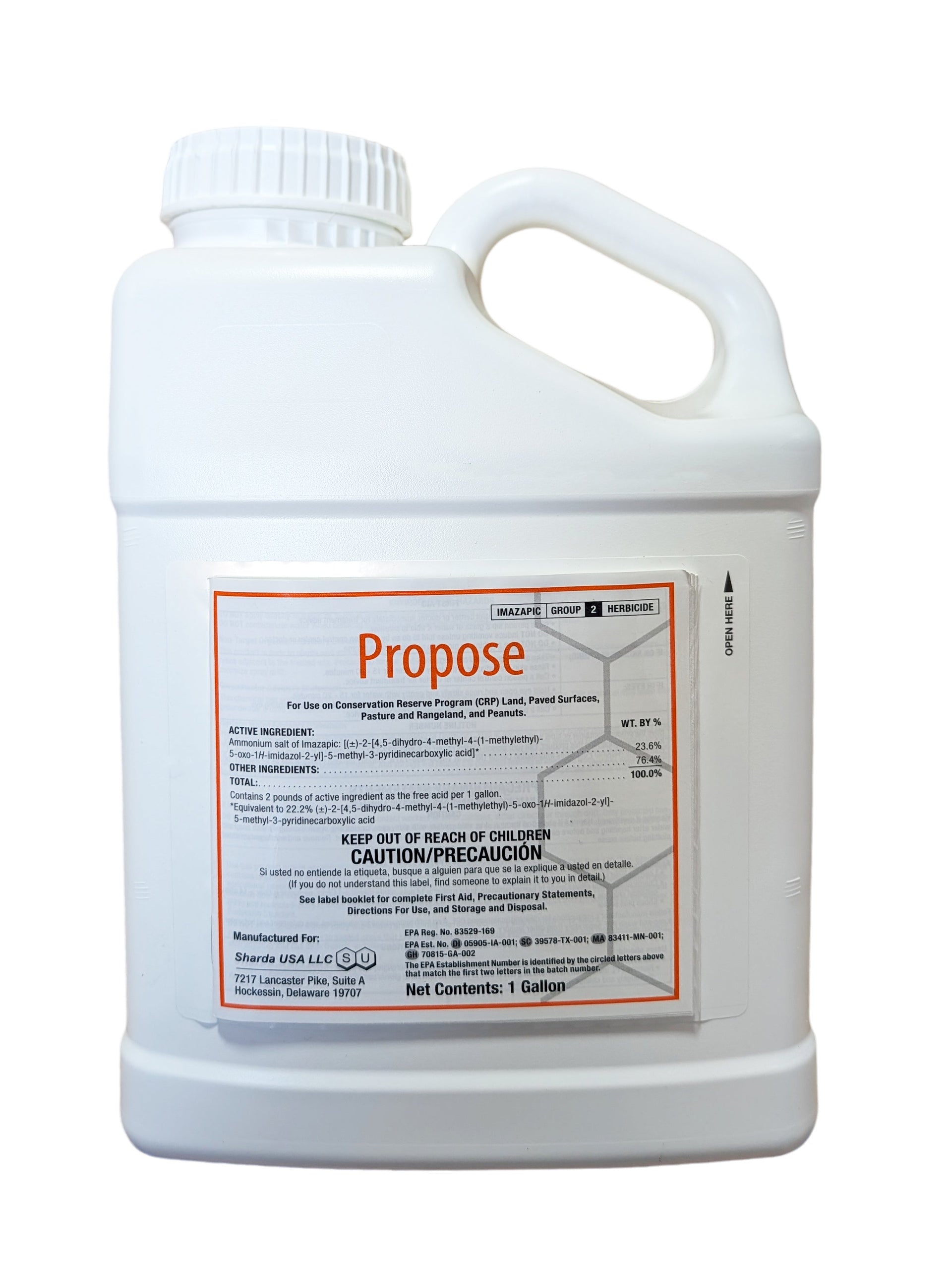
aim herbicide Propose Imazapic 2L Herbicide (Plateau Generic)

Sale price$21.92 Regular price$24.35
Save 10%

Pay in installments of $6.09 with ShopPay, AfterPay and Klarna

Shipping Estimate
USA
  • USA
  • CAN

Ships within 48 hours · Estimated delivery Jul 21 - Jul 26

Promo Codes Available:

For Your Every Summer RSVP, with Code: SUMMER15

Description

aim herbicide Propose Imazapic 2L Herbicide (Plateau Generic)Propose Herbicide is a professional grade selective herbicide formulated with 23. 6% imazapic for long lasting pre emergent and post emergent control of annual grasses, perennial grasses, broadleaf weeds, sedges, and invasive vegetation. As a generic equivalent to Plateau Herbicide, Propose is widely used for rangeland improvement, pasture weed management, Conservation Reserve Program (CRP) acres, prairie restoration, pollinator habitat establishment,

Propose Herbicide is a professional-grade selective herbicide formulated with 23.6% imazapic for long-lasting pre-emergent and post-emergent control of annual grasses, perennial grasses, broadleaf weeds, sedges, and invasive vegetation. As a generic equivalent to Plateau® Herbicide, Propose is widely used for rangeland improvement, pasture weed management, Conservation Reserve Program (CRP) acres, prairie restoration, pollinator habitat establishment, rights-of-way maintenance, industrial vegetation management, and wildlife habitat enhancement. Propose works by inhibiting the AHAS/ALS enzyme system responsible for plant growth. Once absorbed through foliage and roots, it moves throughout the plant and accumulates in growing points, providing effective control of many difficult annual and perennial weeds. In addition to post-emergent activity, Propose provides residual soil activity that helps prevent germination of susceptible weeds and invasive annual grasses. Widely recognized for cheatgrass and medusahead management, Propose is also used to release native grasses, improve wildlife habitat, establish prairie plantings, suppress invasive vegetation, and reduce wildfire fuel loads in rangeland and conservation programs.

Features & Benefits

Generic equivalent to Plateau® Herbicide

Provides both pre-emergent and post-emergent weed control

Controls annual grasses, perennial grasses, broadleaf weeds, and sedges

Excellent control of cheatgrass, medusahead, johnsongrass, and invasive annual grasses

Helps establish native grasses, prairie plantings, and pollinator habitats

Valuable tool for CRP acres, rangeland restoration, and wildlife habitat management

Provides residual activity to reduce future weed germination

Supports wildfire fuel reduction by suppressing invasive vegetation

Rainfast within one hour after application

Use Sites

Conservation Reserve Program (CRP) land, pasture, rangeland, rights-of-way, railroad corridors, utility rights-of-way, pipeline rights-of-way, highway rights-of-way, airports, petroleum tank farms, utility plant sites, pumping stations, storage facilities, non-agricultural fence rows, prairie restoration sites, wildlife habitat areas, non-irrigation ditch banks, industrial turf areas, golf course non-residential turf areas, recreational non-residential turf areas, and other non-crop vegetation management sites.

Target Weeds

Cheatgrass, medusahead, downy brome, annual ryegrass, perennial ryegrass, johnsongrass, bahiagrass, dallisgrass, smutgrass, vaseygrass, crabgrass, goosegrass, foxtail, sandbur, signalgrass, stiltgrass, wild oats, nutsedge, leafy spurge, Russian knapweed, Dalmatian toadflax, kochia, bindweed, ragweed, pigweed, lambsquarters, chickweed, dandelion, curly dock, horseweed, purslane, puncturevine, smartweed, sunflower, thistle, whitetop, garlic, onion, pepperweed, and numerous other annual and perennial weeds.

Application Notes

Propose may be applied pre-emergence or post-emergence depending on target species and management objectives. Best post-emergent performance occurs when weeds are actively growing and treated with an appropriate adjuvant. Soil moisture is important for residual activity and control of germinating weeds. Applications may be made as broadcast, spot, or aerial treatments where permitted by the label. For optimum post-emergent performance, use a methylated seed oil adjuvant. Vortex Xtra is an excellent companion adjuvant for improving herbicide uptake and control of difficult perennial weeds.

Why Choose Propose Herbicide?

Propose is one of the most versatile vegetation management herbicides available for range improvement, invasive grass control, prairie restoration, wildlife habitat enhancement, and CRP management. Its ability to control annual and perennial weeds while promoting desirable forage species makes it a valuable tool for land managers, ranchers, conservation professionals, and vegetation management contractors.

Product Information

Active Ingredient: Imazapic (Ammonium Salt) 23.6%
Acid Equivalent: Imazapic Acid 22.2%
HRAC Group: Group 2 Herbicide (ALS/AHAS Inhibitor)
Chemical Family: Imidazolinone
Formulation: Soluble Liquid (SL)
EPA Reg. No.: 83529-169
Manufacturer: Sharda USA LLC
Shipping Notes
  • Free Standard Shipping on $100+ Orders to the USA.
  • Except Preorder products are shipped in 48 hours.
  • Delivery to the USA:
  1. Standard Shipping : 3-10 business days
  • If time is of the essence, please consider selecting expedited delivery for faster service.
Exchange/Return Notes
  • We offer a 30-day return/exchange service after receiving.
  • Final sale items are not eligible for returns or exchanges.
  • To process your return/exchange, please contact us at [email protected]
  • Please click here for more details>>> Return & Exchange Policy
SKU: 57674019059

Discover Niche Categories That Outsell aim herbicide

Top-Converting Item to Boost Your Average Order

4.9 ★★★★★
Based on 12 reviews
Sort
Highest Rating
Newest First
Oldest First
Product Reviews
R
Verified Purchase
Russ White
Omaha, US
★★★★★ 4
Great Foundational Book
Format: Hardcover
If you've ever wondered how the major pieces of Christian theology --things like the Trinity, Predestination, and Baptism-- you will find them here. Dr. Olson, a historian by trade, takes on the places, times, and movements that developed and hardened the Christian doctrines we know today. Essentially, this book follows a strictly chronological format, starting from the birth of the Church in the book of Acts, and carrying through to the split of the Fundamentalist movement and Reformed theology in the 20th Century. The first section deals with the fundamental heresies that came in with the founding of the Church by examining the writing of the Patristic Fathers, the Apologetic Fathers, and then focusing specifically on Irenaeus. Here the fundamental issues of the nature of Christ in his incarnation were initially resolved. Of course, many of these issues have risen again in recent time with the formation of heretical branches of Christian thought, such as the Jehovah's Witnesses and the LDS Church. The second section deals with the unity of the Church which is primarily founded on the conversion of Rome to a Christian state. While Dr. Olson does a good job of explain the good results of the unity of the Church, he doesn't cover the concerns of those Christians who objected to the sacralism of merging the state and church, and using state power to impose consistency of theology. The major argument over the nature of the Trinity is dealt with in the fourth section, and the fifth returns to the nature of Christ. Section five describes the split between the Eastern and Western church over the issue of the procession of the Spirit --does the Spirit proceed only from the Father, or from the Father and the Son. According to Dr. Olson, the theological quarrel was founded on different views of the place of Scripture and hermeneutics. Martin Luther, John Calvin, and the Reformers are covered in the seventh section. Dr. Olson provides good insight into the relationship between the various Reformers, laying the groundwork for the ultimate split of the Reformed movement described in section eight. The author's ability to lay out the relationships in this section provides a very easy to understand historical picture, though he tends to downplay the role and objections of the Anabaptists, and the sacralizing power grounded in Constantinian Christianity. In the final section Dr. Olson discusses the split between liberal and conservative Christianity, the split between fundamentalism and mainline Christianity. Some of the most interesting pieces he discusses here relate to the role of Billy Graham's ministry, and the role of various schools, strong personalities, and even the impact of scientific thinking in this era. A long read, but a good basis from which to reach out and investigate Christian history and theology.
WAS THIS REVIEW HELPFUL?YesReportShare
Reviewed in the United States on January 12, 2012
J
Verified Purchase
J.D. Jones
Houston, US
★★★★★ 5
Great Read for "Emerging" Christians (Kindle edition)
Format: Hardcover
I have a lot to say which is positive about this book, but first let me say my one disappointment: In his review of theological development of the 20th century, he completely skipped over the pentecostal and charismatic movements. He spent lots of time discussing liberation and feminist theologies, but skipped over these massive movements which claim followers in the 100s of millions. This is surprising to me do to the author's pentecostal roots and the fact that he is a solidly evangelical theologian. It could be argued that these movements haven't introduce "new doctrine" but rather just a "new emphasis" on existing doctrines such as spiritual gifts or the Holy Spirit. True, but then why did he spend so much time discussing the Pietists for whom the same could be argued. The theological influence of the pentecostal and charismatic movements is significant and their omission is glaring. Other than that... This is a timely book, especially for younger Christians. So many "emerging" Christians are writing books and spouting off ideas which they take to be new and innovative. Reading this book shows you just how tiered they are. Reading Olson's chapter on the emergence of 19th century theological liberalism in Germany reminded me of the last Brian McLaren book I read. Same ideas, but but in the context of church history one realises that these "new perspectives" have already been tried and found wanting. Solomon's declaration that, "There is nothing new under the sun" is what rand through my ears when I considered what a lot of hip, trendy, "innovative" preachers are saying now-a-days. Olson's dealing with Catholic and Orthodox church history was fair and unbiased given that many evangelical protestants often are when writing about them. I personally learned a lot about both the Scholastics as well as the Pietists. I also valued his perspective on Augustine. It is a great one volume work. Also, unlike the other reviewer, my Kindle version worked just fine.
WAS THIS REVIEW HELPFUL?YesReportShare
Reviewed in the United States on November 26, 2010
J
Verified Purchase
Jeffrey Van Wagoner
Boise, US
★★★★★ 5
Now I finally have a much better understand of theology
Format: Hardcover
I have always had a fascination with Christian theology and history. What could be better than a book on the history of Christian theology? It turns out that this book exceeded my expectations. What had been a confused and fuzzy understanding of theology has now crystallized into a much clearer view of the big picture. This helps to confirm my belief that the best way to understand any subject is by learning its history. Olsen's writing style is clear, concise and very interesting. I like how he is able to summarize vast quantities of information and ideas in such a short amount of space. I'm not saying this book is short, it is still over 600 pages long, but it could have been much longer. Olsen has obvious leanings on which doctrines he supports, and those that he doesn't. I didn't find his biases distracting, and it is always nice to know which way an author is leaning. I thought he did a reasonable job presenting the variety of worldviews within Christianity in a fair manner. I personally have the most experience studying early Christianity and I still learned a lot from this book. My weakest area of understanding was in modern theology and this gave me a good view at least to the year 2000. I'll probably need to get some advice on a good book to update me on current theology. I highly recommend this book for anyone interested understanding the history and diversity of Christianity.
WAS THIS REVIEW HELPFUL?YesReportShare
Reviewed in the United States on July 6, 2009
C
Verified Purchase
Charles C.
Battle Creek, US
★★★★★ 5
Great Church History Book - Very Readable!
Format: Hardcover
I'm really enjoying this history of theology. I'm only about 250 pages into it, but so far it has been very readable. I know it's not strictly a church history book, but it really has shed a lot of light on the people and the events that shaped the church in the first four or five centuries (that's as far as I have read so far). I now feel like I have a much better understanding what all the debates were about, and especially the major heresies that arose during those centuries, and about the meanings of some of the key terms (homoousios, homoiousios, etc.) And this is the first book that has made the byzantine debates around the Chalcedonian councils at least somewhat comprehensible to me. If the first 250 pages are any measure of how the rest of the book will be, I know it will be good! I can't wait to read about Augustine, medieval and scholastic theology, Aquinas, and especially the reformation. I'll come back after I finish the book and complete this report. So far, it's five star material for sure. Edit. After finishing this book I can only add that it is a wonderful book by a great author. The book kept my attention and was always interesting. I highly recommend it!
WAS THIS REVIEW HELPFUL?YesReportShare
Reviewed in the United States on December 19, 2019
R
Verified Purchase
Rusty Russell
Charlottesville, US
★★★★★ 5
Super!
Format: Hardcover
A great book.
WAS THIS REVIEW HELPFUL?YesReportShare
Reviewed in the United States on August 11, 2025

recommand products