Pay in installments of $5.30 with
 ,
,
 and
and

Shipping Estimate
USA
- USA
- CAN
- USA
- CAN
Ships within 48 hours · Estimated delivery Jul 18 - Jul 23
 Promo Codes Available:
For Your Every Summer RSVP, with Code: SUMMER15
Description
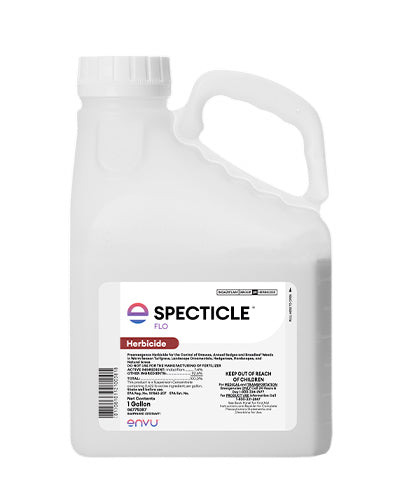
sapphire herbicide Specticle FLO Turf Herbicide – Indaziflam Pre-Emergent Weed ControlSpecticle FLO Herbicide Specticle FLO Herbicide is a professional grade selective pre emergent herbicide formulated with indaziflam for long lasting control of troublesome grassy weeds, annual sedges, annual kyllinga, and broadleaf weeds in labeled warm season turfgrass, landscape ornamentals, hedgerows, hardscapes, and natural areas. As a Group 29 cellulose biosynthesis inhibitor, Specticle FLO controls weeds by reducing seedling emergence before
Specticle FLO Herbicide
Specticle FLO Herbicide is a professional-grade selective pre-emergent herbicide formulated with indaziflam for long-lasting control of troublesome grassy weeds, annual sedges, annual kyllinga, and broadleaf weeds in labeled warm-season turfgrass, landscape ornamentals, hedgerows, hardscapes, and natural areas.
As a Group 29 cellulose biosynthesis inhibitor, Specticle FLO controls weeds by reducing seedling emergence before they become established. It provides extended residual pre-emergence control of key weeds such as crabgrass, goosegrass, annual bluegrass, annual sedges, annual kyllinga, and many broadleaf weeds when activated by rainfall or irrigation.
Features & Benefits
✓ Long-lasting pre-emergent control of many annual grasses, broadleaf weeds, annual sedges, and annual kyllinga
✓ Controls key turf weeds including crabgrass, goosegrass, annual bluegrass, doveweed, annual kyllinga, and many broadleaf weeds
✓ Low-use-rate suspension concentrate formulation for professional applicators
✓ Labeled for established warm-season turf, golf course fairways and roughs, sod farms, sports fields, commercial lawns, residential lawns, parks, and cemeteries
✓ Also labeled for landscape ornamentals, hedgerows, hardscapes, natural areas, and certain non-crop bareground sites
✓ Can be used in single or split application programs to extend residual weed control
✓ Compatible with many labeled herbicide tank-mix partners when compatibility is confirmed before use
Labeled Use Sites
Specticle FLO is labeled for use on established warm-season turfgrass areas including golf course roughs and fairways, sod farms, sports fields, residential and commercial lawns, parks, and cemeteries. It may also be used in landscape ornamentals, hedgerows, hardscapes, managed natural areas on golf courses, roadsides, non-bearing fruit and nut trees in residential plantings, and non-crop areas such as paths, parking lots, curbs, sidewalks, driveways, around buildings, gravel areas, loading ramps, educational facilities, storage yards, vacant lots, fence rows, parks, and hardscapes.
Target Weeds
Specticle FLO provides pre-emergence control or suppression of many weeds including crabgrass, goosegrass, annual bluegrass, annual kyllinga, annual sedges, doveweed, barnyardgrass, foxtails, Italian ryegrass, perennial ryegrass, sandbur, common chickweed, mouse-ear chickweed, white clover, common dandelion, chamberbitter, Florida pusley, henbit, horseweed, kochia, common lambsquarters, lawn burweed, prostrate pigweed, redroot pigweed, common purslane, prostrate spurge, spotted spurge, common ragweed, shepherd’s-purse, annual sowthistle, velvetleaf, yellow woodsorrel, and other labeled weeds.
Application Notes
Apply Specticle FLO according to the product label and only to labeled sites. Specticle FLO must be activated by rainfall or light irrigation before weed germination for best pre-emergent performance. Uniform application is essential for satisfactory weed control. Apply in a minimum of 10 gallons of water per acre, or 1 quart of water per 1,000 square feet.
Do not apply to newly seeded turf, golf course greens, tees, collars, slopes immediately above greens, or weakened turf that requires significant recovery. Do not apply to cool-season turfgrasses or mixtures containing sensitive grasses unless thinning or removal is desired. Specticle FLO may inhibit root development, so observe all seeding, overseeding, sprigging, and sodding intervals on the label.
Product Information
Active Ingredient:
Indaziflam 7.4%
HRAC Group:
Group 29 Herbicide
Chemical Family:
Cellulose Biosynthesis Inhibitor
Formulation:
Suspension Concentrate (SC)
EPA Reg. No.:
101563-207
Signal Word:
Caution
Manufacturer:
Environmental Science U.S., LLC / Envu
Recommended Rotation Partner:
A labeled herbicide with a different mode of action. The label specifically references tank-mix or program use with products such as Ronstar FLO, Revolver, Celsius WG, Tribute Total, glyphosate, glufosinate, Acclaim Extra, and other labeled herbicides where appropriate for the site and weed spectrum.
Recommended Surfactant:
Not required for pre-emergent use. Use only when required by a labeled tank-mix partner and follow the most restrictive label directions.
Shipping Notes
- Free Standard Shipping on $100+ Orders to the USA.
- Except Preorder products are shipped in 48 hours.
- Delivery to the USA:
- Standard Shipping : 3-10 business days
- If time is of the essence, please consider selecting expedited delivery for faster service.
Exchange/Return Notes
- We offer a 30-day return/exchange service after receiving.
- Final sale items are not eligible for returns or exchanges.
- To process your return/exchange, please contact us at [email protected]
- Please click here for more details>>> Return & Exchange Policy