SKU: 5645887422
pink leaf house plant

pink leaf house plant Hypoestes 'Pink'

Sale price$22.82 Regular price$25.36
Save 10%

Pay in installments of $6.34 with ShopPay, AfterPay and Klarna

Shipping Estimate
USA
  • USA
  • CAN

Ships within 48 hours · Estimated delivery Jul 15 - Jul 20

Promo Codes Available:

For Your Every Summer RSVP, with Code: SUMMER15

Description

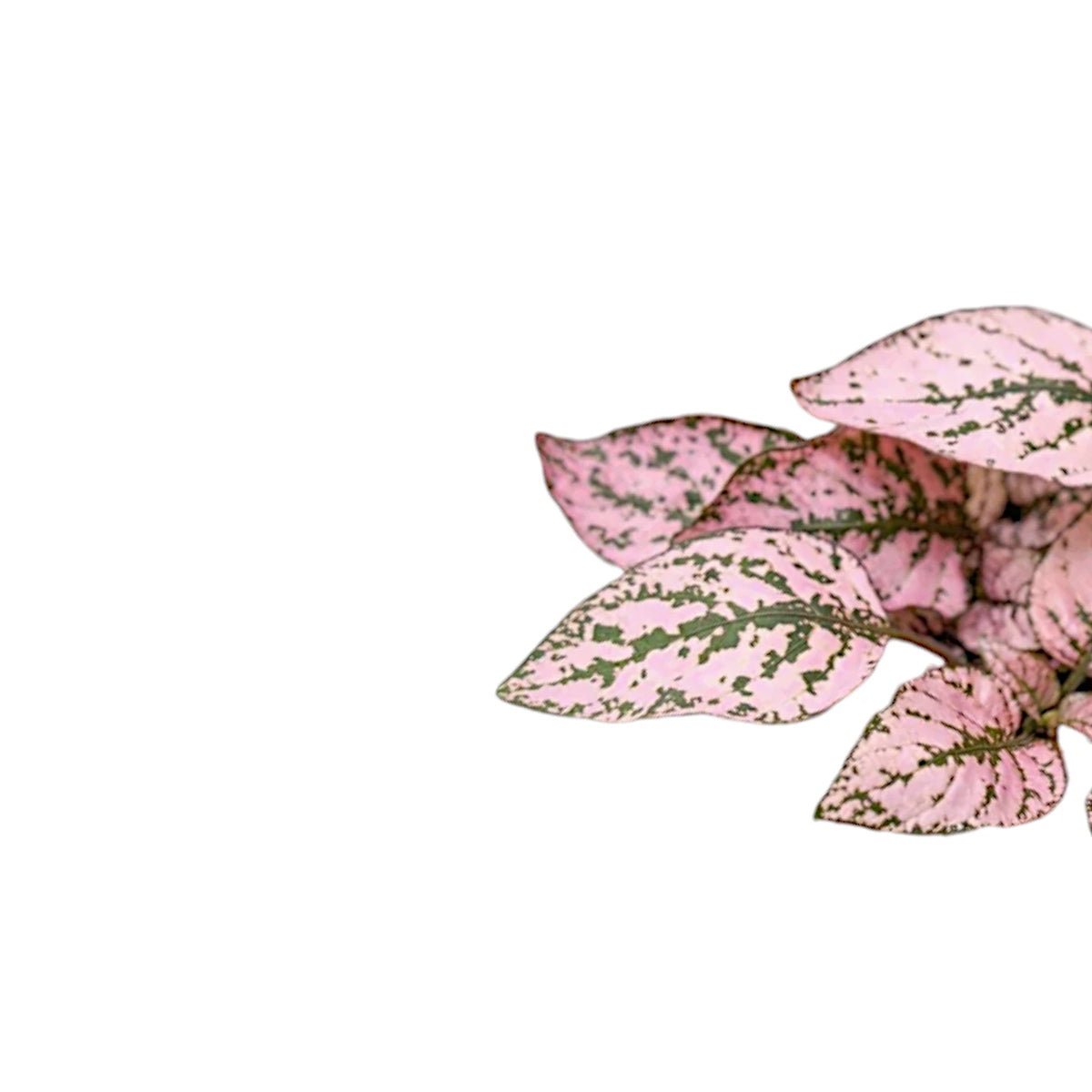
pink leaf house plant Hypoestes 'Pink'Hypoestes phyllostachya Pink Hypoestes phyllostachya Pink is a compact, bushy foliage plant with small oval green leaves heavily marked in soft pink. The pattern appears as spots, freckles and irregular patches across fresh growth. Branching stems respond well to light pinching, which keeps new shoots forming from several points instead of letting single stems stretch. This tender Acanthaceae plant can produce small lilac toned blooms on spikes.

Hypoestes phyllostachya ‘Pink’

Hypoestes phyllostachya ‘Pink’ is a compact, bushy foliage plant with small oval green leaves heavily marked in soft pink. The pattern appears as spots, freckles and irregular patches across fresh growth. Branching stems respond well to light pinching, which keeps new shoots forming from several points instead of letting single stems stretch.

This tender Acanthaceae plant can produce small lilac-toned blooms on spikes. Indoor plants are usually maintained for dense, patterned growth, and removing flower spikes redirects growth back into new leaves and side shoots.

Pink-spotted leaves and branching stems

  • Leaf pattern: Green leaves marked with pink spots, freckles and irregular colour patches.
  • Growth habit: Bushy, branching stems that stay fuller with occasional tip pruning.
  • Plant type: Tender herbaceous perennial to subshrub, commonly kept as a compact indoor foliage plant.
  • Origin: The species is native to Madagascar and grows in wet tropical conditions.
  • Pet safety: Listed by the ASPCA as non-toxic to cats and dogs.

Madagascar species background behind pink polka dot plant

Hypoestes phyllostachya belongs to Acanthaceae and is native to Madagascar, where the species grows as a wet-tropical subshrub. The leaves are oval, softly textured and carried on slender branching stems. Pink-marked plants show the contrast between green tissue and coloured spotting across each small leaf.

The thin leaves react quickly to dry substrate, hot sun and weak light. Hypoestes phyllostachya ‘Pink’ grows best with even moisture, warmth and bright filtered light. Strong direct sun can scorch the soft leaves, while weak light can make growth looser and the leaf pattern less clear.

Light, pruning and moisture for pink Hypoestes

  • Light: Give bright, indirect light. Morning or very gentle filtered sun can be tolerated after acclimation, but hot midday sun can damage the leaves.
  • Watering: Water when the upper 20–30% of the substrate has dried. The plant wilts quickly when too dry, but roots still need air around them.
  • Substrate: Use a light, moisture-retentive houseplant mix with added perlite or pumice for drainage.
  • Humidity: Moderate to higher humidity keeps soft new leaves expanding evenly when airflow remains good.
  • Temperature: Keep warm, ideally around 18–27 °C. Avoid cold windowsills and sudden night drops.
  • Pruning: Pinch stem tips above leaf nodes to encourage branching. Remove flower spikes after they appear to reduce stem stretch and keep the pot tidier.
  • Feeding: Feed lightly during active growth. Too much fertiliser can push soft, stretched growth.

Wilting, leggy stems and crisp leaf edges

  • Wilting: Usually caused by dry substrate. Water evenly, then check that the plant perks up within a few hours.
  • Leggy stems: Often linked to low light or missed pruning. Move to brighter indirect light and pinch back long shoots.
  • Crisp leaf edges: Can come from drying out, hot sun or low humidity. Check light intensity and watering rhythm.
  • Pale or dull growth: Usually a sign of weak light, exhausted substrate or old stems. Refresh care and prune to promote new shoots.
  • Powdery mildew risk: Crowded, damp leaves with poor airflow can develop fungal issues. Water the substrate and keep leaves from staying wet.

Refreshing an older pink polka dot plant

Hypoestes phyllostachya ‘Pink’ naturally ages into longer stems if left untrimmed. Regular small pinches create a fuller plant than one hard cut after the base has become bare. Stem cuttings root easily in a warm, bright setup, so trimmings can be used to refresh the pot.

Pet safety for Hypoestes phyllostachya

Hypoestes phyllostachya is listed as non-toxic to cats and dogs. Chewing any houseplant can still cause mild stomach upset, so keep it away from pets that repeatedly nibble leaves.

Hypoestes phyllostachya name background

Hypoestes is commonly explained from Greek roots meaning under and house, referring to floral bracts. The species epithet phyllostachya means with a leaf spike. The quoted colour name ‘Pink’ refers to the visible pink spotting of this product selection.

Hypoestes phyllostachya ‘Pink’ stays small, branches readily and carries soft pink-speckled leaves on fresh green growth.

Shipping Notes
  • Free Standard Shipping on $100+ Orders to the USA.
  • Except Preorder products are shipped in 48 hours.
  • Delivery to the USA:
  1. Standard Shipping : 3-10 business days
  • If time is of the essence, please consider selecting expedited delivery for faster service.
Exchange/Return Notes
  • We offer a 30-day return/exchange service after receiving.
  • Final sale items are not eligible for returns or exchanges.
  • To process your return/exchange, please contact us at [email protected]
  • Please click here for more details>>> Return & Exchange Policy
SKU: 5645887422

Discover Niche Categories That Outsell pink leaf house plant

Top-Converting Item to Boost Your Average Order

4.2 ★★★★★
Based on 14 reviews
Sort
Highest Rating
Newest First
Oldest First
Product Reviews
L
Verified Purchase
Lynne Summers
Bozeman, US
★★★★★ 4
Good quality
Color: yellow
Perfect, just what I needed
WAS THIS REVIEW HELPFUL?YesReportShare
Reviewed in the United States on November 28, 2025
K
Verified Purchase
Kelvin
Battle Creek, US
★★★★★ 5
Nice addition
Color: yellow
These aren’t the most gentle but a good gentle exfoliation. They are thick enough to keep the soap in. Fits a normal bar soap easily. With the quantity included you’ll be able to share as you’ll not need many yourself since they hold up to washing very well. The color is a nice off white- natural looking.
WAS THIS REVIEW HELPFUL?YesReportShare
Reviewed in the United States on May 11, 2026
C
Verified Purchase
Cortney D. Olsen
Whiting, US
★★★★★ 5
All natural alternative to loofas
Color: yellow, Color: yellow
I love that they are all natural, plant based, and exfoliating. Mine is already starting to stink a little, so I’ve started making sure that I’m squeezing all the water and soap out after using and it doesn’t smell anymore lol. I prefer these over using loofa with microplastics. They are effective, strong, thick, and size is for small or regular sized soaps. If u have a bigger soap just use the soap first and then lather with this. You will still have to switch out every once in a while (like a loofa). Amazing value for price ⭐️
WAS THIS REVIEW HELPFUL?YesReportShare
Reviewed in the United States on February 9, 2026
G
Verified Purchase
Greg Taylor
Draper, US
★★★★★ 5
Why aren't people reading this and discussing it?
Format: Paperback
This book should be read by everybody on any side of the current debate as to what are future Iraq (Iran?, N. Korea?- w/ the current set of maroons you never know) policy should be. Ikle was Undersecretary of Defense for the Reagan administration. He is one of the original neocons. This book had an enormous influence on how Bush I and Powell decided to end our first Gulf War. He revised this book in 1991 and revised it again and wrote a new intro in 2005. My point is that this man is no cut and run liberal (and I should admit that, right now, I am leaning toward just that position). However, what makes Ikle stand out from his demented neocon brethren is that he is willing to face up to ALL of the possibilities, the difficulties and the ambiguities that are inherent in any foreign policy, let alone a war. He mentions many of the wars and theatres of those wars in the twentiety century and points out how many times politicians and generals went wrong because they would not 1. clearly set out the goals they were trying to accomplish in a war and 2. constantly reevaluate those goals in light of the developing situation. Ikle outlines a few of the difficulties that are obstacles to such a course. Rather prophetically, he talks about how difficult it is to get good intelligence to base your policies on. Sources from within the country of your opponent may mislead you for their own purposes. Agencies within your own government are posturing with the intelligence to protect their influence. Does any of this sound familiar? In one of my favorite chapters of this book, Ikle talks about a tendency that occurs when things start to get difficult in a war. Those who are supporters of the war will start posturing as patriots and referring to the opponents of the war as traitors (or, in the parlance of the editorial page of the Wall Street Journal, as "surrender monkeys"). Again does this sound at all familiar? Here is another one for ya. Ilke argues that it is essential to know why exactly you are fighting. Otherwise, you will never really know when you have won. It is very clear that the whole WMD was just what Rumsfeld or Cheney (I have forgotten which- neither one of them has said anything about the war that is worth remembering in a positive sense) said it was-the one justification they "could all agree on." The role of America as the Great Democratizer has faded into memory. Now we are left with The MisDecider telling us that it is all about leaving Iraq with "a viable government" What does that mean? How is that different from what they had under Sadam? Here is my main point. Here is what makes me so angry. Powell, Rumsfeld, and Cheney all read this book back before the first Gulf War. Nothing has changed in the world to make the recommendations of this book any less vital. These men and women were supposed to be the most experienced foreign and military people the Republicans had produced (which should blow all claims to the Republicans being the party of security out of the water). They ignored these lessons because they choose to and went ahead and made what may be the most serious strategic error since Hitler invaded the Soviet Union. I am hopeful that the Dems now have more power but only slightly so. We need to have a serious discussion now. Not posturing. It may be that we should simply leave at this point because the decline of Iraq into chaos is inevitable. But as someone who is an internationalist, I think we need to look long and hard at the results of doing that before we simply do so. We owe it to the people of Iraq and the surrounding area to do whatever we can to minimize their suffering, to restore a working infrastructure and government to their country and to restore peace to their daily lives. Facing up and discussing the issues as suggested by Ilke is our duty as a democratic polity. There are no easy answers here except for the obvious fact that we cannot rely on Bush and his minions to do what needs to be done. Give this book a read. It is not gracefully written but it is short and direct. You may find it one of the strangest ironies of our time that one of the most telling critiques of the administration comes from someone who is their ally. The main difference between Ikle and people like Bush is that Ikle takes the world more seriously than his ideology.
WAS THIS REVIEW HELPFUL?YesReportShare
Reviewed in the United States on February 4, 2007
J
Verified Purchase
James 634685
Battle Creek, US
★★★★★ 5
Good book. Insightful but an easy read
Format: Paperback
Good material in international relations.
WAS THIS REVIEW HELPFUL?YesReportShare
Reviewed in the United States on June 4, 2024

recommand products