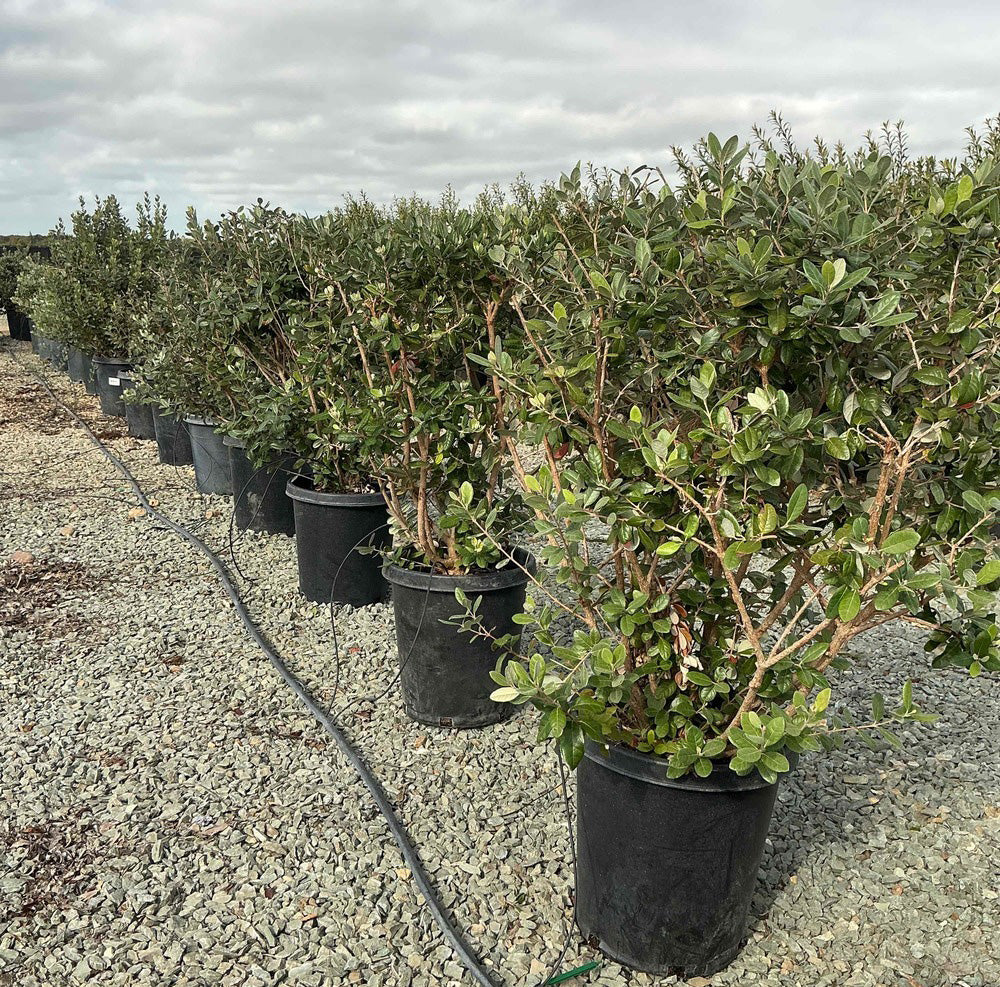
SKU: 5309203528
where to buy pineapple guava plant

where to buy pineapple guava plant Pineapple Guava Tree (Feijoa Sellowiana)

Sale price$20.52 Regular price$22.80
Save 10%

Shipping Estimate
USA
  • USA
  • CAN

Ships within 48 hours · Estimated delivery Jul 11 - Jul 16

Promo Codes Available:

For Your Every Summer RSVP, with Code: SUMMER15

Description

where to buy pineapple guava plant Pineapple Guava Tree (Feijoa Sellowiana)The Perfect Dual Purpose Tree for California Gardens The pineapple guava tree gives you ornamental beauty and edible fruit in one compact, drought tolerant plant ideal for California gardens where every square foot should work hard. Also known as acca sellowiana pineapple guava, feijoa, or feijoa sellowiana, this evergreen shrub from South America brings silvery foliage, unusual white flowers with red stamens, and sweet tart fall fruit to your edible

The Perfect Dual-Purpose Tree for California Gardens

The pineapple guava tree gives you ornamental beauty and edible fruit in one compact, drought tolerant plant-ideal for California gardens where every square foot should work hard.

Also known as acca sellowiana pineapple guava, feijoa, or feijoa sellowiana, this evergreen shrub from South America brings silvery foliage, unusual white flowers with red stamens, and sweet-tart fall fruit to your edible garden. It solves the common landscape tradeoff: you do not have to choose between a beautiful small tree and a productive fruit tree.

Pineapple guava thrives in full sun and well-draining soil, preferably with a slightly acidic to neutral pH between 6.0 and 6.5. It also grows well in USDA Hardiness Zones 8-11 and prefers full sun or part shade, with slightly acidic soil for optimal growth-making it especially useful for coastal gardens, moderate summers, and many subtropical climates across California.

Why You’ll Love Your Pineapple Guava Tree

  • Edible Flowers and Fruit – In late spring to early summer, pineapple guava produces showy white flowers with long red stamens and yellow pollen. The petals are edible, sweet, and sometimes compared to marshmallows, making them a delightful addition to salads and desserts. In early fall, the tree produces egg shaped fruits with edible fruit pulp that tastes like a mix between guava and minty pineapple.

  • Year-Round Beauty – Pineapple guava, or Acca sellowiana, is an evergreen shrub that can reach heights of 10-15 feet and is known for attractive silvery foliage and unusual flowers. Its leathery leaves stay handsome through winter, giving your garden structure even when other fruit trees are bare.

  • Low Maintenance – Mature pineapple guava trees are drought-tolerant, but young trees require weekly deep watering during their first year. The pineapple guava tree is known for its pest and disease resistance, and is generally untroubled by deer. Minimal pest issues may include black scale or fruit flies in some regions, but this tree is typically easier to manage than many edible fruit options.

  • Versatile Growth – Grow it as a shrub, large shrub, informal hedge, multi-trunk specimen, or small tree with a single trunk. Regular pruning helps shape the branches, encourage new growth, and maintain size without heavy pruning.

  • Wildlife Friendly – Birds and bees are the primary pollinators of pineapple guava, with hand pollination achieving nearly 100% fruit set. The flowers attract beneficial pollinators, while mature fruit can support garden wildlife if you leave a few to fall.

What Makes It Different

Most fruit trees ask you to compromise: they are productive but seasonal, ornamental but not edible, or too large for smaller California yards.

Pineapple Guava Tree provides:

  • Unique Edible Flowers – Pineapple guava flowers have white petals, red stamens, and a sweet edible quality that makes them useful fresh in salads and desserts. Unlike a true guava, pineapple guava belongs to the myrtle family, and its genus name Acca reflects its distinct botanical identity.

  • Exceptional Drought Tolerance – Unlike many fruit trees, mature pineapple guava is drought tolerant once established. Regular deep watering is still essential during flowering and fruit formation, especially in dry conditions, to prevent fruit drop and ensure quality harvests. Mulch and organic matter help protect shallow roots and keep soil moisture steady without standing water.

  • Compact Size – Pineapple guava naturally fits smaller landscapes. It can be maintained as a small tree, screen, or evergreen shrub, usually about 10-15 feet tall with an equal spread when allowed to mature, or kept tighter with pruning. It also tolerates coastal salt spray, light shade, and partial shade, though full sun gives the best bloom and fruit production.

How It Works in Your Garden

  1. Plant and Establish
    Plant pineapple guava in well drained soil with good organic matter, where it receives full sun to partial shade. Pineapple guava thrives in full sun and well-draining soil, preferably with a slightly acidic to neutral pH between 6.0 and 6.5. Water deeply after planting, and keep young trees on weekly deep watering during the first year.

  2. Seasonal Beauty Cycle
    In spring, the plant pushes new growth and prepares to bloom. By late spring or early summer, white flowers with long red stamens open and attract bees and birds. For best fruit production, pineapple guava requires a minimum of 50 hours of chilling temperatures during winter, and it is sensitive to extreme heat and frost. Flower production in pineapple guava is poor in areas with fewer than 50 hours of chilling, which is essential for fruit quality.

  3. Fall Harvest
    Fruit develops through summer and begins to ripen in early fall. Pineapple guava fruits are best harvested when they begin to fall from the tree, indicating ripeness, and can also be picked when they are firm and allowed to ripen at room temperature. To prevent bruising during harvesting, place a tarp or cloth under the tree to catch the fruit as it falls, and handle the fruit gently when picking. Enjoy tree ripened fruit fresh, or use the pulp in jellies, desserts, and salads.

Tree Specifications

  • Size: Mature height 10-15 feet, width 8-12 feet

  • Growth Habit: Evergreen shrub, large shrub, informal hedge, or small tree

  • Botanical Name: Acca sellowiana

  • Also Known As: Pineapple guava, feijoa, Feijoa sellowiana

  • Family: Myrtle family

  • Hardiness: Yardwork recommends USDA Zones 8-10 for most California gardens; pineapple guava also thrives in USDA Hardiness Zones 8-11 where climate and soil conditions are suitable

  • Soil Requirements: Well-draining soil; slightly acidic to neutral pH, ideally 6.0-6.5, with tolerance toward 7.0

  • Sun Exposure: Full sun to partial shade; light shade is helpful in hotter inland areas

  • Water Needs: Mature pineapple guava trees are drought-tolerant, but young trees require weekly deep watering during their first year

  • Flower Season: Late spring to early summer

  • Fruit Season: Early fall into fall, depending on climate and cultivar

  • Fruit Type: Egg shaped fruits with aromatic pulp and edible fruit

  • Flavor: Pineapple guava fruit is often described as a mix between guava and minty pineapple

  • Uses: Eat fresh, make into jellies, or use in desserts and salads

  • Fruit Production: Begins about 2-3 years after planting for grafted or cutting-grown named plants

  • Pollination: Pineapple guava flowers are often self-incompatible, so planting two or more named types together is necessary for effective cross-pollination

  • Propagation: Pineapple guava can be propagated through seeds, cuttings, layering, and grafting, with grafting being the most effective method for quicker fruiting

  • What Yardwork Provides: A healthy, container-grown pineapple guava plant selected for California growing conditions, plus planting guidance, care instructions, delivery options, and expert support

Who It’s Perfect For

Ideal for:

  • California homeowners who want edible landscaping with year-round structure

  • Gardeners seeking a drought tolerant fruit tree for full sun or part shade

  • Coastal gardens needing a plant with salt spray tolerance

  • Smaller yards that need a compact small tree instead of a large fruit tree

  • Gardeners who want edible flowers, edible fruit, and ornamental foliage in one plant

  • Home growers interested in cross pollination, named varieties, and better fruit production

If you want an edible garden that looks polished in every season, pineapple guava fits beautifully. It gives you flowers in spring, fruit in fall, evergreen foliage in winter, and a versatile shape that works as a specimen tree, privacy screen, or informal hedge.

Frequently Asked Questions

How long until it produces fruit?
Fruit production usually begins about 2-3 years after planting when you start with a grafted or cutting-grown named pineapple guava plant. Seed-grown plants can take longer and may produce less predictable fruit quality.

Does it need a pollinator?
Some varieties are described as self fertile, but pineapple guava flowers are often self-incompatible. For reliable fruit production, plant two or more named types close enough for bees and birds to move pollen between them. Cross pollination improves fruit set, fruit size, and harvest quality. Hand pollination can achieve nearly 100% fruit set.

How much water does it need?
Young trees need weekly deep watering during their first year. Mature pineapple guava trees are drought-tolerant, but regular deep watering is essential during flowering and fruit formation, especially in dry conditions, to prevent fruit drop and ensure quality harvests. Avoid standing water, because pineapple guava needs well drained soil.

Can I grow it in a container?
Yes. Pineapple guava can grow in a large container if you provide well drained soil, full sun to light shade, regular watering, mulch, and occasional pruning. Container plants need more attentive watering than in-ground trees because shallow roots dry faster.

When is the fruit ready to eat?
Mature fruit is ready when it begins to fall from the tree. You can also pick firm fruit and allow it to ripen at room temperature. For the best tree ripened fruit, place a tarp or cloth under the tree, collect fallen fruit promptly, and handle each fruit gently to avoid bruising.

What does pineapple guava taste like?
The flavor of pineapple guava fruit is often described as a mix between guava and minty pineapple. The pulp is aromatic and sweet-tart, excellent to eat fresh or use in jellies, desserts, and salads.

Will extreme heat or frost affect it?
Yes. Pineapple guava needs at least 50 hours of winter chill for strong flower production and fruit quality. It can be sensitive to extreme heat, which may reduce flavor, and frost can damage flowers or immature fruit.

Ready to Add This Beauty to Your Garden?

Choose the Pineapple Guava Tree (Acca sellowiana) from Yardwork and bring home a low-maintenance, drought tolerant, edible, evergreen plant selected for California gardens. You get silvery foliage, edible flowers, fall fruit, and expert support from a team focused on helping California gardeners plant with confidence.

Yardwork offers convenient delivery, a plant guarantee, and practical guidance for planting, watering, pruning, and harvest success.

Shipping Notes
  • Free Standard Shipping on $100+ Orders to the USA.
  • Except Preorder products are shipped in 48 hours.
  • Delivery to the USA:
  1. Standard Shipping : 3-10 business days
  • If time is of the essence, please consider selecting expedited delivery for faster service.
Exchange/Return Notes
  • We offer a 30-day return/exchange service after receiving.
  • Final sale items are not eligible for returns or exchanges.
  • To process your return/exchange, please contact us at [email protected]
  • Please click here for more details>>> Return & Exchange Policy
SKU: 5309203528

Discover Niche Categories That Outsell where to buy pineapple guava plant

Top-Converting Item to Boost Your Average Order

4.3 ★★★★★
Based on 2452 reviews
Sort
Highest Rating
Newest First
Oldest First
Product Reviews
D
Verified Purchase
D.S.
West Palm Beach, US
★★★★★ 5
Bomb.com
Configuration: 3-pack, Style: without eero Plus
Not sure why this doesn’t have 5 stars from everyone! Got the three device set up and man this couldn’t have been easier to set up. This system is bomb, like I’m not sure how much easier of a setup people even want. Everything was basically plug-and-play, and the app walks you through it so smoothly it almost feels too easy. Performance-wise, it’s been amazing. The coverage is solid throughout the whole house, and the speeds are not just fast—they’re consistent everywhere on Wi-Fi, not just when you’re hardwired. I haven’t had any random drops or dead zones like I used to deal with. Compared to the Cox gateway, it’s not even close. They charge $15 a month to rent that thing and it doesn’t hold a candle to this setup—honestly kind of ridiculous. And the quality? Top tier. It honestly feels like an Apple product. From the packaging to the devices themselves, even the cords and the app—everything just feels super polished and premium. I’m actually glad Amazon acquired eero because you can see that level of refinement in the whole experience. My only complaint is the price tag. $400 is definitely not cheap. But when you break it down, Cox charges $15 a month to rent their gateway—that’s $180 a year. In just about two years, this system basically pays for itself, and you’re getting way better performance the whole time. Overall, 110% happy with this purchase.
WAS THIS REVIEW HELPFUL?YesReportShare
Reviewed in the United States on March 25, 2026
Verified Purchase
314
Louisville, US
★★★★★ 5
Works very well. Very easy to set up.
Configuration: 1-pack, Style: without eero Plus
Previously just had the standard wifi router provided by ATT with fiber connection. It was fine really but some parts of the house lacked good signal. Purchased the 6 Pro E and put the ATT router in bridge mode, the Eero instructions on doing that were perfect and it worked. The 6 Pro E was up and running in minutes and did it's own software updated immediately. Was super easy to rename the network, set the password and permissions and every single device that was previously on the old router connected seamlessly on it's own without any intervention. I think possibly one 2.5GHz device may not have auto-connected but it connected just fine once I put it in pairing mode. We have a lot of devices, mixed 5ghz and 2.5ghz, and so far both networks broadcast fine and everything works. Also 5th Gen Echo Dots seamlessly boost the wifi signal and I already had those in nearly every room before getting the Eero 6 Pro E. Few things to note: I don't pay for Eero Plus subscription so I don't use any of the extra reporting features. New devices connect with what looks like a random code or with a manufacturers name, which usually does not help identify what it is. That can be a challenge when you're trying to figure out if it is something you just added or someone else who managed to get in passed the firewall. Googling the name that shows up does not always help figure out what it is. For some reason my iphone reconnects every few weeks as a "new device" with a name of "unknown device". This does not happen with my husband's iphone. This means that at any given time there is one active "unknown device" and several others that are inactive with that name. Looks like eventually they drop off the recently connected inactive list. Even if I rename it to something specific, after a few weeks it will reconnect as if it's brand new and I'll get an Eero notification that a new device has connected. It is frustrating to have to continually check the app to make sure it's just my own phone and not something intruding. The Eero devices have a Zigbee hub built-in but my recent purchase of motorized Alexa compatible shades with Zigbee motors had issues. They connected sort of, but were not functioning in the Alexa app even though both Eero and the shade manufacturer said they should work. Eventually I had to also buy 2 older 4th gen Echo's that also have a Zigbee hub built-in, only then would they be found by Alexa and then they started working in Alexa app with voice and scheduling. However, adding the old 4th gen echos created two more issues: While every single other device in my house on other floors away from the Eero 6 Pro can connect just fine because I have 5th Gen Echos in most rooms boosting the mesh coverage, for some reason, the 4th Gen Echo placed on the second floor could not connect to the 6 Pro E router on the first floor. I had to end up buying a second Eero 6 for the second floor to act as a booster up there as well. Only then did the second floor 4th Gen Echo connect to wifi and stay connected. That's very odd because everything else on the second floor and in the basement and detached garage had no issues connecting to either the wide array of 5th Gen Echos or to the main 6 Pro E on the first floor. The second new issue... the Eero devices are set to roam automatically which is the point of mesh coverage. However, the Zigbee shades hated that feature and would constantly bounce from the nearest 4th Gen Echo to the 6 Pro E and back. Each bounce made them "unresponsive" in the Alexa App. Eventually I had to turn off that roaming feature in the Eero app settings so that every device now connects to whichever Echo or Eero it sees first and then stays there. Defeats the purpose of having mesh but it was the only way to make the $2000 worth of "smart" shades actually work with the network and Alexa.
WAS THIS REVIEW HELPFUL?YesReportShare
Reviewed in the United States on July 22, 2025
P
Verified Purchase
Patrick Calder
San Leandro, US
★★★★★ 4
Having trouble deciding if this is right for you? Read this.
Configuration: 3-pack, Style: without eero Plus
I'm only two days in to this, but I want to leave a review to help others who went through the same ordeal I have. This Eero Pro 6E has replaced an Orbi R750 system which I purchased in 2021 and used with two satellites. The Eero has some pros and cons over the Orbi. First, the reason for my replacement: while the Orbi still gives good coverage and speed, the stability of the wifi network has significantly decreased in the last year or so. I've done a lot of research on this and the only thing I can think of is that the Orbi 750 is rated for "40+" devices. I have "Smart Homed" my house and have 40-50 devices in total connected. Additionally, my wife owns a hair salon which operates out of our home so we have a guest wifi for that. So, I think that while theoretically the Orbi should still be fine, in practice it can't deal with more than 40 or so devices and starts "cycling through them" causing some devices to disconnect and reconnect repeatedly. I live in a rural area where cell signal is lousy, so you notice it very quickly when your device loses connectivity - especially if you are streaming. What good is my 65" OLED TV with wifi sound and my $300 a month cable and internet bill if I can't use the damn thing? So, on the Eero. I bought the three unit package since it was on sale (I'd actually initially bought the 2 unit package, and they went on sale the day afterwards so I returned it and ordered the 3 set. One complaint is that while I think you should get a "bulk deal" by ordering a 3 pack over a 2 pack over a single unit, but it's a huge difference. The 3 pack was $350 which equals $116 each. To buy just one if you misjudged how many you need, would be another $160.) Set up was quite simple, and was all done through the app. So it gets +1 for ease of use. As others have noted, there is no web log in and without the Eero plus subscription, there isn't much beyond set up and maintain the wifi. For the majority of users this is likely to not be a problem. Due to my recent wifi challenges, I wanted to use the analytics function of the app to see how the new coverage compared to the old. You can't do that without the plus subscription. So that's strike 1. However, you can set up the Guest network and basic things like that with the regular app access, so at least there's that. Likewise, adding each additional unit was pretty easy. What I recommend you do is download an app like WiFiman (which seems pretty legit) after you set up your first Eero and walk around with the shortcut function on in the WiFiman app which will tell you the signal strength as you move about. I would say right about the limit of where it stops being either "Excellent" or "Good" is where you need to place your next Eero unit. "Excellent" ensures the best quality, but if you have a lot of space to cover you'd need to stretch it to "Good". I will note here that unlike the Orbi, which has a router and two (or more) satellites, each Eero unit is functionally identical, so it doesn't matter which one you grab first, and which one are the satellites. It's easy to add the next Eero device from the app even if you didn't immediately select "Add another device" after the first one. Like I said, I recommend walking around and getting an idea of your coverage needs before adding the next ones anyway. So that's a +1, again for ease of use. However, I notice compared to the Orbi that its range and speed drops off much faster the further you get. So, you're not going to get the overall quality range. I noticed this while out doing yardwork this morning - my phone would stay on the Orbi wifi a hundred or so feet from the house. It loses the Eero wifi (or, the quality goes way down) at the same range. So this is another point that I guess I knew, but is important to remember: at range, the speed at which you transmit decreases despite what your internet connection actually is. So, for example, my service provider gives me 1000 mb/S service which is reasonably fast. Standing next to the Eero unit which is connected to my modem via the ethernet cable gives me close to that speed. But, get a dozen feet away with a wall in the way, and you are down to about 400 mb/s. As stated, the Orbi has better range and the speed keeps up better. But what good is range and speed if you are constantly getting booted off the Wifi? Supporting my max device theory, I'd often get booted off the Orbi wifi somewhat predictably at various times in the day. Last night, on the new Eero network, it didn't happen! I was able to stay connected the whole time. (As was my mother in law in the in-law apartment, so not having to deal with that is a major plus!). So stability is a +2 on the score scale. Finally, if you're like me and have several dozen Wifi devices you don't need to worry about the new Eero units and compatibility - as long as you name your new Wifi network the same and keep the same password, the devices don't know the difference. They connect to the new network the same way they'd go back to your old one as if it were nothing more than a power outage. So, ultimately the Eero 6E is a little slower and gives a little less coverage than the Orbi 750....but unlike the Orbi it says it will take "100+" devices...and it *works*. At least so far. That said, I'd definitely get it on sale. While functionality is always key, the fact is the features are much less than many competitors. It might not be worth the full price.
WAS THIS REVIEW HELPFUL?YesReportShare
Reviewed in the United States on June 20, 2025
V
Verified Purchase
Victoria N.
Lake Worth, US
★★★★★ 5
Great Upgrade — Worth Every Penny
Configuration: 3-pack, Style: without eero Plus
We previously used the dual‑band eero 2 model, and it served us fairly well. After doing some research (and getting a little help from Copilot), we upgraded to the eero Pro 6E — and the difference has been incredible. We bought the 3‑pack, but quickly realized that 2 units easily covered our entire home (~2,000 sq ft). It’s not a loss, though; we’ll leave 2 behind for the family when we move and bring the extra 1 with us and we can buy another single unit later if needed. For context, we pay for 800 Mbps, but with our old modem/router combo we were only getting 70–150 Mbps in most rooms. Zoom calls were hit‑or‑miss, and the layout of our house doesn’t help — the modem is stuck in the far right corner of the house, and moving the line would require some construction/rewiring = $$$. After installing the eero Pro 6E, we’re now consistently getting 350–680 Mbps in every room, and even our garage pulls around 300 Mbps. That’s roughly an 80% improvement without touching any wiring. Setup was straightforward. Since we have a modem/router combo, the only tricky part was remembering to turn off the router portion. Once the main eero was connected, our devices automatically joined the new network since we kept the same Wi‑Fi name and password. From there, placing the second unit halfway through the house filled in the weak spots that we use to have. The speed and stability have been game‑changing for our hybrid/WFH household. We run Ring cameras, smart plugs, a MyQ garage opener, Google devices, and smart lights. For the smart lights, garage and smart locks, I had to manually reset the wifi though and 2 out of 7 of the ring cameras. Pros - Very easy to set up, especially if you’ve used eero before - The app makes managing devices, checking status, and updating Wi‑Fi info simple - Excellent coverage for homes with dead zones or awkward layouts - Truly plug‑and‑play — anyone can get this running Cons - It’s definitely pricey (we were lucky to have a gift card that covered most of it) - Much larger than the older eero 2 units — about 2.5× the size - Works best elevated on a table, so don’t leave it on the floor Overall, if you’re struggling with weak speeds, dead spots, or a modem stuck in a bad corner of the house, the eero Pro 6E is absolutely worth considering. It made a dramatic difference for us.
WAS THIS REVIEW HELPFUL?YesReportShare
Reviewed in the United States on January 25, 2026
A
Verified Purchase
A. Sudol
Draper, US
★★★★★ 1
Wanted to like this, but had to return... and return was not easy.
Configuration: 3-pack, Style: without eero Plus
This review is on the EEPRO 6E tri-band mesh. I'm not a network novice so after my bad experience I wanted to warn people away from this product. In my 25 years working in technology infrastructure I've acquired experience, network certifications, etc believe me when I claim I'm not stupid. I live in a three floor house on an acre lot so have little external signal penetration into my home. All rooms I wired with Cat6 for gigabit ethernet. My internet service is 1Gb; from the wire I speed test at 800 Mbps down and the same upload. No one in my family wants to plug in anymore so we all rely on three independent wireless routers connected by wire and bridged into the network: a netgear nighthawk (2,4Ghz and 5Ghz bands) on floor two, a Verizon gigabit router (2,4Ghz and 5Ghz bands) on floor three and an apple extreme (2.4Ghz band ) on floor one in the basement. From my apple phone (12 pro) I consistently get 550Mbps download and 300-400 upload except on the basement router where my office is. I wanted a mesh to improve signal handoff and for my office to get the same as the rest of the house. I picked this one because I read good things and the price was discounted compared to the orbi which at $2,000 I just could not bring myself to buy. The installation of the first node was easy (connect to the wire and run the app) on the second floor, the second node complained it was out of reach on floor 1 (directly under node one & connected to the ethernet wire). After two attempts to find it, it worked. The third one was a nightmare. Tried putting it on the other side of the house and connect to ethernet and just would not pickup. I had to bring it one room away from node one before it picked up. Job done? Well the first day I had 450 Mbps download and 400 upload everywhere. Thinking I was happy. Next day, "Dad we have no wifi!". My wife tells me she was dropping connections from her laptop all day within 20 feet of node 2. I thought ok I'll reset the system. Re-input all their devices with fresh connections. That worked for 24 hours. Next day, I'm sitting in the room with node2 and it affect me; 1Mbps download .01 Mbps upload. I renew my connection, no fix. Reset the system and back to 450 Mbps. I check any firmware updates, nope all current. I thought maybe the node below #2 was too close, so moved it an additional 15 feet away to lessen any signal cancellation. Next day,"Honey why did you buy this, it slower and worse than our old system?'. Yep it's time to return. So the old network went back in and all iphones and macbooks are happy again. Here is the worst part, the return. I initiate the return, pack it all nice and find out I can't drop it off at the UPS store. Why? Because Amazon will only process the return if they pickup from my home. Ugg, but fine. Here is where it goes downhill...you have to wait for a phone call from the carrier to arrange a pickup. After a week of waiting for a call and answering numerous telemarketer garbage calls, I decided to call back customer service and find another way because I have to travel for work and can't wait at my house for a phone call. The only other way - is to pay for shipping yourself. So um why can a return label or QR code be processed for anything else but not this product. Very Dodgey. Do yourself a favor and pick another system or maybe the mesh is just not worth it. PS. I did find out that the system ( even though it has a 2.5Mbps network port) is rated as one of the slower systems when it works. I could never get it as fast as my existing netgear with is over 2 years old.
WAS THIS REVIEW HELPFUL?YesReportShare
Reviewed in the United States on July 20, 2022

recommand products