SKU: 48982600476
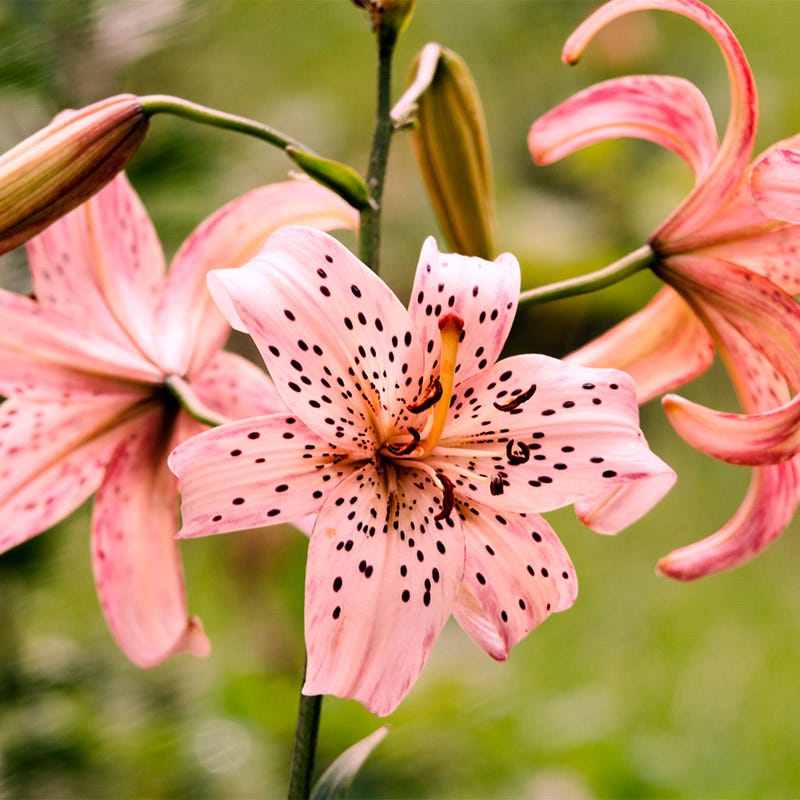
picture of a tiger lily plant

picture of a tiger lily plant Pink Tiger Lily Bulbs, Lilium

Sale price$19.33 Regular price$21.48
Save 10%

Pay in installments of $5.37 with ShopPay, AfterPay and Klarna

Shipping Estimate
USA
  • USA
  • CAN

Ships within 48 hours · Estimated delivery Jul 24 - Jul 29

Promo Codes Available:

For Your Every Summer RSVP, with Code: SUMMER15

Description

picture of a tiger lily plant Pink Tiger Lily Bulbs, LiliumIn more recent years, the hybridizers have managed to create new colors in the Tiger Lily group, maintaining the large flowers, the easy culture, the perennial qualities, and even the handsome black spots of the original Orange Tiger.' The true Tiger Lilies: Don't make a common mistake, and call just any old spotted orange lily a 'Tiger Lily.' Only one group is descended from the real thing. Like most Asian species lilies, this old reliable was a

In more recent years, the hybridizers have managed to create new colors in the Tiger Lily group, maintaining the large flowers, the easy culture, the perennial qualities, and even the handsome black spots of the original Orange Tiger.'

The true Tiger Lilies: Don't make a common mistake, and call just any old spotted orange lily a 'Tiger Lily.' Only one group is descended from the real thing. Like most Asian species lilies, this old reliable was a staple in the Oriental diet for centuries. The bulbs were--and are--cooked for foods and soups. But it's not the taste that made this lily bulb world famous. It's the beautiful flowers and the ease of growing them.

The true Tiger Lily is native to Korea, but today, gardeners the world over enjoy the beautiful big flowers on strong stems that return year after year. In fact, Tiger lilies are now so common in the US, many people think they're native.

As long as you have well-drained soil, they will grow for you, perfectly perennial even in some of America's coldest climates.

This is the lily with little black 'bulbils' (baby bulbs) that form up and down the stem in the leaf axils. These little bulbs drop to the ground naturally, and spring up the next year as baby tiger lily plants. Over the years, you'll have an expanding clump.

This is the perfect no-maintenance lily to add to your flower border or particularly, your wildflower meadow. A few towering lilies over a wild meadow in full bloom is a wonderful mid-summer sight.


Growing Lilies: True lilies (which don't include daylilies and others which are not in the genus Lilium) are easy to grow today, and more popular every season. Since they are upright and take practically no space at ground level, it's easy to plant lilies between other established perennials and shrubs. Most can also tolerate some shade, which adds versatility for the gardener. There are many lily groups, but to keep it simple, we will consider only a few of the main types that are important to gardeners. Each lily we ship includes complete instructions for planting. So don't hesitate. You can easily bring the spectacular beauty of lily flowers to any summer meadow or garden.

'Wild' Lilies or 'Species' Lilies These are the true wildflowers from the world over. They are the ones all the glamorous hybrids are descended from. We're fortunate to have some of these botanical treasures on our list of lilies this season.

Oriental Hybrid Lilies are the now famous, very fragrant ones with large, flattened flowers such as red Stargazer and white Casa Blanca. These are the ones now so popular in the floral trade, but are also very easy to grow. They bloom from mid-summer through early fall. Most have very large, outward-facing, fragrant flowers.

Asiatic Hybrid Lilies are today's largest group of garden lilies, quite easy to 'naturalize'. This growing group of lilies was begun by hybridizers in the US, and were first called 'Mid-Century Hybrids.' Compared to Orientals, the Asiatic Hybrid lilies bloom earlier (early to mid summer), the plants are shorter, the flowers a bit smaller, and most blooms are upward-facing and star-shaped. Some of the most famous Asiatic Hybrids are yellow 'Connecticut King,' and the famous red, 'Gran Paradiso.'

Tiger Lilies. This group is led by the famous old orange wild lily, which used to be called Lilium tigrinum. Botanists have changed that to Lilum lancifolium, but that doesn't stop most people (including us) from using the old name 'tigrinum.' From the original orange, the hybridizers have created new colors from white to pink. All have the large flowers, black spots, and tough perennial qualities of the original. (By the way, don't call any old spotted orange lily 'tiger lily'. This one is the real thing, and no lily common name is more mis-used.)

Trumpet Lilies Sometimes called 'Aurelian Hybrids' or other names, the large, tall trumpet lilies are all descended from The Regal Lily, a white wild species lily from China. All are incredibly fragrant, and wonderful for cutting. They grow tall, and often need staking, since a well-grown stalk can have over 15 huge flowers.

Shipping Notes
  • Free Standard Shipping on $100+ Orders to the USA.
  • Except Preorder products are shipped in 48 hours.
  • Delivery to the USA:
  1. Standard Shipping : 3-10 business days
  • If time is of the essence, please consider selecting expedited delivery for faster service.
Exchange/Return Notes
  • We offer a 30-day return/exchange service after receiving.
  • Final sale items are not eligible for returns or exchanges.
  • To process your return/exchange, please contact us at [email protected]
  • Please click here for more details>>> Return & Exchange Policy
SKU: 48982600476

Discover Niche Categories That Outsell picture of a tiger lily plant

Top-Converting Item to Boost Your Average Order

4.0 ★★★★★
Based on 6 reviews
Sort
Highest Rating
Newest First
Oldest First
Product Reviews
D
Verified Purchase
Donald Walker
Natrona Heights, US
★★★★★ 3
instructive but limited
The testimonies of creative people that give this book its flesh and blood provide fascinating examples of creative people at work. That said, if a journalist had written the book, it would be more readable, and I don't think any less of an intellectual contribution. Moreover, the definition of creativity is elitist and stunts the topic (as observed by other reviewers): "Creativity is any act, idea, or product that changes an existing domain, or that transforms an existing domain into a new one. And the definition of a creative person is: someone whose thoughts or actions change a domain, or establish a new domain. It is important to remember, however, that a domain cannot be changed without the explicit or implicit consent of a field responsible for it." Given the people interviewed, much more needs to be said about the function of social institutions in promoting creativity. Many of the accomplishments lauded in this book would never have happened without grant-making agencies (e.g., NSF, NIH, HHMI) or non-profit employers like research universities and hospitals. To offer just one obvious example of the difference made by one's institutional context, the author had advanced students to help him do his research for this book. The elitism of the definition is even clearer in the role that marketplace plays as a judge of creativity. None of us buys books from amazon.com because some official group validated amazon.com as a good idea. We didn't wait for computer programers to affirm and certify it. Amazon.com is not deemed successful because it impressed its peers. It is successful because millions of us purchase goods through it. Similarly, auto-executives did not make the minivan a successful idea, millions of shoppers did. (Obviously I don't think the marketplace fits into the author's definition of creativity. If 300 million American consumers comprise a domain with 300 million judges, then the word no longer has any useful meaning.) The definition also precludes that countless ephemeral acts of creativity that take place daily. I think instantly of two women I have worked with who were great at holidays. Their clever costumes or decorations brightened my day, adding a little element of surprise and delight. Their acts of creativity don't meet the definitions of this book. The way that creativity is defined in this book is simply a filtering mechanism by which the author selected the people he would interview. It is not a definition of creativity. It is only a description of a subsection of creativity, the kind where institutions provide paychecks to highly practiced individuals to work hard at what they love. I also found little new to take away and apply to my own social existence inside the organization where I work. Perhaps I can summarize my dissatisfaction by observing that the subtitle sets out an agenda for the psychology of creativity, but the definitional filter is intrinsically social. This disconnection sets the book up to fail. So, count this as a negative review, yes, but I did enjoy reading the testimonies of the people interviewed, and the author adds some value in the generalizations he draws. Still, much, much more could have been said.
WAS THIS REVIEW HELPFUL?YesReportShare
Reviewed in the United States on April 30, 2012
J
Verified Purchase
Judith R. Hert
Battle Creek, US
★★★★★ 5
Wise and Complete
Format: Paperback
I've read a lot of books, too many, on creativity, and this is by far the best, the most complete, the most interesting. The idea that creativity comes out of immersion in a domain or field seems absolutely right and the idea missed by so many other writers. I'm a writer and a painter and I've learned that I'm not going to be any better than the work I've come to know and love, that I have to live in that work. If you want to be a better string player, play with a better ensemble. In many ways a creative person is someone who is in a conversation with what has come before, with work that excites her, teaches her, challenges her. This book makes that plain. But he has other insights as well, especially about the creative personality, the interesting dichotomies. Just read the book.
WAS THIS REVIEW HELPFUL?YesReportShare
Reviewed in the United States on February 22, 2015
C
Verified Purchase
Common Arts Farm
Whiting, US
★★★★★ 4
Creativity which has the power to change the world
A few caveats to those who are generally interested in creativity studies: Csikszentmihalyi's analysis and discussion of creativity does not directly relate to those who are personally creative. People who enjoy engaging in creative activities are not demoted, in his terms, but are simply not a part of the study. It is unfortunate that his language makes it seem this way; he distinguishes between the two by saying that Creativity has the power to shape a domain or the world, while creativity applies to those who enjoy coming up with new recipes, who are engaged in research that may not change a domain, but may "tweak" it, etc. What he is trying to discover are the underlying principles and traits of creativity in those whose work has made a significant change. Think Albert Einstein, Eleanor Roosevelt, Mark Strand: people who are either widely known for their influence, or who have been influential within their area or domain. This book provides an interesting view into the minds and work habits of Creative individuals, and concludes by offering general advice to those who wish to make their own lives and work more creative. It is a useful book, but one which requires a great deal of supplemental reading, in order to truly engage in creativity studies.
WAS THIS REVIEW HELPFUL?YesReportShare
Reviewed in the United States on January 29, 2003
T
Verified Purchase
Tracy Carvalho
Phoenix, US
★★★★★ 5
Fun easy to read way to see how the wealthy stay wealthy
Format: Paperback
Mark Quann’s Be Smart Pay Zero Taxes is an eye-opening, engaging, and highly informative guide that challenges everything most of us think we know about taxes, wealth, and the financial system. With his "Buy, Borrow, Die" strategy, Quann presents a bold new way to build and preserve wealth—legally and ethically—while minimizing tax liability. One of the things that really stands out about this book is how approachable and enjoyable it is to read. Quann has a knack for breaking down complex financial concepts into bite-sized, digestible pieces. Whether you're a finance newbie or have been managing your own portfolio for years, you'll find the material easy to grasp and even fun to read. The tone is conversational, and the author's humor and wit shine through, making the book a far cry from the dry, overly technical finance books out there. What I loved most was how Quann exposes the ways in which the banking industry and the government have duped ordinary people into believing we have no choice but to pay exorbitant taxes. He takes a deep dive into the financial system and reveals how the wealthiest individuals have been using clever strategies for years to legally avoid paying significant taxes. The “Buy, Borrow, Die” method isn’t just some gimmick; it’s a smart and effective way to sidestep the tax traps most of us fall into. Quann’s perspective will make you question everything from your investment strategies to the way you think about saving and building wealth. This book empowers you with a strategy that not only helps you protect your wealth but also ensures that you're making the most of what you've worked so hard for. By the end, you’ll realize that we’ve been sold a false narrative about taxes and money, and there’s a much smarter way to approach wealth-building. Overall, Be Smart Pay Zero Taxes is a must-read for anyone who wants to get ahead financially. It’s a wake-up call wrapped in a fun and easy-to-read package. If you're ready to take control of your financial future and start building wealth like the ultra-wealthy, this book is the perfect place to start. Highly recommended!
WAS THIS REVIEW HELPFUL?YesReportShare
Reviewed in the United States on March 28, 2025
I
Verified Purchase
Is it worth it with Renee
Lowell, US
★★★★★ 5
Not Just a Tax Book — A Wealth Blueprint
Format: Paperback
I picked up Be Smart Pay Zero Taxes because I wanted to learn how to be more strategic about building and protecting my money. This book completely changed how I think about wealth. The “Buy, Borrow, Die” strategy finally made sense to me. Instead of just earning more (and paying more taxes), it explains how owning appreciating assets and borrowing strategically can legally reduce your tax burden over time. What I loved most is that it didn’t feel overly technical or intimidating. The author explains things clearly in a way that made me stop and rethink my own financial plan. I found myself highlighting pages and re-reading sections because it challenged how I’ve always approached money. If you feel like the tax system is confusing or unfair, this book brings clarity. It’s not about avoiding taxes illegally — it’s about understanding the system and making smarter decisions within it. For me, this wasn’t just a finance book. It truly felt like a mindset shift. Highly recommend if you're serious about building long-term wealth.
WAS THIS REVIEW HELPFUL?YesReportShare
Reviewed in the United States on February 13, 2026

recommand products