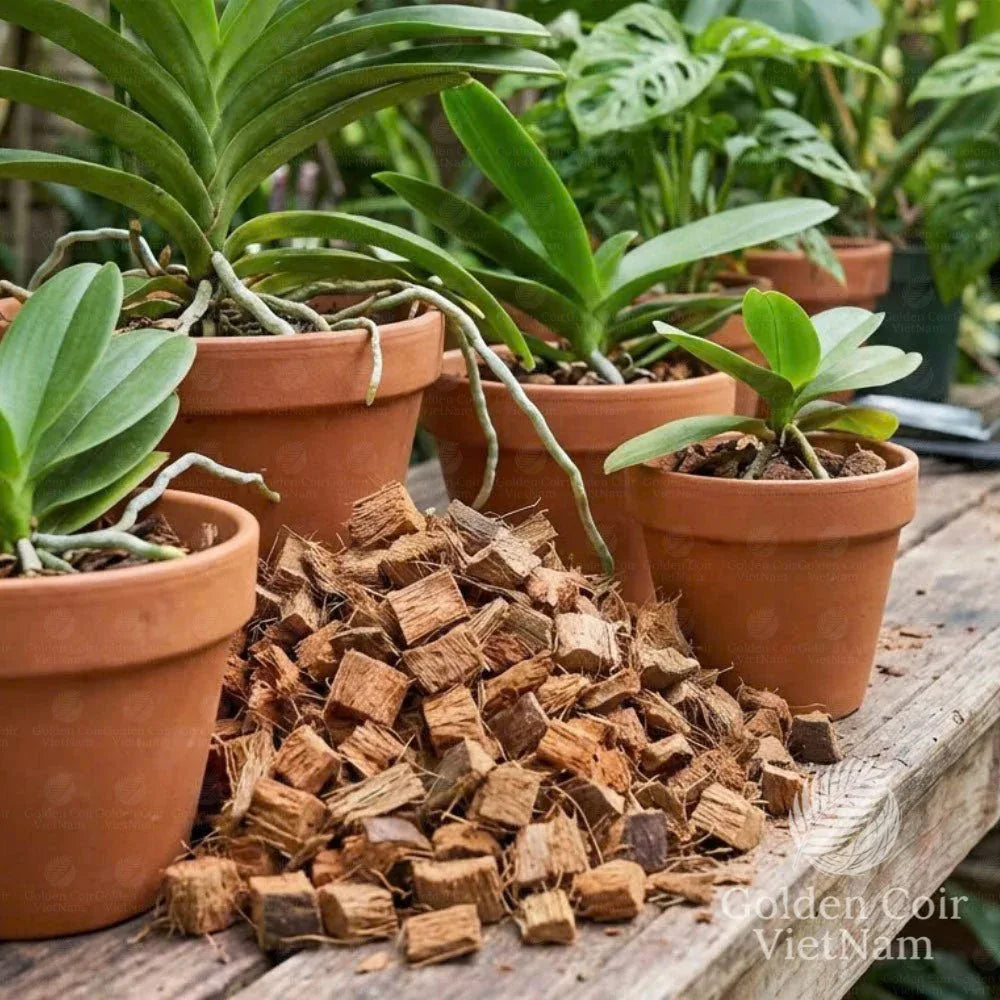
SKU: 47570200833
coco chips potting mix

coco chips potting mix Coco Chips, Organic Coconut Husk Chips for Orchids, Aroids, Potting Mix

Sale price$26.04 Regular price$28.93
Save 10%

Pay in installments of $7.23 with ShopPay, AfterPay and Klarna

Shipping Estimate
USA
  • USA
  • CAN

Ships within 48 hours · Estimated delivery Jul 20 - Jul 25

Promo Codes Available:

For Your Every Summer RSVP, with Code: SUMMER15

Description

coco chips potting mix Coco Chips, Organic Coconut Husk Chips for Orchids, Aroids, Potting MixProduct Information Coco Coir Chips Bulk from Vietnam are supplied by Golden Coir Vietnam using coconut husk sourced from Ben Tre, Vietnam. These chips are widely used in potting mixes, orchid media, aroid mixes, mulch, and hydroponic growing blends. For buyers looking for a chunkier coconut based growing medium, coco coir chips bulk are a practical option for improving airflow, drainage, and structure in the root zone. 1. What Are Coco Coir Chips?

Product Information

Coco Coir Chips Bulk from Vietnam are supplied by Golden Coir Vietnam using coconut husk sourced from Ben Tre, Vietnam. These chips are widely used in potting mixes, orchid media, aroid mixes, mulch, and hydroponic growing blends. For buyers looking for a chunkier coconut-based growing medium, coco coir chips bulk are a practical option for improving airflow, drainage, and structure in the root zone.

1. What Are Coco Coir Chips?

Coco coir chips are cut pieces of coconut husk. They are larger than fine coco coir or coco peat, which gives them a chunkier texture in the growing mix. This helps create air pockets around the roots while still holding enough moisture for healthy plant growth.

2. Why Growers Use Coco Chips

The structure of coco coir chips for plants helps prevent growing media from packing down too quickly. Compared with dense soil, the chips help open the mix. Compared with fine coir, the chips add more structure and better drainage. That is why many growers use them for orchids, aroids, and specialty plants that do not do well in compacted media.

3. Moisture and Airflow Balance

Coconut husk chips hold moisture while still allowing extra water to drain away. This supports a better balance between moisture retention and root airflow. For many growers, that balance makes organic coco coir chips useful in both indoor and commercial growing applications.

4. Renewable Coconut-Based Growing Medium

Coco chips are made from coconut husk, a renewable by-product of the coconut industry. For importers, wholesalers, and commercial growers, they offer a coconut-based alternative to some peat-based or bark-based substrates.

Technical Specifications
Specification Detail User Benefit
Product Name Coco Coir Chips Bulk from Vietnam Clear positioning for buyers sourcing coconut husk chips in bulk.
Brand / Supplier Golden Coir Vietnam Supports supplier identity and export trust.
Raw Material Natural coconut husk from Ben Tre, Vietnam Made from renewable coconut material from a known sourcing region.
Material Type Cut coco husk chips / chunky coconut substrate Adds structure, drainage, and root-zone airflow.
Main Applications Potting mixes, orchid media, aroid mixes, mulch, hydroponic growing blends Useful across indoor growing, greenhouse use, and commercial substrate production.
Texture Chunky structure Helps prevent compaction and improves air space around roots.
Moisture Behavior Holds moisture while allowing excess water to drain Supports a more balanced growing medium for roots.
Suitable Crops Orchids, aroids, monstera, philodendron, anthurium, indoor plants Good option for plants that prefer an airy, open substrate.
Use Format Bulk supply for importers, wholesalers, and growers Supports large-volume orders and export needs.
Origin Vietnam Useful for buyers searching for bulk coco coir chips from Vietnam.
Usage

Coco coir chips are commonly used when growers want a chunkier substrate that creates more airflow in the mix. They work well as a standalone component in some systems or as part of a blended growing medium.

Common Uses for Coco Coir Chips

  • Orchid growing
  • Aroid potting mixes
  • Indoor plant substrate blends
  • Hydroponic growing medium mixes
  • Mulch for potted plants and garden beds
  • Soil improvement in container gardening

Works Well in Potting Mixes

Coco chips are often blended with coco peat, perlite, bark, compost, or other substrate materials to build a more balanced mix. This helps growers manage both moisture retention and drainage depending on plant type.

Coco Chips for Orchids and Aroids

Many growers use coco coir chips for orchids and aroids because the chunky texture helps support drainage and root airflow. They are also popular for monstera, philodendron, anthurium, and similar plants that prefer an open root zone.

Coco Chips vs Coco Coir

People often use these terms together, but they are not the same. Coco coir usually refers to finer material such as coco peat or fiber, which holds more water. Coco chips are larger cut pieces of coconut husk that add structure, airflow, and drainage.

  • Use coco coir when you want more water retention
  • Use coco chips when you want more airflow and chunkier texture
  • Use both together when you want a more balanced growing medium

Coco Coir Chips vs Orchid Bark

For growers comparing coco coir chips vs orchid bark, coco chips are often chosen as a coconut-based alternative that holds moisture a bit longer while still keeping the mix open.

Shipping & Order Terms

Golden Coir Vietnam works with importers, wholesalers, and commercial growers who need a steady source of coco coir chips bulk from Vietnam. We understand that buyers need more than product availability. They also need clear communication, stable supply, and on-time shipping.

Bulk Supply from Vietnam

We source raw material from Ben Tre and produce coconut-based products for export. If you are looking for coco coir husk chips, coco chips, or coco chip coir mulch for your market, we can support bulk supply and export orders from Vietnam.

Production and Delivery Support

Golden Coir Vietnam works to keep production moving and orders prepared for shipment as scheduled. We also coordinate with shipping partners to support international delivery for overseas buyers.

About Golden Coir Vietnam

Golden Coir Vietnam focuses on coconut-based products made for export. Our goal is to provide overseas buyers with a dependable source of coconut materials from Vietnam, including coco coir chips, coir rope, coconut fiber, and other coconut husk products.

Shipping Notes
  • Free Standard Shipping on $100+ Orders to the USA.
  • Except Preorder products are shipped in 48 hours.
  • Delivery to the USA:
  1. Standard Shipping : 3-10 business days
  • If time is of the essence, please consider selecting expedited delivery for faster service.
Exchange/Return Notes
  • We offer a 30-day return/exchange service after receiving.
  • Final sale items are not eligible for returns or exchanges.
  • To process your return/exchange, please contact us at [email protected]
  • Please click here for more details>>> Return & Exchange Policy
SKU: 47570200833

Discover Niche Categories That Outsell coco chips potting mix

Top-Converting Item to Boost Your Average Order

4.6 ★★★★★
Based on 28 reviews
Sort
Highest Rating
Newest First
Oldest First
Product Reviews
R
Verified Purchase
Ricky Luis
Battle Creek, US
★★★★★ 5
One more crappy college study guide
Format: Paperback
When I was taking 4 classes at my local community college, I tried to follow the part of the book that said just to learn math by examples. I ended having to drop the class because at first I was actually ahead of the professor. Then I tried this stupid book's technique of learning by examples and I ended up falling behind. The same can be said of "What smart students know" it's actually a good technique (smart students), but you end up spending hours thinking up questions. Questions can be a part of the process, but it can't be the whole process. I just bought an online course than is way better than both of these combined. It's so good. The point I'm at in the course you can memorize up to 50 items in reverse and forward. You can also tell which place in the list. An example could be The order of my hallway: Dog = front door Cat = wall Duck = light switch Printer = holder Hitler = chair MAO = rug Goku = ceiling light Kurrin = mirror Gohan = heater Frieza = painting You would then connect / visualize each word / picture with a part of your house. The rule is to visualize each for only 6 seconds while recalling can only take 6 seconds. If you miss one you have to do the six second process again until you make no mistakes. P.S. I'm not telling anyone the name of the course or where to buy it. I want to be ahead of all other students. Edit: I'm back in college taking two college level courses. While I don't agree with everything in this book (I have to re-read it) I agree with 80-85% of the methods used in this book that I remember. Such as not doing the reading he was right. I haven't done the reading in my psychology 101 class and have only focused on taking / memorizing / learning the notes and while I haven't gotten a grade yet, I actually feel I'm learning enough and today in class I note notes from a documentary we watched. The professor said to do the reading for chapter 2 of the textbook. I'm not even going to do it. I'm going to just take notes in class then go over the reading. I did this for my 1st set of notes and I didn't understand something in the lecture notes. I ended up re-reading that / part / example [it was on the scientific method]. I remember from taking my developmental math class that the professor was actually doing examples (even though I couldn't figure out from what part of the book they were from and / or I couldn't write every example like he said) If I had just asked questions and either watched videos on Youtube I would've probably remembered the material from that class. I'll do another edit once I'm done with classes. I'm also going to write / provide a list of books that I think are good for learning and have good advice for college. Edit: I ended up trying to do the advice from this book and if I didn't look up the answers for the test for my psychology class I wouldn't be in college today. I'm not saying that all of this book is bad but I went from thinking that 85% of it is good to now thinking that 50% of this book is good. The other half is crap. Such as the technique for Q/E/C he doesn't give any examples or enough examples. The other advice like making your own problem sets I wouldn't have thought of. Even though this is an all right technique your wasting time because you can just practice doing other peoples problems (like those online or from a professor) or do Bullet point concept from another book I read (I'm going to provide a list once I'm done with this review). The one technique that is very good is the lecture technique he mentions in the book. For some reason, this technique helps with putting material into memory. His section on writing papers is also very good. His explanation on how to prepare for and take exams is also good. Also, he should have made the book more visual and put actual writing from actual students other than that it's an all right book. Here's the list of books I've read (so far) that will most likely get you A's College Rules https://www.amazon.com/College-Rules-4th-Survive-Succeed/dp/1607748525/ref=sr_1_1?s=books&ie=UTF8&qid=1530133408&sr=1-1&keywords=college+rules Guaranteed 4.0 https://www.amazon.com/Guaranteed-Follow-3-Step-Plan-Dont/dp/0974264806/ref=sr_1_1?s=books&ie=UTF8&qid=1530134451&sr=1-1&keywords=guranteed+4.0 How to study in college https://www.amazon.com/How-Study-College-Walter-Pauk/dp/1133960782/ref=sr_1_4?s=books&ie=UTF8&qid=1530134633&sr=1-4&keywords=how+to+study+in+college The only book I've read from cover to cover is GT 4.0 it's probably the best in my opinion because the system in this book will get you A's. The only reason last semester I didn't get A's was because I didn't follow the system to the t. If you follow the GT 4.0 system to a t and don't get all A's she'll give you $100. Hope this helps. Edit 2020: From what I remember reading this book, this applies to college level courses and even at the same time I tried using his question / evidence technique while taking a psy101 class and couldn't do it. Also he's right to a very large degree about living off of lecture notes. Living off of the lecture notes IMHO can only be done if it's a science science class or a college level math class. I'm currently taking a pre-req class and the professor explains everything. Along with the Guaranteed 4.0 technique this is a pretty decent book.
WAS THIS REVIEW HELPFUL?YesReportShare
Reviewed in the United States on January 24, 2012
S
Verified Purchase
S. Bandy
Grantham, US
★★★★★ 4
Wish I had read this sooner
Format: Paperback
This book is not that revolutionary, but very helpful. It essentially tackles three main problem areas for college students: 1) time management skills, 2) studying and exam prep, and 3) essay writing. Some of these are common sense things that many people resist implementing. If you are struggling with college, or are a high school senior unsure of what to expect in college, this book is very helpful. The true value in this book, for me at least, was in providing the satisfaction that these strategies worked. I would often start out a semester by doing the things listed in the book. I would manage my time, study effectively for exams, thoughtfully plan out papers and assignments. Halfway through the semester, I always had straight As. But as finals crept up, I would panic. Since every other student spent hours in the library studying, I abandoned the effective strategies to follow suit. As a result, my final exam grades were inconsistent and my final papers were always rushed. This book gave me the satisfaction of knowing that I can trust these time saving strategies. You do not need to spend hours and hours on projects to get a good grade. It's okay to not spend hours in the library studying for a final. Trust that these strategies work, and enjoy your stress-free semester. But, the book does have faults. While this book provides very useful information, I feel it misses two aspects of the college experience that can have a large impact on your grade: presentations and group projects. (Also the dreaded group presentation). While you can implement some of these strategies in these situations, it would be nice to know how top students manage working in group project settings, especially those that require research. I can't tell you how many times I've been in a group project where half the group doesn't show up to meetings, members refuse to do their work, or people drop the class halfway through the project. I still haven't figured out an adequate way to deal with these situations besides just doing the work myself at the last minute. Bottom line, this book is well worth the money. Whether you are a college senior or a high school senior and everything in between, this book will help you as long as you faithfully implement the strategies. But do search out other resources for help with managing group projects.
WAS THIS REVIEW HELPFUL?YesReportShare
Reviewed in the United States on December 12, 2012
T
Verified Purchase
tavodu
New York, US
★★★★★ 5
Tried it, it worked!
Format: Paperback
I first have to say I practiced what the author tell us to do, and that semester I got A's on all my classes, and my GPA has improved considerably (I wish I had read this several years ago). I bought this book at the end of 2011 and decided to put to practice what it says. I was very amazed at my former roommate's 5.0 GPA and scholarship to Stanford once he got his minor in Biology. This guy would just come home, watch movies, go out with his girlfriend, play sports a lot, go dancing, etc. We never saw him cramming or pulling one all-nighter, NOT EVEN ONCE!. The other 2 guys were jealous studying like crazy but with 3.85 GPA. When I asked him about his success he said he wasn't doing anything special, except for staying in school until he finished his homework for the day. It didn't make sense since we saw him at home around 6 pm. "I just divide the work for each assignment unless it is too easy, and I never stay more than 1 or 2 hours doing just one assignment, That helps me usually get over 100% so at the end of the semester I don't have to worry too much about tests and other stuff like that; I don't read the whole thing, EVER! I would never be able to read the 100+ pages required each week, plus memorizing, and then doing an essay, it is ridiculous." I read a few books about getting A's (I am from Mexico so the grading system is different), but they all said the same: read the whole thing, learn everything to avoid surprises, repeat it but in your own words, make notes in every paragraph, develop mental maps, and so on... This book is different (some of the things are similar but not the same). Here's the most useful piece of advice I got from it: It is very often more important to know what NOT to study, than what to study. Time is very limited and we shouldn't waste it trying to read all the materials, learn absolutely everything for the tests, etc (especially the night before whatever is due). Your brain will shut off before you can do that, so you're better off knowing what you can and cannot do without burning out. I also have to say I enjoyed precious nights of deep sleep, and going to the test with a fresh mind (and scent), instead of tired, desperate, stinky, and trying to memorize 5 minutes before the test. This book is a lot about having free time to enjoy (not just getting drunk like some reviewers said) while others are wishing they would have studied earlier. It is a lot about structure and dividing the workload throughout the semester, month, week, day. You need to pay attention since at some point it could get a little tedious, like when he explains how to prepare for an essay. But if you try them they will work; the ultimate goal here is making college less tedious, more enjoyable, and an experience that will enrich your life instead of becoming a very expensive hell. It is also worth mentioning that the author is not giving you something he just though of, but these are common habits among top students attending top universities. I can also suggest you try the methods in the book and combine them with others such as mnemonics; I memorize whatever information I don't think I'll need in the future, and just pour it on the test, then forget about the rest; I do this ONLY with useless info that won't help me in any other class, and when I know the test will allow it (like multiple choice, short answers, yes/no, etc). Would definitely recommend it.
WAS THIS REVIEW HELPFUL?YesReportShare
Reviewed in the United States on September 14, 2012
M
Verified Purchase
Michelle Fehr
Louisville, US
★★★★★ 5
Struggling College Students...This is a Great Help!!
Format: Paperback
Picking up the book How to Become a Straight-A Student by Cal Newport I hoped to improve my study skills and eliminate my procrastination. Cal Newport is a professor at Georgetown University and is the author of five self-improvement books. He is the founder of Study Hacks, which is one of the Web’s most popular student advice blog. Newport uses his own knowledge of being a successful college student and conducted interviews receiving advice from top-scoring undergraduates from some of the “most rigorous colleges and universities – including Harvard, Princeton, Yale, Dartmouth, Brown, Columbia, Duke…” (3). Newport uses humor and an easy to understand conversational style of writing to keep the reader engaged. The book is set up in three parts. Part 1 is titled Study Basics and has 3 steps that it touches on. Part 2 is titled Quizzes and Exams and consists of 6 steps. Part 3 is titled Essays and Papers and has 8 steps. At the end of each part there are “Cheat Sheets” that summarize each part in a bullet style fashion. Two of the three steps spoken about in the book include “The Plan in Action” section. These sections use situational examples to give the reader a more visual explanation of the information the author describes. One of the most influential topics Newport touched on –I thought— was part one of his book – “Study Basics” (11). He splits this topic up into three steps. My favorite step was step one – “Manage Your Time in Five Minutes a Day” (19). The main idea of this section is to have a record of all your to-dos and deadlines on your calendar. Another thing I liked about the book was that Cal uses real life examples of successful college students to prove his point. He also uses direct quotes from top-rated students at major universities that said things like “Time management is critical – it’s a skill that you absolutely must develop over the course of your time at college” (19). Looking at the perspective from a student that already manages their time and occasionally gets that one low grade that they cannot for the life of the get up and is looking for helpful tips to fine tune that B to an A— this book is probably not for you. Although I do see the down side to this book to an audience that is already studious and knows how to manage their time, but overall, Newport has a lot of advice to give to student who are in the early stages of learning how to be a good student. A person might give a bad rating because it did not help them. People like me who chose to read this book because they were never really taught how to study, manage their time, or how write a college paper or know tricks in taking exams and tests – this book will help you; for that I am giving this book a 5/5 star.
WAS THIS REVIEW HELPFUL?YesReportShare
Reviewed in the United States on December 10, 2017
J
Verified Purchase
Jenny Rogers
Natrona Heights, US
★★★★★ 5
this book was great, it helped me when I was a college student 10 years ago...
Format: Paperback
Now I work as a guidance counselor and I bought 5 copies to gift to my advisees for new years gift!
WAS THIS REVIEW HELPFUL?YesReportShare
Reviewed in the United States on January 24, 2026

recommand products