SKU: 43575539215
hilo hawaii ponytail palm

hilo hawaii ponytail palm Ponytail Palm — Jolly Green Nursery

Sale price$19.74 Regular price$21.93
Save 10%

Pay in installments of $5.48 with ShopPay, AfterPay and Klarna

Shipping Estimate
USA
  • USA
  • CAN

Ships within 48 hours · Estimated delivery Jul 20 - Jul 25

Promo Codes Available:

For Your Every Summer RSVP, with Code: SUMMER15

Description

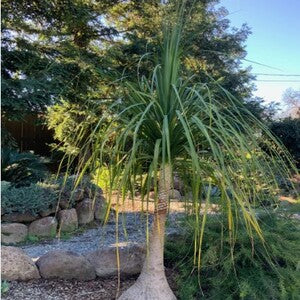
hilo hawaii ponytail palm Ponytail Palm — Jolly Green NurseryPonytail Palm (Beaucarnea recurvata) Common Names: Ponytail Palm, Elephant's Foot Tree, Bottle Palm, Monja. Best Growing Environment: Ponytail Palms are not true palms but are a type of succulent. They're native to eastern Mexico's semi desert regions and thrive in dry, well draining soils. Their bulbous base, often likened to an elephant's foot, stores water, enabling the plant to endure drought conditions. Average Height: In indoor settings,

Ponytail Palm (Beaucarnea recurvata)

Common Names: Ponytail Palm, Elephant's Foot Tree, Bottle Palm, Monja.

Best Growing Environment: Ponytail Palms are not true palms but are a type of succulent. They're native to eastern Mexico's semi-desert regions and thrive in dry, well-draining soils. Their bulbous base, often likened to an elephant's foot, stores water, enabling the plant to endure drought conditions.

Average Height: In indoor settings, Ponytail Palms typically range from 6 to 8 feet tall. However, in their natural outdoor habitat, they can reach heights of up to 20-30 feet.

Growth Rate: These plants are relatively slow-growing, especially when kept indoors or in containers.

Sun Requirements: Ponytail Palms adore sunlight. Indoors, they should be placed near a window that receives bright, indirect light. Outdoors, they can handle full sun but will also tolerate partial shade.

Cold Hardiness: While the Ponytail Palm is hardy, it doesn't fare well in freezing temperatures. It is best suited for USDA zones 9-11. In colder zones, it's preferable to grow them in containers that can be moved indoors during the winter.

Water Requirements: Due to their succulent nature, Ponytail Palms are drought-tolerant. Overwatering is a common mistake. It's best to let the soil dry out between waterings. When you do water, ensure it's a deep watering and that the pot has adequate drainage to prevent root rot.

Fertilizing Guide: While Ponytail Palms aren't particularly demanding about fertilization, a light application of a balanced, water-soluble fertilizer during the growing season (spring and summer) can support their growth. Fertilize once or twice during this period and avoid fertilizing in the fall and winter.

Planting Guide: When planting a Ponytail Palm, select a well-draining potting mix, ideally cactus or succulent soil. Ensure the pot has good drainage. Plant the palm so that the bulbous base is above the soil. When the soil is entirely dry to the touch, water thoroughly. If planting outdoors, choose a spot with well-draining soil and ensure the base remains above ground level.

USDA Zone: The Ponytail Palm thrives in USDA zones 9-11.

Distinctive with its swollen base and long, hair-like leaves that cascade downwards, the Ponytail Palm is a unique addition to any indoor or outdoor space. Contrary to its name, it's not a true palm but rather a member of the Agave family. This easy-to-care-for plant is an excellent choice for those new to gardening or those who prefer low-maintenance plants.

Shipping Notes
  • Free Standard Shipping on $100+ Orders to the USA.
  • Except Preorder products are shipped in 48 hours.
  • Delivery to the USA:
  1. Standard Shipping : 3-10 business days
  • If time is of the essence, please consider selecting expedited delivery for faster service.
Exchange/Return Notes
  • We offer a 30-day return/exchange service after receiving.
  • Final sale items are not eligible for returns or exchanges.
  • To process your return/exchange, please contact us at [email protected]
  • Please click here for more details>>> Return & Exchange Policy
SKU: 43575539215

Discover Niche Categories That Outsell hilo hawaii ponytail palm

Top-Converting Item to Boost Your Average Order

4.1 ★★★★★
Based on 7 reviews
Sort
Highest Rating
Newest First
Oldest First
Product Reviews
S
Verified Purchase
Sea Dog (retired)
Cuba, US
★★★★★ 5
A Comprehensive Balanced History of the Guadalcanal Campaign -- Must Read!
Format: Hardcover
I've read a number of good books on the Guadalcanal campaign, and always thought that "Neptune's Inferno" by Hornfischer was the absolute best. I was wrong. Although Hornfischer does a superb account of the Navy and its travails and triumphs, Inferno doesn't delve deeply into the Marine (and Army) land battles. This book does both. Moreover, it provides a continuous timeline of both, and does so in such a way that the reader better understands both as related actions. For instance, I was never really aware that for the first three and a half months the Americans controlled the seas during daylight, and the Japanese at night (sounds a little like Viet Nam). The November 13 sea battle between Americans and Japanese -- in which US cruisers took on Japanese battleships and two American admirals died -- was in fact a clash of a major last ditch effort by the Japanese to reinforce their troops and destroy Henderson Field, which would have allowed them to control the seas both day and night. By that time there had been multiple bloody battles ashore between the Marines and Japanese, with the balance favoring the Marines, but if the Japanese had wrested control of the airfield and seas that would have been old history. The book includes a good view from the Japanese perspective, and some little known historical tidbets as well, e.g., Guadalcanal received its name from the Spanish home town of a ships officer who accompanied Spanish explorer Don Alvaro Medana, who discovered the island during a 1568 expedition to discover the fabled King Solomon's gold mines. Who knew? :-) Bottom line: I highly recommend this book, both for its balanced coverage of the entire campaign, land and sea, and even more for its integrated narrative -- you know what was taking place (or had taken place) on almost a day-by-day basis, which allows the reader to fully appreciate how actions ashore influenced those at sea, and vice versa. IMO, a must read, even for those who thought (like me) that they knew it all!
WAS THIS REVIEW HELPFUL?YesReportShare
Reviewed in the United States on October 12, 2017
J
Verified Purchase
Jeffrey T. Munson
Grantham, US
★★★★★ 5
The Island Of Death
Format: Hardcover
On August 7th, 1942, American Marines stormed ashore on Guadalcanal. What lay before them was a six-month odyssey of fighting against the best of what the Japanese had to offer. In this fine book, author Joseph Wheelan describes the battle that turned the tide in the Pacific War. The Japanese had started construction of an airfield on Guadalcanal. If completed, Japanese aircraft would be able to harass American convoys and threaten Australia. The Americans seized the airfield and eventually, planes from the Cactus Air Force began attacking the Japanese. Throughout the book, the reader learns about all phases of the Guadalcanal campaign, including the battles of Alligator Creek and Bloody Ridge. On the sea, the Americans and Japanese slugged it out at Savo Island, as well as the great naval battles of November, 1942. Names such as Chesty Puller, John Baslone, "Archie" Vandegrift, Joe Foss, and "Bull" Halsey became household names in the United States. Each side lost many men, ships, and planes, but the tenacity and, finally, the industrial might and the ability to rapidly replace losses, led the Americans to victory. Never again would the Japanese regain the offensive in the Pacific War. "Midnight in the Pacific" is a very good book, and the author has done a good job of describing all of the main points of the battle. Each chapter is broken down into a single month's worth of action, and the narrative is well-written. Highly recommended.
WAS THIS REVIEW HELPFUL?YesReportShare
Reviewed in the United States on September 25, 2017
L
Verified Purchase
Laurence J. Rusiecki
Houston, US
★★★★★ 4
Good Narrative History
Format: Hardcover
The account of the Guadalcanal campaign was well-written. It has several good maps but it falls short with the two carrier battles associated with the action. There should have detailed maps for the Battle of the Eastern Solomons and the Battle of the Santa Cruz Islands. Aside from this shortcoming, the book provides an excellent, readable history of a crucial confrontation between the US and Japan.
WAS THIS REVIEW HELPFUL?YesReportShare
Reviewed in the United States on April 7, 2019
D
Verified Purchase
Donald J. Hanson
Massapequa, US
★★★★★ 5
A Very Thorough Accounting of One of the Most Savage Battles of World War 2
Format: Kindle
My father served in the United States Marine Corps during World War 2 and fought in the first offensive battle by the US during the war, the battle for the island of Guadalcanal. He was seriously wounded there and evacuated back to the states where he spent a year in a naval hospital. As a result, I have read many of the books about this battle. This book was particularly interesting because the author described the battle from the perspective of both the allied forces and the Japanese, drawing from historical records and other books. It was a very thorough accounting and demonstrated what a monstrous battle this was. I only wish my father were still alive so that I could have discussed it with him. His experience at Guadalcanal was not something he would often talk about, but considering savagery of what he saw and endured, I understand. If you are interested in Guadalcanal, I recommend this book.
WAS THIS REVIEW HELPFUL?YesReportShare
Reviewed in the United States on October 21, 2017
Q
Verified Purchase
qtjudyg
Chelsea, US
★★★★★ 5
Excellent book on the Campaign!
Format: Hardcover
I highly recommend this book! I have read many books on the Guadalcanal Campaign and I rate this one at the top. It has just the right blend of stragity and personal accounts to keep the story interesting. It is actually a real page-turner, which is rare for a non-fiction work. Wheelan writes in a style that reminds me of the books I read in my teens by Cornelius Ryan and John Toland, which captured my interest in WWII and history. The book jumps right into the invasion, no multiple chapters concerning the planning and build up, but this info is covered later. All phases of this campaign are covered; ground, air and sea. The maps are okay. There are never enough. The author skims over much of the U. S. Army battles after the Marines are relieved, but that seems to be a trend in all of the books on Guadalcanal that I have read. Overall, this is an excellent book for those who want to learn about the campaign and those who need a re-fresher after reading Starvation Island and Guadalcanal by Frank in years past.
WAS THIS REVIEW HELPFUL?YesReportShare
Reviewed in the United States on October 1, 2017

recommand products