SKU: 4044019816
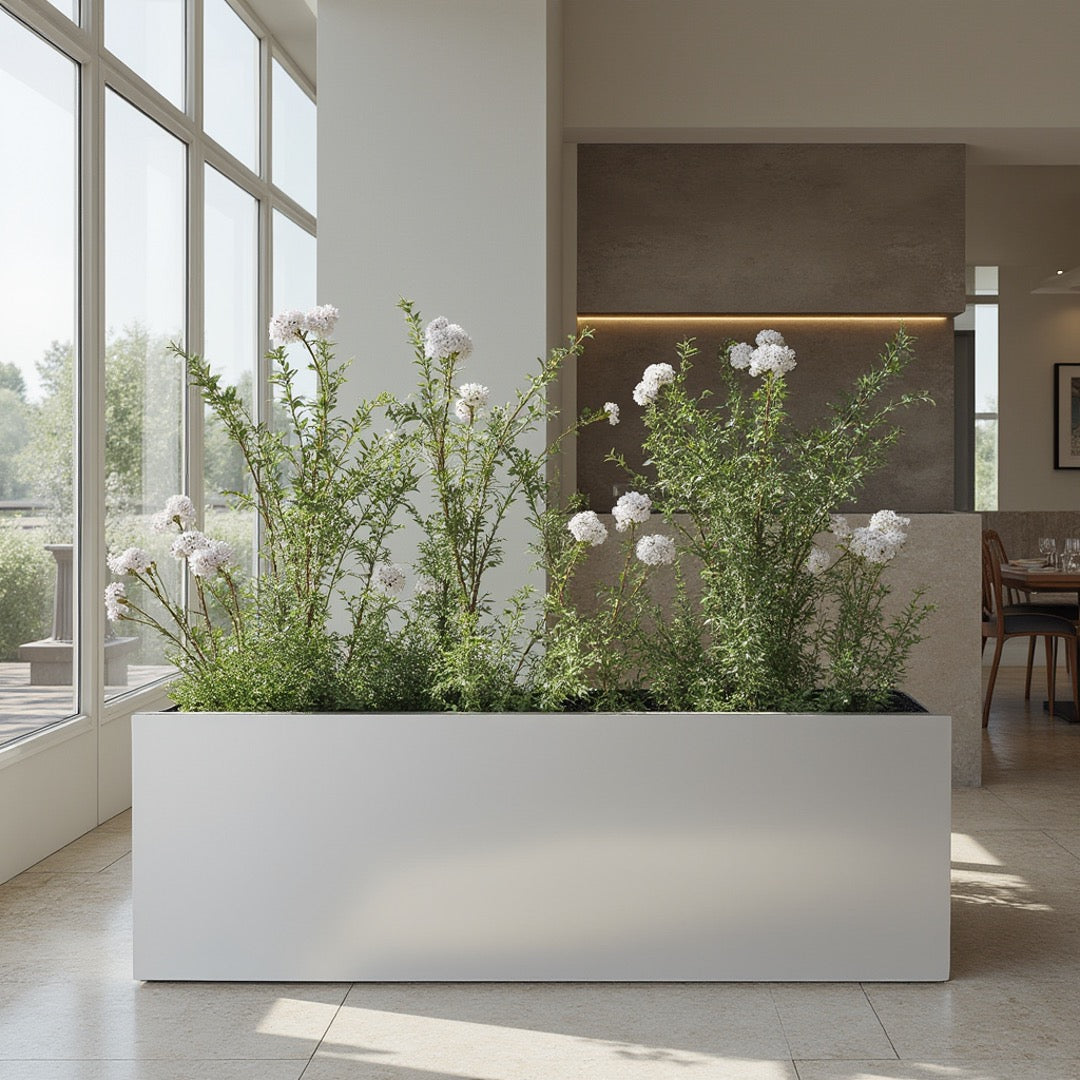
long rectangular planter indoor

long rectangular planter indoor Large

Sale price$20.92 Regular price$23.24
Save 10%

Shipping Estimate
USA
  • USA
  • CAN

Ships within 48 hours · Estimated delivery Jul 11 - Jul 16

Promo Codes Available:

For Your Every Summer RSVP, with Code: SUMMER15

Description

long rectangular planter indoor LargeMadeira Rectangle Planter Seamless Modern Minimalist Aluminum (Silver) Metal, Large Long Block 12" Height x 30" Long Architectural Industrial Planter Box Outdoor Indoor No Drainage Elevate your dcor and create a visually stunning display of greenery! Ultra Heavy Duty Brushed Aluminum. Durable and long lasting. Lightweight and easy to reposition. No Drainage Holes. Easily drillable. Waterproof Epoxy Lining Indoor or Outdoor use. Everywhere to make a

Madeira Rectangle Planter - Seamless Modern Minimalist Aluminum (Silver) Metal, Large Long Block 12" Height x 30" Long Architectural / Industrial Planter Box - Outdoor / Indoor - No Drainage

Elevate your décor and create a visually stunning display of greenery!

  • Ultra Heavy-Duty Brushed Aluminum. Durable and long-lasting.
  • Lightweight and easy to reposition.
  • No Drainage Holes. Easily drillable. 
  • Waterproof Epoxy Lining
  • Indoor or Outdoor use. Everywhere to make a statement. Entrances, Patio, Balcony, Commercial Spaces
  • Modern and Contemporary Rectangle Design
  • Weather and UV Resistant Finish
  • 30” L x 12” W x 12” H
  • Made in India by NMN Designs

30" Rectangular Span Aluminum Planter

The 30" Rectangular Span Planter is a streamlined solution for defining boundaries and adding structured greenery to any environment. With its elongated profile and minimalist design, this planter serves as a high-end architectural tool for creating natural partitions in lobbies, offices, and outdoor terraces.

Customizable Drainage Options

Designed as a watertight vessel, the Span Planter offers total flexibility for indoor placement, ensuring floors and delicate surfaces remain protected. For permanent outdoor installations, drainage holes can be easily drilled using a standard metal drill bit, allowing for direct planting and proper moisture management in exposed environments.

Engineered Excellence

Crafted from high-grade brushed aluminum, the Span Planter features seamless welding for a flawless, modern finish. The interior is treated with a waterproof epoxy lining, enhancing its durability and ensuring long-term performance. Lightweight and frost-resistant, it is built to maintain its structural integrity in any professional setting.


Why Choose Aluminum for Architectural and Commercial Spaces?

Aluminum is the preferred material for professional installations due to its specific performance advantages:

  • High Strength-to-Weight Ratio: This 30" trough is significantly lighter than stone or concrete, making it easy to move and install while remaining structurally rigid.

  • Natural Corrosion Resistance: Aluminum resists rust naturally. It remains unaffected by moisture, making it ideal for high-traffic outdoor areas.

  • Structural Stability: Aluminum does not warp or crack like wood or plastic. It maintains sharp, clean rectangular lines even in extreme temperature fluctuations.

  • Ease of Customization: Unlike fiberglass or stone, aluminum can be easily modified on-site—such as drilling drainage holes—without compromising the material's integrity.

Placement & Plant Suggestions

Indoor Placements

  • Reception Counter: The 30" length provides a professional buffer without obstructing sightlines.

  • Window Ledges: The 12" width fits most deep ledges, creating a living curtain for natural privacy.

  • Office Zoning: Use multiple units atop low cabinets to define work zones while maintaining an open feel.

Outdoor Placements

  • Rooftop Terraces: Being lightweight, these are ideal for weight-restricted balconies and rooftop decks.

  • Entrance Framing: Use a pair of Span planters to flank a doorway or walkway, creating a crisp, geometric entrance.

  • Patio Dividers: Align several planters to create a "low wall" that defines outdoor dining or seating areas.

  • Poolside Accents: The corrosion-resistant aluminum is ideal for poolside environments, as it will not rust from moisture exposure.

Recommended Plant Pairings

  • Snake Plants (Sansevieria): Their vertical growth complements the modern lines; perfect for indoor privacy.

  • Ornamental Grasses (e.g., Blue Fescue): Excellent for outdoor movement and texture against the smooth metal.

  • Low Boxwood Hedge: For a formal outdoor look, three small boxwoods create a clean geometric silhouette.

  • Agave or Succulents: These thrive in low-water environments and offer a high-end, low-maintenance aesthetic.

Also available with raised base for indoor use.

Madeira Large Rectangle is just one style from the Madeira Metal Planter Collection. You can add coordinating shapes to your collection.

Save Extra 10% OFF Entire Order ($125 Minimum) with Code GET10

Enjoy always free, fast shipping. Typically the same business day or the next.

Shipping Notes
  • Free Standard Shipping on $100+ Orders to the USA.
  • Except Preorder products are shipped in 48 hours.
  • Delivery to the USA:
  1. Standard Shipping : 3-10 business days
  • If time is of the essence, please consider selecting expedited delivery for faster service.
Exchange/Return Notes
  • We offer a 30-day return/exchange service after receiving.
  • Final sale items are not eligible for returns or exchanges.
  • To process your return/exchange, please contact us at [email protected]
  • Please click here for more details>>> Return & Exchange Policy
SKU: 4044019816

Discover Niche Categories That Outsell long rectangular planter indoor

Top-Converting Item to Boost Your Average Order

4.7 ★★★★★
Based on 1479 reviews
Sort
Highest Rating
Newest First
Oldest First
Product Reviews
M
Verified Purchase
Mary L Mazzocco
Alexandria, US
★★★★★ 5
Hickey and Minnie
Format: Hardcover
These small books fit into a toddlers hand with vibrant pictures and just enough text to hold their interest. The box is fun to carry
WAS THIS REVIEW HELPFUL?YesReportShare
Reviewed in the United States on May 24, 2026
T
Verified Purchase
Tahira
Port Orchard, US
★★★★★ 5
Size
Format: Hardcover
Nice books! Bought these for my 2 year old grandson fits his little hands perfect. Cute and durable carrying case.
WAS THIS REVIEW HELPFUL?YesReportShare
Reviewed in the United States on April 25, 2026
D
Verified Purchase
Dayna
Louisville, US
★★★★★ 5
Nice books for a 2 year old
Format: Hardcover
My grandson loves these books. They’re easy to hold.
WAS THIS REVIEW HELPFUL?YesReportShare
Reviewed in the United States on January 24, 2026
C
Verified Purchase
Charles McDade
Phoenix, US
★★★★★ 5
Little books for toddlers
Format: Hardcover
Great and would definitely recommend
WAS THIS REVIEW HELPFUL?YesReportShare
Reviewed in the United States on January 4, 2026
R
Verified Purchase
R. C. Walker
Waukegan, US
★★★★★ 5
The jewel in modern Russia's literary crown.
The problem with modern totalitarian regimes - the most disgusting form of government - is that they produce no art: no music, no literature, no poetry, no architecture, no visual arts. The art that does come out of such states comes from those who hate what they are and oppose them (at least passively). One of the most terrifying possibilities of the 21st Century is that the ultra-conservative/religious right wing of American politics will realize its long-held aim of a totalitarian theocracy. (Another case of the need to be careful what you wish for: the NRA's policy of making sure white supremacists have an adequate supply of Uzis may backfire. If the rightwingers establish their tyranny, one of the first things they'll do is repeal the 2nd Amendment.) The tyrannies of the 1930s and `40s were classics of the form - although reading Orwell's "1984" shows the terrifying possibility that more far-reaching totalitarianism could occur. In prewar Stalinist Russia, the alleged art of the state was "Soviet realism". Even the actual (and therefore anti-Soviet) artists of Russia occasionally felt the brunt of Stalin and his thugs - with results such as Shostakovich's intensely Stalinist (and therefore antimusical) "Hymn of the Forest". The dreary banality of all the arts under such antihuman regimes as Bolshevik Russia and Nazi Germany was almost beyond belief. Even so, flowers bloomed in the virtually sterile artistic soil of Stalin's Russia. Great musical talents such as Prokofiev and Kabalevsky - although no fans of their genocidal dictator - were able produce pretty much what they wanted because their styles tended not to offend Stalin and his cultural goon squad. Literature in the Soviet period suffered even more than music: Russia's greatest writers could publish their works, if at all, abroad. What the government allowed to be published were propagandistic (although not entirely hack) works like Shokolov's "Virgin Soil Upturned". Although the hack writers of the Stalinist period didn't lack talent, the really great writers of the Bolshevik state were obliged to work mostly sub rosa. From the 1920s to the end of his life, Mikhail Afanasyevich Bulgakov lived and worked within the Stalinist tyranny. Denied permission to emigrate and virtually denied permission to create, he lived unhappily until 1940 when he died prematurely of cancer. Paradoxically, Stalin was actually rather fond of Bulgakov, having seen and enjoyed one of his plays. Bulgakov died early enough to avoid Stalin's usual betrayal of nearly everyone he originally befriended (however marginally). The dictator died before he got around to Lavrentiy Beria and some others, but they were certainly on his list by that time. Even at that late date, more than a decade after his death, Bulgakov remained an obscure figure. His greatest work was not published in any form until 1966. This work is "Master and Margarita", one of a small handful of immortal novels produced within (and in defiance of) Soviet Russia - and possibly the greatest of them. The greatness of M&M is advanced by its universality. This is achieved by abstracting it to a large extent from the political reality of 1930s Moscow. While the novel paints a vivid picture of life in the Soviet capital, the Stalinist system is virtually invisible and its founder totally so. M&M could be taking place in the capital of any strongly centrist European state. It should be noted that many editions of M&M exist. The only one you will wish to purchase is this one (translated by Burgin and O'Connor). It is far above the others in the accuracy and felicity of its translation, not to mention its wonderful notes and analytical essay ("Afterword"). The "Master" of the novel's title is in many respects Bulgakov himself: a brilliant writer with little success at being published, whose masterpiece (a novel) seems condemned to nonpublication. The novel in this case is about Pontius Pilatus, the Procurator of Judea until mid-36 CE (the year in which Yeshua bar-Yosif ["Jesus son of Joseph"] was crucified). Some chapters of this novel appear in M&M, allowing the author to tie many elements of M&M together. Bulgakov is well versed in Gospel history, learnedly referring to Yeshua as "ha-Notsri". This term is frequently mistranslated as "the Nazarene" or "of Nazareth" (leading the author of "Matthew" of quote a probably nonexistent older text). It actually means "of the branch", from netser or nezer ("branch") - generally taken to mean a claimed descent from the very early Israeli king David. Bulgakov cleverly gives Pilatus a character that doesn't match what we know of him from Josephus. Similarly he gives us a different Yeshua and Yehudah ("Judas") than we would expect. The "Margarita" of the title, the Master's muse, is in some respects Bulgakov's 3rd wife (and also his muse), Elena Sergeyevna Shilovskaya. In terms of text devoted to her, Margarita is a far more important than the Master. The Master's story line in this work is reality mostly hers. Her name is an important clue to the novel as a whole. Marguerite (Margarita) is one of the names given to Faust's inamorata. In her passionate devotion to the Master, in her uncompromising and uncompomisable innocence, Margarita is a dramatic picture of Marguerite - but more real and compelling than the portraits of Goethe and Gounod. In a literary sense, Margarita as a shadow of Marguerite, just as M&M is a shadow of the Faust legend. It seems equally obvious that the Master must be a shadow of Faust himself. Yet the connection seems improbably remote. The Master appears as anything but Faustian, and rather than immersing himself in the world he has removed himself from it and immured himself in an asylum. Even so, his connection with Faust is palpable and compelling. Faust sought something that was not approved by the mediaeval state: knowledge (particularly of the dark arts). Bulgakov sought something deeply disapproved by the Stalinist state: truth. Indeed, no tyrant or would-be tyrant can tolerate truth. (This, I believe, explains Führer Bush's hatred of the truth and Vice-Führer Cheney's pathological fear of it.) The trinity Faust-Marguerite-Mephisopheles brings us inevitably to the protagonist (dare I say hero?) of M&M, Woland. His name, founded on the German for "where?", raises instant questions about where he is actually from and, consequently, who he actually is. That he is the "devil" of New Testament legend becomes quickly and readily apparent. He begins his visit to Moscow by going after a number of unsavory individuals. That they are of little consequence is a necessary reflection of the fact that going after people of real consequence would have landed Bulgakov in a non-mythical hell thanks to Russia's non-mythical devil (Stalin). That Woland's real mission is salvation - at least of Margarita and the Master - will seem far-fetched to the reader until it actually happens. The question is whether that mission was deliberate - for as Goethe says of his devil, "That Power I serve ... wills forever evil yet does forever good." More accurately in M&M, Woland's mission seems to be insuring that evil begets evil and good begets good. Woland in turn is part of yet another trinity: himself, Behemoth, and Korovyov. Behemoth ("the Beast", one might say) appears mostly in the form of a 6-foot upright cat. Korovyov is more human in form but just as obviously a demon. This trinity turns parts of Moscow upside-down through the use of particularly bizarre pranks. (It might be observed that the prominent presence in their company of an owl and a mirror suggests "[Till] Eulenspiegel", another famous prankster.) The merriment begins almost at once with the death of the unpleasant Rimsky, run over by a streetcar. The image of his head, rolling kabumpty-bumpty-bump down the street is hilariously macabre. Much of the novel is full of this trinity's high-jinks. I'd have to reread the novel with a mind to make notes in this regard, but I suspect that other trinities appear with some frequency in M&M. As the pranks in Moscow wind down, the story shifts gears to focus on the adventures of Margarita with Woland and his entourage. There is a grand ball that takes place in an impossibly large space. This is a reflection of Dante Alighieri's "Inferno". There is then a witch's Sabbath in a remote location. This Faustian episode is accompanied by another, a wild ride on black horses, that appears again at the end of the novel. Throughout, as earlier, it is Woland who guides and directs the activities. Finally, it is Woland, saying he does so at the request of Yeshua, who arranges the salvation of the Master and Margarita. Bulgakov - who has been standing things on their heads throughout the text - thus ultimately stands Christian mythology on its head. It is one of his greatest achievements that he uses the Master's novel and his own novel's ending to add a deep and refreshing humanity to hoary and less human New Testament myths. M&M has lent several sayings to popular Russian culture. Most important of them is the non sequitur, "manuscripts don't burn". In the novel, the Master burns his novel, just as Bulgakov burned the original ms. of M&M. The phrase comes from Woland, but magically produces the Master's ms. Bulgakov, on the other hand, re-transcribed his work from memory. The problem here is, and Bulgakov certainly knew it, that manuscripts do burn. If that were not so, we should now be able to purchase a CD of Sibelius' 8th Symphony. Still, it's amazing how many musicians and authors have left posthumous instructions that certain mss. should be burned, only to have people with a better grasp of reality refuse to burn them. Bulgakov's incomparable novel ends in a chapter of ravishing prose, of which I would like to quote a small paragraph. "'And there too," said Woland, pointing backward. `What would you do in your little basement?' The fragmented sun dimmed in the glass. `Why go back?' continued Woland in a firm and gentle voice. `O Master, thrice a romantic, wouldn't you like to stroll with your beloved under the blossoming cherry trees by day and then listen to Schubert by night? Wouldn't you like to sit over a retort, like Faust, in the hope of creating a new homunculus? Go there! Go there! There where a house and an old servant already await you, where the candles are already burning, but will soon go out because you are about to meet the dawn. Take that road, Master, that one! Farewell! It is time for me to go.'"
WAS THIS REVIEW HELPFUL?YesReportShare
Reviewed in the United States on June 29, 2007

recommand products