SKU: 36851953677
hps grow lights for indoor plants

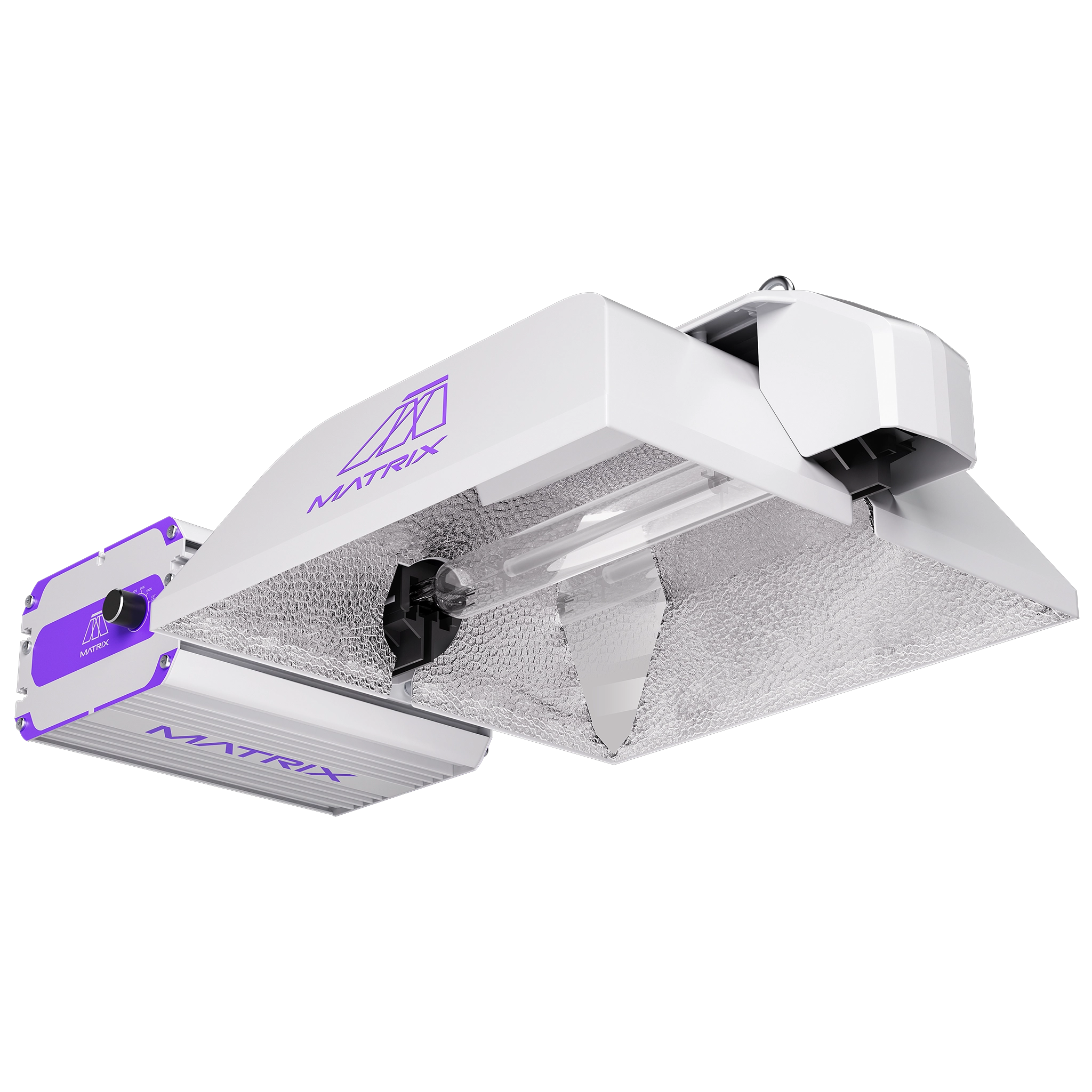
hps grow lights for indoor plants Matrix 1,000 Watt Double Ended HPS Grow Light Fixture With HPS La

Sale price$18.43 Regular price$20.48
Save 10%

Pay in installments of $5.12 with ShopPay, AfterPay and Klarna

Shipping Estimate
USA
  • USA
  • CAN

Ships within 48 hours · Estimated delivery Jul 22 - Jul 27

Promo Codes Available:

For Your Every Summer RSVP, with Code: SUMMER15

Description

hps grow lights for indoor plants Matrix 1,000 Watt Double Ended HPS Grow Light Fixture With HPS LaThe Gold Standard in HPS Lighting Introducing the Matrix DE 1000W, a high performance double ended HPS fixture designed for professional horticulture. Ideal for indoor growing and greenhouse, it features over 98% highly reflective aluminum for exceptional light output. DE 1000W Features PPE 2. 1 mol J High Output Over 98% Highly Reflective Aluminum 0 10V Dimming from 50% to 115% Consistently High Red Intensity Compared to natural sunlight, which is

The Gold Standard in HPS Lighting

Introducing the Matrix DE 1000W, a high-performance double-ended HPS fixture designed for professional horticulture. Ideal for indoor growing and greenhouse, it features over 98% highly reflective aluminum for exceptional light output.

DE 1000W Features

  • PPE 2.1 µmol/J
  • High Output
  • Over 98% Highly Reflective Aluminum
  • 0-10V Dimming from 50% to 115%

Consistently High Red Intensity

Compared to natural sunlight, which is broad and diffused, Matrix DE 1000w concentrates its energy on the wavelengths most beneficial to plants in the flowering stage, maximizing yield potential.


Over 98% Highly Reflective

Highly reflective aluminum surfaces, with over 98%reflectivity, ensure that nearly all emitted light from the bulb is redirected back toward the plants. This enhances light distribution across the canopy, resulting in more even coverage and improved plant growth. With minimal light loss, every photon is effectively utilized for photosynthesis, boosting overall plant health and yield.


Designed for Horticulture

Ideal for indoor growing and greenhouse, this fixture supports optimal plant development and enhances environmental control when paired with LED grow lights.

Extreme Performance

Delivers high light output with over 98% premium reflective aluminum for maximum efficiency.

Easy Control

Features on-fixture step-dimming from 50% to 115% across six levels, with additional support for external 0-10V control.

Long-Term Guarantee

Built to last, the Matrix DE 1000w features robust construction that stands up to the demands of heavy use. Backed by a 3-year warranty, providing reliable performance and peace of mind.


Specifications

Product Dimensions 25″ x 14″ x 5.2″
Packaging Dimensions 29.1″ x 15.2″ x 7.5″
N.W. 16.5LBS / 7.5KG
Input Current 9.3A / 4.6A / 5.1A / 3.85A
Input Power 1000W

OPTIMIZED LAYOUTS

Seamless Integration with VEGA


Elevate your grow with the perfect pairing. MATRIX lights are designed to integrate seamlessly with our DE 1000W fixtures, allowing for a versatile checkerboard layout favored by professional growers. This powerful combination enhances light distribution, optimizing growth potential across every inch of your grow space.

Shipping Notes
  • Free Standard Shipping on $100+ Orders to the USA.
  • Except Preorder products are shipped in 48 hours.
  • Delivery to the USA:
  1. Standard Shipping : 3-10 business days
  • If time is of the essence, please consider selecting expedited delivery for faster service.
Exchange/Return Notes
  • We offer a 30-day return/exchange service after receiving.
  • Final sale items are not eligible for returns or exchanges.
  • To process your return/exchange, please contact us at [email protected]
  • Please click here for more details>>> Return & Exchange Policy
SKU: 36851953677

Discover Niche Categories That Outsell hps grow lights for indoor plants

Top-Converting Item to Boost Your Average Order

4.4 ★★★★★
Based on 8 reviews
Sort
Highest Rating
Newest First
Oldest First
Product Reviews
A
Amazon Customer
Chelsea, US
★★★★★ 5
This is a "Go-To" for thinking about Cloud Challenges.
Format: Paperback
Delivering and managing fully realized applications in the cloud is different. Different approaches to classic engineering problems than traditional On Premise development and different ways of thinking through the problems of "always available" solutions. I've been in the software delivery business a long time, and with the cloud emerging, for good and ill: I understand the problems, but may be just a little set in my ways. I find this book helps me re-frame challenges in a way that aligns with the strengths of cloud computing. Solve the same problems faster, by thinking about them differently. I'm finding "97 Things Every Cloud Engineer Should Know" great for re-centering my expectations about Cloud Native development and deployment of assets. I started reading it cover to cover over the Christmas Holiday but now i just pick it up and look for the group of essays about exactly the problem I'm wrestling with. P.S. I'm heartened by the editors commitment to Black Lives Matter and Rule of Law. Mentioned only to balance the concerns from another review.
WAS THIS REVIEW HELPFUL?YesReportShare
Reviewed in the United States on January 24, 2021
C
Verified Purchase
cloud-learner
San Leandro, US
★★★★★ 3
have some good contents but too general
Format: Paperback
The book covers some good points, but overall, it's too general.
WAS THIS REVIEW HELPFUL?YesReportShare
Reviewed in the United States on June 28, 2024
E
Verified Purchase
Engineer Dude
Dallas, US
★★★★★ 3
Why Politics in a Tech Book????
Format: Kindle
Well... I'm surprised to see the book blatently calls out its dedication to Black Lives Matter, which is in all caps so I assume it's referring to the political organization. It goes on to speak of 2020 being the year of an "awakening of injustices of systematic racism"... I thought I was buying a technical book??? Had I known this political bs was included I wouldn't have purchased it! However, I bought and I'm still reading it. If the politics goes away and the TECHNICAL content is good I'll update my review.
WAS THIS REVIEW HELPFUL?YesReportShare
Reviewed in the United States on December 13, 2020
P
Verified Purchase
PeaceBee
New York, US
★★★★★ 2
Not good use of time
Format: Paperback
It’s not clear who this book targets - neither experts nor novice will benefit. There are expert perspectives, only few of these are helpful, rest are too generic to be of any use. For instance the last entry is one an engineer who shares how she went from zero to expert in cloud engineering in six months but fails to mention a single resource or pathway for others to follow.
WAS THIS REVIEW HELPFUL?YesReportShare
Reviewed in the United States on April 2, 2022
N
Nilendu Misra
Pawtucket, US
★★★★★ 3
Uneven compendium of tips and insights, but still very useful
Format: Kindle, Format: Kindle
“In theory, theory and practice are the same. In practice, they are not" is why such bottom-up insights and lessons from the field are the fastest way to learn real life stuff. This series had a GREAT start with "Engineering Management" - I guess because it is way more subjective than Cloud Engineering and offered a variety of non-overlapping POVs. This one is a mixed bag, perhaps because "Cloud Engineering" was perceived amorphously by the authors. The scope was broad - from cloud-native (architecture), to cloud-ready (topology), to cloud-operations, to choosing tech (e.g., Lambda/serverless), to -ilities and economics -- it is like celebrating Halloween, Christmas and Labor Day together in a single long weekend. I would give it 4/+ stars if at least 25% of such a book was "superb", giving 3 because about 10% of the book is. That still leaves 10 solid insights or learning that would otherwise take many failures to learn. And failures, especially in this emerging domain of complexity, is VERY expensive. Would love to see more books like this. Let's summarize some key insights - -- Real-time visibility across the entire DevOps lifecycle is key to winning in cloud. -- Operations, especially operations at scale, is extremely hard. So, wherever possible, use Managed Services. -- Distinguish between "availability" and "uptime" and measure each separately, and concretely. -- In FaaS/Serverless, calling a function synchronously increases debugging complexity. -- Good code is like good joke - it needs no explanation. -- "Building your app or platform on top of the abstractions that a cloud provider gives you does not make the underlying layers stop existing. In many cases, it makes them even more important." That makes the failure modes LESS obvious than we were used to. Therefore having "extreme visibility" into your systems will help "separate the issues at the layer you're focused on from the fundamental system issues". i.e., just because what was under the hood is now even less visible, don't forget them. Many recent "cloud failures" have been in networking fault domains. -- Cloud is not optimized for replacing static infrastructures. -- Containers, service meshes and serverless jumpstart dev productivity but they also change the attack surface of apps and infra. -- "Number of containers that are alive for 10 sec or less has doubled to 22%". 73% of all containers live for 30 minutes or less. -- Adopt an "assume breach" stance for everything. Have a break-glass account. -- Ensure you have a thorough understanding of where and how secrets are secured. -- Grey failures (transient degradation of services) are often worse than complete crashes, since the latter have a short feedback loop. -- Resilience engineering has existed as a sub-discipline within safety sciences. We just recently started applying its concepts in technology. Resilience can be thought of as a "socio-technical system" with Robustness ("system X has property Y that is robust in sense Z to perturbation W"); Reliability (consistent operations or service levels); Rebound (ability to deal with a chaotic situation using structures developed AND deployed BEFORE the chaos). In other words, robustness protects systems against a SPECIFIC type of failure mode. When a system is robust in many dimensions, it approaches good resilience to failure. -- Resilience is something you "do", not something you "have". Resilience is a verb. -- Moving from one class of nines to the next is 10 times more expensive. -- Production System really means "system that someone else, anyone else, can hold you accountable for". -- Most common theme across incidents is that something, somewhere was surprising. -- Incidents are unplanned investments...your challenge is to maximize ROI. -- We used to think of scale in two dimensions - horizontal (more) and vertical (bigger). In cloud, think of "scale out" (when demands increase) and "scale in" (when demand decreases). -- Architecture diagram is also a map of failure modes. -- Async communication is a friend of Cloud Reliability. -- Test in production is a competitive advantage. The complexity of traffic patterns going through high-scale production systems is increasingly harder to reproduce in a controlled env. -- Hundreds of open issues is fine, but if the repo has gone months (or, years!) without a release, THAT is a warning sign. -- It is hard to write good tests for bad code. -- Platforms come and go. But first principles and patterns will always exist, because they are the ones and zeros.
WAS THIS REVIEW HELPFUL?YesReportShare
Reviewed in the United States on November 6, 2023

recommand products