SKU: 34192636589
rectangular plastic trays for plants

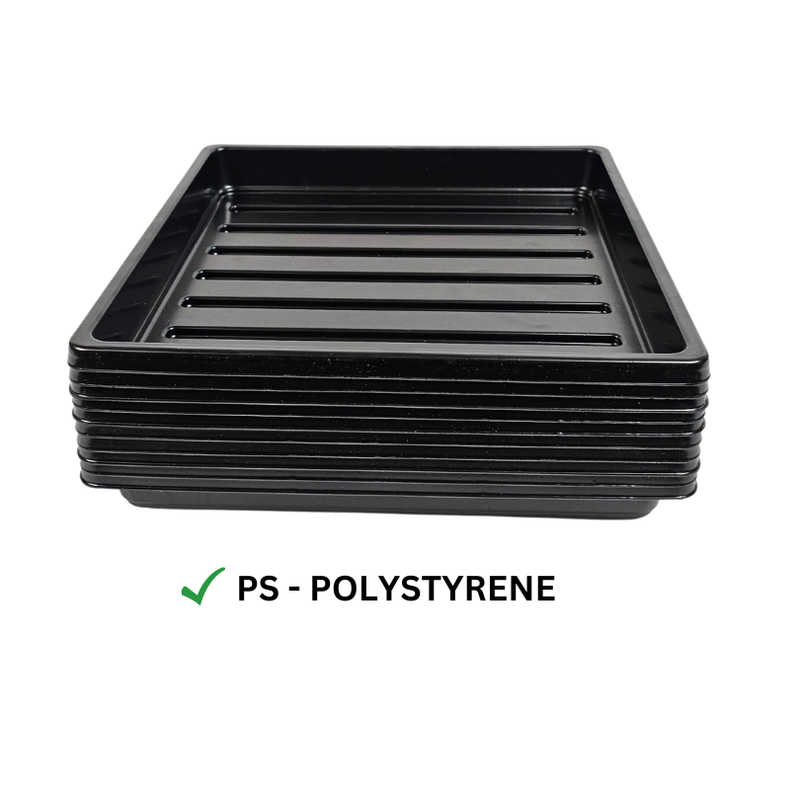
rectangular plastic trays for plants 10x10 Shallow Microgreen Growing Trays – With or Without Holes

Sale price$25.52 Regular price$28.35
Save 10%

Pay in installments of $7.09 with ShopPay, AfterPay and Klarna

Shipping Estimate
USA
  • USA
  • CAN

Ships within 48 hours · Estimated delivery Jul 23 - Jul 28

Promo Codes Available:

For Your Every Summer RSVP, with Code: SUMMER15

Description

rectangular plastic trays for plants 10x10 Shallow Microgreen Growing Trays – With or Without Holes10x10 Growing Trays Shallow With or Without Holes Looking for an affordable 10x10 tray solution for small batch growing or variety testing? These shallow 10x10 trays offer versatility and valueavailable in packs of 10 with holes for drainage or without holes for bottom watering reservoirs. At a budget friendly price point, they're perfect for growers who need multiple trays for sprouting, microgreens, wheatgrass, or seed starting without the premium

10x10 Growing Trays - Shallow - With or Without Holes

Looking for an affordable 10x10 tray solution for small-batch growing or variety testing? These shallow 10x10 trays offer versatility and value—available in packs of 10 with holes for drainage or without holes for bottom-watering reservoirs. At a budget-friendly price point, they're perfect for growers who need multiple trays for sprouting, microgreens, wheatgrass, or seed starting without the premium cost.

Why These Trays Work

Complete bottom-watering system in one purchase: Each pack includes 10 trays (your choice of with holes or without holes). Buy one pack of each and you have a complete 10-tray growing system—trays with holes nest perfectly inside trays without holes for efficient bottom-watering.

Compatible with reusable grow mediums: These trays work perfectly with our 10x10 Reusable Grow Mediums (both silicone and stainless steel). The inner dimensions are designed to accommodate standard 10x10 grow mats.

5x5 tray compatibility: Unlike Bootstrap Farmer 10x10 trays (which are slightly smaller to fit two per 10x20), these standard-sized 10x10 trays fit four 5x5 trays perfectly inside. This gives you ultimate flexibility for variety testing and small-batch growing.

Cost-effective strength: Made from BPA-free Polystyrene (PS), these trays hit the sweet spot between affordability and durability. They're not as heavy-duty as our Bootstrap Farmer 10x10 Heavy Duty Trays, but for lighter-duty applications and growers watching their budget, they offer solid performance at a fraction of the cost.

Versatile growing applications: Perfect for indoor or outdoor growing, greenhouse propagation, nursery setups, and home growing operations where you need multiple trays without breaking the bank.

Key Specifications

Both versions (with or without holes):

  • Outer Dimensions: 10.75" x 10.75"
  • Inner Dimensions: 9.5" x 9.5" x 1.5" deep
  • Material: BPA-Free Polystyrene (PS) Plastic
  • Pack Size: 10 trays per pack
  • Weight Capacity: Moderate—suitable for most small-batch growing applications

With holes version:

  • Hole Size: 0.25" for drainage
  • Use: Growing trays, top trays in bottom-watering systems

Without holes version:

  • Use: Bottom-watering reservoirs, germination covers, solid growing trays

Perfect For:

  • Microgreens and baby greens
  • Sprouting seeds
  • Wheatgrass production
  • Seed starting and propagation
  • Small-batch variety testing
  • Indoor or outdoor nursery setups
  • Greenhouse growing operations
  • Home growers on a budget

The 1.5" shallow depth is ideal for microgreens, sprouts, and quick-turn crops where you want to minimize growing medium while maintaining proper moisture.

Compatible Growing System

Bottom-watering setup: Nest trays with holes inside trays without holes. Add water to the bottom tray, and the holed tray allows roots to access moisture while maintaining drainage. Simple and effective.

Reusable grow medium compatible: Works perfectly with our 10x10 Reusable Grow Mediums in both silicone and stainless steel.

5x5 tray compatibility: Four 5x5 trays fit inside these 10x10 trays for ultimate growing flexibility. (Note: This is different from Bootstrap Farmer 10x10 trays, which are slightly smaller and don't accommodate 5x5s well.)

Modular options: Two 10x10 trays don't fit perfectly side-by-side in a 10x20 tray. For that configuration, use Bootstrap Farmer 10x10 trays instead.

Care & Maintenance - IMPORTANT

CRITICAL - No Heat Exposure: These Polystyrene trays will warp when exposed to heat.

DO NOT:

  • Put in dishwasher
  • Wash with hot water
  • Expose to steam or heat mats
  • Leave in direct sunlight

DO:

  • Hand-wash with cool or room-temperature water and mild dish soap
  • Air dry completely before storage
  • Store in a cool, dry location out of direct sunlight

Lifespan: With proper care, these trays can last through many growing cycles, though they won't be as long-lasting as premium heavy-duty polypropylene options like our Bootstrap Farmer 10x10 Heavy Duty Trays.

What to Know Before You Buy

Perfect for growers who prioritize:

  • Affordable trays in bulk quantities (10-pack)
  • Small-batch growing and variety testing
  • Compatibility with 10x10 reusable grow mediums and 5x5 trays
  • Growing on a budget without sacrificing basic functionality

Care requirements:

  • Hand-wash only with cool water (will warp if exposed to heat/dishwasher)
  • Store out of direct sunlight

Performance notes:

  • Lighter-duty than Bootstrap Farmer Heavy Duty trays but significantly more affordable
  • Best for standard microgreen loads; not designed for extremely heavy applications

The bottom line: These trays deliver solid performance for small-batch growing and variety testing at an unbeatable price point. They're not trying to compete with premium heavy-duty trays—they're giving budget-conscious growers a practical way to scale up tray quantities without breaking the bank.

Product Details

  • Material: BPA-free Polystyrene (PS) plastic
  • Pack options: 10 trays with holes OR 10 trays without holes (sold separately)
  • Seeds, grow mediums, and other items shown in photos are NOT included

Affordable 10x10 trays in bulk—perfect for growers who need quantity without the premium price. 🌱

Shipping Notes
  • Free Standard Shipping on $100+ Orders to the USA.
  • Except Preorder products are shipped in 48 hours.
  • Delivery to the USA:
  1. Standard Shipping : 3-10 business days
  • If time is of the essence, please consider selecting expedited delivery for faster service.
Exchange/Return Notes
  • We offer a 30-day return/exchange service after receiving.
  • Final sale items are not eligible for returns or exchanges.
  • To process your return/exchange, please contact us at [email protected]
  • Please click here for more details>>> Return & Exchange Policy
SKU: 34192636589

Discover Niche Categories That Outsell rectangular plastic trays for plants

Top-Converting Item to Boost Your Average Order

4.1 ★★★★★
Based on 26 reviews
Sort
Highest Rating
Newest First
Oldest First
Product Reviews
R
Verified Purchase
Russell C.
West Palm Beach, US
★★★★★ 5
Great History book
Format: Paperback
This book was a gift for husband. He loves it. He is a slow reader, but he can’t put book down. New and interesting history facts and stories.
WAS THIS REVIEW HELPFUL?YesReportShare
Reviewed in the United States on February 6, 2026
J
Verified Purchase
John D. Cofield
Massapequa, US
★★★★★ 5
Consequence After Consequence
Format: Hardcover
"In Fourteen Hundred Ninety Two, Columbus Sailed The Deep Blue Sea" is a ditty sung by generations of school children. Most of those students learned and believed that Columbus was the only man in Europe who believed the world was round and proved it by sailing three ships west to find the East. In 1493, Charles C. Mann dismisses these legends and goes on to demonstrate that Columbus (or as he refers to him, Colon) and the other Europeans who sailed across the Atlantic in the 1400s and 1500s did far more than just discover a New World, they helped create a planet wide system in which people, plants, animals, and diseases travelled further and were linked in more ways than had ever before been possible. In other words, 1493 was the beginning point of a new age of globalization. This is not a new theory. Alfred W. Crosby developed the term Columbian Exchange back in the 1970s to describe the changes that took place after 1492. Jared Diamond's Guns, Germs, and Steel and Collapse also detailed some of the consequences of the European "discovery" of the Americas. What makes Mann's new book so appealing is his ability to tell an engrossing story that ably explains how one consequence led to another, fundamentally changing society after society and helping to creat our modern world. This is global history at its best, jumping from Ming and Qing China's opulent but troubled societies to the fast growing but still relatively backwards European states to the myriad African and Native American cultures, all of them to be affected by the transfer of peoples, plants, diseases, and ideas. Mann has a keen eye for an appealing and informative anecdote which really details the consequences of seemingly small decisions, such as how the introduction of the sweet potato to China led to deforestation, or how the Little Ice Age was affected by the abandonment of the Native American practice of burning off underbrush in North American forests. Its books like 1493, as well as Mann's earlier and equally excellent 1491, which make studying history so fascinating. I taught Advanced Placement World History to high school students for many years before retiring, and I regularly amused them (at least I hope I did) with many references to Jared Diamond and Alfred Crosby's ideas. With 1493 Charles C. Mann deserves equal recognition by global historians.
WAS THIS REVIEW HELPFUL?YesReportShare
Reviewed in the United States on August 19, 2011
V
Verified Purchase
Victor Vögel
Waukegan, US
★★★★★ 5
Mesmerizing; shows the butterfly effect in action
Format: Paperback
Charles Mann’s “1493” is about globalization and the Homogenocene epoch. Unlike the plenitude of other recent books about globalization, however, “1493” is about biological globalization rather than economic globalization. The book traces the results of the Columbian Exchange, with chapters devoted to tobacco, the earthworm, malaria, silver, potatoes and sweet potatoes, guano and rubber. The book is in four parts, and is written in an accessible, non-academic style. I found the first three parts of the book, which cover the impact of the Columbian Exchange on the Atlantic, the Pacific and Europe, respectively, to be captivating. These parts of the book demonstrated the fascinating interconnectedness of all things in a globalized society (in other words the “butterfly effect”) – for example, how transporting the sweet potato to Western China led to population migrations from Eastern to Western China, deforestation and overflowing of the Yellow River. The general result of such biological globalization is the creation of the Homogenocene epoch, a term which Mann uses to describe the biological homogenization that has replaced biological diversity since the time of Columbus. In the first three parts of the book, Mann demonstrates how history, biology and chemistry are all interrelated, and how today’s world continues to be influenced by the Columbian Exchange. I found the last part of the book to be less impressive than the first three parts. Part Four is called “Africa in the World,” but confusingly it is about South America, not Africa. Parts of it read more like travel writing than history. Still, the book deserves five stars for the first three thrilling parts, which successfully trace the mesmerizing history of various everyday biological substances.
WAS THIS REVIEW HELPFUL?YesReportShare
Reviewed in the United States on December 31, 2017
J
Verified Purchase
Jamie Barnett
West Palm Beach, US
★★★★★ 3
There were periods I was on the edge of my seat. There were times I just wanted to the book to end.
Format: Paperback
I recently started reading at 40 years old to make up for a lot of wasted time and missed education. This is a very informative read, but that said, I had a hard time staying focused sometimes. He gets into a lot of the science pertaining to plagues, epidemics etc which is interesting and I am reluctant to list science as a con as I did learn, but frequently found myself scrolling through several pages just to get the main idea behind the historical part. There were periods that I was on the edge of my seat and there were times I just wanted to the book to end. 1491 was similar. Both useful books, but a bit challenging to follow along especially if you are only reading small amounts at at time like on break at work etc. It jumps around from S. America, N America and China all through the book. I would have preferred that each region be separated. I get that he had his reasons. I am glad I read both books, but I probably should have gone with more of an overview vs the more in-depth content in this. I do not regret reading both books however, and recommend if you already have a good knowledge of this subject and are just trying to learn a little more. I found the information about the slave trade, the most interesting and wasn't aware that the majority of slaves shipped over from Africa went to Mesoamerica and the Caribbean. I also did not realize that plague and sickness really enabled use of African slaves as they were not prone to malaria like the Europeans. There is also some good info about ancient China and also sliver and mercury mining with South American Indians which made the book worth it for me.
WAS THIS REVIEW HELPFUL?YesReportShare
Reviewed in the United States on March 7, 2023
R
Verified Purchase
R. D. Morris
Natrona Heights, US
★★★★★ 4
If you liked 1491, you'll like 1493
Format: Hardcover
I originally read the first edition of 1491, which I loved. So that's why I ordered 1493. At about the same time 1493 arrived, I found out there was a new, revised version of 1491, which my husband bought from another source. So I re-read it at the same time I read 1493 for the first time. The reason I mention this is that there are some similarities between the revised version of 1491 and the newer book, 1493 - actually some repeated material. That's ok, as the author is taking the premise of 1491 another step further. Essentially, 1491 focuses on what new studies show was really going on in the Western Hemisphere before Columbus' arrival, where native peoples were far more numerous and had more advanced cultures than Europeans previously thought possible. In 1493, Charles Mann shows not only how Columbus and Europeans changed the New World, but how the "Columbian exchange" wrought great changes in the other direction as well. And he pulls in the further exchanges with Asia, to show the trans-global linkages of the phenomenon. So, some of his exposition gets a little repetitious, but overall he's an engaging writer, and for those of us who love the history of cultural exchanges and first contact, these books are mandatory reading!
WAS THIS REVIEW HELPFUL?YesReportShare
Reviewed in the United States on October 5, 2011

recommand products