SKU: 33349145429
portulacaria afra common name

portulacaria afra common name Shop 'Elephant bush - Portulacaria afra' Care and Info

Sale price$21.51 Regular price$23.90
Save 10%

Pay in installments of $5.97 with ShopPay, AfterPay and Klarna

Shipping Estimate
USA
  • USA
  • CAN

Ships within 48 hours · Estimated delivery Jul 20 - Jul 25

Promo Codes Available:

For Your Every Summer RSVP, with Code: SUMMER15

Description

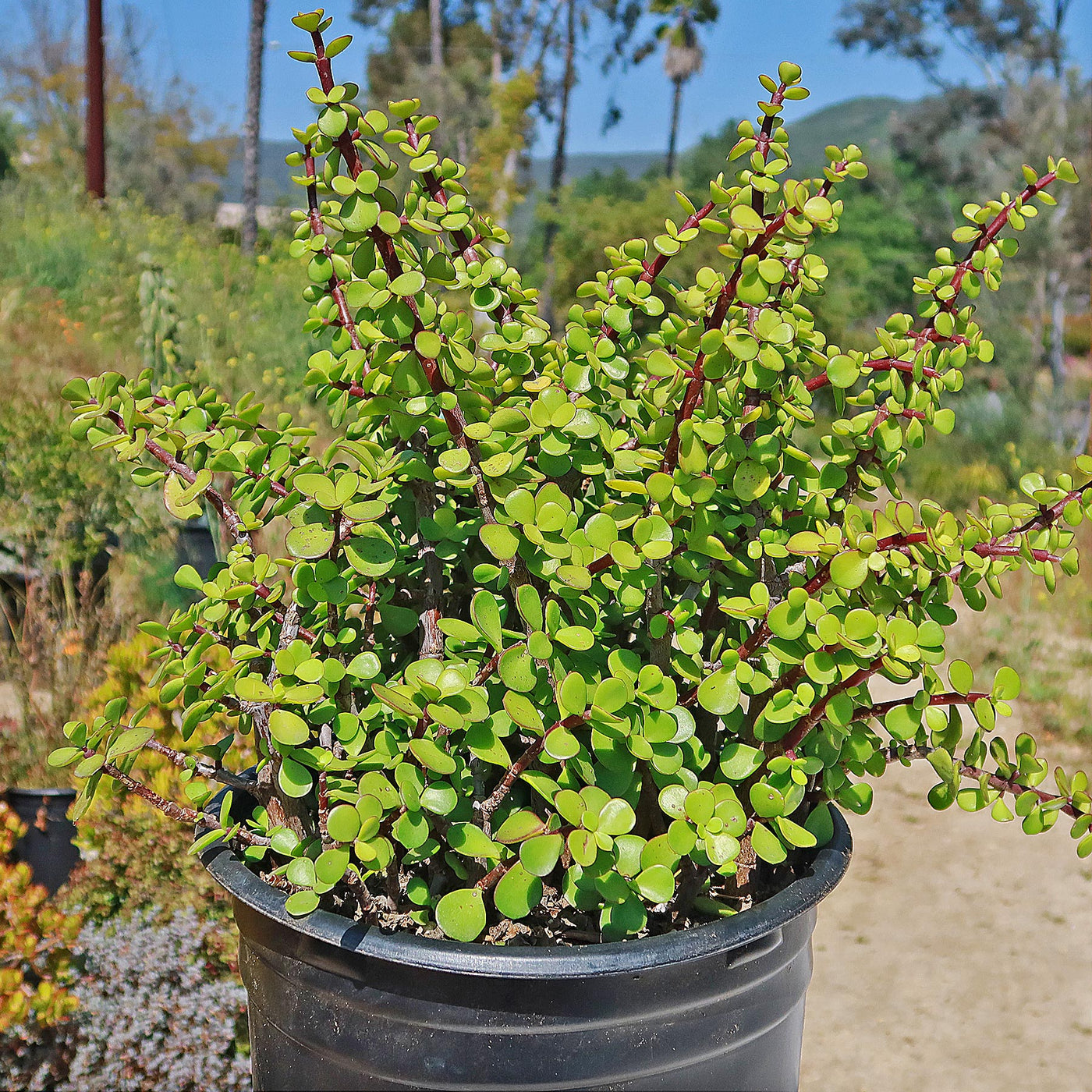
portulacaria afra common name Shop 'Elephant bush - Portulacaria afra' Care and InfoIntroducing the Elephant Bush, also known as Portulacaria afra, which is a fascinating and popular succulent garden plant native to South Africa. It belongs to the Portulacaceae family and is known for its unique appearance and easy care requirements. The elephant bush succulent gets its name from its resemblance to the foliage of an elephant's trunk. It is also commonly referred to as the dwarf jade plant, small leaf jade, miniature jade, elephant

Introducing the Elephant Bush, also known as Portulacaria afra, which is a fascinating and popular succulent garden plant native to South Africa. It belongs to the Portulacaceae family and is known for its unique appearance and easy-care requirements.

The elephant bush succulent gets its name from its resemblance to the foliage of an elephant's trunk. It is also commonly referred to as the dwarf jade plant, small leaf jade, miniature jade, elephant food, or the Spekboom. The name "Dwarf Jade Plant" comes from its small, jade-like leaves, while "Spekboom" is an Afrikaans term meaning "bacon tree" due to the plant's edible leaves that reportedly taste like bacon.


The elephant bush plant features small, round, and fleshy pale green leaves that store water, allowing your elephant bush plant to withstand drought conditions. 

The trailing stems of the elephant bush plants are thick and red-hued, which gives them a unique and appealing appearance in hanging baskets.

When grown as a houseplant, the elephant bush typically reaches a height of 1 to 3 feet.

However, if planted outdoors in its native habitat, your Portulacaria afra can grow much larger, reaching heights of up to 20 feet. The elephant bush makes for an excellent bonsai due to its unique growth pattern and ability to withstand pruning. Its thick, fleshy leaves and sturdy branches give it a robust appearance, making it an ideal succulent for shaping into intricate bonsai designs. 

The elephant bush flowers are small, star-shaped, and usually a light pink or lavender color. While the flowers are not the main attraction of this elephant bush succulent, they can add a touch of beauty when they bloom during the spring to late summer.

The elephant bush Portulacaria afra comes in various varieties, including a slow-growing variegated form Portulacaria afra variegata; a trailing growth bush Portulacaria afra prostrata; and a midstripe rainbow bush Portulacaria afra medio-picta, offers a diverse range of beauty in green spaces.

When and How to Water Your Elephant Bush

Like other drought-tolerant jade plants, your elephant bush succulent prefers a watering routine that allows the soil to dry out between waterings. Overwatering can harm the elephant bush plant and cause root rot.

In the summer, during the growing season, you should water elephant bush succulents once or twice a month when the soil is dry. A good rule of thumb is to water this elephant plant when the top 1-2 inches of soil feel dry to the touch. In the winter, during the dormant period,  you probably do not need to water them at all. 

Remember, it's always better to underwater than to overwater the elephant bush plant. This resilient Portulacaria afra plant can tolerate drought conditions better than excessive moisture. So, keep an eye on the soil moisture and adjust your watering schedule accordingly.

Light Requirements - Where to Place Your Elephant Bush Plant

When growing the elephant bush indoors, it thrives in bright, indirect light. Place your elephant bush plant near a window where it can receive plenty of natural bright light, but make sure to avoid direct sunlight, especially during the hottest parts of the day.

If you notice the leaves turning yellow or getting scorched, it's a sign that the Portulacaria afra elephant bush is receiving too much direct sunlight. So, finding that sweet spot of bright, indirect light is key to keeping your elephant bush succulent plant happy indoors.

If you decide to grow your elephant bush outdoors, it loves basking in the full sun. Although partial shade in the afternoon is frequently preferred, these plants need at least six hours of strong light each day to survive.

This is true, especially in hotter climates where the plant may become stressed by the afternoon sun's intense heat.

Your succulents should not be placed in any areas that receive continuous, direct sunlight, as this could lead to burned foliage.

Remember, the elephant bush is a versatile succulent plant and can adapt to different light conditions. Just keep in mind that it prefers bright, indirect light indoors and full sun to partial shade outdoors.

Optimal Soil & Fertilizer Needs 

Elephant succulents are very airy, porous, nutrient-rich well-drained soil with a pH of 5.5- 6.5; succulents require fast-draining soil that dries completely between waterings. Your soil must have a sandy texture and a low water-holding capacity, just like desert soil.  Ideally, you want to use our specialized succulent potting mix that contains 5 natural substrates to promote the development of a strong root system that helps your African elephant bush plant to thrive.   

When it comes to fertilizing your elephant bush plant, it only needs a small amount of fertilizer applied once a year in spring. These succulents prefer a fertilizer with lower doses of NPK, with a maximum ratio of 5-10-5 that is higher in phosphorus than nitrogen.

Hardiness Zones & More 

When it comes to growing the Elephant Bush plant indoors, the Elephant Bush prefers a cozy environment with temperatures between 65°F and 75°F. It can tolerate slightly cooler temperatures, but it's best to avoid extreme cold or frost. If you notice the leaves starting to shrivel or the tips turning brown, it may be a sign that the air is too dry. You can increase humidity by placing a tray of water near the plant or using a humidifier.

If you are living in USDA zones 9-11, you can grow your Elephant Bush plant outdoors year-round. These zones have mild temperatures and are less prone to frost.  

In cooler zones, it can be kept outdoors during the summer and brought in as the temperature drops. 

Elephant Bush can handle average to slightly higher humidity levels outdoors. Just make sure to provide well-draining soil to prevent waterlogged conditions, as excessive moisture can lead to root rot.

Don't worry if your succulents become too hot; they can tolerate triple-digit temperatures in the summer and prefer constant temperatures above 70 degrees Fahrenheit. 

Wildlife - Portulacaria afra Attracts the Following Friendly Pollinators

Portulacaria afra have tiny, star-shaped flowers, which bloom in clusters, and are a magnet for friendly pollinators. Bees are particularly drawn to its nectar-rich blooms, while butterflies and other beneficial insects are also frequent visitors. In areas where it thrives outdoors, hummingbirds may be attracted to the vibrant blossoms as well. 

Butterflies
Bees
Hummingbirds
Lady Bugs
Multi Pollinators
Other Birds

According to ASPCA, the Portulacaria afra Elephant Bush is friendly to both humans and pets such as dogs and cats. This makes it a great choice for households with curious pets or small children.

How to Propagate Your Portulacaria afra

This African elephant bush is relatively easy to propagate. It can be grown from stem cuttings, which should be allowed to dry for a day or two before being planted in well-draining soil. The cuttings usually root quickly and can be grown into new, young plants.

Key Takeaways

  1. Elephant Bush (Portulacaria afra) is a fantastic succulent with small, jade-like leaves.
  2. Visually appealing and easy to care for, adaptable for both indoor and outdoor growth.
  3. Tolerates a wide range of warm temperatures, between 65°F and 75°F, and handles higher humidity levels.
  4. It can thrives in bright, indirect light. It is suitable for beginner and experienced plant enthusiasts alike.
  5. Often grown as a seasonal accent plant or houseplant.
  6. Order your Elephant Bush today and add something truly exceptional to your garden.

The Bottom Line

Overall, Portulacaria afra, or Elephant Bush, is a remarkable plant that combines beauty, resilience, and ecological value. Its succulent, jade-like leaves and sprawling growth make it a striking addition to both indoor and outdoor settings, while its ability to tolerate drought and thrive in poor soils underscores its low-maintenance appeal. This plant’s capacity to attract friendly pollinators such as bees and butterflies further enhances its value in promoting biodiversity. With minimal care—bright, indirect light, well-draining soil, occasional watering, and protection from frost—Portulacaria afra can flourish for years, serving as both a stunning decorative element and an eco-friendly choice for any garden or home.

Shipping Notes
  • Free Standard Shipping on $100+ Orders to the USA.
  • Except Preorder products are shipped in 48 hours.
  • Delivery to the USA:
  1. Standard Shipping : 3-10 business days
  • If time is of the essence, please consider selecting expedited delivery for faster service.
Exchange/Return Notes
  • We offer a 30-day return/exchange service after receiving.
  • Final sale items are not eligible for returns or exchanges.
  • To process your return/exchange, please contact us at [email protected]
  • Please click here for more details>>> Return & Exchange Policy
SKU: 33349145429

Discover Niche Categories That Outsell portulacaria afra common name

Top-Converting Item to Boost Your Average Order

4.2 ★★★★★
Based on 25 reviews
Sort
Highest Rating
Newest First
Oldest First
Product Reviews
C
Verified Purchase
CE
Port Orchard, US
★★★★★ 5
Good quality
Size: 3 Pack, Color: Optic Yellow
These are really good quality. The color is easy to see on the outdoor court, especially when the sun is bright. Definitely has good bounce to them.
WAS THIS REVIEW HELPFUL?YesReportShare
Reviewed in the United States on May 28, 2026
T
Verified Purchase
Trevor & Tiffany G
Waukegan, US
★★★★★ 5
Franklin X-40 vs. Dura Fast 40 (vs. Onix)
Size: 12 Pack, Color: Optic Yellow, Size: 12 Pack, Color: Optic Yellow
Review order: Review summary (quick read) Review update (4-13-2021) Full review (long read) Summary: This review might save you a lot of time researching balls, but here's the summary if you don't want to read the full review... For 4.0+ play consider the Dura Fast 40 when preparing for certain tournaments, but expect only about 2 games per ball, which is quite annoying in my opinion... for 95% of players, definitely go with the Franklin X-40 (except when preparing for a Dura only tournament of course). If you just want the ball to last and last year after year and don't care at all about egging or quality of play consider the much softer and much slower and much bouncier Onix ball. The Onix ball is so soft that I can't recommend it for typical play, but it is actually an excellent choice when introducing new players to the game and it is often the preferred ball in 65+ play if mobility becomes a common issue because extra bounce = extra time to get there, but in my area many older players seem to play the X-40 just fine. * * * * * * * * * * * * * * * * * * * * * * * * Update: 4-13-2021: Popularity: Almost everyone in my area is playing the Franklin X-40 in every park. I finally saw a Dura in play yesterday, but it's been a long time! Outdoor tournaments in my state are now about 60% X-40 and about 40% Dura (Washington), so even in tournament play the Dura seems to be going out pretty quick. Seasonal durability of X-40: for the first year I don't think my group cracked a single X-40 (despite having a faster paced game), but using that same batch of balls this Spring, they've all been dropping like flies so now my 1 year old batch of X-40's probably isn't much more durable than brand new Dura's (very annoying to deal with those cracks). I just bought new X-40's yesterday and I'll be discarding the few X-40's that are left from last year when the new stock arrives. It will be new X-40's for me once a year from now on assuming quality doesn't slide... fresh manufacturing is apparently very important, so hopefully Franklin will keep their runs moderate, and maybe that's what Dura did wrong.(?) * * * * * * * * * * * * * * * * * * * * * * * * Full review: This review will focus largely on the physical & quality comparisons between the Franklin Outdoor X-40 pickleball and the Dura Fast 40 pickleball, but I'll also give a summary of my impressions from the mouth of experts and supplement also by my own amateur impressions and measurements. Dura hole specs: 16 drilled holes @ 0.325" & 24 drilled holes @ .264" Franklin hole specs: 40 drilled holes @ 0.288" Both balls have 40 holes with an average hole size of 0.288", but the Dura ball has a far more randomized hole pattern. I personally didn't notice any difference in spin characteristics or any notable advantage to the randomized hole pattern of the Dura. Franklin weight: 26g Dura weight: 25g Both balls are rotationally molded in one continuous piece so the seam is just as strong as the rest of the ball on either ball... the appearance of a seam is on the outside of the ball only but the visual molding mark is not actually separated in any way in the middle of the ball and the inside of the ball will likewise appear 100% seamless on either ball, so no true seam exists (both balls are true "1-piece" balls). The Dura ball has much smoother molding marks w/ no plastic flashing like the Franklin... this is primarily cosmetic but quality in this regard definitely goes to the Dura. Subjective color preference: in the shade I think the Dura "Neon" color looks better (see pic), but in typical full sun the green tint looks dingy on the Dura ball in my opinion, and I feel the Franklin "Optic Yellow" is a crisper color that's probably a little more visible. These are the only 2 ball colors I have to compare. I would prefer more dye to be used for a green ball so it still looks green in full sun because in my experience with disc golf and ball golf neon green is the most visible color and neon pink is good too... with these 2 options I'd pick the yellow... the green tint on the Dura is so subtle in full sun it ends up looking more like a dingy yellow rather than a green. A more apples to apples comparison would be Dura's yellow option but I'm pretty confident Franklin would win that contest also based on the notably higher translucency in the plastic used by Dura. Color: Franklin wins. Franklin X-40 country of origin: China Dura Fast 40 country of origin: Vietnam - - EXPERT INSPIRED IMPRESSIONS - - From what I've gathered, expect much longer play per dollar out of the Franklin and expect very little life out of the Dura. Dura's are supposed to be a little harder/better/faster, but they often only last a few games based on everything I've read and heard. For older players consider the Onix over either of these balls... softer balls bounce higher and hit slower which allows more time to get to the ball for longer rallies... the Onix seems to be the favorite for play in older aged groups. Based on expert advise from the "pickleball kitchen" youtube channel... Best performance award (fastest, hardest): Dura Fast 40 Best Value (also w/ great performance): Franklin Outdoor X-40 - - - except high level players should opt for the Dura due to tournament requirements (note: this observation may be outdated... check tournaments in your state to verify what local tournaments are still using the Dura in your area and which tournaments have switched to the X-40) Longest lasting, but soft and bouncy: Onix Note: I have not seen a single outdoor tournament publish the Onix as their ball. My personal recommendation for most players based on a lot of reviews and some research and a close look would be to skip the Dura and go straight to the Franklin X-40 until you're playing tournaments... if/when you advance to the level of playing serious tournament play I don't think it would take long to transition muscle memory and power from the Franklin outdoor ball to the Dura ball and a lot of money and annoyance can be saved w/ the Franklin over the very brittle Dura... Franklin X-40 balls don't last very long either (according to some... possibly old stock), but compared to the Dura it's a notable improvement strongly worth considering even if you're a quality buff like myself. Manufacturing quality: Dura wins Material durability: Franklin easily wins and Onix lasts much longer still if you don't mind a notably slower game (more similar to indoor) and more egging. Quality of play: Mixed... many elite players prefer the extra speed of the Dura, but I prefer the consistency of virtually everyone using the same ball and even more notably, I'd rather sacrifice just a little speed to get the higher consistency / predictability / reliability of an uncracked ball and I find it distracting to look for cracks all the time. Value (w/o sacrificing much): Franklin Despite the long read, I'm hoping this helps the reader save some time in selecting a pickleball, especially for players new to the game.
WAS THIS REVIEW HELPFUL?YesReportShare
Reviewed in the United States on August 15, 2020
S
Verified Purchase
Sean Bozarth
Phoenix, US
★★★★★ 5
Comfortable and Effective Ear Plugs for Swimming
Color: Multicolored 1, Size: 1 pair (Pack of 3)
I picked up these ear plugs for swimming and was pleasantly surprised by how well they work. They’re soft and flexible, so they fit comfortably without feeling like they’re digging into your ears, even during longer swim sessions. They do a great job keeping water out whether you’re in a pool or just showering, and they stay in place well without constantly needing adjustment. I also like that they’re reusable and easy to rinse off and store after use. Overall, this is a solid set of swim ear plugs that are comfortable, practical, and easy to use. A good choice if you spend a lot of time in the water and want something reliable.
WAS THIS REVIEW HELPFUL?YesReportShare
Reviewed in the United States on February 1, 2026
J
Verified Purchase
J D
Port Orchard, US
★★★★★ 5
Good earplug. Will buy again.
Color: Multicolored 1, Size: 1 pair (Pack of 3)
These work better than another swimming earplug I tried on amazon. They stay in well, they completely block water from entering the ear canal and generally seem more firm and durable than the other pair. They are also cheaper. I have had the little tail pop out of my ear while swimming, but that hasn't been a problem other than I notice it. The earplug still stays in. Did multiple 2.4 mile swims in them including an Ironman race and they stayed in the whole time. I'm going to try the version with the goggles straps now.
WAS THIS REVIEW HELPFUL?YesReportShare
Reviewed in the United States on February 4, 2026
D
Verified Purchase
Dania valle vina
Boise, US
★★★★★ 5
Comfortable and easy to use
Color: Multicolored 1, Size: 1 pair (Pack of 3)
These ear plugs fit better than a lot of others I’ve tried and they stay in place while swimming. They’re soft enough to wear comfortably for longer periods without irritating my ears. I also like that they come with different sizes, which makes it easier to find the right fit. They block water well and the carrying case is convenient for keeping everything organized.
WAS THIS REVIEW HELPFUL?YesReportShare
Reviewed in the United States on May 19, 2026

recommand products