Shipping Estimate
USA
- USA
- CAN
- USA
- CAN
Ships within 48 hours · Estimated delivery Jul 10 - Jul 15
 Promo Codes Available:
For Your Every Summer RSVP, with Code: SUMMER15
Description
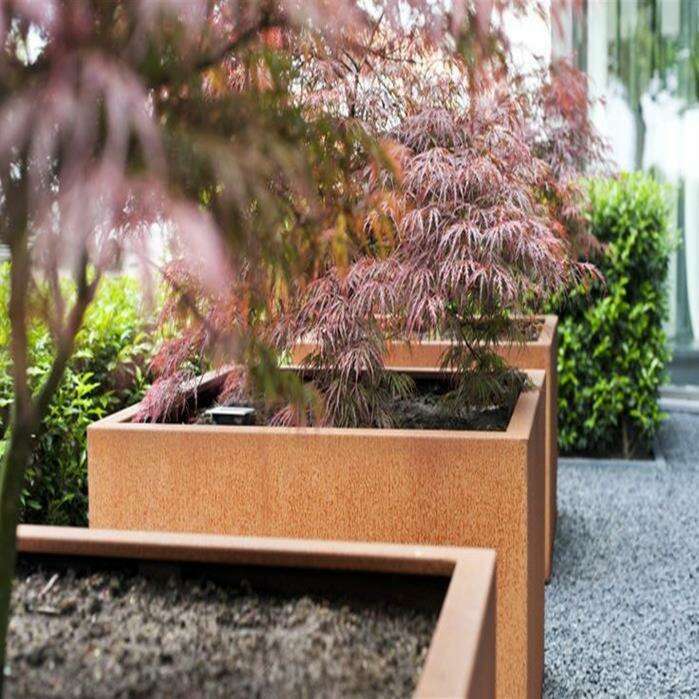
pot de plante exterieur Pot pour fleur bac cube rouillé - extérieur jardinLe bac cube en Corten H. 70x70 cm se place aussi bien l'intrieur qu' l'extrieur grce sa matire rsistante aux UV et au gel. Caractristiques du bac cube en Corten effet rouill Matire : Acier Corten (rsistance la corrosion et l'tirement) Dimensions : L. 70 x l. 70 x H. 70 cm paisseur de l'acier Corten : 2 mm Couleur : effet rouill aspect lisse et naturel Rsistance au climat : Rsistant au gel et aux UV Le produit est livr non oxyd Assurez un bon drainage
Le bac cube en Corten H.70x70 cm se place aussi bien à l'intérieur qu'à l'extérieur grâce à sa matière résistante aux UV et au gel.Caractéristiques du bac cube en Corten effet rouillé
Matière : Acier Corten (résistance à la corrosion et à l'étirement)
Dimensions : L.70 x l.70 x H.70 cm
Épaisseur de l'acier Corten : 2 mm
Épaisseur de l'acier Corten : 2 mm
Couleur : effet rouillé aspect lisse et naturel
Résistance au climat : Résistant au gel et aux UVLe produit est livré non oxydé
Assurez un bon drainage (trous dans la version standard de la jardinière). Aucun excès d’eau ne doit rester dans la jardinière, sinon le matériel peut éventuellement rouiller à cause de la combinaison d’oxygène et de terre.
Ne pas utiliser d’hydro grains qui peut retenir l’humidité
Le produit doit être déballé immédiatement après la livraison, afin que toute humidité entre l’emballage et le produit ne soit pas emprisonnée. Cela peut causer de la rouille et des taches irrégulières.
La rouille peut être fixée en appliquant un antirouille pénétrant qui forme une couche protectrice contre la rouille. L'antirouille protège la jardinière et empêche l'acier Corten de déteindre. (produit non fourni)
Univers : Bacs et jardinières intérieur extérieur
Description du bac cube en acier patiné pour extérieur
Le Pot pour fleur bac cube effet rouillé - extérieur - H.70 cm Corten est un pot à plantes en acier Corten. L'acier Corten est le nouveau favori des jardins. Donnez à votre extérieur un aspect luxueux et chaleureux avec les bacs en acier Corten pour un concept unique au look naturel. L’acier Corten, également appelé acier résistant aux intempéries, est un alliage métallique constitué de fer, auquel du cuivre, du silicium, du nickel et du chrome ont été ajoutés. L’acier Corten est un type d’acier solide qui a la propriété d’être recouvert d’une couche de rouille protectrice lorsqu’il est exposé à l’air extérieur. Cette couche de rouille solide naturelle constitue la protection contre plus de corrosion. L’acier Corten est caractérisé par sa couleur rouille brun-orange et sa longévité. Le Pot pour fleur bac cube effet rouillé - extérieur - H.70 cm Corten résiste au gel et aux UV pour affronter toutes les saisons tout en gardant le même éclat.
Le Pot pour fleur bac cube effet rouillé - extérieur - H.70 cm Corten doit être déballé immédiatement après la livraison, afin que toute humidité entre l’emballage et le produit ne soit pas emprisonnée. Cela peut causer de la rouille et des taches irrégulières. Assurez un bon drainage (trous dans la version standard de la jardinière). Aucun excès d’eau ne doit rester dans la jardinière, sinon le matériel peut éventuellement rouiller à cause de la combinaison d’oxygène et de terre. Nos produits en acier Corten sont livrés sans rouille et le processus de rouille prendra alors environ 4-5 mois. Pour l'entretien, nous vous conseillons un nettoyage annuel en éliminant les grosses salissures avec de l’eau du robinet. Faites attention! N’utilisez pas de nettoyeur haute pression.
Shipping Notes
- Free Standard Shipping on $100+ Orders to the USA.
- Except Preorder products are shipped in 48 hours.
- Delivery to the USA:
- Standard Shipping : 3-10 business days
- If time is of the essence, please consider selecting expedited delivery for faster service.
Exchange/Return Notes
- We offer a 30-day return/exchange service after receiving.
- Final sale items are not eligible for returns or exchanges.
- To process your return/exchange, please contact us at [email protected]
- Please click here for more details>>> Return & Exchange Policy
4.9 ★★★★★
Based on 2481 reviews
Sort
Product Reviews
★★★★★ 4
How many trees do we have left?
In this book, the author takes a look at the downfall of civilizations. Yes, that's plural. There are several models of how civilization is progressing. One is that we're getting better and better as time goes by. Another, less popular one states that we are actually in decline, going down from some sort of golden age. You'll find many of these proponents in the old age homes and such. For them, the only disagreement is when we are declining from.
Wright takes a look at the cyclical nature of the rise and fall of civilizations, taking examples from several once- prospering civilizations. This book stands as a call to action that something must be done to grow smartly and be careful on how we allocate the scant resources we have left. While he doesn't hit an anything new, this book's strength is its concise nature. The several examples are familiar and in that have more impact.
The strongest example is one he visits several times to show an analogy of current times: Easter Island. This isolated speck in the Pacific was once a thriving mini-civilization with culture and art. And a lot of trees. These trees helped the islanders fish and raise their ceremonial head sculptures. However, these trees also were a poorly cultivated resource. Someone not too long ago cut down the last tree, and the island is now a wasteland and anthropological curiosity. We are doing the same thing. How many trees do we have left to cut?
WAS THIS REVIEW HELPFUL?YesReportShare
Reviewed in the United States on October 14, 2009
★★★★★ 3
Good on Review Short on Direct Experience
It is an extensive review of the literature on rise and fall of civilizations with observations on our's. Extremely well footnoted and referenced it however suffers from the author appearing to have little direct primary experience in the study of his topic. Nonetheless there is good information here and substantiation of the notion that cultures come and go, frequently going as a result of the lack of capacity necessary to change group behavior in response to certain challenges. He presents compelling evidence that those overwhelming challenges often revolve around irrational and compulsive exploitation of natural resources.
Sadly I share the author's pessimism in regard to our global culture being likely to respond adequately to the ongoing destruction of our livable earthly environment. I fear the planet is headed for a massive kill off in the disturbingly near future.
WAS THIS REVIEW HELPFUL?YesReportShare
Reviewed in the United States on April 13, 2013
★★★★★ 5
I hate to be the kind of person preaching on Doom's ...
This is an impressive quick read. I hate to be the kind of person preaching on Doom's Day, but I do find the definition of progress to be a multi-faceted, direct correlation to humanity, or as this book challenges, inversely related. As Le Corbusier once stated in Towards a New Architecture, "[Progress is] the study of minute points pushed to its limits." I think that we forget that limits do exist. On a sustainability level, we seem to forget that growth is bound to a carrying capacity which is only a constant. We exceed limits in population, in wealth, in energy consumption, and we are doing so blindly because we believe we are progressing. This is the first that I heard the term "progress traps" (which I think Wright may have coined himself), and I believe we seem to fall under the impression that distilling or expanding our limitations is an ultimate form of progress, when in fact, its lack in sustainability will only push us back. If you have the time, it's a pretty quick and enlightening read. If you are still on the fence with the concepts discussed in the book, I recommend finding it at a local library before committing to buy. For me, I recommend it.
Also, if you are interested, there is a documentary based on this book called "Surviving Progress" (2011). I prefer the book so much more, but the documentary wasn't that bad.
WAS THIS REVIEW HELPFUL?YesReportShare
Reviewed in the United States on August 29, 2015
★★★★★ 5
Negro Slave Bible
I like the large print. And, I appreciate the honest commentary.
WAS THIS REVIEW HELPFUL?YesReportShare
Reviewed in the United States on May 7, 2026
★★★★★ 5
None
Format: Paperback
Great book, very informative
WAS THIS REVIEW HELPFUL?YesReportShare
Reviewed in the United States on May 4, 2026
recommand products
The Works Seattle Succulent Terrariums Kit | made In Washington
25.49
Life Would Succ Without You Plant Pot, Positive Vibes Plant Pot, Funny plant pot design, Planter Pot Decal, encouragement gift – Wolfantique
27.40
Graptosedum California Sunset Purple Succulent For Sale
24.99
Gardenera Premium Organic Potting Soil, Succulent & Cactus Soil Mix, Fast Draining Pre-Mixed Blend
21.93
Succulents Needle Felting Kit
25.46