Pay in installments of $7.01 with
 ,
,
 and
and

Shipping Estimate
USA
- USA
- CAN
- USA
- CAN
Ships within 48 hours · Estimated delivery Jul 16 - Jul 21
 Promo Codes Available:
For Your Every Summer RSVP, with Code: SUMMER15
Description
blue flax seeds planting Blue Flax - Linum Perenne SeedsLinum Perrenne is a wildflower originally native to Europe that naturalized in other parts of the world a long time ago. The oldest evidence of human use of flax was found in a cave in the country of Georgia, from a piece of wild flax that was dyed and knotted into a textile, dating back to 30,000 years ago. First domesticated in the Middle East about 10,000 years ago and cultivated extensively in ancient Egypt, flax linens were worn by priests as a
Linum Perrenne is a wildflower originally native to Europe that naturalized in other parts of the world a long time ago. The oldest evidence of human use of flax was found in a cave in the country of Georgia, from a piece of wild flax that was dyed and knotted into a textile, dating back to 30,000 years ago. First domesticated in the Middle East about 10,000 years ago and cultivated extensively in ancient Egypt, flax linens were worn by priests as a symbol of purity and used in the process of mummification.
The Romans also cultivated flax on a large scale to make sails, ropes and nets out of the fibre, amongst other things. As the Roman Empire collapsed, so did the cultivation of flax. It was only during the eight century that Charlemagne revived the crop to enhance hygiene practices. The Flanders region of Belgium became the centre of production of the linen industry during the Middle Ages. Linum Perrene was brought to North America by the early settlers, but by the 1700s, cheap cotton and other more durable fibres eventually contributed to the decline of flax as a commercial crop.
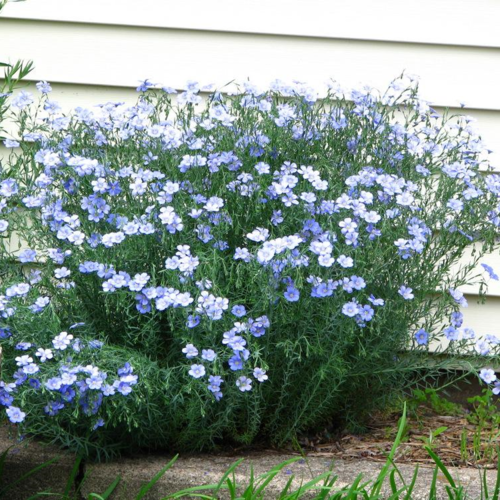
Linum Perrene is a perennial crop that will provide you with a blanket of charming, light blue blossoms for years to come. Often flowering the first year when planted in the spring, the blooming period, usually from mid-summer into autumn, lasts up to eight weeks or up to twelve weeks if planted in partial shade. Blue Flax is an easy to grow plant that reach 12-24 inches tall, with long linear foliage and masses of small sky-blue flowers ½ inch to 1 inch wide. The tiny flowers last only from sunrise to sunset, to be replaced by another one the following day. Linum Perrene is a heat and drought tolerant variety that adapts well to a wide range of soil types.
Blue Flax makes a beautiful, useful and edible addition to your perennial garden, borders, walkways and meadows. If you don’t feel like making your own fabric with the fibres, Blue Flax can also be cultivated for its delicious seeds. Full of nutrients with a nutty flavour, flax seeds are popular on breads, muffins, cookies and other baked goods.
- Life Cycle: Perennial
- Days to Maturity: Second-year
- Planting Depth: 3-4 seeds 3-4 mm deep or broadcast directly
- Growth Habit: 45-60 cm tall
GROWING INSTRUCTIONS
Flax is a fast-growing perennial that produces dainty blue blossoms and slender green leaves, maturing in its second season of growth. Some flowers may pop out during the first summer, but an explosion of the tiny blue blooms can be expected the following year. Dense, directly-sown plantings do well as meadows and wild-grown flowers left to naturalize. The short-lived flowers last about a day and then turn into seed pods containing small, dark flax seeds.
Flax is easy to start from seed when provided ideal conditions. Sow directly outside in the spring when the danger of frost has passed. Starting seeds indoors is not recommended, as flax will not transplant well into the garden. If you decide to try starting seeds inside, time it so they can be transplanted as young seedlings to avoid any major root disturbance.
Flax will adapt to most climates readily, but don’t do particularly well in hot, humid climates. To prepare the garden bed, remove any weeds, grass and rocks and loosen the soil 15 cm deep with a garden hoe or tined cultivator. Rake out the soil so that it’s smooth and level.
Seeds can be scattered densely and thinned later or planted in rows 10-15 cm apart. Rows can be spaced 30-45 cm apart. Sow the seeds and cover very lightly with fine soil or compost. They will need the sunlight to germinate. Mist the soil until it’s damp and keep it moist while seeds germinate and get established. Seeds should start sprouting in two to three weeks. Seedlings can be thinned to 15-30 cm apart.
Flax will thrive when provided with a well-sheltered, full-sun site. It prefers light, sandy, well-drained soil. If the soil condition is poor, work in some compost to feed flax through the season. Evenly moist soil is required for flax to get established, but otherwise will tolerate dry conditions well. Mulch could be used in especially hot areas to retain moisture and keep down weeds. Overall, flax will grow best in cool, wet conditions.
Be sure to remove any competing weeds while flax is getting established. The plant can be cut back by half after their first bloom in hopes of getting another set of flowers. Mature plants can reach up to 90 cm in height and 45 cm in width.
After the first year, the plants will have developed a hardy winter root system to prepare for the cold, returning stronger the following season. Flax will also self-seed and sprout up again in the same spot next spring.
The blossoms are durable and beautiful, and the by-products of flax are numerous.
QUICK FACTS
- There are two types of flax seeds, brown and golden, and they are both used as a food and a fiber crop.
- Flax fibers are used in industry for paper for cigarettes, tea bags and bank notes.
- Flax has been used in the manufacturing of linens for thousands of years, dating back to Ancient Egypt.
- Linum seeds will remain viable for 2 years if stored in a cool, dark place, ideally between 4 and 10⁰C. After that, the germination rate may start to go down.
Shipping Notes
- Free Standard Shipping on $100+ Orders to the USA.
- Except Preorder products are shipped in 48 hours.
- Delivery to the USA:
- Standard Shipping : 3-10 business days
- If time is of the essence, please consider selecting expedited delivery for faster service.
Exchange/Return Notes
- We offer a 30-day return/exchange service after receiving.
- Final sale items are not eligible for returns or exchanges.
- To process your return/exchange, please contact us at [email protected]
- Please click here for more details>>> Return & Exchange Policy