SKU: 30986950442
philodendron verrucosum problems

philodendron verrucosum problems Philodendron verrucosum – Foliage Factory

Sale price$18.98 Regular price$21.09
Save 10%

Shipping Estimate
USA
  • USA
  • CAN

Ships within 48 hours · Estimated delivery Jul 13 - Jul 18

Promo Codes Available:

For Your Every Summer RSVP, with Code: SUMMER15

Description

philodendron verrucosum problems Philodendron verrucosum – Foliage FactoryPhilodendron verrucosum Philodendron verrucosum has broad, heart shaped leaves with a velvety to matte surface and textured petioles. The foliage can appear dark green to bronze green on top, with paler undersides that may show red purple tones. This species is native from Costa Rica to Peru, where it grows as a climber in wet tropical forest. Indoors, its scaly looking petioles and soft leaf surface need careful handling, stable humidity, and space

Philodendron verrucosum

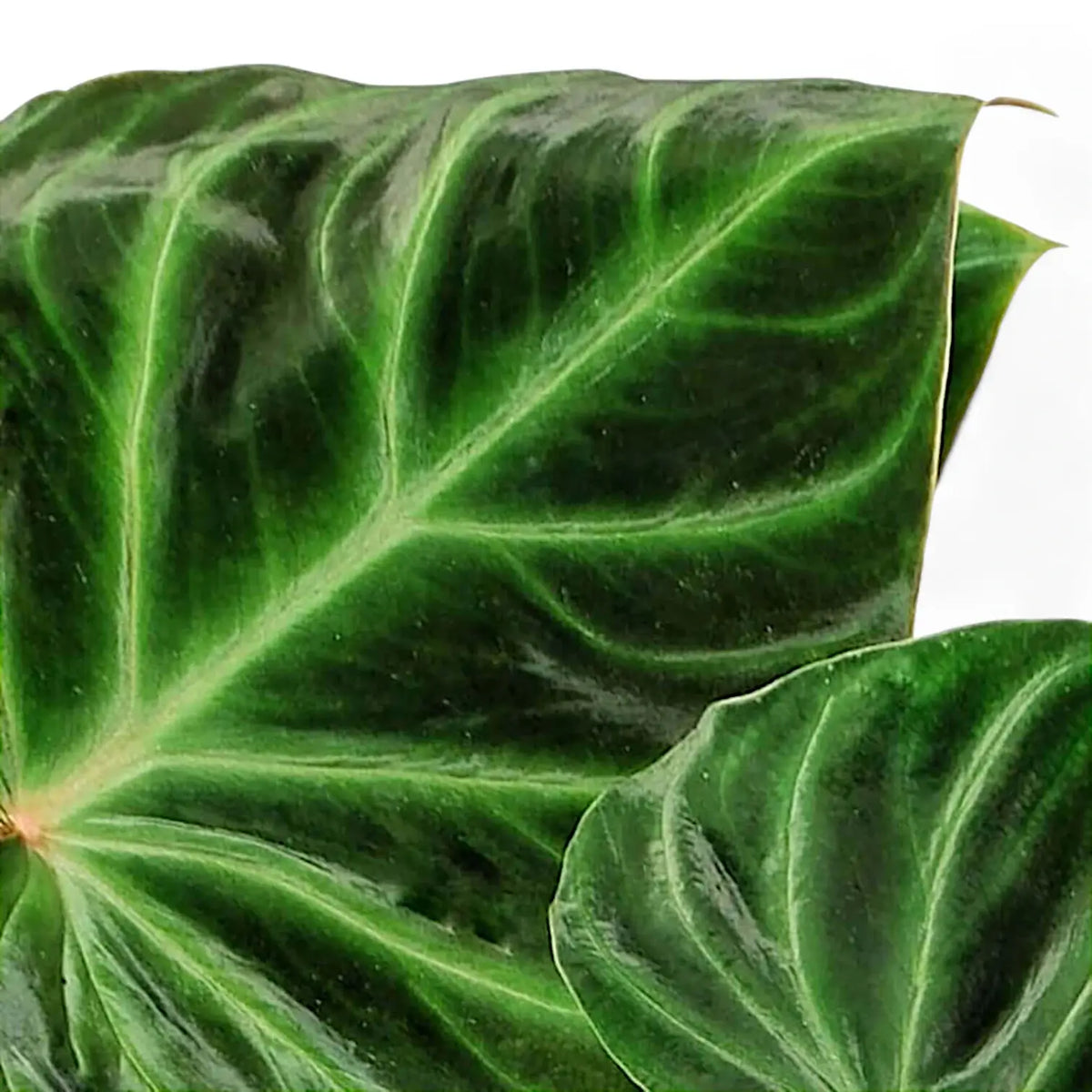
Philodendron verrucosum has broad, heart-shaped leaves with a velvety to matte surface and textured petioles. The foliage can appear dark green to bronze-green on top, with paler undersides that may show red-purple tones.

This species is native from Costa Rica to Peru, where it grows as a climber in wet tropical forest. Indoors, its scaly-looking petioles and soft leaf surface need careful handling, stable humidity, and space for new leaves to open cleanly.

Visible traits of Philodendron verrucosum

  • Leaf shape: Broad cordate leaves form a rounded, heart-shaped profile.
  • Leaf surface: Velvety to matte texture marks more easily than glossy Philodendron foliage.
  • Colour detail: Dark green to bronze-green upper leaves with paler undersides that can show red-purple tones.
  • Petioles: Scaly to hairy-looking petioles remain visibly textured below the leaf blade.
  • Growth habit: A climbing stem develops nodes and grows upward on vertical support.

Climbing behaviour of Philodendron verrucosum

Philodendron verrucosum climbs from node to node, producing aerial roots along the stem. A stable pole or plank keeps the plant upright and gives developing leaves space to open without rubbing against older foliage.

The velvet leaf surface responds quickly to handling damage, dry air, and pests. Place the plant where new leaves can unfurl freely and avoid brushing the leaf surface during routine care.

Care for Philodendron verrucosum

  • Light: Bright filtered light keeps growth compact while protecting the velvet leaf surface from scorch.
  • Water: Water once the upper part of the mix has started to dry; soggy roots can lead to yellowing and collapse.
  • Humidity: Higher humidity helps new velvet leaves unfurl without sticking or tearing.
  • Substrate: A chunky aroid mix keeps thick roots aerated and reduces wet-root stress.
  • Support: A moss pole or plank gives aerial roots contact points as the stem climbs.
  • Temperature: Warm, stable conditions reduce leaf deformation and root stress.

Common issues with Philodendron verrucosum

  • Stuck leaves: Low humidity can cause new leaves to catch, wrinkle, or tear during unfurling.
  • Dry edges: Crispy margins can come from dry air, irregular watering, or salt buildup in the substrate.
  • Pests: Thrips and spider mites can mark soft velvet leaves quickly, especially on new growth.
  • Root decline: Dense wet substrate can cause yellowing, limp leaves, and slow recovery after watering.

Botanical background of Philodendron verrucosum

Philodendron verrucosum was described by L. Mathieu ex Heinrich Wilhelm Schott in 1856. The name verrucosum refers to a rough or warted surface, matching the species’ textured petioles.

Safety note for Philodendron verrucosum

Like other Philodendron, this plant contains calcium oxalate crystals and should be kept away from pets and children who may chew the leaves or stems.

Shipping Notes
  • Free Standard Shipping on $100+ Orders to the USA.
  • Except Preorder products are shipped in 48 hours.
  • Delivery to the USA:
  1. Standard Shipping : 3-10 business days
  • If time is of the essence, please consider selecting expedited delivery for faster service.
Exchange/Return Notes
  • We offer a 30-day return/exchange service after receiving.
  • Final sale items are not eligible for returns or exchanges.
  • To process your return/exchange, please contact us at [email protected]
  • Please click here for more details>>> Return & Exchange Policy
SKU: 30986950442

Discover Niche Categories That Outsell philodendron verrucosum problems

Top-Converting Item to Boost Your Average Order

4.0 ★★★★★
Based on 1087 reviews
Sort
Highest Rating
Newest First
Oldest First
Product Reviews
D
Verified Purchase
Dawn Christner
Lake Worth, US
★★★★★ 5
Excelent company and quality products
Size: 16 Ounce (Pack of 1)
I have always loved the products from this company. We buy Turkey Tail, Lion's Mane, and other products. They are all natural and excelent quality. Ships fast too. Thank you
WAS THIS REVIEW HELPFUL?YesReportShare
Reviewed in the United States on March 26, 2026
S
Verified Purchase
Sean Shrestha
Phoenix, US
★★★★★ 5
Loved it.
Size: 8 Ounce (Pack of 1)
Loved the earthy taste. I and my wife drink it every morning.
WAS THIS REVIEW HELPFUL?YesReportShare
Reviewed in the United States on April 20, 2026
K
Verified Purchase
KK
Port Orchard, US
★★★★★ 5
No taste
Size: 8 Ounce (Pack of 1)
Really good. I put it in my black coffee. There’s no taste or complaints. My second purchase.
WAS THIS REVIEW HELPFUL?YesReportShare
Reviewed in the United States on March 31, 2026
R
Verified Purchase
Ryan Mease
Phoenix, US
★★★★★ 5
Excellent Tool for Approaching Homer via English
Format: Hardcover
I love the Loeb editions of Homer. I've already ready the Odyssey, now moving on to the Iliad. What I've especially started to enjoy with this volume of the Iliad is the editors decision to "call out" which lines were rejected by which ancient commentators (Aristarchus, etc.). This adds some fun to the reading because you get to review the line in Greek and try to surmise why they rejected it, or how the passage would work without the line. The translation is reasonably modern but still "lordly" and has the tone of a war epic. It was enjoyable to read aloud in both English and Greek.
WAS THIS REVIEW HELPFUL?YesReportShare
Reviewed in the United States on September 25, 2025
B
Verified Purchase
Bryan Kerr
Waukegan, US
★★★★★ 5
2,800 years worth of people have heard/read Homer
Format: Hardcover
I just finished reading volume 1 of Homer's Iliad published by The LOEB Classical Library in conjunction with Harvard University Press. The translation is by A.T. Murray with revisions made by William F. Wyatt. The LOEB Classical Library is a academically trusted collection of Greek and Latin publications. The translations are normally more literal than those you might find at your local Barnes and Noble, therefore they read more like an archaic form of English. Homer's Iliad can be found on nearly every great works of literature list. Harold Bloom considered Homer to be in the same family with Cervantes, Dante, and Shakespeare. The Iliad has been read for thousands of years, and every reputable honors program includes his works in their required readings lists. His writings influenced Tolkien and George R.R. Martin. His descriptions of war are grotesque and inspiring. The pantheon of deities he created in his stories set the stage for the Greek mythology that followed him. This is the understanding I had when approaching the book. The bar was set rather high and unlike most expectations these ones were surpassed. As I finished reading volume 1, I asked myself, "how could a writer from the 8th century B.C. have achieved so much, when so many from our era have achieved so little?" Homer had no paper trail of literary criticism to follow. He had no classes in writing style and technique, and yet the Iliad is of such a high caliber that we still read him today. Wayne C. Booth brought to our attention Homer's "leave nothing up to the reader" style of reading. If Homer wants you to favor one group over another, he is going to come out and say it. He can tell you every thought and intent of each character. Homer doesn't care that it would be impossible for anyone to know the thoughts of Agamemnon or Hector. He knows what they thought and that's enough. Many writers today shy away from such literary techniques in favor of modes that demand "reader response." This is not necessarily bad, it's just a different approach but many of their works, if not all, will not demand the attention of 2,800 years worth of readers.
WAS THIS REVIEW HELPFUL?YesReportShare
Reviewed in the United States on August 4, 2012

recommand products