SKU: 29899646466
images of pencil cactus

images of pencil cactus Euphorbia Tirucalli Pencil Cactus House Plant – Plants For All Seasons

Sale price$23.81 Regular price$26.46
Save 10%

Pay in installments of $6.62 with ShopPay, AfterPay and Klarna

Shipping Estimate
USA
  • USA
  • CAN

Ships within 48 hours · Estimated delivery Jul 17 - Jul 22

Promo Codes Available:

For Your Every Summer RSVP, with Code: SUMMER15

Description

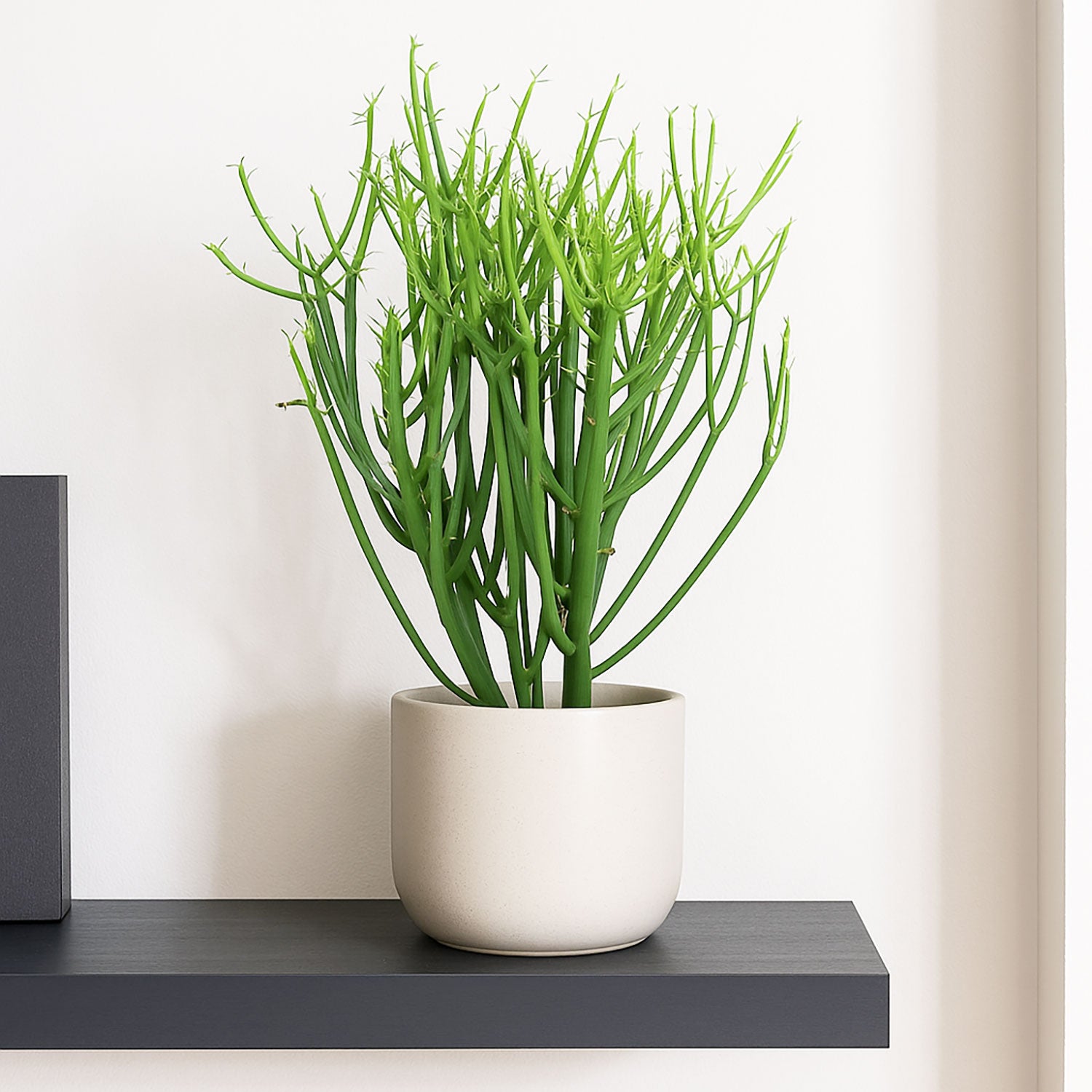
images of pencil cactus Euphorbia Tirucalli Pencil Cactus House Plant – Plants For All SeasonsEuphorbia tirucalli, commonly known as the Pencil Cactus, Sticks on Fire, or Firesticks Plant, is a striking succulent shrub admired for its vivid colouration and sculptural, coral like form. A member of the Euphorbiaceae family and native to the dry regions of Africa and India, this distinctive species is beloved by collectors and designers for its architectural silhouette and vibrant hues that shift beautifully with the seasons. The plants thin,

Euphorbia tirucalli, commonly known as the Pencil Cactus, Sticks on Fire, or Firesticks Plant, is a striking succulent shrub admired for its vivid colouration and sculptural, coral-like form. A member of the Euphorbiaceae family and native to the dry regions of Africa and India, this distinctive species is beloved by collectors and designers for its architectural silhouette and vibrant hues that shift beautifully with the seasons.

The plant’s thin, cylindrical stems resemble clusters of glowing coral, ranging in colour from fresh green in lower light to fiery shades of orange, red, and gold in bright sun. These slender, leafless branches form an upright, branching structure that looks almost like living sculpture — making Euphorbia tirucalli a dramatic addition to both modern interiors and outdoor xeriscapes.

Low-maintenance, resilient, and visually bold, the Pencil Cactus is the perfect statement plant for lovers of colour, texture, and architectural form.


Euphorbia tirucalli – Care Guide

Light

Thrives in bright, direct sunlight. For the strongest colour, give it at least 4–6 hours of full sun daily. In lower light, the stems remain green; under strong light, they develop orange and red tones. If grown indoors, place it near a south-facing window or under a grow light.

Watering

Water sparingly. Allow the soil to dry out completely between waterings, then water thoroughly and let any excess drain away. Overwatering is the most common cause of problems — this plant stores moisture in its stems and tolerates extended dry periods. In winter, reduce watering to once every 4–6 weeks.

Temperature and Humidity

Temperature: Prefers warmth between 18–30 °C; avoid exposure to temperatures below 12 °C. It is highly sensitive to frost.
Humidity: Low to average humidity is ideal. The Pencil Cactus thrives in dry air and does not require misting.

Soil and Potting

Use a free-draining cactus or succulent mix — a blend of compost, coarse sand, and perlite or pumice works perfectly. Good drainage is essential to prevent root rot. Repot every 2–3 years in spring, refreshing the soil and giving roots a little more room. Choose a heavy pot to prevent tipping, as tall plants can become top-heavy.

Feeding

Feed lightly every 6–8 weeks during spring and summer with a diluted cactus or succulent fertiliser. Avoid feeding in autumn and winter when the plant is dormant.

Pruning and Maintenance

Prune only to control size or shape, removing unwanted branches with sterilised tools. Always wear gloves and protective clothing when pruning — Euphorbia tirucalli produces a milky latex sap that is toxic and can cause severe skin or eye irritation. Wash hands thoroughly after handling.

Growth and Maturity

A fast-growing succulent under the right conditions, Euphorbia tirucalli can reach up to 1.5–2 metres indoors and even larger outdoors in warm climates. Its branching structure becomes more intricate with age, creating a coral- or candelabra-like silhouette that’s both dynamic and sculptural.

Common Issues

  • Soft, collapsing stems: Overwatering or poor drainage.

  • Lack of colour: Insufficient light.

  • Shrivelled stems: Extended drought or extreme cold.

  • Pests: Occasionally affected by mealybugs or spider mites — treat promptly with neem oil or insecticidal soap.


Background and Benefits

Native to semi-arid regions of Africa and India, Euphorbia tirucalli grows naturally in sandy soils and full sun, where it has adapted to drought and heat. Its vibrant colours serve as natural sun protection, deepening in tone with exposure to strong light.

In addition to its ornamental appeal, it’s a symbol of strength and endurance — thriving in even the harshest conditions. In modern interiors, its sculptural form and seasonal colour shifts make it a popular plant for minimalist, desert-inspired, or architectural designs.


Quick Care Summary

  • Light: Bright, direct sunlight; 4–6 hours daily

  • Water: Allow soil to dry completely before watering

  • Temperature: 18–30 °C; avoid below 12 °C

  • Humidity: Low to average; thrives in dry air

  • Soil: Free-draining cactus/succulent mix – compost, sand, perlite

  • Feed: Every 6–8 weeks in spring/summer

  • Growth: 1.5–2 m; upright branching plant with green to red pencil-thin stems

⚠️ Toxicity note: Contains toxic latex sap; harmful if ingested and may cause skin and eye irritation. Always handle with gloves and keep away from pets and children.


Styling Tip

Showcase Euphorbia tirucalli as a sculptural statement piece in a bright, sunny location — perfect for minimalist homes, conservatories, or offices. Its vivid hues look striking in neutral or matte ceramic pots that contrast with its fiery tones. Pair with other structural succulents like Euphorbia lactea ‘White Ghost’, Sansevieria ‘Moonshine’, or Aloe vera for a curated, desert-inspired display. Outdoors, it’s a show-stopping addition to rock gardens or sunny patios, bringing dynamic colour and texture year-round.

Shipping Notes
  • Free Standard Shipping on $100+ Orders to the USA.
  • Except Preorder products are shipped in 48 hours.
  • Delivery to the USA:
  1. Standard Shipping : 3-10 business days
  • If time is of the essence, please consider selecting expedited delivery for faster service.
Exchange/Return Notes
  • We offer a 30-day return/exchange service after receiving.
  • Final sale items are not eligible for returns or exchanges.
  • To process your return/exchange, please contact us at [email protected]
  • Please click here for more details>>> Return & Exchange Policy
SKU: 29899646466

Discover Niche Categories That Outsell images of pencil cactus

Top-Converting Item to Boost Your Average Order

4.7 ★★★★★
Based on 22 reviews
Sort
Highest Rating
Newest First
Oldest First
Product Reviews
K
Verified Purchase
Ken
Natrona Heights, US
★★★★★ 5
Review
Style: 7.2 Receiver
So far I’ve been very pleased with the unit although I only use it for powering two large front 4 ohm external speakers while listening to music streaming on apps in the TV. Unlike AVs from both Denon (who I believe has the best tech support) and Onkyo that I returned, when I turn on my Sony Bravia TV with settings enabled for eARC, the Yamaha unit does not automatically turn on and subsequently switch sound to the external speakers. Perhaps it’s possible but it’s not something that I wanted. Additionally, I came to learn that both Denon and Onkyo are owned by the same parent company, which may explain their common behavior. However, the Yamaha receiver does automatically switch to the external speakers when I power it on and I am able to control the AVR volume with my TV remote control. Additionally, with the settings I have on the TV and AVR, when I turn off the AVR, the sound automatically switches back to coming from the TV speakers, and the TV does remain on. Again, something I want to happen. In general, I’ve found that these devices are very complicated with their myriad number of settings on both the TV and the AVR, and it can be very challenging to properly set them. I’m retired now but my undergraduate degree is in electrical engineering from an Ivy League school at a time when we used slide rules to do the mathematics. I would say that it’s not easy to learn how to use the devices with eARC. If you only want to improve the TV sound, I'm guessing that's it's a lot simpler to use a sound bar. In my case, I've had large and expensive 4 ohm front speakers that I wanted to continue to use (my old AVR does not have any HDMI connections) so a sound bar was not an option for me.
WAS THIS REVIEW HELPFUL?YesReportShare
Reviewed in the United States on March 14, 2024
I
Verified Purchase
Inksweat
Los Angeles, US
★★★★★ 1
Sound is fine thus far, but the rest is an exercise in irritation
Style: 7.2 Receiver
I selected this receiver based on spec sheet comparison to other receivers in its general class and price point, as well as reading through ‘professional’ reviews and assessments of various levels of dubiousness. The general specs as far as features and performance were the biggest factor. But there are things that can’t be discovered in ad copy and that are frequently omitted from even the most genuine and considered review. tl;dr: This is a device with an incredible range of functionality that is hidden from the end user by poor documentation practices, and irritating design choices that bury critical menus under unstated tech dependencies. You must have an Android/iPhone capable of running their apps, and a display connected via a video out to get good output from anything but the headphone jack. Thus far the sound output has proven quite satisfactory. It is these other factors that are dragging the rating into the proverbial pit. The display is a bit cheap, and the backlighting across the panel tends to wash things out about half as much as it illuminates. It’s very old tech—but forgivable if the result is better components elsewhere. Still, the display on my mini battery powered air inflator is a crisp full color OLED, so I have my doubts that that is the case here. The biggest problem is the lack of a physical manual. There’s something of a quickstart guide, but when you consider that most of the controls are via the remote and hidden in menu systems and that those menus have a certain opacity to them, it’s not enough information by long shot, especially if you’re not an experiential learner who strongly prefers to dive into the action and see what happens. If you prefer a more studious approach where you don’t even touch a button until you have some idea what it might do, this is going to be more challenging. There are digital manuals. You can get access to the manual via the Yamaha website, or by downloading via an app that exists to serve up Yamaha manuals. This dependence on screens for vital information is grotesque and should be considered unacceptable. There are multiple problems with this approach. One is the assumption the end user is going to have a suitable phone and be comfortable downloading an app and having a manual on a poor screen for reading technical information and diagrams on. I’m also averse to the idea of my manual requiring adequate battery power, and the only touch navigation I find acceptable in a manual is turning a page; for clarity, I mean physically moving a paper page, not tapping or swiping. Call me old fashioned, call me old, but I’ve had failures in these things before. I’ve never had a book fail to work without it being destroyed. Another issue is longevity. I’ve had too many devices outlive the availability of their digital documentation to be on board with that being the only way it is available. An app is also a requirement to get access to bluetooth as an input. Or at least, that is the only way I was able to get it to work, and then only because I decided to see if the “Musiccast” thing was going to get me access to bluetooth. If there is another way, it wasn’t documented, not that the way I found was particularly well documented. There was nothing saying that that was how to get access to bluetooth as an input, only a short sentence saying you had to set the input to bluetooth for it to receive audio over bluetooth—but cycling through inputs via the remote or the dial on the front never reached a bluetooth input until I had set up Musiccast. Musiccast requires a phone with a working wifi radio to connect to it. Once again, this dependence on an app on a phone, and presumption the end user will both have one and be willing to link it up this way is an obscenity. But it’s made worse by having basic labeled functionality hidden behind it, and poorly documented at that. There are at least two separate menu systems, and two means of accessing them. It is possible to access them from the front panel, using a dial, but the interface is incredibly cramped on a tiny display with bad contrast and worse use of space. The other method is using the remote to trigger an overlay on video out, assuming you are using the HDMI out of the receiver to connect to a display. Ultimately, this is required to have full access to to all the settings. The menu on the unit itself is absolutely tiny in what it can do compared to the full functionality of the unit. For example, it is required you access the on screen menu to select which speakers are in use, what kind they are, and whether or not you are wired for Bi-Amp. If you don't set these settings and your setup doesn't match the default setup, you're going to have issues. The app doesn't cover all of this, and for a device that places such heavy emphasis on it's ability to play music, it is very annoying to have to have a display hooked up to have access to critical setup functions--granted, they really want you to buy into their Musiccast eco-system, so much so that the app is only suitable for setting up Musiccast branded speakers. I don't object to having to set things up. While it would be nice if the unit could sense whether or not an output was connected, I realize that with some of those outputs, knowing it is connected isn't sufficient as they might be put to several uses--still, that could be handled with a switch or a system menu on the device itself. There are a few buttons on the front of the receiver, but all but the power button are capacitive buttons, marked in faint white print with poor contrast. I only discovered them when peering at what I had thought was a blank face looking for the “Connect” button called out in the manual to get Musiccast working. These are terrible buttons, and it’s clear the engineers knew it when they made the power button physical. Internet Radio was apparently also locked behind the Musiccast app connection as it didn’t show up as an input until I connected the Musiccast app—again, not documented beyond saying you had to set the input to Internet Radio to use it. Another irritating grievance hidden in menus only accessibly by poking around the on-screen menu, only accessible if you have a display hooked up: Eco mode. In its default state, this will partially shut down after 20 minutes of not processing sound. If hooked up to a display, this will then go to a pass-thru mode, and it will not automatically pick back up again once audio signal is again being sent. For example, you have a console or PC hooked up to HDMI in, and the display hooked up to HDMI out/eArc. If you are using those devices in a video only mode, with no audio signal, whether it's because you paused a game, or simply got lost reading something and the music stopped, after 20 minutes, the audio processing will shut down, there will be a bit of a flicker and a snap as internal routings are switched around, and the unit will no longer output sound. All sound will iinstead be sent to the display as if the receiver didn't exist. This will persist even if you do start sending audio again. It will not turn itself back on even if you swap inputs, though other inputs will work as normal. The only way I've found to get it out of pass-through for that input is power cycling either the receiver or the sending unit. Fortunately this can be changed, unfortunately, you absolutely have to have a display hooked up to access the menus to do so. Overall, the user experience has been underwhelming at best with poor documentation where it exists, an absence of physical documentation, and some terrible choices in terms app dependency. I absolutely hate that I have to use my phone to get access to not just full function but a basic function like being able to pair a bluetooth source to the receiver for playback.
WAS THIS REVIEW HELPFUL?YesReportShare
Reviewed in the United States on May 15, 2025
A
Verified Purchase
Audiophile
Los Angeles, US
★★★★★ 5
The best amplifier Ive had since my 1985 Yamaha R-7.
Style: 7.2 Receiver
The Yamaha rx-v6a, tsr-700, and yes, the rx-a2a, are all pretty much the same AVR, on the same firmware channel. Same power, same dacs, same dac implementation, same output stages, same construction, they’re the same. The a2a has a 5th foot, and 2 ten thousand micro farad capacitors in the power supply, while the v6a and tsr-700 have 2 eighty-one hundred micro farad capacitors in the power supply, and only 4 feet. These 2 tiny differences make no difference in sound quality or reliability, whatsoever. All three are simply awesome. From the DACS to the amps, and everything in between, these Yamahas sound better and out perform all the others. The HDMI boards have all been updated, and the firmware is mature. To even match these in sound quality and reliability and longevity, you would have to spend many thousands of dollars. Of the rx-v6a, the tsr-700, and the rx-a2a, which ever one is on sale for the least, get that one, because they’re the same device. In this case, that’s a good thing because you’ll love them.
WAS THIS REVIEW HELPFUL?YesReportShare
Reviewed in the United States on January 16, 2025
W
Verified Purchase
Working Dad
Bozeman, US
★★★★★ 5
Yamaha quality, solid audio
Style: 7.2 Receiver
Best in class YAMAHA .... better than DENON or ONKYO in my opinion. DENON and ONKYO both have issues with overheating and then shutting down. Yamaha cruises along on same power level without any hiccups.
WAS THIS REVIEW HELPFUL?YesReportShare
Reviewed in the United States on March 24, 2026
R
Verified Purchase
Robert
Draper, US
★★★★★ 5
SOUND - is Amazing, Incredible and better than the movie theater!
Style: AVR-X1800H
Arrived quickly. Setup was easy for for quick start, but to fine tune will take a good deal of effort (fun for me so no issues). OK, SOUND - is amazing, incredible and better than the movie theater! (paired with Klipsch 5.1, but will turn it into a 7.2). Drowns out my neighbors dogs which bark all the time - this system can get loud but the clarity is crisp and clean. Recall 20 years ago this system would have cost $10k plus for everything, now set me back around $1500 for all. But this review is on the receiver and it is superb! Looks brand new, has sufficient warranty and 90-day return option so more than enough time to try and determine for yourself. The price is about $2-300 lower than a new one and every bit as effective so I definitely recommend this product to anyone that wants a very high quality home theater at a super low price point. Entry level to experienced, this receiver should satisfy all.
WAS THIS REVIEW HELPFUL?YesReportShare
Reviewed in the United States on April 20, 2025

recommand products