SKU: 2680379179
planter on wheels with trellis

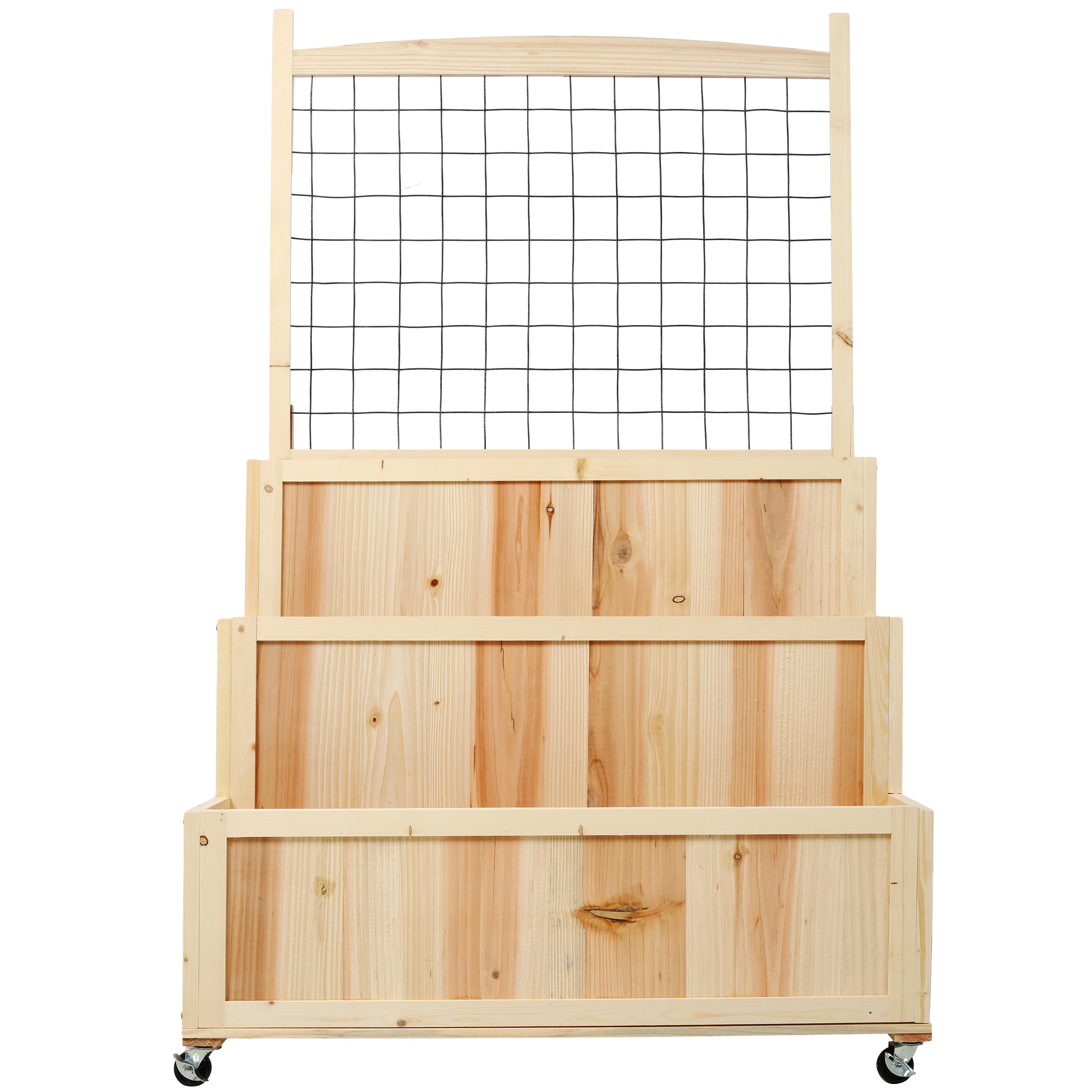
planter on wheels with trellis 3-Tier Vertical Planter with Trellis & Wheels

Sale price$23.13 Regular price$25.70
Save 10%

Pay in installments of $6.42 with ShopPay, AfterPay and Klarna

Shipping Estimate
USA
  • USA
  • CAN

Ships within 48 hours · Estimated delivery Jul 23 - Jul 28

Promo Codes Available:

For Your Every Summer RSVP, with Code: SUMMER15

Description

planter on wheels with trellis 3-Tier Vertical Planter with Trellis & WheelsProduct Description 3 Tier Raised Garden Bed with Trellis 3 Tier Raised Garden Bed with Trellis 53" H Vertical Planter Box with Wheels & Back Storage Small space? No problem. Want to grow up, not just out? This vertical planter delivers. If you're a balcony gardener, patio enthusiast, or someone who loves fresh herbs and flowers but hates bending over or tripping over pots, the 3 Tiers Raised Garden Bed with Trellis is your new best friend. This all

Product Description - 3-Tier Raised Garden Bed with Trellis

3-Tier Raised Garden Bed with Trellis – 53" H Vertical Planter Box with Wheels & Back Storage

🌱 Small space? No problem. Want to grow up, not just out? This vertical planter delivers. If you're a balcony gardener, patio enthusiast, or someone who loves fresh herbs and flowers but hates bending over or tripping over pots, the 3-Tiers Raised Garden Bed with Trellis is your new best friend. This all-in-one wooden planter gives you three separate planting boxes, a built-in trellis for climbing vines, plus a hidden back storage area for your tools. And yes – it rolls on wheels (with brakes), so you can chase the sun or move it out of the way during storms. No more messy sheds, no more cramped gardens. Just smart, vertical growing that looks beautiful and works hard.

🌿 Key Features – 3-Tier Vertical Raised Garden Bed with Trellis

🪵

Quality Solid Wood Construction & Drainage

Built from durable solid wood, this outdoor planter is strong and weather-resistant. Each of the three raised boxes has two drainage holes at the bottom to prevent waterlogging and root rot. Your flowers, vegetables, and herbs will thrive with healthy airflow and moisture control.

🌻

2-in-1 Design – Plant + Trellis for Climbing Plants

The three lower boxes are perfect for planting greens, herbs, or flowers, while the upper trellis gives support to climbing vines like peas, beans, morning glories, or cucumbers. This vertical setup maximizes your growing space and adds a charming focal point to any garden.

🛞

Easy Mobility – 4 Wheels with Brakes

Equipped with four smooth-rolling wheels (two with brakes), this raised bed can be moved effortlessly around your patio, deck, or garden. Lock the brakes to keep it securely in place, then unlock and roll to follow the sun or protect plants from harsh weather.

🧰

Convenient Back Storage Area

A hidden storage compartment behind the planter keeps your garden tools organized and within reach – store your watering can, pruning shears, gloves, or small fertilizer bottles. No more running back to the shed every five minutes.

📏

Spacious & Strong – 110 lbs Capacity per Box

Overall dimensions: 31.5" L x 24.2" W x 53" H. Each of the three planting boxes can hold up to 110 lbs of soil and plants – that's serious growing power. Perfect for deep-rooted vegetables or heavy flowering shrubs.

📐 Technical Specifications – 3-Tier Vertical Planter with Trellis & Wheels

Item Code W465P189518
Product Type Single Box Product (3-Tier Raised Bed + Trellis + Storage)
Color Natural Wood Finish
Material Solid Wood (Weather-Resistant)
Assembled Length 31.50 inches
Assembled Width 24.20 inches
Assembled Height 53.00 inches
Product Weight 20.80 lbs
Number of Planting Boxes 3 tiers
Drainage 2 drain holes per box (6 total)
Wheels 4 wheels (2 with locking brakes)
Storage Area Rear compartment for garden tools
Weight Capacity per Box 110 lbs each
Package Length 34.30 inches
Package Width 29.90 inches
Package Height 5.50 inches
Package Weight 24.40 lbs

❓ Frequently Asked Questions – 3-Tier Raised Garden Bed with Trellis

🔹 Is the wood treated for outdoor use? Will it rot or warp?

Yes, the solid wood is naturally weather-resistant and suitable for outdoor conditions. To extend its life even further, we recommend applying a non-toxic wood sealant or outdoor furniture oil once a year, especially if you live in a very rainy or humid climate. The planter also has drainage holes to prevent standing water that could damage the wood.

🔹 How do the wheels work on grass or uneven surfaces?

The wheels are designed for smooth surfaces like decks, patios, concrete, or compacted gravel. On grass or soft soil, they may sink slightly, but the planter can still be moved with a bit of effort – the brakes help lock it in place once you find the right spot. For mostly grassy areas, we recommend placing a flat board or paver underneath.

🔹 Can I assemble this myself? Are instructions included?

Absolutely. The package includes a clear, illustrated instruction manual and all necessary hardware. Most customers assemble the 3-tier bed in about 30–45 minutes with just a Phillips screwdriver (not included). The wheels and trellis attach easily – no advanced DIY skills required.

🔹 What kind of plants work best with this vertical design?

The lower three boxes are great for shallow to medium-root plants: herbs (basil, mint, thyme), lettuce, strawberries, flowers (petunias, marigolds), and small vegetables like radishes or green onions. The trellis is perfect for climbing plants: peas, pole beans, morning glories, jasmine, or small cucumbers. You can even mix trailing plants that spill over the edges for a lush look.

🔹 Does the back storage area get wet when it rains? Can I store tools there long-term?

The storage compartment is open to the back (no sealed door), so light rain may enter. It's best for storing tools that can handle occasional moisture, like galvanized watering cans, plastic pots, or metal shears (wipe them dry). For sensitive items, we recommend keeping them in a weatherproof box inside the storage area. The compartment is perfect for quick-access items you use daily.

Shipping Notes
  • Free Standard Shipping on $100+ Orders to the USA.
  • Except Preorder products are shipped in 48 hours.
  • Delivery to the USA:
  1. Standard Shipping : 3-10 business days
  • If time is of the essence, please consider selecting expedited delivery for faster service.
Exchange/Return Notes
  • We offer a 30-day return/exchange service after receiving.
  • Final sale items are not eligible for returns or exchanges.
  • To process your return/exchange, please contact us at [email protected]
  • Please click here for more details>>> Return & Exchange Policy
SKU: 2680379179

Discover Niche Categories That Outsell planter on wheels with trellis

Top-Converting Item to Boost Your Average Order

4.1 ★★★★★
Based on 17 reviews
Sort
Highest Rating
Newest First
Oldest First
Product Reviews
R
Verified Purchase
Russell C.
Fort Morgan, US
★★★★★ 5
Great History book
Format: Paperback
This book was a gift for husband. He loves it. He is a slow reader, but he can’t put book down. New and interesting history facts and stories.
WAS THIS REVIEW HELPFUL?YesReportShare
Reviewed in the United States on February 6, 2026
J
Verified Purchase
John D. Cofield
Massapequa, US
★★★★★ 5
Consequence After Consequence
Format: Hardcover
"In Fourteen Hundred Ninety Two, Columbus Sailed The Deep Blue Sea" is a ditty sung by generations of school children. Most of those students learned and believed that Columbus was the only man in Europe who believed the world was round and proved it by sailing three ships west to find the East. In 1493, Charles C. Mann dismisses these legends and goes on to demonstrate that Columbus (or as he refers to him, Colon) and the other Europeans who sailed across the Atlantic in the 1400s and 1500s did far more than just discover a New World, they helped create a planet wide system in which people, plants, animals, and diseases travelled further and were linked in more ways than had ever before been possible. In other words, 1493 was the beginning point of a new age of globalization. This is not a new theory. Alfred W. Crosby developed the term Columbian Exchange back in the 1970s to describe the changes that took place after 1492. Jared Diamond's Guns, Germs, and Steel and Collapse also detailed some of the consequences of the European "discovery" of the Americas. What makes Mann's new book so appealing is his ability to tell an engrossing story that ably explains how one consequence led to another, fundamentally changing society after society and helping to creat our modern world. This is global history at its best, jumping from Ming and Qing China's opulent but troubled societies to the fast growing but still relatively backwards European states to the myriad African and Native American cultures, all of them to be affected by the transfer of peoples, plants, diseases, and ideas. Mann has a keen eye for an appealing and informative anecdote which really details the consequences of seemingly small decisions, such as how the introduction of the sweet potato to China led to deforestation, or how the Little Ice Age was affected by the abandonment of the Native American practice of burning off underbrush in North American forests. Its books like 1493, as well as Mann's earlier and equally excellent 1491, which make studying history so fascinating. I taught Advanced Placement World History to high school students for many years before retiring, and I regularly amused them (at least I hope I did) with many references to Jared Diamond and Alfred Crosby's ideas. With 1493 Charles C. Mann deserves equal recognition by global historians.
WAS THIS REVIEW HELPFUL?YesReportShare
Reviewed in the United States on August 19, 2011
V
Verified Purchase
Victor Vögel
Fort Morgan, US
★★★★★ 5
Mesmerizing; shows the butterfly effect in action
Format: Paperback
Charles Mann’s “1493” is about globalization and the Homogenocene epoch. Unlike the plenitude of other recent books about globalization, however, “1493” is about biological globalization rather than economic globalization. The book traces the results of the Columbian Exchange, with chapters devoted to tobacco, the earthworm, malaria, silver, potatoes and sweet potatoes, guano and rubber. The book is in four parts, and is written in an accessible, non-academic style. I found the first three parts of the book, which cover the impact of the Columbian Exchange on the Atlantic, the Pacific and Europe, respectively, to be captivating. These parts of the book demonstrated the fascinating interconnectedness of all things in a globalized society (in other words the “butterfly effect”) – for example, how transporting the sweet potato to Western China led to population migrations from Eastern to Western China, deforestation and overflowing of the Yellow River. The general result of such biological globalization is the creation of the Homogenocene epoch, a term which Mann uses to describe the biological homogenization that has replaced biological diversity since the time of Columbus. In the first three parts of the book, Mann demonstrates how history, biology and chemistry are all interrelated, and how today’s world continues to be influenced by the Columbian Exchange. I found the last part of the book to be less impressive than the first three parts. Part Four is called “Africa in the World,” but confusingly it is about South America, not Africa. Parts of it read more like travel writing than history. Still, the book deserves five stars for the first three thrilling parts, which successfully trace the mesmerizing history of various everyday biological substances.
WAS THIS REVIEW HELPFUL?YesReportShare
Reviewed in the United States on December 31, 2017
J
Verified Purchase
Jamie Barnett
Port Orchard, US
★★★★★ 3
There were periods I was on the edge of my seat. There were times I just wanted to the book to end.
Format: Paperback
I recently started reading at 40 years old to make up for a lot of wasted time and missed education. This is a very informative read, but that said, I had a hard time staying focused sometimes. He gets into a lot of the science pertaining to plagues, epidemics etc which is interesting and I am reluctant to list science as a con as I did learn, but frequently found myself scrolling through several pages just to get the main idea behind the historical part. There were periods that I was on the edge of my seat and there were times I just wanted to the book to end. 1491 was similar. Both useful books, but a bit challenging to follow along especially if you are only reading small amounts at at time like on break at work etc. It jumps around from S. America, N America and China all through the book. I would have preferred that each region be separated. I get that he had his reasons. I am glad I read both books, but I probably should have gone with more of an overview vs the more in-depth content in this. I do not regret reading both books however, and recommend if you already have a good knowledge of this subject and are just trying to learn a little more. I found the information about the slave trade, the most interesting and wasn't aware that the majority of slaves shipped over from Africa went to Mesoamerica and the Caribbean. I also did not realize that plague and sickness really enabled use of African slaves as they were not prone to malaria like the Europeans. There is also some good info about ancient China and also sliver and mercury mining with South American Indians which made the book worth it for me.
WAS THIS REVIEW HELPFUL?YesReportShare
Reviewed in the United States on March 7, 2023
R
Verified Purchase
R. D. Morris
Lexington, US
★★★★★ 4
If you liked 1491, you'll like 1493
Format: Hardcover
I originally read the first edition of 1491, which I loved. So that's why I ordered 1493. At about the same time 1493 arrived, I found out there was a new, revised version of 1491, which my husband bought from another source. So I re-read it at the same time I read 1493 for the first time. The reason I mention this is that there are some similarities between the revised version of 1491 and the newer book, 1493 - actually some repeated material. That's ok, as the author is taking the premise of 1491 another step further. Essentially, 1491 focuses on what new studies show was really going on in the Western Hemisphere before Columbus' arrival, where native peoples were far more numerous and had more advanced cultures than Europeans previously thought possible. In 1493, Charles Mann shows not only how Columbus and Europeans changed the New World, but how the "Columbian exchange" wrought great changes in the other direction as well. And he pulls in the further exchanges with Asia, to show the trans-global linkages of the phenomenon. So, some of his exposition gets a little repetitious, but overall he's an engaging writer, and for those of us who love the history of cultural exchanges and first contact, these books are mandatory reading!
WAS THIS REVIEW HELPFUL?YesReportShare
Reviewed in the United States on October 5, 2011

recommand products