SKU: 25744628391
vista car seat and stroller

vista car seat and stroller UPPAbaby Vista V3 Stroller

Sale price$20.41 Regular price$22.68
Save 10%

Pay in installments of $5.67 with ShopPay, AfterPay and Klarna

Shipping Estimate
USA
  • USA
  • CAN

Ships within 48 hours · Estimated delivery Jul 21 - Jul 26

Promo Codes Available:

For Your Every Summer RSVP, with Code: SUMMER15

Description

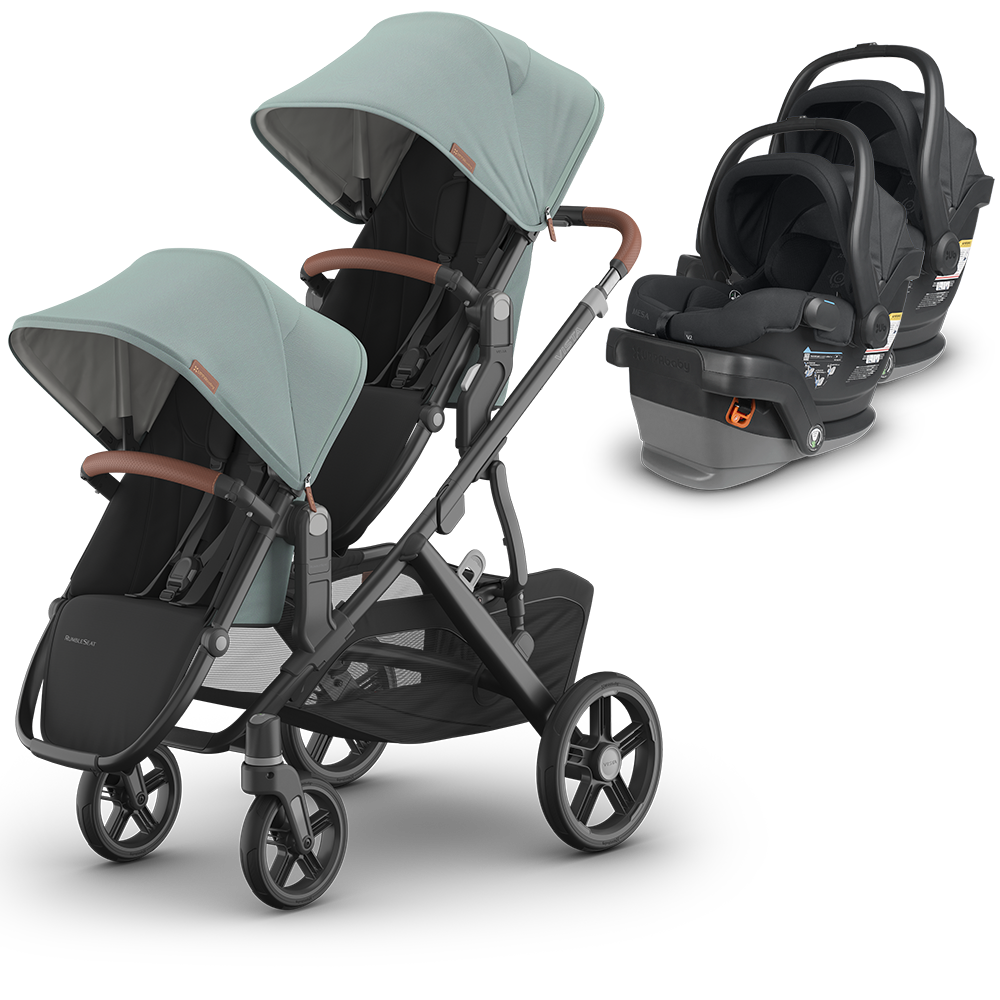
vista car seat and stroller UPPAbaby Vista V3 StrollerUPPAbaby Vista V3 Twin Stroller + 2 Mesa V3 Aria V2 Car Seats Travel System The Uppababy Vista V3 Twin Travel System provides the perfect solution for families with twin bundles of joy. This special UPPAbaby travel bundle provides everything a parent needs for strolling with two little passengers. It includes the incredibly versatile and newly upgraded Vista V3 stroller and your choice of either two (2) newly upgraded Mesa V3 infant car seats or two

UPPAbaby Vista V3 Twin Stroller + 2 Mesa V3/Aria V2 Car Seats Travel System

The Uppababy Vista V3 Twin Travel System provides the perfect solution for families with twin bundles of joy. This special UPPAbaby travel bundle provides everything a parent needs for strolling with two little passengers.  It includes the incredibly versatile and newly upgraded Vista V3 stroller and your choice of either two (2) newly upgraded Mesa V3 infant car seats or two (2) of the super lightweight Aria V2 infant car seats, both stylish and full-featured options that provide you with a convenient and tasteful travel system. This particular travel bundle also includes the RumbleSeat which is designed for a second sibling, and the upper adapters which create additional spacing between the two seats so both children can ride comfortably.

What’s Included with this Travel System?

UPPAbaby VISTA V3 stroller including:

  • UPPAbaby Vista V3 Stroller
  • Toddler Seat Seasonal Seat Liner
  • Toddler Seat Bug Shield
  • Toddler Seat Rain Shield
  • Stroller Storage Bag
  • 3-Year UPPAbaby Warranty

Two (2) UPPAbaby Mesa V3 or Aria V2 Infant Car Seats including:

  • Your choice of two (2) Infant Car Seats, either the Mesa V3 or the or Aria V2
  • Two (2) Car Seat Bases
  • Two (2) Two-Piece Robust Infant Inserts
  • Limited Lifetime Warranty (up to expiration of car seat)

UPPAbaby RumbleSeat including:

  • Lower Adapters
  • Bumper Bar
  • Bug Shield
  • 3-Year UPPAbaby Warranty

UPPAbaby Upper Adapters

  • Compatible with all Vista models after 2015.
  • For use with all Bassinet models, Vista Toddler Seat, Mesa Infant Car Seats, and Aria Infant Car Seat

UPPAbaby Vista V3 Stroller:

One of the best just got better. Making improvements to arguably one of most popular and in-demand strollers on the market is no easy task, but UPPAbaby was up to the challenge. Introducing the UPPAbaby Vista V3, an upgraded version of the ever-popular Vista V2, designed for the growing family and loaded with new features and improvements.

UPPAbaby has kept everything customers loved about the predecessor Vista V2 stroller and introduced several upgrades and functional improvements that will make the Vista V3 a favorite with growing families for years to come.

UPPAbaby Vista V3 Key Features:

  • Offering 30+ configurations to grow with your family starting from birth up to three children in tow
  • The Vista V3 will no longer include the UPPAbaby bassinet with purchase. The UPPAbaby bassinet will continue to be offered as an accessory and can be added to the Vista V3 system.
  • The Mesa and Aria Infant Car Seats as well as the Bassinet attach directly to the stroller with no adapters needed, creating an easy from-birth solution
  • All-weather Comfort Seat with padded insert for cooler days will convert to mesh for warmer days
  • Quick-to secure harness system with magnetic buckle and easy-to-adjust no rethread harness
  • Enhanced FlexRide Suspension delivers a smooth ride on all types of terrain with either one, two or three little passengers
  • Full size toddler seat grows with child up to 50 pounds and accommodates both the parent-facing or forward-facing positions
  • Never flat tires for increased durability and smooth strolling on any type of terrain
  • Reflective trims on wheels and basket provide increased visibility when strolling in low light or evenings
  • Use of RumbleSeat and Piggyback board provides ability to transport up to three children
  • Please note that the Piggback board is sold separately and not included in this listing.
  • One-handed, multi-position recline allows for comfortable strolls and easy nap time
  • Adjustable handlebar allows you to accommodate strollers of different heights with ease
  • Front wheel locks with visual indicators for safety and extra piece of mind
  • Adjustable footrest positions feet and legs comfortably as they grow
  • Extendible UPF 50+ canopy
  • Machine washable fabrics
  • New all-terrain wheels available and sold separately (4-wheels, $150)
  • GREENGUARD Gold Certified
  • REACH Certified
  • JPMA Certified

The Vista V3 is Available in a Variety of Stylish Options:

UPPAbaby is introducing several new colors to compliment their already impressive stable of fashions. With elegant frame options and several luxurious leather accents to choose from, the UPPAbaby V3 will make a sophisticated and stylish companion.

  • OWEN: Mocha Mélange | Carbon Frame | Chestnut Leather
  • ADA: Sandstone Mélange | Carbon Frame | Chestnut Leather
  • JULIAN: Dusty Blue Mélange | Carbon Frame | Chestnut Leather
  • EVELYN: Meadow Green | Graphite Frame | Chestnut Leather
  • SAVANNAH: Pearl Gray Jacquard | Carbon Frame | Chestnut Leather
  • KENZI: Mystic Aqua | Carbon Frame | Saddle Leather
  • GREYSON: Charcoal Mélange | Carbon Frame | Saddle Leather
  • JAKE: Charcoal | Carbon Frame | Black Leather
  • CALLUM: Stone Blue |Silver Frame | Sand Leather
  • NOA: Navy I Carbon Frame l Saddle Leather

UPPAbaby Vista RumbleSeat V3 Key Features:

  • Suitable up to 40 lbs.
  • Seasonal seat with breathable mesh backing for comfort in warmer climates
  • Comfy insert for cooler days is easily removable without the use of tools
  • Quick and easy magnetic closure buckle
  • Easy one-handed release
  • GREENGUARD® Gold Certified to support healthier air quality and low chemical emissions
  • Multi-position adjustable footrest aids in child comfort for growing child
  • Grow-with-me canopy height adjustment provides extra headspace for child
  • Adapters ensure quick, easy, and intuitive attachment to Vista
  • Can be positioned forward and parent-facing
  • One handed, multi-position recline
  • Extended zip out canopy provides even more shade from the sun. Mesh panels also make it easy to peek in while adding airflow.
  • No-rethread harness allows the entire harness system to be tightened or loosened in a singular motion for a precise fit for growing babies

Choose The Car Seat That is Right For You:

Pair the versatile Vista V3 with one of UPPAbaby’s popular and adaptable infant car seats to create a travel system that delivers the ultimate in portability and safety. The key features for the UPPAbaby Mesa V3 and the Aria V2 Infant Car Seats are outlined below.

UPPAbaby Mesa V3 Key Features:

  • 4th anti-rebound handle position for increased safety in rebound & rear-impact collisions
  • Large, adjustable headrest for additional Side Impact Performance and comfortable fit
  • Advanced Side Impact Protection that meets FMVSS New 213A regulation and 213B
  • Deluxe, full coverage UPF 50+ canopy with mesh ventilation and peek-a-boo window
  • Robust Infant Insert designed to optimize fit and body positioning
  • No-rethread 5-point harness that adjusts with headrest
  • Headrest totals 25 positions to ensure proper fit and ease of adjustment
  • Intuitive, magnetic buckle holder to keep the straps out of the way while placing child in seat
  • Installation quick and simple by combining our innovative SmartSecure® system, auto-retracting LATCH design, red to green tightness indicator, and four-position adjustable foot
  • European Routing for a more secure installation when installing without the base
  • Robust infant insert ensures a proper fit and body positioning for infants weighing as little as 4 lbs
  • Ergonomic carry handle featuring a one-handed stroller release button
  • Two crotch buckle positions for a precise fit
  • Removable and washable seat fabric for convenience and easy clean up
  • Fabric free from flame-retardant chemicals
  • Carrier weighs under 10 lbs
  • Car seat base included
  • Direct attachment for Vista® and Cruz® strollers
  • Convenient adapters available for the Minu® and Ridge® strollers
  • FAA certified for aircraft use
  • Product Lifetime Warranty

UPPAbaby Aria V2 Key Features:

  • Lightest infant car seat on the market weighing in at just 6 lbs.
  • Extra-large, UPF 50+ canopy with pop-out sunshade and ventilation for airflow
  • Two-piece robust infant insert ensures proper fit and body positioning for preemies from approximately 4 lbs. with ability to fit babies up to 4 months
  • SmartSecure® System with red-to-green visual indicator accurately installs in seconds
  • Effortless no-rethread 5-point harness for a customized fit as baby grows
  • Enhanced safety with Anti-Rebound+ Panel and Load Leg for increased stability and energy absorption
  • GREENGUARD® Gold Certified to support healthier air quality and low chemical emissions
  • Direct attachment for Vista® and Cruz® strollers + convenient adapters for Minu® and Ridge® 

Specifications:

Vista V3 stroller:

  • Suitable from birth with accessories or 3 months to 50 lbs. without accessories
  • Dimensions:
    • Unfolded: 36” L x 25.7” W x 39.5” H
    • Folded with seat attached: 17.3” L x25.7” W x 33.3” H
    • Folded without Seat attached: 13” L 25.7” W x 32” H
  • Product weight for seat and frame: 27 lbs.
  • Product weight for frame only: 20 lbs.
  • Product weight for seat only 7 lbs.
  • Please note that the Piggback board is sold separately and not included in this listing.

Mesa V3 Infant Car Seat:

  • Suitable from approximately 0–1 years
  • Suitable from birth (4 lbs - 30 lbs and up to 32” in height) - whichever comes first
  • Car Seat dimensions: 17”W x 25.8”L x 23”H
  • Car Seat on base dimensions: 17”W x 28”L x 25”H
  • Car Seat base-only dimensions: 14.5”W x 21.3”L x 10.3”H
  • Car Seat 9.9 lbs
  • Base 9 lbs

Aria V2 Infant Car Seat: 

  • Suitable from approximately 0–1 years
  • Suitable from birth (4 lbs - 30 lbs and up to 30” in height) whichever comes first (US only)
  • Carrier Weight: 6 lbs (without canopy and insert)
  • Base Weight: 12.8 lbs
  • Carrier Dimensions 25.8 L x 17 W x 23.7 H
  • Base Dimensions 23.9” L x 14” W x 15.2” H

V3 RumbleSeat:

  • Suitable for children from 3 months to 40 lbs or 36″, whichever comes first
  • Suitable from birth with the SnugSeat Accessory
  • Compatible with Vista 2015+ (including Vista V2 and Vista V3)
  • Note: RumbleSeat V3 adapters are for use in the lower position only and are NOT compatible with the Vista Toddler Seat, which can only be used in the upper position.


Shipping Notes
  • Free Standard Shipping on $100+ Orders to the USA.
  • Except Preorder products are shipped in 48 hours.
  • Delivery to the USA:
  1. Standard Shipping : 3-10 business days
  • If time is of the essence, please consider selecting expedited delivery for faster service.
Exchange/Return Notes
  • We offer a 30-day return/exchange service after receiving.
  • Final sale items are not eligible for returns or exchanges.
  • To process your return/exchange, please contact us at [email protected]
  • Please click here for more details>>> Return & Exchange Policy
SKU: 25744628391

Discover Niche Categories That Outsell vista car seat and stroller

Top-Converting Item to Boost Your Average Order

4.4 ★★★★★
Based on 12 reviews
Sort
Highest Rating
Newest First
Oldest First
Product Reviews
E
Verified Purchase
Eric G
Pawtucket, US
★★★★★ 5
A great book for anyone interested in US foreign policy, history, or economics
Format: Hardcover
In July of 1944 representatives from forty-four nations gathered at the Mount Washington Hotel in Bretton Woods, NH to establish the rules for the post World War II international monetary system. Although nations from around the globe were at the table, the primary debate was between the United States and Great Britain. The U.S. was determined to advance a policy ensuring the dollar reigned supreme in world trade, thus guaranteeing American dominance. The British were holding out for a monetary system that would not relegate them to a secondary status after the war. Representing the two great nations were two men. For the U.S. it was a little-known economist working as an assistant to the Secretary of Treasury, Harry Dexter White, and representing the British was world-known economist John Maynard Keynes. Benn Steil examines the Bretton Woods conference, and the inter-war years leading up to it, using these two men as a backdrop. Not only is the work well researched, but as a senior fellow and director of international economics at the Council on Foreign Relations, Steil is eminently qualified to make economic judgements. Steil’s thoroughness and expertise combine to make an enjoyable read of what could otherwise be an exceptionally dry topic. The main argument Steil makes is that the dominance of dollar in the post WWII economy was a fait accompli at Bretton Woods. Mr. Steil introduces the reader to the relatively unknown Harry Dexter White, a minor player at the U.S. Treasury commanding great influence. Steil shows the reader that going into Bretton Woods, White and his boss, Treasury Secretary Henry Morgenthau, were committed to bringing President Roosevelt’s New Deal to the rest of the world. Part of this plan was to shift power not only from London, but from Wall Street as well, to the U.S. Treasury. White was convinced international banking had played a key role in creating the instability responsible for WWII. A new gold standard tied to the U.S. dollar would ensure stability in White’s view. Ultimately White’s ideas led to the creation of “the three so-called Bretton Woods institutions: the International Monetary Fund (IMF), the World Trade Organization (WTO), and the World Bank” (Steil, The Battle of Bretton Woods, 127). Adding intrigue to economics Steil also shows through declassified F.B.I. documents and recently discovered writings by White, that White was an agent of the Soviet Union. Keynes is often regarded as “the first-ever international celebrity economist” (Steil, The Battle of Bretton Woods, 3). While this may be true, he was no match for the little-known White. White (and Morgenthau) considered the British a threat on the economic stage and made sure their Lend-Lease terms would bankrupt the U.K. by the end of the war and bring them to the bargaining table. As well as being an interesting historical read, and a useful primer on international monetary policy, Steil captures the importance of economic policy in relation to foreign policy. Morgenthau and White realized the power of the U.S. to inflict its will upon other nations was rooted in the power of the dollar. Today as then, U.S. power flows from the economy. Students of modern U.S. foreign policy would be wise to have a basic understanding of U.S. economic policy and how the U.S. economy interacts in the global system.
WAS THIS REVIEW HELPFUL?YesReportShare
Reviewed in the United States on March 2, 2020
E
Verified Purchase
Etienne RP
Houston, US
★★★★★ 5
Hosting Diplomatic Conferences 101: The Case of Bretton Woods
Format: Paperback
Bretton Woods was the most important international gathering since the Paris Peace Conference of 1919. I read this book looking for clues on how to host international conferences: how to accommodate delegates, maintain protocol, overcome obstacles, build consensus, and reach a satisfying outcome. I was disappointed on that count. The Battle of Bretton Woods doesn’t focus on the Bretton Woods conference per se. It is a work of intellectual history built around the two characters of John Maynard Keynes and Harry Dexter White. It describes the way these two Treasury officials negotiated the main financial issues facing the United States and the United Kingdom during World War II and immediately after: the Lend-Lease Act of 1941 granting the British access to war finance and equipment; the blueprints for a postwar monetary order that began circulating in 1942 and ultimately culminated in the adoption of the Articles of Agreement of the International Monetary Fund and the International Bank for Reconstruction and Development at Bretton Woods; the signing of the $4.4 billion Anglo-American Financial Agreement in December 1945; and the inaugural meeting of the IMF board of governors in Savannah, Georgia, on March 8, 1946. It mixes these elements of diplomatic history with personal aspects of the lives of the two main characters: Keynes’s inflated ego and lack of diplomatic acumen that resulted in missed opportunities for Great Britain; and White’s dual personality as the braintrust of the US Treasury and as a mole operating clandestinely for the Soviets. To be sure, there are some useful indications on the Bretton Woods conference itself. It took place in the Mount Washington Hotel in New Hampshire, a luxury resort with striking views of the White Mountains. The organization itself was a mess: “everything is in a state of glorious confusion,” commented British economist Lionel Robbins, who added: “with all their virtues as technicians—and these are very great—the Americans are not good organizers of international conferences.” The conference took place in war time, and army bus and personnel brought the delegates in and out. Delegates were thrown out of the hotel on July 23 for fear they would reopen the discussion and have a closer look at the hastily agreed texts. The location itself owed a lot to domestic politics. US Treasury Secretary Henry Morgenthau wanted to court a local politician for future support of the agreement in the Senate, remembering the disastrous defeat of Wilson’s League of Nations in Congress after World War I. The press was also in attendance, and Bretton Woods became one of the first international conferences to be covered live by the media. Most of the delegates came from Ministries of Finance or central banks, and true diplomats—the ones hailing from Ministries of Foreign Affairs—were a rare occurrence. The US Treasury Department had willingly kept the State Department out of the loop, and considered the only senior diplomat present, Undersecretary of State Dean Acheson, as “one of them”. The conference was only the tip of the iceberg: everything was set in advance, during the two years when plans were circulated and drafts were discussed. The invitations were sent to forty-four nations, but the United States ran the show from start to finish, and even British delegates were relegated to a secondary role. Keynes, who had termed the Reconstruction Bank scheme imagined by White “the work of a lunatic,…some sort of bad joke,” was named chairman of the commission that drafted the Bank’s Articles of Agreement, while White himself dealt with the much more significant IMF. As for other nations, their input was limited to discussing the national quotas that would measure their relative power and influence at the boards of the two institutions or, in the case of the Cubans, to “providing the cigars”. White’s goal was to “channel the energy, aims, ambitions, and vanities of the mass of delegates into meaningless debate.” As an American organizer wily remarked, “there should be just one general rule: that anybody can talk as long as he pleases, provided he doesn’t say anything.” To make things even safer, the session secretaries were all Americans, appointed by White, and it was they who wrote the official minutes of the committees. Some important remarks made during sessions disappeared from the draft minutes, while crucial provisions were introduced surreptitiously in the final text versions. As an example, White’s technicians strategically replaced “gold” with “gold and dollars” in the paper describing the foundations of the postwar monetary order, a crucial modification that Keynes discovered only after his departure from Bretton Woods. The result was, in Keynes’s words, “the most monstrous monkey-house assembled for years.” The distinguished Cambridge don liked that expression, and indeed often referred to non-Anglo-saxons as monkeys, with a special mention to the French which he utterly despised. But the monkey-king in this diplomatic jungle was certainly Keynes himself. Long before Paul Krugman and Thomas Piketty, Keynes was the first-ever international celebrity economist. He was surrounded by an aura of awe and admiration, and the printed media craved for his every declarations. In Benn Steil’s rendering, he had “an effortless facility with words that might have made him a master diplomat, had he actually been more concerned with convincing opponents than with cornering them logically and humiliating them.” “The man is a menace for international relations,” remarked fellow British economist James Meade, who nonetheless revered him. He would make aggressive jokes on lawyers in front of American lawyers, show his contempt for other delegates by displaying his immense intellectual superiority, and try to steal the show by pretending the outcomes of negotiations were all due to his influence while in fact they ran counter to his prescriptions. His last speech in Savannah, where he metaphorically summoned spirits and fairies to bestow the newborn institutions with their gifts, was taken as a personal attack by the American delegate: “I do mind being called a fairy,” he muttered to his aide. If a statesman is to be judged by his capacity to serve the national interest, Keynes failed miserably in his attempt at statesmanship. This is not to say that he didn’t have Britain’s interest in mind. His visionary monetary schemes notwithstanding, he had ultimately come to the United States with the mission of conserving what he could of bankrupt Britain’s historic imperial prerogatives. As Schumpeter wrote, “Keynes’s advice was in the first instance always English advice, born of English problems.” Keynes was thoroughly British, and it was the British problems of his day that drove his theorizing: problems of deflation and depression, paying for war and surviving the perilous transition to peace. He had spent his career thinking about monetary issues as a way to preserve his country’s clout in the world. In particular, the shift of financial power from London to New York was a matter of constant concern for him. But he lacked the basic insight that the Americans did not share British national interests, and that they could even be rival powers on the international scene. Throughout the war, Keynes continuously overestimated American sympathies with Britain and underestimated the importance of public and congressional resistance to US aid or involvement. He thought of Bretton Woods as a battle of ideas, counting on his immense intellectual superiority to carry the day, whereas it was first and foremost a battle of power and influence, with the United States as the clear winner. Indeed, British and American interests were not identical, however much both peoples were dedicated to destroying Nazism. Henry White had a clear goal in Bretton Woods: to entrench the dollar as the world’s currency, and to make it “as good as gold”. He used the leverage provided by the Lend-Lease agreement and Britain’s quasi-bankrupt situation in order to put a permanent end to the pound sterling’s international role. This required dismantling the structural supports of the British empire. In particular, Americans sought to put an end to “imperial preference”, by which Britain secured privileged trade access to the markets of its colonies and dominions. There was no room in the new order for the remnants of British imperial glory: the postwar world needed to be grounded in nondiscriminatory multilateral trade and full monetary convertibility. The Americans never deviated from their hard-line geopolitical terms. Many held no particular sympathy for the British, who had “shamefully walked away from their Great War debt obligations,” and who were trying to extend their Empire’s lease of life by credit. At Bretton Woods, we see American power in full swing, and in particular the role of the US Treasury as the economic arm of American foreign policy. Contrary to the myth, Bretton Woods did not provide the economic foundation for postwar prosperity and monetary stability. And it was not the cooperative, disinterested, forward-looking endeavor that people often have in mind when they stress the need for a new Bretton Woods. The Bretton Woods system didn’t work the way it was supposed to. It was effective for only a brief period, and then not for the reason its authors had envisaged. It was not until 1961, fifteen years after the IMF was inaugurated, that the first nine European countries formally adopted the required provisions that their currencies be convertible into dollars. Even then, Bretton Woods was an ineffective and crisis-prone monetary system. It began experiencing potentially fatal difficulties as early as the late 1950s, and was only kept alive by a series of political fixes that made little long-term, macroeconomic sense. It could never have survived the globalization of finance and the removal of capital controls that began to take place in the 1970s. Indeed, it can be argued that the system was doomed the moment that it came into existence, and that the Bretton Woods agreements contained fatal flaws that could only lead to the abandon of gold convertibility. Not only was Bretton Woods a crisis-prone, unstable system: it was also a bad deal for Great Britain and, one could argue, for the United States and for the world as well. What Britain actually needed in 1944-45 was short-term financing at reasonable cost with few geopolitical strings attached, and possibly a lower exchange rate. There was evident hubris in the attempt to design a global monetary system, to be managed by an international body, at a time when the outcome of the war was not yet clear. Keynes and White’s ambition was to create “a New Deal for a new world,” but they lacked the political legitimacy and also the effective means to achieve such a grand plan. Another course of action was possible for the United Kingdom, one suggested by a British Treasury official after the facts: postpone the “Grand Design” negotiations, avoid irreversible decisions, try to buy time until you see how the new postwar world develops, and borrow your way out of the crisis by getting a commercial loan from Wall Street. Who at Bretton Woods would have thought that the British empire would unravel, the United States and the Soviet Union turn into arch-enemies, and the world divide into hostile camps just two years after the conference? There was no necessity to conclude Bretton Woods in a haste. Waiting for the San Francisco conference to address the issue of money and finance jointly with the creation of the United Nations would have made the postwar institutional framework more coherent. The world would have avoided the dichotomy between the Bretton Woods institutions in Washington and the United Nations in New York, in which both seem to live on completely different planes. So are there practical lessons from Bretton Woods for statesmen and diplomats hosting international meetings, such as the Paris Conference on Climate Change that will take place in end-November and December 2015? First, as the previous attempt to tackle climate change at Copenhagen taught us, the summit itself is not the place where comprehensive negotiations should take place. Most items on the agenda should be solved beforehand, in preparatory meetings among experts or in a pre-summit rehearsal such as the UN General Assembly in New York. Second, organizers should make sure they keep a bone for the leaders and national delegates to chew, one that is easy enough to grasp and with a clear payoff in terms of national interest, such as the quota issue at Bretton Woods. Managing expectations and egos will always be a tricky issue, but one that diplomats are best equipped to handle. How to deal with the media is also a key issue, particularly in our age of instant communication and world broadcasting. Lastly, a modicum of modesty should be in order: the world is not going to be saved by international conferences, however successful they turn out to be. For Britain in 1944 and for the planet as a whole in 2015, buying time is always a sensible option.
WAS THIS REVIEW HELPFUL?YesReportShare
Reviewed in the United States on September 10, 2015
A
Verified Purchase
active reader
Draper, US
★★★★★ 3
History worth reading
Format: Kindle
Presents the history of the Bretton Woods conference, creation of the World Bank and the IMF and global and US politics surrounding the events. Discussion of Harry Dexter White, key US representative at Bretton Woods focuses on claims he was a Soviet spy beginning in the late 1930s and continuing through the conference and into the late 1940s; spends more time than necessary on this even though it is not clear how this affected the outcome of the conference. Most of the discussion of Keynes is on his reputation rather than his economics. Not the definitive history of Bretton Woods.
WAS THIS REVIEW HELPFUL?YesReportShare
Reviewed in the United States on July 10, 2013
J
Verified Purchase
John Hemphill
Lake Worth, US
★★★★★ 4
Foes at the Top Table
Format: Kindle
Those of us who studied economics in the 60s grew up on Keynes. This book provides a fascinating picture of the great man in action. And an equally fascinating picture of the Lend Lease negotiations and then the US hard line at Bretton Woods. Behind this hard line was Harry Woods, of Lithuanian emigre stock, who clawed his way by hard work and intelligence to negotiating prominence in the US Treasury. And who was a Soviet agent of influence. Well written, lucid, and remarkably interesting.
WAS THIS REVIEW HELPFUL?YesReportShare
Reviewed in the United States on May 19, 2013
M
Verified Purchase
Manuel Hinds
Whiting, US
★★★★★ 5
A distant mirror of our current problems
Format: Hardcover
The title of this excellent book accurately describes its contents:it is about a battle fought to define a new world order, that which was emerging from the ashes of World War II. The book also conveys the messy complexity of such a historical process--how individual characters interpreted the events around them, realized that they were giving shape to a radically new future, tried to take advantage of them to advance their own personal and national interests, and succeeded in accordance with their intelligence, the cunning of their argumentation, and, above all, the shifts in the real power that supported them. Masterly, Benn Steil makes the reader feel how Keynes and White gradually reached an unspoken and unrecognized agreement regarding the shape that the new world would have, and then fought to gain advantage in that new world--Keynes trying to keep the British Empire paramount in the world order, now based not on the Royal Navy but on Britain's alliance with the United States, the emerging superpower, and White asserting the unimpeded power of the United States. Focusing on one crucial aspect of the new order, money, Steil is able to reenact the human drama of the transfer of world power from Britain to the United States in all orders of life. It is an excellent history book. The book, however, goes beyond history as the narration and understanding of past events. When reading it, there is an eerie feeling that you are reading about current events. The process that led to Bretton Woods started thirty years before, with World War I and the end of the classical gold standard. When the war ended, a new monetary system was created, which was called the gold exchange standard. It resembled but emasculated the power of the old gold standard to keep monetary order in the world at large. This new system gave central banks the power to create money independently of the international consequences of doing it. With time, central banks abused this power, created a boom in the 1920s and then a depression in the 1930s. Bretton Woods was convened to reintroduce order in the monetary world. Like the gold standard of old, the new system created there was tied to gold in an effort to ensure stability. Yet, it also allowed central banks freedom to create money under certain circumstances. As it happened in the 1920s and 1930s, central banks abused their power, blew up the international system (in this case the Bretton Woods system) and then led the world into a series of booms and busts that has not ended as yet. A new monetary order will be needed to avoid worldwide inflation and protracted recessions. To understand the issues that will be crucial to give shape to this new monetary order it will be necessary to revisit the making of Bretton Woods in detail. There is no better way to understand these issues that Ben Steil's The Battle of Bretton Woods. Thus, in addition to being an excellent history book, it is also an excellent book about current events. Full disclosure: I wrote a previous book with Benn Steil: Money, Markets and Sovereignty (Yale University Press, 2009).
WAS THIS REVIEW HELPFUL?YesReportShare
Reviewed in the United States on May 28, 2013

recommand products