SKU: 25379471669
slipper plant indoors

slipper plant indoors Shop 'Pedilanthus bracteatus - Tall Slipper Plant' Care and Growing Guide

Sale price$18.33 Regular price$20.37
Save 10%

Pay in installments of $5.09 with ShopPay, AfterPay and Klarna

Shipping Estimate
USA
  • USA
  • CAN

Ships within 48 hours · Estimated delivery Jul 16 - Jul 21

Promo Codes Available:

For Your Every Summer RSVP, with Code: SUMMER15

Description

slipper plant indoors Shop 'Pedilanthus bracteatus - Tall Slipper Plant' Care and Growing GuideIntroducing the Pedilanthus bracteatus, known as tall slipper plant, which is a unique and eye catching plant native to Mexico and Central America. The scientific name comes from the Greek words 'pedil' meaning 'shoe' and 'anthos' meaning 'flower', referring to the shoe shaped flower structures and the species' epithet meaning 'bearing bracts'. The Pedilanthus bracteatus is also referred to by other common names such as lady slipper plant, Candelilla,

Introducing the Pedilanthus bracteatus, known as tall slipper plant, which is a unique and eye-catching plant native to Mexico and Central America. The scientific name comes from the Greek words 'pedil' meaning 'shoe' and 'anthos' meaning 'flower', referring to the shoe-shaped flower structures and the species' epithet meaning 'bearing bracts'.  

The Pedilanthus bracteatus is also referred to by other common names such as lady slipper plant, Candelilla, Slipper flower, slipper spurge, and Zigzag Plant due to the shape of its flowers and the zigzag pattern of its stems. 


The Pedilanthus bracteatus, a succuent plant in the genus Euphorbia, and the name has been reclassified multiple times.

The current treatment is to include it with Euphorbia
bracteata, naming it Euphorbia bracteata until it's more widely recognized.

It does not have thorns and can be used as a
poolside plant.

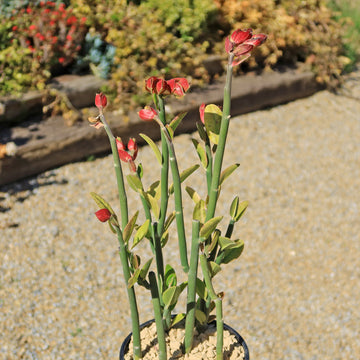
The upright slipper succulent plant can grow up to 6 feet tall and has narrow cylindrical light green stems and ovate leaves.

It has a thick mid-vein near branch tips and sparsely hairy vegetative parts, with a prominent mid-vein on the lower surface of the woody root crown. The stems of the slipper plant are thick, and leafless before flowering, and have a zigzag or accordion-like growth pattern, adding to its visual appeal. 

The Pedilanthus bracteatus blooms during the late spring to early fall with small, tubular slipper flowers that are typically red or orange in color. The curiously shaped red cyathia (flower structures with separate male and female parts) are enclosed in rounded reddish-pink bracts near the branch tips. These flowers have a unique shape that resembles a slipper or shoe, hence the plant's common name slipper plant. The flowers are arranged in clusters at the ends of the stems, creating a beautiful display when they bloom. 

In terms of propagation, the tall slipper plant can be propagated through stem cuttings. Simply take a healthy stem cutting from longer stems, allow it to dry for a few days to form a callus, and then plant it in well-draining soil. With proper care and conditions, the cutting will develop new growth.  

Watering Needs 

When it comes to watering the Pedilanthus bracteatus, it's important to strike a balance. This plant prefers a moderate watering routine. You don't want to overwater it, as it is susceptible to root rot, but you also don't want to let it dry out completely. 

A good rule of thumb is to water the slipper plant when the top inch or so of the soil feels dry to the touch. This ensures that the roots have enough moisture without sitting in wet soil for too long. In the spring and summer, during the growing season, you may need to water it more frequently. In the cooler months, you can reduce the frequency of watering. 

Remember, it's always better to underwater than overwater the slipper plant. If in doubt, it's safer to wait a bit longer between waterings than to risk causing root rot. 

Pro Tip

Instead of using regular tap water that has chlorine, you can try using filtered or distilled water. This can help prevent the buildup of minerals in the soil, which can sometimes affect the plant's health. It's like giving your slipper plant a refreshing treatment. Just make sure the water is at room temperature before you give it a drink

Light Requirements 

When growing indoors, this tall slipper plant Pedilanthus bracteatus generally prefers bright, indirect light. Find a spot near a window where it can receive plenty of filtered sunlight throughout the day. Avoid placing it in direct sunlight, as this can scorch its leaves. If you notice the plant leaning towards the light source, rotate it occasionally to promote even growth. 

For outdoor cultivation, your Pedilanthus bracteatus can thrive in partial shade to full sun for at least 4-6 hours a day, depending on your climate. In areas with hot summers, providing some afternoon shade can help protect the plant from intense sunlight. Just make sure it still receives a few hours of direct sunlight each day to support healthy growth and flowering. 

Remember that each environment is unique, so it's important to observe your tall slipper plant and adjust its placement accordingly. If you notice the leaves turning pale or yellow, they might be getting too much direct sunlight. On the other hand, if the plant becomes leggy or doesn't produce flowers, it might need more light. 

Optimal Soil & Fertilizer Needs 

The Pedilanthus bracteatus favors very airy, sandy soil that drains well. Planting them in ordinary soil will result in compacted roots, stunted growth, and most likely root rot. Instead, make or buy a well-draining potting mix, or ideally use our specialized potting mix, opens in a new tabGo to soil cactus mix blend 1 gal 4 qt cacti succulent dirt compost growing media that contains 5 natural substrates and mycorrhizae to promote the development of a strong root system that helps your lady slipper succulent to thrive. 

As for fertilizer, the slipper plant doesn't require a lot of feeding. Once a year in the spring, during the active growing season, you can use a balanced (5-10-5), water-soluble NPK fertilizer diluted to half strength. During the cooler months, when the plant is in its dormant phase, you can reduce or even stop fertilizing altogether. It's important not to over-fertilize, as it can lead to salt buildup in the soil, which can harm the plant. 

Remember to always follow the instructions on the fertilizer packaging and adjust the frequency and strength based on the specific needs of your slipper plant. It's also a good idea to water the plant before applying fertilizer to avoid any potential root burn. 

Hardiness Zones & More 

When you are growing your Pedilanthus bracteatus indoors, it can thrive in average room temperatures between 60°F to 75°F. It can tolerate slightly cooler temperatures, but it's best to avoid extreme cold drafts or sudden temperature fluctuations. As for humidity, the slipper plant can handle average indoor humidity levels, but it appreciates a slightly higher humidity. You can increase humidity by placing a tray of water near the plant or using a humidifier. 

For outdoor cultivation, it is typically hardy in USDA hardiness zones 9 to 11. These zones generally have mild to warm climates with minimal frost or freezing temperatures. In colder regions, it's best to grow the slipper plant as a potted plant that can be brought indoors during the winter months. If you live in a drier climate, you can mist the plant occasionally or place it in a location with higher humidity, such as near a water feature or in a greenhouse. 

Final Thoughts 

Overall, the tall slipper plant (Pedilanthus bracteatus) is a fascinating and visually appealing succulent. It's loved for its slipper-shaped flowers, the plant reaches about 6 feet tall and 3 ft wide. With its thick, succulent stems and beautiful red or orange tubular flowers, it adds a touch of visual appeal to any space. Taking care of the slipper plant is relatively easy, as it prefers well-draining soil, moderate sunlight, and infrequent watering. Whether grown indoors or outdoors, this plant is sure to add a touch of beauty and intrigue to any space. 

Shipping Notes
  • Free Standard Shipping on $100+ Orders to the USA.
  • Except Preorder products are shipped in 48 hours.
  • Delivery to the USA:
  1. Standard Shipping : 3-10 business days
  • If time is of the essence, please consider selecting expedited delivery for faster service.
Exchange/Return Notes
  • We offer a 30-day return/exchange service after receiving.
  • Final sale items are not eligible for returns or exchanges.
  • To process your return/exchange, please contact us at [email protected]
  • Please click here for more details>>> Return & Exchange Policy
SKU: 25379471669

Discover Niche Categories That Outsell slipper plant indoors

Top-Converting Item to Boost Your Average Order

4.2 ★★★★★
Based on 6 reviews
Sort
Highest Rating
Newest First
Oldest First
Product Reviews
C
Verified Purchase
Charles H. Hooker Jr.
Battle Creek, US
★★★★★ 5
Very enlightening for those who truly appreciate creativity more than cleverness!
Format: Paperback
I love how the author almost redefines creativity .and sheds new light (for me, at least!)on what what real-for-true creativity is and how it benefits individuals and society. It's far more than simply brightening up a room with new wallpaper and curtains -- it describes how genuine creativity requires a thorough working knowledge of the fundamentals of any given field before one can truly create something new or better, and it reveals how those of us who aren't capable of creating something ourselves can yet be part of the process by demonstrating appreciation and support for those who create, whether as sponsors, patrons, or even just ardent fans!
WAS THIS REVIEW HELPFUL?YesReportShare
Reviewed in the United States on July 4, 2023
D
Verified Purchase
Donald Walker
New York, US
★★★★★ 3
instructive but limited
The testimonies of creative people that give this book its flesh and blood provide fascinating examples of creative people at work. That said, if a journalist had written the book, it would be more readable, and I don't think any less of an intellectual contribution. Moreover, the definition of creativity is elitist and stunts the topic (as observed by other reviewers): "Creativity is any act, idea, or product that changes an existing domain, or that transforms an existing domain into a new one. And the definition of a creative person is: someone whose thoughts or actions change a domain, or establish a new domain. It is important to remember, however, that a domain cannot be changed without the explicit or implicit consent of a field responsible for it." Given the people interviewed, much more needs to be said about the function of social institutions in promoting creativity. Many of the accomplishments lauded in this book would never have happened without grant-making agencies (e.g., NSF, NIH, HHMI) or non-profit employers like research universities and hospitals. To offer just one obvious example of the difference made by one's institutional context, the author had advanced students to help him do his research for this book. The elitism of the definition is even clearer in the role that marketplace plays as a judge of creativity. None of us buys books from amazon.com because some official group validated amazon.com as a good idea. We didn't wait for computer programers to affirm and certify it. Amazon.com is not deemed successful because it impressed its peers. It is successful because millions of us purchase goods through it. Similarly, auto-executives did not make the minivan a successful idea, millions of shoppers did. (Obviously I don't think the marketplace fits into the author's definition of creativity. If 300 million American consumers comprise a domain with 300 million judges, then the word no longer has any useful meaning.) The definition also precludes that countless ephemeral acts of creativity that take place daily. I think instantly of two women I have worked with who were great at holidays. Their clever costumes or decorations brightened my day, adding a little element of surprise and delight. Their acts of creativity don't meet the definitions of this book. The way that creativity is defined in this book is simply a filtering mechanism by which the author selected the people he would interview. It is not a definition of creativity. It is only a description of a subsection of creativity, the kind where institutions provide paychecks to highly practiced individuals to work hard at what they love. I also found little new to take away and apply to my own social existence inside the organization where I work. Perhaps I can summarize my dissatisfaction by observing that the subtitle sets out an agenda for the psychology of creativity, but the definitional filter is intrinsically social. This disconnection sets the book up to fail. So, count this as a negative review, yes, but I did enjoy reading the testimonies of the people interviewed, and the author adds some value in the generalizations he draws. Still, much, much more could have been said.
WAS THIS REVIEW HELPFUL?YesReportShare
Reviewed in the United States on April 30, 2012
J
Verified Purchase
Judith R. Hert
Grantham, US
★★★★★ 5
Wise and Complete
Format: Paperback
I've read a lot of books, too many, on creativity, and this is by far the best, the most complete, the most interesting. The idea that creativity comes out of immersion in a domain or field seems absolutely right and the idea missed by so many other writers. I'm a writer and a painter and I've learned that I'm not going to be any better than the work I've come to know and love, that I have to live in that work. If you want to be a better string player, play with a better ensemble. In many ways a creative person is someone who is in a conversation with what has come before, with work that excites her, teaches her, challenges her. This book makes that plain. But he has other insights as well, especially about the creative personality, the interesting dichotomies. Just read the book.
WAS THIS REVIEW HELPFUL?YesReportShare
Reviewed in the United States on February 22, 2015
C
Verified Purchase
Common Arts Farm
Boise, US
★★★★★ 4
Creativity which has the power to change the world
A few caveats to those who are generally interested in creativity studies: Csikszentmihalyi's analysis and discussion of creativity does not directly relate to those who are personally creative. People who enjoy engaging in creative activities are not demoted, in his terms, but are simply not a part of the study. It is unfortunate that his language makes it seem this way; he distinguishes between the two by saying that Creativity has the power to shape a domain or the world, while creativity applies to those who enjoy coming up with new recipes, who are engaged in research that may not change a domain, but may "tweak" it, etc. What he is trying to discover are the underlying principles and traits of creativity in those whose work has made a significant change. Think Albert Einstein, Eleanor Roosevelt, Mark Strand: people who are either widely known for their influence, or who have been influential within their area or domain. This book provides an interesting view into the minds and work habits of Creative individuals, and concludes by offering general advice to those who wish to make their own lives and work more creative. It is a useful book, but one which requires a great deal of supplemental reading, in order to truly engage in creativity studies.
WAS THIS REVIEW HELPFUL?YesReportShare
Reviewed in the United States on January 29, 2003
T
Verified Purchase
Tracy Carvalho
Grantham, US
★★★★★ 5
Fun easy to read way to see how the wealthy stay wealthy
Format: Paperback
Mark Quann’s Be Smart Pay Zero Taxes is an eye-opening, engaging, and highly informative guide that challenges everything most of us think we know about taxes, wealth, and the financial system. With his "Buy, Borrow, Die" strategy, Quann presents a bold new way to build and preserve wealth—legally and ethically—while minimizing tax liability. One of the things that really stands out about this book is how approachable and enjoyable it is to read. Quann has a knack for breaking down complex financial concepts into bite-sized, digestible pieces. Whether you're a finance newbie or have been managing your own portfolio for years, you'll find the material easy to grasp and even fun to read. The tone is conversational, and the author's humor and wit shine through, making the book a far cry from the dry, overly technical finance books out there. What I loved most was how Quann exposes the ways in which the banking industry and the government have duped ordinary people into believing we have no choice but to pay exorbitant taxes. He takes a deep dive into the financial system and reveals how the wealthiest individuals have been using clever strategies for years to legally avoid paying significant taxes. The “Buy, Borrow, Die” method isn’t just some gimmick; it’s a smart and effective way to sidestep the tax traps most of us fall into. Quann’s perspective will make you question everything from your investment strategies to the way you think about saving and building wealth. This book empowers you with a strategy that not only helps you protect your wealth but also ensures that you're making the most of what you've worked so hard for. By the end, you’ll realize that we’ve been sold a false narrative about taxes and money, and there’s a much smarter way to approach wealth-building. Overall, Be Smart Pay Zero Taxes is a must-read for anyone who wants to get ahead financially. It’s a wake-up call wrapped in a fun and easy-to-read package. If you're ready to take control of your financial future and start building wealth like the ultra-wealthy, this book is the perfect place to start. Highly recommended!
WAS THIS REVIEW HELPFUL?YesReportShare
Reviewed in the United States on March 28, 2025

recommand products