SKU: 20247660934
papaya seeds to plant

papaya seeds to plant Papaya – UJAMAA SEEDS

Sale price$22.57 Regular price$25.08
Save 10%

Shipping Estimate
USA
  • USA
  • CAN

Ships within 48 hours · Estimated delivery Jul 12 - Jul 17

Promo Codes Available:

For Your Every Summer RSVP, with Code: SUMMER15

Description

papaya seeds to plant Papaya – UJAMAA SEEDSCarica Papaya Approximately ~12 seeds per packet. Germination: 71% Packed for 2025 Native to tropical regions of the Americas, particularly southern Mexico and Central America this tropical fruit plant is now cultivated in most tropical countries. In the continental USA it will thrive in zones 9 10. It also does well in Hawaii (zone 12). The papaya tree is a fast growing, herbaceous plant (producing soft flexible green stems above the ground). This

Carica Papaya

Approximately ~12 seeds per packet.

Germination: 71% Packed for 2025

Native to tropical regions of the Americas, particularly southern Mexico and Central America this tropical fruit plant is now cultivated in most tropical countries. In the continental USA it will thrive in zones 9 – 10. It also does well in Hawaii (zone 12).

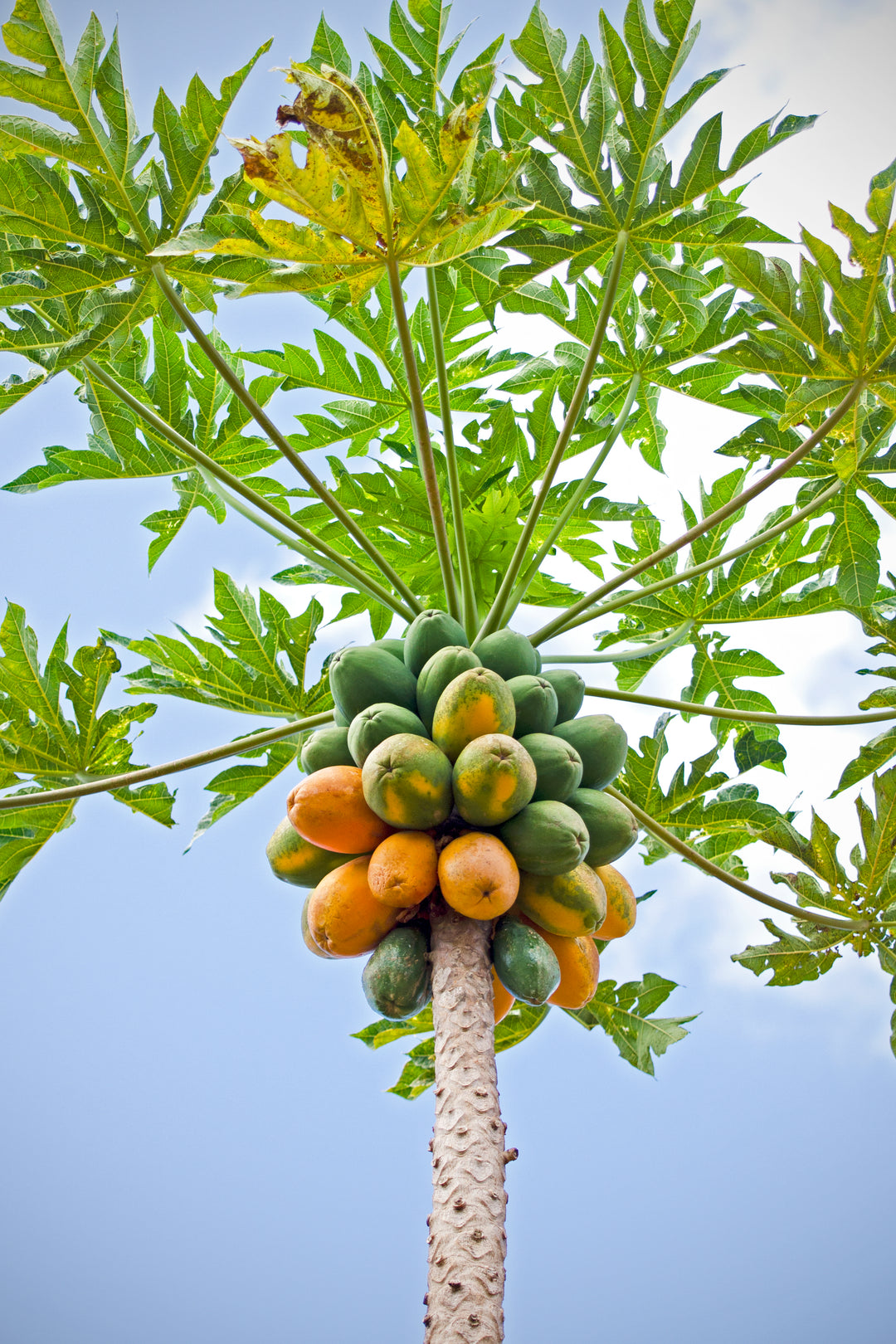
The papaya tree is a fast-growing, herbaceous plant (producing soft flexible green stems above the ground).   This tree can reach up to 33 feet (10 meters) in height, growing rapidly and fruiting within three years.

Small and sparsely branched, with leaves arranged spirally at the top of the trunk, the papaya tree leaves are large, lobed, and palmate. The leaves can reach up to 24 inches (60 centimeters) in diameter.

Usually fragrant and tubular in shape, papaya tree flowers are small, white to cream-colored. With a hermaphrodite flower, which can self-pollinate, male and female hermaphroditic flowers can occur on the same plant.

The fruit is a large berry, ripening to a large, oval or pear-shaped berry, that is amber to orange hue when soft. Skin color ranges from green to yellow or orange as it ripens. They can weigh between 1 to 20 pounds. The flesh is sweet, juicy, and typically orange or red when ripe, with black seeds clustered in the center. Papaya have a shallow but extensive fibrous root system.

Papaya is consumed raw when ripe, either without skin or seeds, and cooked when unripe, often in curries, salads, or stews. Papaya skin, pulp, and seeds contain several phytochemicals, including carotenoids and polyphenols, as well as benzyl isothiocyanates and glucosinates.

Growing Guidance for Carica Papaya

Prefers tropical and subtropical climates. Ideal temperature range:  70-90°F (21-33°C). Sensitive to frost and prolonged cold weather. Requires high humidity and ample sunlight. Well-draining, fertile soil is crucial. The pH range should be 5.5 to 7.0. Avoid waterlogged or compacted soils.

Planting, Spacing, & Watering: Best propagated from seeds. Seeds should be sown fresh, directly into the soil or in containers. Plant seeds about 0.4-0.8 inches (1-2 centimeters) deep. Germination occurs within 2-3 weeks. Space plants 6 to 10 feet (1.8 to 3 meters) apart. Ensure adequate air circulation to prevent diseases. Regular, deep watering is essential. Maintain consistent moisture but avoid waterlogging. Drip irrigation is recommended for optimal growth.

Fertilization: Balanced fertilizer rich in nitrogen, phosphorus, and potassium. Apply fertilizer every 2-3 months. Supplement with micronutrients such as magnesium, zinc, and iron if needed. Minimal pruning required. Remove dead or diseased leaves to promote air circulation and reduce pest problems.

Pest and Disease Management:  Common pests: aphids, whiteflies, fruit flies, spider mites. Common diseases: papaya ringspot virus, anthracnose, powdery mildew. Integrated pest management (IPM) strategies, including biological control, can be effective. Regular monitoring for signs of stress, pests, and diseases. Mulching around the base can help retain soil moisture and suppress weeds.

Harvesting: Fruits typically mature within 6-9 months after flowering. Harvest when the skin starts to turn yellow. Use a sharp knife to cut the fruit from the tree to avoid damage. Papaya plants have a relatively short lifespan, typically producing fruit for 3-4 years.

By following these guidelines, you can expect healthy growth and productive yields of Carica papaya in suitable climates and vegetation zones.

GUIDELINES - FALL SOWING TREE SEEDS-PDF FOR PRINTING

KEEP SEEDS REFRIGERATED FOR LONG TERM STORAGE PRIOR TO SCARIFICATION TREATMENT BELOW.

GROWING INFORMATION

Scarification

Soak in water, let stand in water for 24 hours

Stratification

None required

Germination

Sow seed 1/8” deep, tamp the soil, keep moist but not wet


Shipping Notes
  • Free Standard Shipping on $100+ Orders to the USA.
  • Except Preorder products are shipped in 48 hours.
  • Delivery to the USA:
  1. Standard Shipping : 3-10 business days
  • If time is of the essence, please consider selecting expedited delivery for faster service.
Exchange/Return Notes
  • We offer a 30-day return/exchange service after receiving.
  • Final sale items are not eligible for returns or exchanges.
  • To process your return/exchange, please contact us at [email protected]
  • Please click here for more details>>> Return & Exchange Policy
SKU: 20247660934

Discover Niche Categories That Outsell papaya seeds to plant

Top-Converting Item to Boost Your Average Order

4.6 ★★★★★
Based on 934 reviews
Sort
Highest Rating
Newest First
Oldest First
Product Reviews
P
Panda Incognito
Draper, US
★★★★★ 4
Rich Academic Insight
Format: Hardcover
Near the beginning of "Reading for the Love of God," Jessica Hooten Wilson addresses why we should read fiction, responding to arguments in some Christian circles that we should only read the Bible. Other topics that she covers include the difference between using and enjoying books, how reading can help us develop greater virtue, and how we can rightly interpret books through the "trinity" of rightly balancing the text, the author's intent, and our own takeaways, instead of forcing the text to mean whatever we want. She also shares "bookmarks" between chapters about the reading lives of Augustine of Hippo, Julian of Norwich, Frederick Douglass, and Dorothy L. Sayers. These sections are thoughtful and encouraging, and the latter two are my favorite parts of the book. There is a recommended reading list at the end that offers many wonderful selections, but I want to offer one quick warning. She includes the graphic novel adaptation of Octavia Butler's "Kindred" in her list for school-age readers, and although she mentions that it's more for the 10-12 age range, it is an adult book. The main character is an adult, and the graphic novel includes vivid on-page depictions of racial violence, attempted rape scenes, and a lot of talk about rape. Some older kids can handle that, but it would terrify others and was never intended for that age group. Reading and the Bible Hooten Wilson emphasizes that enhancing our reading skills through literature will help us better read, understand, and appreciate the Bible. She makes excellent points about how learning to read different literary genres will help with biblical interpretation, and she makes a convincing case for how practicing our interpretive skills and becoming more fluent with metaphor and other literary devices will enhance our experience with the Bible. However, I felt that she sometimes went too far, making it sound like Bible-reading is an activity for the well-educated and well-practiced. God intended the Bible for everyone regardless of their socioeconomic class, abilities, or educational level, and even though reading the Bible badly can have negative consequences, this book focuses more on our own literary skills than the power of the Holy Spirit to reveal truth to us, convict us, and comfort us through Scripture. Hooten Wilson provides excellent next steps for people who want to deepen their relationship with the Bible, but I wished that she had articulated additional vital context around this. Audience This book is highly academic in content and tone, and even though I enjoyed this book and found it very enriching, it is only for serious readers. Hooten Wilson writes about highly abstract concepts in complex ways, and she often uses specialized vocabulary without explaining what she means. She also makes lots of references to monastic practices and obscure literary works that even highly bookish Christians are unlikely to be familiar with. This book shares rich scholarly perspectives, but it is not for reluctant or casual readers, especially since Hooten Wilson only acknowledges the worth of popular-level books in the special section on Dorothy L. Sayers. It disappoints me that Christian books about reading are almost always written at such a lofty level that they are inaccessible to the people who need them most. I read hundreds of books every year, including dozens of academic ones, but I still felt that parts of the book were beyond me. If someone wants to begin getting more serious about reading, I would recommend Karen Swallow Prior's "On Reading Well" as a more accessible alternative with similar themes. My other concern is that Hooten Wilson was always the expert in the anecdotes she shared, never the person learning something new. Only one anecdote bothered me in and of itself, and that is the chapter-opening illustration about a time when she set up an undergrad student for embarrassment to make a point during class. The other anecdotes don't involve power differentials and were perfectly fine, but taken together, they give the impression that the author needs to feel superior. I am sure this was unintentional, but I wish she had given examples of times that she lost an argument and learned something new. Conclusion Overall, I enjoyed "Reading for the Love of God," appreciating Hooten Wilson's unique insights and her scholarly perspective on the spiritual importance of reading. This book is deep and thoughtful, and there are a lot of important messages about reading great books to expand your mind, enhance your understanding of Scripture, and become closer to God. However, this book is so dense and academic that it is only for scholarly readers. I wish that this book could be an on-ramp for people who want to get more serious about reading, but it will probably just make them feel judged, lectured at, and so overwhelmed that they give up. This book has great value for people who inhabit the author's literary world or are so well-read that they can make the leap, but I hope that the she will consider ways to effectively reach popular audiences in the future.
WAS THIS REVIEW HELPFUL?YesReportShare
Reviewed in the United States on April 15, 2023
K
Verified Purchase
Karissa Lynn
Chelsea, US
★★★★★ 5
Inspiration and affirmation of the richness of a reading life
Format: Hardcover
I listened to Hooten Wilson give a talk about the book and immediately pre-ordered it. It did not disappoint. I haven’t binge read a book like I did this one since last year with Abolition of Man. It was a delight to learn more about some extraordinary and diverse readers such as Julian of Norwich, Frederick Douglas, Dorothy Sayers and others. Hooten Wilson does an excellent job make a case for the ways reading both the Word and literature expands our capacity for living rightly and for reflecting God.
WAS THIS REVIEW HELPFUL?YesReportShare
Reviewed in the United States on April 15, 2023
T
Verified Purchase
Timothy Shea
Lake Worth, US
★★★★★ 5
Reading as worship?
Format: Hardcover
Dr. Wilson inspires us to see and appreciate reading with new eyes and hearts. This is a book I’m planning to add to my college literature syllabus and even my book club!
WAS THIS REVIEW HELPFUL?YesReportShare
Reviewed in the United States on September 22, 2024
C
Verified Purchase
Cryolitterae
Lowell, US
★★★★★ 5
An excellent survey of Christians should read
Format: Kindle
I love how complicated ideas are presented in a very simple way. This deserves to be read alongside Joshua Hren's How to Read like a Catholic
WAS THIS REVIEW HELPFUL?YesReportShare
Reviewed in the United States on May 12, 2023
K
Verified Purchase
Kathleen M. Moser
Lowell, US
★★★★★ 5
Very good book
Format: Hardcover
Good review I’d value if reading sland recommendations were good
WAS THIS REVIEW HELPFUL?YesReportShare
Reviewed in the United States on June 16, 2023

recommand products