SKU: 19789400385
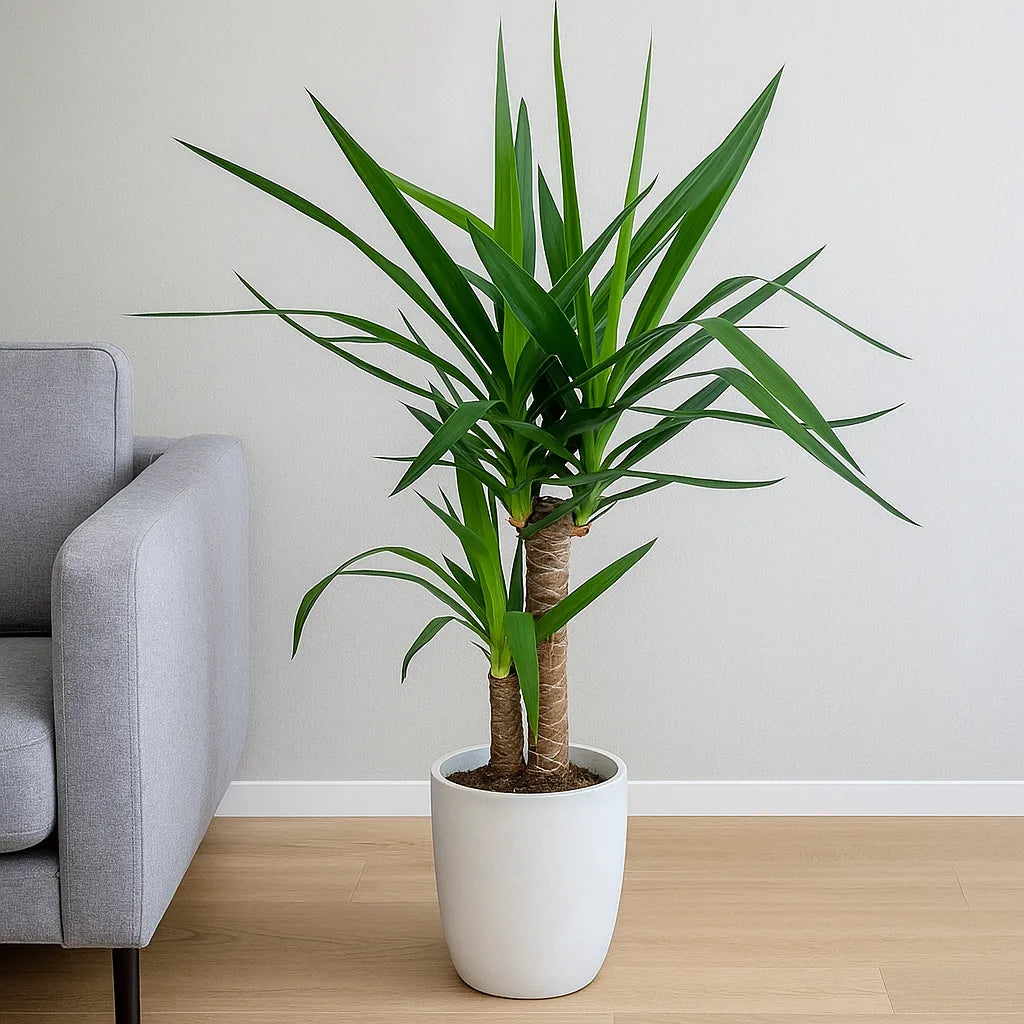
yucca plant potted

yucca plant potted 60

Sale price$25.74 Regular price$28.60
Save 10%

Shipping Estimate
USA
  • USA
  • CAN

Ships within 48 hours · Estimated delivery Jul 10 - Jul 15

Promo Codes Available:

For Your Every Summer RSVP, with Code: SUMMER15

Description

yucca plant potted 60Yucca elephantipes, also known as the Spineless Yucca or Giant Yucca, is a striking, architectural houseplant native to Central America and the Caribbean. A member of the Asparagaceae family, it is prized for its sculptural shape, resilience, and low maintenance nature making it one of the most popular large indoor plants. The plant features tall, sturdy canes (trunks) topped with rosettes of long, sword like green leaves that fan out elegantly,

Yucca elephantipes, also known as the Spineless Yucca or Giant Yucca, is a striking, architectural houseplant native to Central America and the Caribbean. A member of the Asparagaceae family, it is prized for its sculptural shape, resilience, and low-maintenance nature — making it one of the most popular large indoor plants.

The plant features tall, sturdy canes (trunks) topped with rosettes of long, sword-like green leaves that fan out elegantly, creating a bold and contemporary look. Unlike many other Yucca species, elephantipes has soft, non-spiny leaves, making it ideal for homes and offices. Mature plants can develop multiple stems, creating a layered, tree-like silhouette that adds instant impact to any interior.

Perfect for modern spaces, Yucca elephantipes thrives on minimal care and is one of the best plants for those who want height, structure, and tropical style with very little maintenance.


Yucca elephantipes – Care Guide

Light

Thrives in bright, indirect to full light. It can tolerate some direct sunlight, which helps maintain strong growth and vibrant foliage. However, in very intense midday sun, some leaf scorching may occur.

Watering

Water sparingly. Allow the top 5–8 cm of soil to dry out completely between waterings. Overwatering is the most common cause of problems, as Yuccas store water in their thick trunks. In winter, water once every few weeks or when the soil feels dry.

Temperature and Humidity

  • Temperature: Prefers 18–28°C but can tolerate cooler temperatures down to 10°C. Avoid cold draughts or frost.

  • Humidity: Adapts well to normal household humidity and doesn’t require misting.

Soil and Potting

Use a gritty, well-draining compost, such as cactus or succulent mix. Ensure the pot has drainage holes to prevent standing water. Repot every 2–3 years in spring, using a heavy container to support the tall stems.

Feeding

Feed monthly during spring and summer with a balanced, diluted liquid fertiliser. Stop feeding in winter when growth slows.

Pruning and Maintenance

Remove yellowing or dead leaves by gently pulling them downward from the trunk. You can also cut back stems if the plant becomes too tall — it will resprout from the cut area. Dust the leaves regularly to keep them clean and healthy.

Growth and Maturity

A slow to moderate grower that can reach 1–3 metres indoors. It often develops multiple canes over time, giving it a sculptural, multi-tiered appearance.

Common Issues

  • Yellow leaves: Overwatering or poor drainage.

  • Brown leaf tips: Underwatering or exposure to cold draughts.

  • Soft trunks: Sign of rot caused by too much water.

  • Pests: Occasionally spider mites or mealybugs — wipe leaves regularly to prevent infestations.

Background and Benefits

The name elephantipes (“elephant foot”) refers to the swollen, woody base of the trunk, which resembles an elephant’s leg. In its native habitat, it can grow up to 9 metres tall, but indoors it remains far more compact.

This plant is not only beautiful but also incredibly hardy, tolerant of neglect, and excellent at purifying indoor air. Its strong vertical form and clean lines make it a staple of minimalist and contemporary décor.


Quick Care Summary

  • Light: Bright, indirect to full sun

  • Water: Sparingly; let soil dry completely between waterings

  • Temperature: 18–28°C; tolerates down to 10°C

  • Humidity: Average indoor; no misting needed

  • Soil: Gritty, well-draining cactus compost

  • Feed: Monthly in spring/summer

  • Growth: Upright plant, 1–3 m; multiple canes topped with sword-like green leaves


⚠️ Toxicity Note: Yucca elephantipes is mildly toxic if ingested, especially to pets. Keep away from cats and dogs, as ingestion may cause mild irritation.


🌿 Styling Tip:
Place Yucca elephantipes in a bright corner or by a window to accentuate its architectural silhouette. It pairs beautifully with other structural plants like Sansevieria and Dracaena, adding height and drama to any modern interior.

    Shipping Notes
    • Free Standard Shipping on $100+ Orders to the USA.
    • Except Preorder products are shipped in 48 hours.
    • Delivery to the USA:
    1. Standard Shipping : 3-10 business days
    • If time is of the essence, please consider selecting expedited delivery for faster service.
    Exchange/Return Notes
    • We offer a 30-day return/exchange service after receiving.
    • Final sale items are not eligible for returns or exchanges.
    • To process your return/exchange, please contact us at [email protected]
    • Please click here for more details>>> Return & Exchange Policy
    SKU: 19789400385

    Discover Niche Categories That Outsell yucca plant potted

    Top-Converting Item to Boost Your Average Order

    4.7 ★★★★★
    Based on 2320 reviews
    Sort
    Highest Rating
    Newest First
    Oldest First
    Product Reviews
    P
    Verified Purchase
    PhiloX
    Phoenix, US
    ★★★★★ 4
    A Lost Book doesn't Make Up for Lost Time
    Format: Paperback
    I bought the hard back copy of this book years ago & what an interesting read with great time lines & beautiful color photos. Someone borrowed the book & I forgot who I loaned it to. After years of trying to remember where it went, I at last bought it again as a paper back through Amazon.com. It's a used book with no marks & only a slight indentation on a few pages on the side. Now that I am looking into it & remembering it once again, I am over loaded with too many historical theories. Maybe it's my fault for being a book reader rather than an Egyptologist. I am going to write down some simple time frame theories & you will see what this book is about: General View: The Hebrews came into Egypt through reuniting Joseph & his brothers. They experienced the Amarna period of primitive Monotheism. Akhenaton was over thrown & polytheism was reinstated as the Hebrews were enslaved. Moses came during Rameses II & the Exodus was during the last years of Rameses II or the Pharaoh Marneptah. Amarna period of Akhenaton 1352-1337/1334 BC Rameses II 1279-1213 BC Exodus last years of Rameses II or Marneptah. Problems: Biblical History is off by 180 years if counted back from the creation of Solomon's temple. Rameses II was a great conquer, & both he & his son Marneptah never wrote of 10 plagues or an Exodus. Both died as old men & their mummys are still with us. David Rohl's Theory: revised Egyptian history by shortening the 3rd Intermediate Period by almost 300 years. Tutimaios known as Dudimose is the Pharaoh of the Exodus Exodus 1447 BC Amarna period of Akhenaton = time of King David approx. 1000 BC. Proof: letters written between an Egyptian Pharaoh & King of Israel during that period. Rameses II = Shishak of 921 BC sack of Jerusalem. Proof: Rameses II used a monogram that comes close to Shishak. Problems: goes against establish Egyptian time frames or "If the Bible doesn't fit the Egyptian time frames then make the Egyptian time frames fit the Bible". Akhenaton is no longer the 1st political monotheist & seems out of place not influencing Moses & writing letters to King David. From Another Book I Read - "Akhenaton & Moses" by Ahmed Osman Ahmed Osman's Theory: Akhenaton is the same person as Moses Amarna period of Akhenaton 1352-1337/1334 BC Exodus after the overthrow of Akhenaton by Rameses I Problems: Moses doesn't die overlooking the Promise land of Canaan as stated in Deuteronomy 34 but dies without a known grave as did Akhenaton. Moses monotheism doesn't deal with a solar disc as a symbol of the one God or a replacement of a lesser Egyptian God, but is from an inherited convent. Other Dates of the Exodus: Josephus 1552 BC Sedar Olam Rabbah 1440 BC Book of Jubilees 2410 BC Early Church Fathers 1570 to 1320 BC I need to research Immanuel Velikovsky ideas on this subject matter. I just bought the book & will review it.
    WAS THIS REVIEW HELPFUL?YesReportShare
    Reviewed in the United States on January 23, 2013
    A
    Verified Purchase
    Amazon Customer
    Carnegie, US
    ★★★★★ 5
    Correcting the Biblical Chronology
    Format: Hardcover
    When I first begin my study of the Bible, I had purchased another book on archaeology and the first thing I realized is that nothing fit. The time of Solomon was impoverishment in Israel. When you read the Bible Solomon was the richest king ever. David Rohl's book Pharaohs and Kings changed all that. He persuasively shows where the chronology is wrong and when corrected things fall into place. What is commonly called the old testament comes to life. It is the greatest book on Biblical Archaeology ever written. Thank you David !!!
    WAS THIS REVIEW HELPFUL?YesReportShare
    Reviewed in the United States on March 10, 2019
    T
    Verified Purchase
    The Weez
    Massapequa, US
    ★★★★★ 5
    High quality for a slightly used book!!!!!
    Format: Hardcover
    Lots of pics and charts ... Egyptologists will love it
    WAS THIS REVIEW HELPFUL?YesReportShare
    Reviewed in the United States on March 12, 2024
    M
    Verified Purchase
    Meow Meema
    Charlottesville, US
    ★★★★★ 5
    Long expected and now explained mystery of Israels sojourne in Egypt
    Format: Hardcover
    Beautiful, detailed and well explained text book. Very hard for the history of the Bible to be accepted by so many scholars. However, archeology and history just keeps proving it totally reliable over and over again. If you want to see the pieces of the puzzle of ancient mid-east and Bible history fall in place - get this incredible book. The highly credentialed and acclaimed archeologist, David Rohl has really done an outstanding job in this presentation. Read and learn!
    WAS THIS REVIEW HELPFUL?YesReportShare
    Reviewed in the United States on November 5, 2013
    E
    Verified Purchase
    Eman
    Boise, US
    ★★★★★ 5
    An addictive read
    Format: Paperback
    A friend loaned me his copy and I couldn't put it down. Very well written and extremely informative. Why conventional Egyptology doesen't attempt to adhere to the obvious evidences I will never understand. After returning my friends copy to him I not only bought one for myself but have purchased others for friends and family. This book is especially helpful for one who is interested in understanding which Old Testament persons are being referenced in various accounts.Moses did not deal with Raamses the Great
    WAS THIS REVIEW HELPFUL?YesReportShare
    Reviewed in the United States on February 7, 2014

    recommand products