Pay in installments of $5.63 with
 ,
,
 and
and

Shipping Estimate
USA
- USA
- CAN
- USA
- CAN
Ships within 48 hours · Estimated delivery Jul 19 - Jul 24
 Promo Codes Available:
For Your Every Summer RSVP, with Code: SUMMER15
Description
australian lavender plant Shop French Lavender Plant | Lavandula dentataUsually available: All year Life cycle: Perennial Height: 1m Position: Full sun Soil preference: Well drained This is how we pack and send your Herb Plants to all states except TAS & WA You will receive 1 French Lavender Herb Plant in a 50 X 75mm tube General growing instructions All of our Herb Plants are grown organically with certified organic potting mixes and fertilizers Botanical Name: Lavandula dentata French Lavender is a small, dense
Usually available: All year
Life cycle: Perennial
Height: 1m
Position: Full sun
Soil preference: Well drained
This is how we pack and send your Herb Plants to all states except TAS & WA
You will receive
- 1 French Lavender Herb Plant in a 50 X 75mm tube - General growing instructions
All of our Herb Plants are grown organically with certified organic potting mixes and fertilizers
Botanical Name: Lavandula dentata
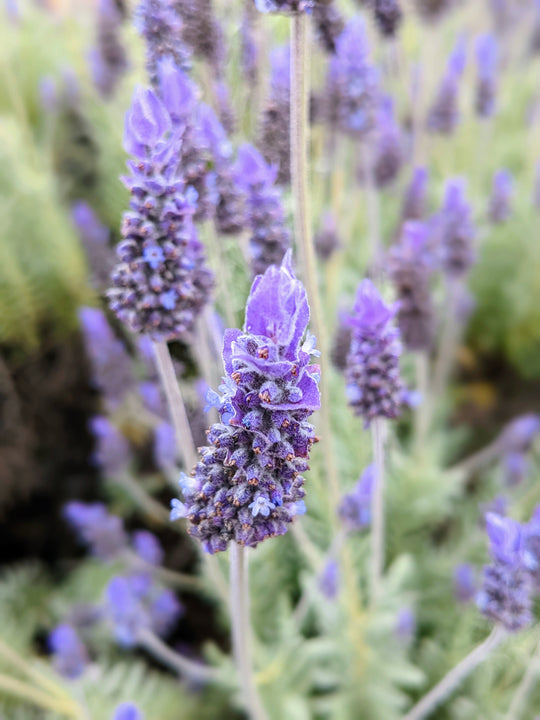
French Lavender is a small, dense evergreen shrub, growing to 1 by 1 meter. It has toothed grey-green leaves held on upright branches, but is woody at the base. The sticky, aromatic leaves are about 3 cm long and borne in rosettes up the woody stem. The synonym ‘Fringed Lavender’ comes from the small serrations in the leaves. The violet-blue flowers are held on slender grey stems and surrounded by papery bract of a similar colour. Lavandula dentata flowers for most of the year in Australia and is a very good bee and butterfly attractant.
Lavender is a much loved garden plant with a long history and many modern cultivars. The Lavandula genus belongs to the Laminaceae family, which is also known as the mint family. It has over 3500 species, from more than 180 genera, distributed across the globe. Lavandula dentata was given its current name by Linnaeus in 1753. Prior to this it was named Stoechas secunda in 1576 by Carolus Clusius, a Flemish doctor. Although this lavender had been known across the Arab world for many centuries Clusius was the first European to discover the plant in his travels to Gibraltar. The name Stoechas dentata may also be used as a synonym referring specifically to the name Fringed Lavender.
The natural habitat of most lavender species is characterised by dry, rocky or poor soil and low water conditions. French Lavender is generally more heat tolerant, although, both French and English lavender are from Mediterranean regions. French Lavender is a significant scrub and understorey plant in forested areas and is native to southern and eastern Spain, Gibraltar, Balearic Islands, north western Africa, Ethiopia, Eritrea, Israel, Jordan and the Arabian Peninsula. It is naturalised in the Mediterranean, California, New Zealand and Western Australia.
Lavender use has been recorded since ancient times, with uses as varied as early cleansers and perfumes, medicinal headache treatments in the Renaissance Period, and even as an insect repellent. The name ‘lavender’ is derived from the word ‘lavare’ which means ‘to wash’. This reflects the early use of lavender plants in bath houses throughout Ancient Greece and Roman culture. Lavender was also spread around the floors and streets during the Middle Ages, to mask bad household odours and the stench from the streets. Today, there is a growing industry providing lavender oil for aromatherapy, cosmetics and cleansers.
Lavender is a multi-purpose garden plant with great potential, although most people are happy to grow it just for the ornamental value. Each variety is distinctive and may have different properties. For further information please check our other lavender plant listings.
Growing Conditions
As with most lavender species, L. dentata requires good drainage. In clay soils it is best to create a raised bed, perhaps in a rockery. Fertile, normal or sandy soil will produce good results. Container growing will also be successful, offering protection from frost and for managing difficult soil. Full sun is ideal, although part shade is also acceptable. French Lavender is very tolerant of hot, dry conditions and requires hot summers to grow well. It has low to average water requirements once established. This species does handle some humidity, but wet and humid summers may present a problem. Cold winters may damage the lavender plant, so planting in a protected position may be advised.
Many evolved with a requirement for high calcium and magnesium and this is commonly present in the natural environment. This lavender will tolerate lime, but does not like acidic soils. Garden lavender plants may need supplements to grow well. The fragrance is said to be stronger in chalky soils. Pruning of dead flowers is recommended, together with a light trim towards the end of the flowering period. In early spring the plants can be cut back quite hard to promote new growth. Plants can get straggly and become woody, so replacing them every 5-6 years is recommended. Propagation may be in spring or autumn with soft wood cuttings.
Medicinal Uses
Lavandula dentata has been used in traditional medicine for relieving headaches, rheumatism, to create vapour for treating colds and flu, and the oil is used in aromatherapy. Place leaves and flowers in boiling water to create steam and an aromatic vapour to treat respiratory conditions.
Culinary Uses
As a culinary herb lavender is used to add colour and flavour to sugar used for making icing, cakes, biscuits, meringues, ice creams and other deserts. It is also added to vinegars, jams and marmalades. Lavender blossoms may also be tied in muslin bags and cooked with black currants and soft fruits. Some lavender species are able to be used for other culinary purposes, but most are not suitable.
Other Uses
Dried lavender leaves and flowers may be used for pot pourri or to create small lavender pillows to help with insomnia or to use as moth/insect repellents. To dry the lavender sprigs, cut the full length of the flower stalk just before flowers are fully open and hang upside down in a cool, dry place with good air flow. The flowers also last well as a cut flower and they are well known for use in dried flower arrangements and to create incense sticks.
All information provided on this website is for informational purposes only. Please seek professional advice before commencing any treatment.
Shipping Notes
- Free Standard Shipping on $100+ Orders to the USA.
- Except Preorder products are shipped in 48 hours.
- Delivery to the USA:
- Standard Shipping : 3-10 business days
- If time is of the essence, please consider selecting expedited delivery for faster service.
Exchange/Return Notes
- We offer a 30-day return/exchange service after receiving.
- Final sale items are not eligible for returns or exchanges.
- To process your return/exchange, please contact us at [email protected]
- Please click here for more details>>> Return & Exchange Policy